
Prussian blue flower-like nano-structure material as well as preparation and application thereof
A Prussian blue, structural material technology, applied in structural parts, positive electrodes, ferricyanide, etc., can solve problems such as large size and affect the structural stability of electrode materials, achieve high rate performance, and be conducive to market promotion and circulation. good stability
Patent Information
- Authority / Receiving Office
- CN · China
- Patent Type
- Applications(China)
- Current Assignee / Owner
- Publication Date
- 2017-08-22
Smart Images
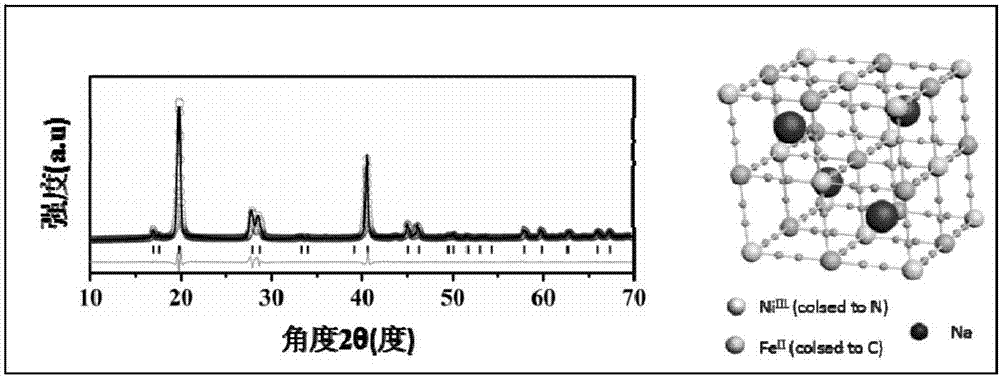
Figure 1 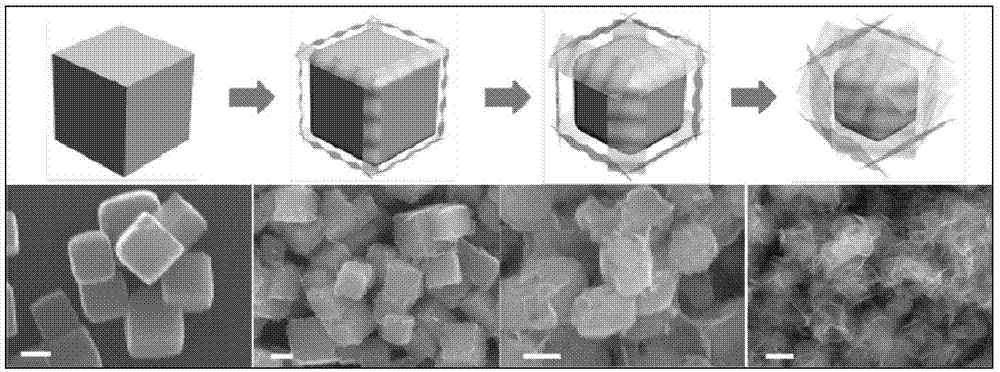
Figure 2 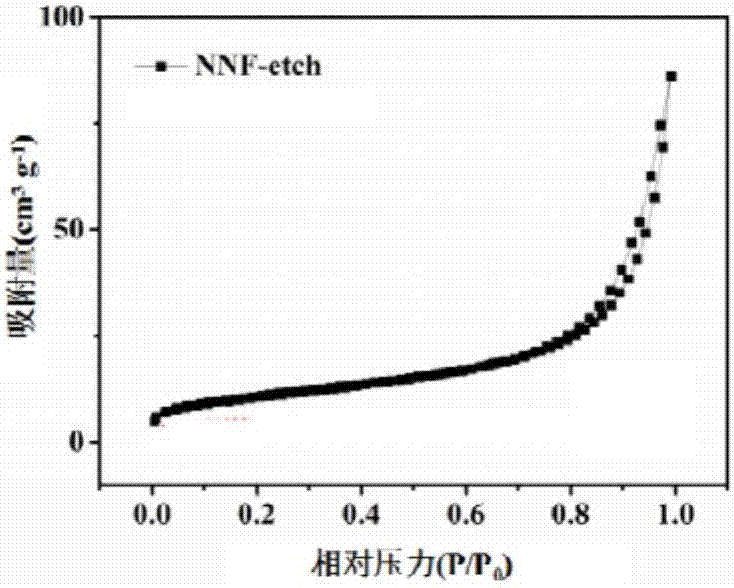
Figure 3
Abstract
Description
technical field
[0001] The invention belongs to the technical field of nanomaterials and electrochemistry, in particular to a kind of Prussian blue (Na 1.11 NiFe(CN) 6 ) A method for preparing an electrode material with a nanoflower structure, the material can be used as a positive electrode active material for a long-life sodium ion battery. Background technique
[0002] With the development of new energy sources and the promotion of smart grid systems, lithium-ion batteries have been widely used due to their advantages such as high energy density and low self-discharge rate. However, the cost increase caused by the shortage of lithium resources has become a major problem restricting its development. In order to meet the current needs of large-scale energy storage and transportation, a Na-ion battery based on Na-ion intercalation / deintercalation has attracted widespread attention. However, due to sodium ions The large size of the electrode leads to a huge stress and st...
Examples
Embodiment 1
[0030] Prussian Blue (Na 1.11 NiFe(CN) 6 ) The preparation method of nano flower structure electrode material, it comprises the following steps:
[0031] 1) First take 4mmol nickel chloride hexahydrate (NiCl 6H 2 O) and 20mmol anhydrous sodium citrate (Na 3 C 6 h 5 o 7 ) was dissolved in 250mL deionized water;
[0032] 2) Take 5mmol sodium ferrocyanide decahydrate (Na 4 Fe(CN) 6 10H 2 O) be dissolved in another 250mL deionized water;
[0033] 3) Pour the solution obtained in step 2) into the mixture of nickel chloride and sodium citrate obtained in step 1) and stir at room temperature for 5 minutes;
[0034] 4) The mixed solution obtained in step 3) was left to stand at 25°C for 48 hours;
[0035] 5) The precipitate was collected by centrifugation, washed three times with water and absolute ethanol, and dried in vacuum at 80°C for 24 hours to obtain the precursor powder;
[0036] 6) Dissolve 16mmol of sodium hydroxide in 40mL of deionized water;
[0037] 7) Add 10...
Embodiment 2
[0044] 1) First take 3mmol nickel chloride hexahydrate (NiCl 6H 2 O) and 20mmol anhydrous sodium citrate (Na 3 C 6 h 5 o 7 ) was dissolved in 250mL deionized water;
[0045] 2) Take 5mmol sodium ferrocyanide decahydrate (Na 4 Fe(CN) 6 10H 2 O) be dissolved in another 250mL deionized water;
[0046] 3) Pour the solution obtained in step 2) into the mixture of nickel chloride and sodium citrate obtained in step 1), and stir at room temperature for 5 minutes;
[0047] 4) The mixed solution obtained in step 3) was left to stand at 25°C for 48 hours;
[0048] 5) The precipitate was collected by centrifugation, washed three times with water and absolute ethanol, and dried in vacuum at 80°C for 24 hours to obtain the precursor powder;
[0049] 6) Dissolve 16mmol of sodium hydroxide in 40mL of deionized water;
[0050] 7) Add 100mg of precursor powder into sodium hydroxide solution and ultrasonicate for 6h;
[0051] 8) The product was collected by centrifugation, washed thr...
Embodiment 3
[0054] 1) First take 4mmol nickel chloride hexahydrate (NiCl 6H 2 O) and 20mmol anhydrous sodium citrate (Na 3 C 6 h 5 o 7 ) was dissolved in 250mL deionized water;
[0055] 2) Take 5mmol sodium ferrocyanide decahydrate (Na 4 Fe(CN) 6 10H 2 O) be dissolved in another 200mL deionized water;
[0056] 3) Pour the solution obtained in step 2) into the mixture of nickel chloride and sodium citrate obtained in step 1), and stir at room temperature for 5 minutes;
[0057] 4) The mixed solution obtained in step 3) was left to stand at 25°C for 48 hours;
[0058] 5) The precipitate was collected by centrifugation, washed three times with water and absolute ethanol, and dried in vacuum at 80°C for 24 hours to obtain the precursor powder;
[0059] 6) Dissolve 16mmol of sodium hydroxide in 40mL of deionized water;
[0060] 7) Add 100mg of precursor powder into sodium hydroxide solution and ultrasonicate for 6h;
[0061] 8) The product was collected by centrifugation, washed thr...