
Preparation method of foam ceramics
A technology of foam ceramics and preparation steps, which is applied in the field of preparation of foam ceramics, can solve the problems of body collapse, high density, and low strength, and achieve the effects of improving strength, avoiding body collapse, and avoiding body structure collapse
Patent Information
- Authority / Receiving Office
- CN · China
- Patent Type
- Applications(China)
- Current Assignee / Owner
- Publication Date
- 2017-09-15
- Estimated Expiration
- Not applicable · inactive patent
Smart Images
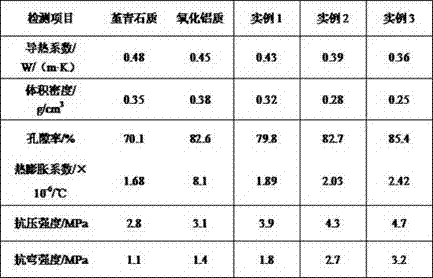
Figure 1
Abstract
Description
technical field
[0001] The invention discloses a preparation method of foam ceramics, which belongs to the technical field of preparation of porous ceramic materials. Background technique
[0002] Foam ceramics is a kind of foam-like porous ceramics in shape. It is the third generation of porous ceramic products developed after ordinary porous ceramics and honeycomb porous ceramics. This kind of high-tech ceramics has three-dimensional interconnected channels, and at the same time, it has attracted increasing attention from all aspects because of its special properties, such as high specific surface area, high permeability, low bulk density, and low thermal conductivity. These excellent properties make it widely used in catalyst carrier, molten metal filtration, high temperature gas filtration, refractory materials, biological materials and other fields.
[0003] The foam ceramic material has developed from the initial ordinary clay to high temperature resistant, corrosion ...
Examples
example 1
[0025]First weigh 300g of rice husk, pour it into a high-pressure steamer filled with 1000mL of water, and cook at a temperature of 120°C for 45 minutes, then filter the material in the high-pressure steamer to obtain cooked rice husk, and let it stand to drain the water and naturally cooled to room temperature, then the cooled rice husk was transferred to a freezer grinder for crushing for 10 minutes, and the crushed rice husk was transferred to an oven, and dried to constant weight at a temperature of 105°C to obtain dried rice husk Then weigh 100g of the obtained dry rice husk powder and 0.6g of nano-iron powder in turn, pour them into a crucible, stir and mix with a glass rod for 10min, then transfer the crucible to a carbonization furnace, and feed argon into the furnace at a rate of 10mL / min. Gas, under the protection of argon, the temperature was programmed to 550 °C at a rate of 6 °C / min, and the carbonization was carried out for 2 hours. Argon, and naturally cooled to...
example 2
[0027] First weigh 400g of rice husk, pour it into a high-pressure steamer filled with 1100mL of water, and cook at a temperature of 130°C for 53 minutes, then filter the material in the high-pressure steamer to obtain steamed rice husk, and let it stand to drain the water and naturally cooled to room temperature, then the cooled rice husk was transferred to a freezer grinder for crushing for 15 minutes, and the crushed rice husk was transferred to an oven, and dried to constant weight at a temperature of 108°C to obtain dried rice husk Then weigh 125g of the obtained dried rice husk powder and 0.7g of nano-iron powder, pour them into a crucible, stir and mix them with a glass rod for 13min, then transfer the crucible to a carbonization furnace, and feed argon into the furnace at a rate of 13mL / min. Gas, under the protection of argon, the temperature was programmed to 575 °C at a rate of 7 °C / min, and the carbonization was carried out for 3 hours. Argon, and naturally cooled t...
example 3
[0029] First weigh 500g of rice husk and 15g of sodium hydroxide, pour them into a high-pressure steamer filled with 1200mL of water, and cook at a temperature of 140°C for 60 minutes, then filter the material in the high-pressure steamer to obtain cooked rice husk. Stand to drain the water and cool to room temperature naturally, then transfer the cooled rice husks to a freezer grinder for 20 minutes, and transfer the crushed rice husks to an oven, and dry them at a temperature of 110°C until constant weight , to obtain dry rice husk powder, then weigh 150g of the gained dry rice husk powder, 0.5g sodium fluoride, and 0.8g nano-iron powder, pour them into a crucible, stir and mix with a glass rod for 15min, then transfer the crucible to a carbonization furnace, Introduce argon gas into the furnace at a rate of 15mL / min, under the protection of argon, heat up to 600°C at a rate of 8°C / min, keep warm for carbonization for 4 hours, then heat up to 1500°C at a rate of 15°C / min, and...