
Self-adjusting method for color saturation of LED display screen
An LED display and saturation technology, applied in static indicators, color signal processing circuits, instruments, etc., can solve problems such as visual discomfort for viewers, color distortion of display screen playback, and inability for viewers to convey video information. Improve the effect of viewing
Patent Information
- Authority / Receiving Office
- CN · China
- Current Assignee / Owner
- Publication Date
- 2018-03-23
- Estimated Expiration
- Not applicable · inactive patent
Smart Images
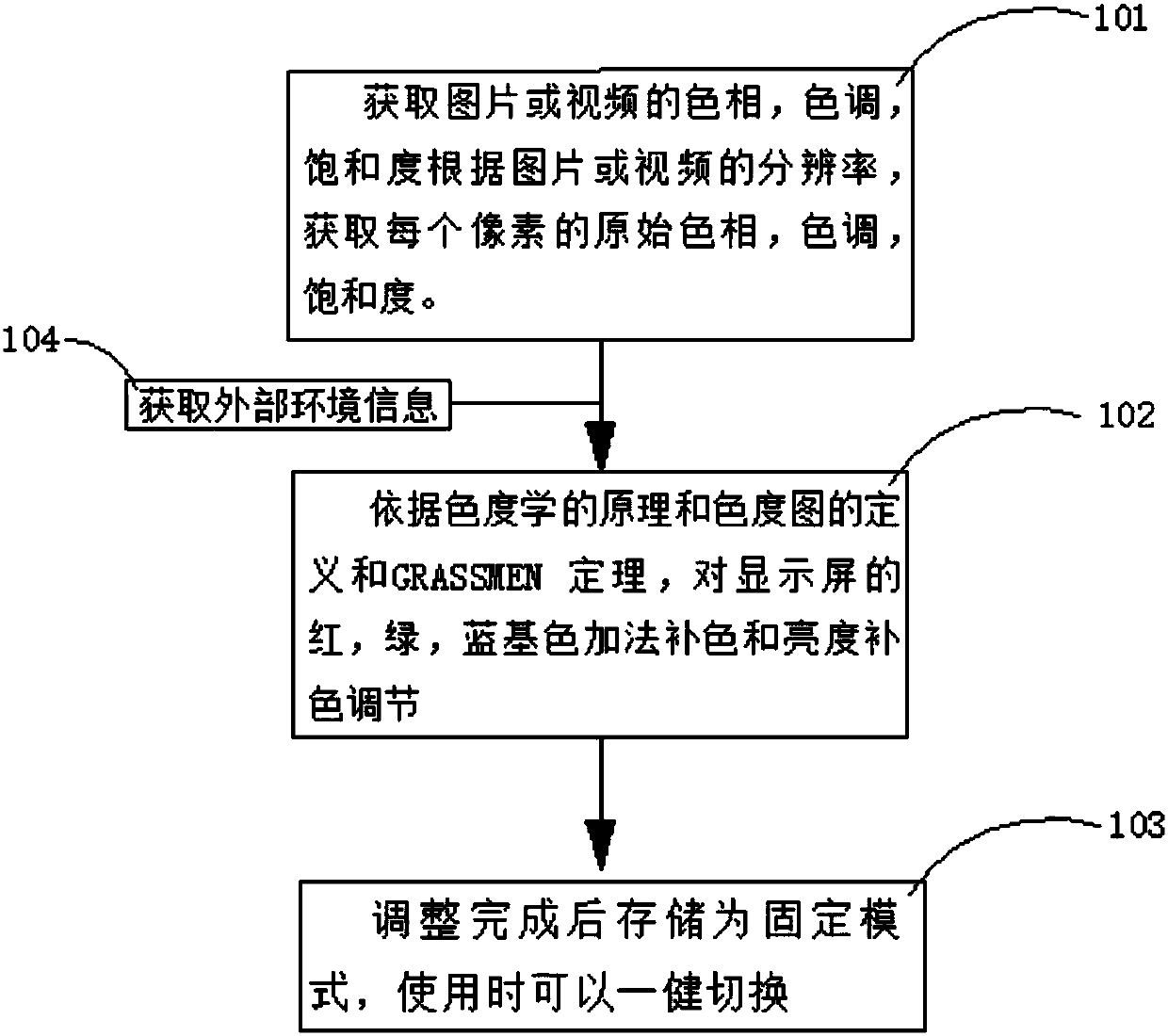
Figure 1
Abstract
Description
technical field
[0001] The invention relates to the technical field of LED display screens, in particular to a method for self-adjusting the color saturation of an LED display screen. Background technique
[0002] In general, the color of a reflective object depends on the color of the light source, and the human brain is able to detect and correct for this color change. On a sunny day, on a cloudy day, or in a room with light bulbs or fluorescent lights, the human eye can adapt to changes in color under different light sources without affecting human perception of white objects. However, the "white" presented by digital images in different environments is different. In order to make the displayed color consistent with the color perceived by the human eye, the digital image device must imitate the human brain and adjust it according to different environments. It must be defined as white. In order to be as white as possible to the human eye. This adjustment is called "white...
Examples
Embodiment Construction
[0019] refer to figure 1 , figure 1 It is a schematic flowchart of an embodiment of the LED display screen self-adjustment method of the present invention.
[0020] Such as figure 1 As shown, the LED display screen self-adjustment method in this embodiment includes the following steps:
[0021] 101: Obtain the hue, hue, and saturation of pictures and videos.
[0022] When the LED display screen plays pictures and videos in the laboratory space, its internal broadcast control software will immediately collect the parameter information related to hue, hue, and saturation. This is the standard value, analyze the light source, and output the corresponding coordinates of the light source Information, red light source coordinates (xr, yr, zr), green light source coordinates (xg, yg, zg), blue light source coordinates (xb, yb, zb), and store and record the data generated by playing pictures and videos at this time , the above parameter information is stored from time to time.
...