
A security and stability risk quantitative assessment method considering the uncertainty of new energy
A safe, stable, and uncertain technology, applied in resources, computing, and single-network parallel feeding arrangements, can solve problems such as increased difficulty in section pre-control, uncertainty and risk, and insufficient measures to achieve guidance Safe and stable operation, quantified risk, high safety and economical effect
Patent Information
- Authority / Receiving Office
- CN · China
- Patent Type
- Patents(China)
- Current Assignee / Owner
- Publication Date
- 2022-07-01
Smart Images
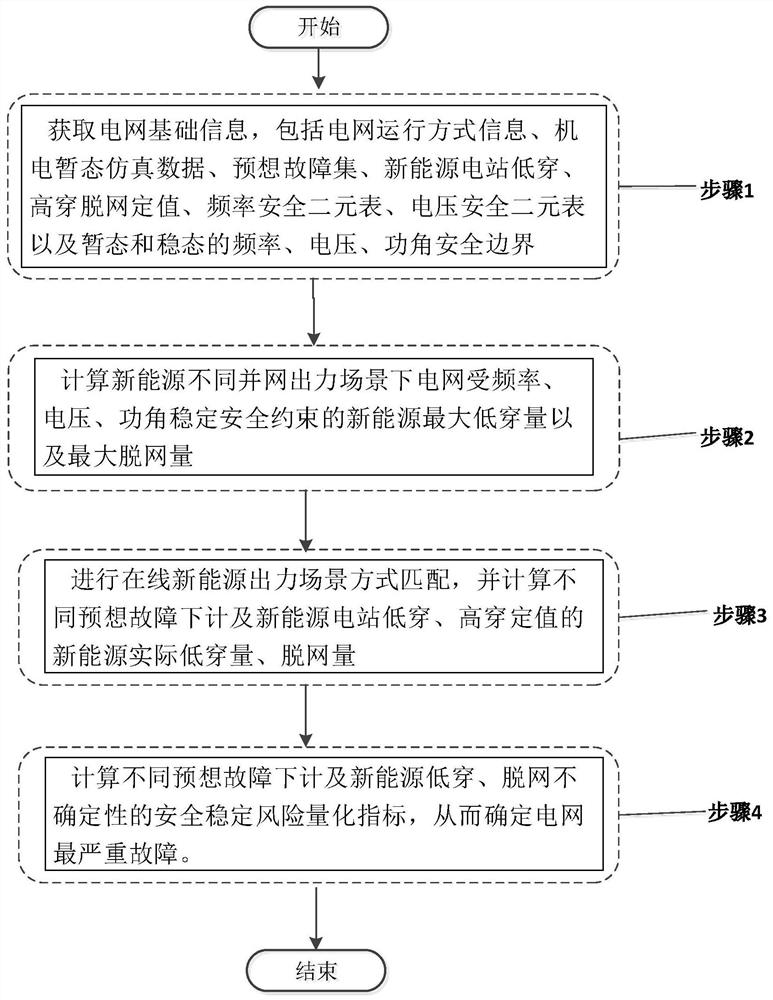
Figure 1 
Figure 2 
Figure 3
Abstract
Description
technical field
[0001] The invention relates to a security and stability risk quantitative assessment method taking into account the uncertainty of new energy, and belongs to the technical field of power system security and stability control. Background technique
[0002] With the large-scale connection of new energy and direct current to the power grid in recent years, a large number of new energy sources have replaced conventional power sources, the primary frequency regulation capability and dynamic reactive power support of the power grid have declined, the moment of inertia of the system has been greatly reduced, and the frequency and voltage stability and anti-disturbance capabilities have deteriorated. At the same time, the volatility of new energy output makes it more difficult to pre-control the section during the operation of the all-clean energy grid. Under certain operating conditions, it will lead to the problem that the security control strategy is not suitable...
Examples
Embodiment Construction
[0028] The present invention will be further described below in conjunction with specific embodiments.
[0029] A security and stability risk quantitative assessment method that takes into account the uncertainty of new energy, including the following:
[0030] 1) Obtain basic power grid information; the basic power grid information includes power grid operation mode information, electromechanical transient simulation data, expected fault set, new energy power station low penetration, high penetration and off-grid setting, frequency safety binary table, voltage safety two Meta table and transient frequency safety boundary, voltage safety boundary, power angle safety boundary and steady state frequency safety boundary, voltage safety boundary, power angle safety boundary.
[0031] The power grid operation mode information includes system load level, startup mode, grid structure, new energy grid-connected quantity and DC power; the expected fault set includes DC blocking, DC com...