
Heat-shrinkable multi-layered film
A shrinkable, multi-layer film technology, applied to layered products, synthetic resin layered products, identification devices, etc., can solve the problems of peeling off shrinkable labels, poor low-temperature shrinkage, and poor tearability
Patent Information
- Authority / Receiving Office
- CN · China
- Patent Type
- Applications(China)
- Current Assignee / Owner
- Publication Date
- 2021-01-01
Smart Images
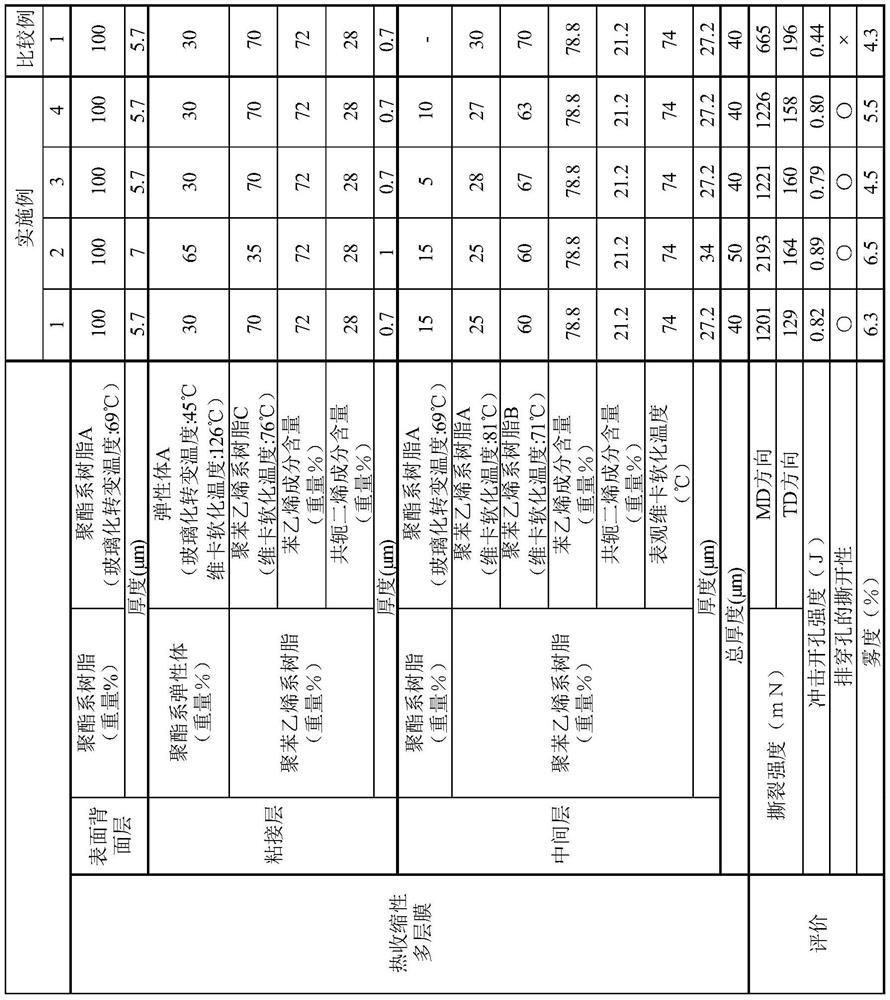
Figure 1
Abstract
Description
technical field
[0001] The present invention relates to a heat-shrinkable multilayer film capable of producing a heat-shrinkable label having excellent row perforation tearability in both the TD direction and the MD direction, as well as excellent impact resistance and transparency. Background technique
[0002] In recent years, many containers such as plastic bottles and metal cans have been attached with shrink labels obtained by printing or the like on a base film made of a heat-shrinkable resin film.
[0003] As shrink labels, labels made of polystyrene-based resins are mainstream due to their excellent low-temperature shrinkability. However, since polystyrene-based resin films have insufficient heat resistance, for example, when heated in a heater in a convenience store or the like, there is a problem that shrinkage occurs when the PET bottle is dumped, and the label is deformed or damaged. In addition, polystyrene-based resin films have insufficient solvent resistance...
Examples
Embodiment 1
[0215] As the resin constituting the front and back layers, 100% by weight of polyester-based resin A was used.
[0216] As the resin constituting the adhesive layer, a mixed resin containing 30% by weight of the elastomer A and 70% by weight of the polystyrene-based resin C was used.
[0217] As the resin constituting the intermediate layer, a mixed resin containing 15% by weight of polyester-based resin A, 25% by weight of polystyrene-based resin A, and 60% by weight of polystyrene-based resin B was used.
[0218] These resins were put into an extruder with a barrel temperature of 160-250°C, extruded into a sheet with a 5-layer structure by a multi-layer die at 250°C, and cooled and solidified by a pulling roll at 30°C. Next, after stretching at a draw ratio of 6 times in a tenter stretching machine with a preheating zone of 105°C, a stretching zone of 90°C, and a heat setting zone of 85°C, it was coiled by a coiler to obtain a A heat-shrinkable multilayer film in which the...
Embodiment 2
[0221] As the resin constituting the front and back layers, 100% by weight of polyester-based resin A was used.
[0222] As the resin constituting the adhesive layer, a mixed resin containing 65% by weight of the elastomer A and 35% by weight of the polystyrene-based resin C was used.
[0223] As the resin constituting the intermediate layer, a mixed resin containing 15% by weight of polyester-based resin A, 25% by weight of polystyrene-based resin A, and 60% by weight of polystyrene-based resin B was used.
[0224] These resins were put into an extruder with a barrel temperature of 160-250°C, extruded into a sheet with a 5-layer structure by a multi-layer die at 250°C, and cooled and solidified by a pulling roll at 30°C. Next, after stretching at a draw ratio of 6 times in a tenter stretching machine with a preheating zone of 105°C, a stretching zone of 90°C, and a heat setting zone of 85°C, it was coiled by a coiler to obtain a A heat-shrinkable multilayer film in which the...
Embodiment 3
[0227] As the resin constituting the intermediate layer, a mixed resin containing 5% by weight of polyester-based resin A, 28% by weight of polystyrene-based resin A, and 67% by weight of polystyrene-based resin B was used, except that it was the same as in Example 1. operation to obtain a heat-shrinkable multilayer film.