
Intelligent automobile following decision and control method based on cognitive risk balance
A technology of intelligent vehicle and control method, applied in the field of intelligent vehicle following decision and control based on cognitive risk balance, can solve the problems of poor mobility, unclear physical meaning, and insufficient anthropomorphic degree of the following model, and achieves a high level of improvement. The effect of breadth, risk reduction, and safety improvement
Patent Information
- Authority / Receiving Office
- CN · China
- Current Assignee / Owner
- Publication Date
- 2022-02-18
Smart Images
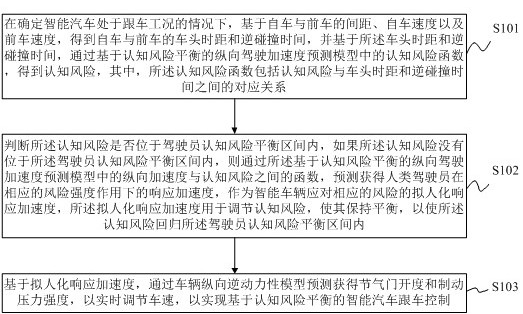
Figure 1 
Figure 2 
Figure 3
Abstract
Description
technical field
[0001] This application relates to the technical field of smart car applications, in particular to a smart car follow-up decision-making and control method based on cognitive risk balance. Background technique
[0002] For smart cars, such as in smart driving and automatic driving, the car-following behavior models used in its longitudinal dynamics motion decision-making mainly include: (1) Stimulus-response models, such as GM model (general motor) and OVM (Optimal velocity model) model ; (2) Safety distance model, such as Gipps model; (3) Social force model, such as IDM (Intelligent driver model) model and LCM (longitudinal control model) model; (4) Statistical learning model, such as neural network model, deep learning model and reinforcement learning models.
[0003] The existing car-following models are usually empirical models or semi-empirical models, which have insufficient physical meaning, insufficient interpretability, poor transferability, and fai...
Examples
Embodiment Construction
[0050] The intelligent car follow-up decision and control method based on cognitive risk balance according to the embodiments of the present application will be described below with reference to the accompanying drawings.
[0051] in particular, figure 1 It is a schematic flowchart of a smart car following decision-making and control method based on cognitive risk balance provided in the embodiment of the present application.
[0052] Such as figure 1 As shown, the smart car follow-up decision-making and control method based on cognitive risk balance includes the following steps:
[0053] In step S101, when it is determined that the smart car is in the vehicle-following condition, based on the distance between the vehicle and the vehicle in front, the speed of the vehicle and the speed of the vehicle in front, the time headway and the reverse collision time between the vehicle in front and the vehicle in front are obtained, And based on the headway and reverse collision ti...