

Method for preparing sugarcane solid fertilizer from culture tail water filtration residues
A fertilizer and solid state technology, which is applied to the field of preparing sugarcane solid fertilizer by filtering residues of aquaculture tail water, can solve problems such as hindering the improvement of sugarcane yield and quality, uneven distribution of sugarcane nutrients, and declining sugarcane soil fertility, so as to improve fish meat quality, Achieve high-value utilization and reduce planting costs
Patent Information
- Authority / Receiving Office
- CN · China
- Patent Type
- Applications(China)
- Current Assignee / Owner
- Publication Date
- 2022-07-15
- Estimated Expiration
- Not applicable · inactive patent
Smart Images
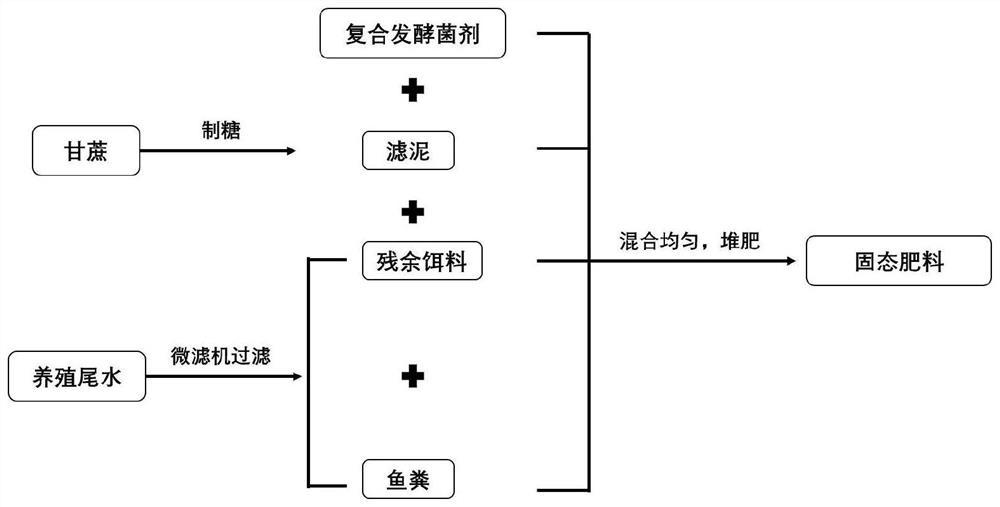
Figure 1 
Figure 2
Abstract
Description
technical field
[0001] The invention relates to the technical field of solid fertilizers, in particular to a method for preparing a sugarcane solid fertilizer by filtering residues of aquaculture tail water. Background technique
[0002] The aquaculture tail water refers to the aquaculture water that is no longer used and discharged from the entire aquaculture system during the aquaculture process or after the aquaculture work is completed. It contains a large amount of pollutants, including ammonia nitrogen, organic matter, etc. deterioration, further reducing the growth rate and quality of fish and shrimp. Scientific and rational treatment of tail water is of great significance for protecting aquaculture waters, creating a suitable growth environment for fish, effectively reducing the probability of disease occurrence, and improving aquaculture benefits.
[0003] Filter mud is a by-product of sugar cane processing. It contains a lot of organic substances, mainly cellulose...
Examples
Embodiment 1
[0043] The raw materials were weighed according to the following parts by weight: 10 parts of fish manure, 10 parts of residual bait, 4 parts of sugarcane filter mud, and a compound fermentation bacterial agent equivalent to 0.25% of the weight of sugarcane filter mud was added.
[0044] The compound bacterial agent is domesticated bacteria freeze-dried powder, yeast freeze-dried powder, Pseudomonas aeruginosa freeze-dried powder and Bacillus freeze-dried powder, and the weight ratio is 3:2:2:1.
[0045] The preparation method of the composite solid compost is:
[0046] (1) Use microfilters with different small apertures to filter the tail water of culture, obtain organic matter such as fish manure and residual bait in turn, dry them, and save them for future use.
[0047] (2) Mix the sugarcane filter mud, fish manure, residual bait and compound fermentation inoculum in a ratio of 10:10:4:0.01 (the ratio of compound inoculum is 3:2:2:1), stir evenly, and pile them into a certa...
Embodiment 2
[0049] The raw materials were weighed according to the following parts by weight: 15 parts of fish manure, 15 parts of residual bait, 9 parts of sugarcane filter mud, and a compound fermentation bacterial agent equivalent to 0.25% of the weight of sugarcane filter mud was added.
[0050] The compound bacterial agent is domesticated bacteria freeze-dried powder, yeast freeze-dried powder, Pseudomonas aeruginosa freeze-dried powder and Bacillus freeze-dried powder, and the weight ratio is 3:2:3:1.5.
[0051] The preparation method of the composite solid compost is:
[0052] (1) Use microfilters with different small apertures to filter the tail water of culture, obtain organic matter such as fish manure and residual bait in turn, dry them, and save them for future use.
[0053] (2) Mix the sugarcane filter mud, fish manure, residual bait and compound fermentation inoculum in a ratio of 15:15:9:0.0225 (the ratio of compound inoculum is 4:2:3:1.5), stir evenly, and pile them into a...
Embodiment 3
[0055] The raw materials were weighed according to the following parts by weight: 12 parts of fish manure, 13 parts of residual bait, 5 parts of sugarcane filter mud, and a compound fermentation bacterial agent equivalent to 0.25% of the weight of sugarcane filter mud was added.
[0056] The compound bacterial agent is domesticated bacteria freeze-dried powder, yeast freeze-dried powder, Pseudomonas aeruginosa freeze-dried powder and Bacillus freeze-dried powder, and the weight ratio is 4:3:3:1.5.
[0057] The preparation method of the composite solid compost is:
[0058] (1) Use microfilters with different small apertures to filter the tail water of culture, obtain organic matter such as fish manure and residual bait in turn, dry them, and save them for future use.
[0059] (2) Mix the sugarcane filter mud, fish manure, residual bait and compound fermentation inoculum according to the ratio of 12:13:5:0.0125 (the ratio of compound inoculum is 3:1:2:1.5), stir evenly, and pile...