
Preparation method of green and environment-friendly flame-retardant wood-plastic plate
A green and environmentally friendly, wood-plastic board technology, applied in the direction of flat products, wood processing appliances, other household appliances, etc., can solve the problems of consumption of petrochemical products, low performance, increased production costs, etc., to meet the requirements of combustion performance, technology Simple process and fast effect
Patent Information
- Authority / Receiving Office
- CN · China
- Patent Type
- Applications(China)
- Current Assignee / Owner
- Publication Date
- 2022-07-29
Smart Images
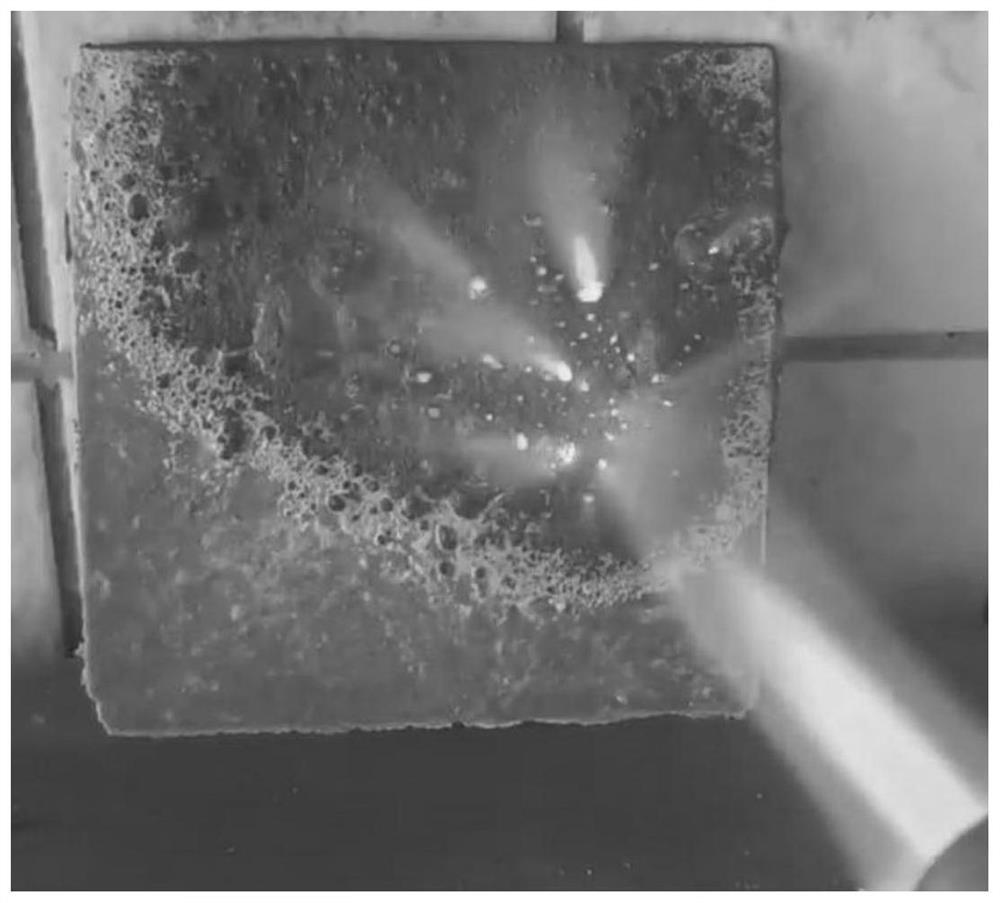
Figure 1
Abstract
Description
technical field
[0001] The invention belongs to the technical field of manufacture of flame-retardant wood-plastic boards, in particular to a preparation method of a green and environment-friendly flame-retardant wood-plastic board. Background technique
[0002] Wood-plastic board is a kind of material obtained by blending pretreated lignocellulose or wood powder with thermoplastic resin binder and molding by extrusion, molding or injection molding process. It can be widely used in household industry, indoor Decoration, packaging and future wooden house construction. According to the requirements for the combustion performance of interior decoration materials in the "Code for Fire Protection Design in Building Interior Decoration" (GB 50222-2017), the combustion performance should not be lower than B1 level. Since wood materials are flammable, the occurrence and spread of many fires are related to wood materials, posing a great threat to the safety of people's lives and pro...
Examples
Embodiment 1
[0028] (1) Weigh high amylose corn starch (amylose content 70%) and mix it with wood flour evenly, and the mass ratio is 6:14.
[0029] (2) Weigh calcium chloride solid, add it to water, and configure 40% calcium chloride solution.
[0030] (3) Add solution (2) to the mixed powder of (1) in a mass ratio of 20:3, and stir evenly.
[0031] (4) Spread the wet powder in (3) evenly in a metal mold of 10cm×10cm×1mm.
[0032] (5) The metal mold in (4) was placed on a hot press molding machine, the temperature was set to 105° C., the clamping pressure was 5 MPa, and the pressure holding time was 10 minutes.
[0033] (6) After the mold is cooled, take it out to obtain a wood-plastic board with a thickness of 1 mm.
[0034] (7) The tensile and bending properties of the wood-plastic board in (6) were measured. The tensile strength was 3.5MPa, the static bending strength was 26.5MPa, and the surface hardness was 90HC.
[0035] (8) Determination of the flame retardant properties of the ...
Embodiment 2
[0038] (1) Weigh high amylose corn starch (amylose content 50%) and mix it with wood flour evenly, and the mass ratio is 3:17.
[0039] (2) Weigh 30 g of calcium chloride solid, add it to 70 g of water, and configure a 30% calcium chloride solution.
[0040] (3) Add the solution (2) to the mixed powder of (1) in a mass ratio of 20:3, and stir evenly.
[0041] (4) Spread the wet powder in (3) evenly in a metal mold of 10cm×10cm×1mm.
[0042] (5) The metal mold in (4) was placed on a hot press molding machine, the temperature was set to 105° C., the clamping pressure was 5 MPa, and the pressure holding time was 10 minutes.
[0043] (6) After the mold is cooled, take it out to obtain a wood-plastic board with a thickness of 1 mm.
[0044] (7) The tensile and bending properties of the wood-plastic board in (6) were measured. The tensile strength was 1.5MPa, the bending stress was 17.2MPa, and the surface hardness was 90HC.
[0045] (8) Determination of the flame retardant prope...
Embodiment 3
[0047] (1) Weigh high amylose corn starch (amylose content 50%) and mix it with wood flour evenly, and the mass ratio is 3:17.
[0048] (2) Weigh calcium chloride solid, add it to water, and configure 40% calcium chloride solution.
[0049] (3) Add solution (2) to the mixed powder of (1) in a mass ratio of 20:10, and stir evenly.
[0050] (4) Add the wet powder in (3) into an injection molding machine, and at a processing temperature of 95° C., extrude and inject into a wood-plastic board with a thickness of 3 mm.
[0051] (5) Determine the tensile and bending properties of the wood-plastic board in (4), the tensile strength is 5.5MPa, the static bending strength is 35MPa, and the surface hardness is 98HC.
[0052] (6) Determination of the flame retardant properties of the wood-plastic board in (4). According to GB / T 2408-2008 Test Method B-Vertical Burning Test, the after-flame time of a single sample after the first application of flame is 0 seconds, and the after-flame ti...