
Method for producing protease of thermophilic bacteria by using artificial gene
A technology of thermolysin and production method, applied in the field of artificial gene production of thermolysin, can solve the problems of high production cost, high cost of thermolysin, low enzyme yield and the like, and achieves low cost, thermolysin The effect of high activity and high yield
Patent Information
- Authority / Receiving Office
- CN · China
- Current Assignee / Owner
- Publication Date
- 2003-10-08
- Estimated Expiration
- Not applicable · inactive patent
Smart Images
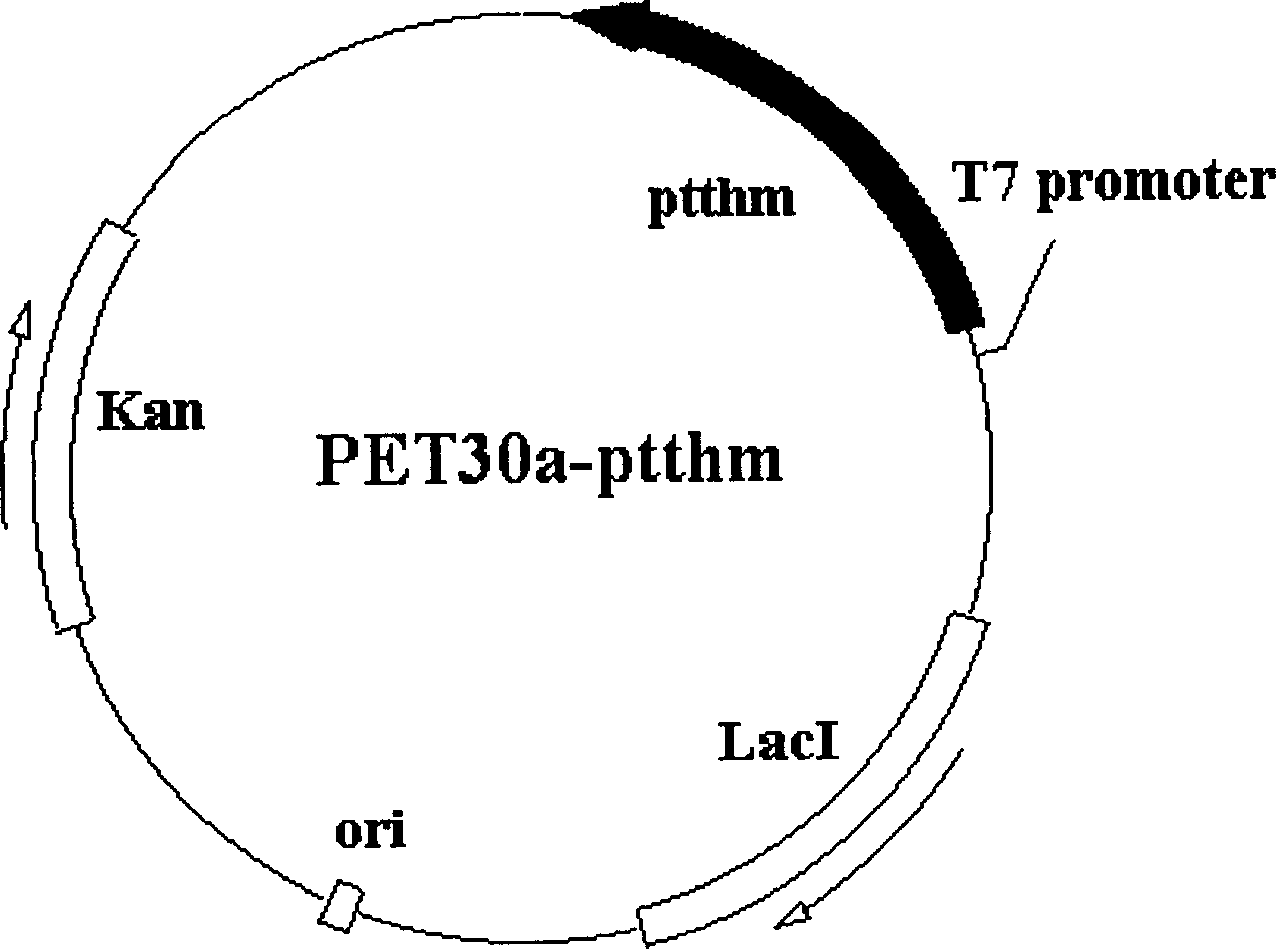
Figure 1
Abstract
Description
technical field
[0001] The invention belongs to the technical field of bioengineering, and in particular relates to a method for producing thermolysin by artificial gene. Background technique
[0002] Thermolysin was first isolated from Gram-positive bacteria Bacillusthermoproteolyticus Rokko (Endo, 1962). Due to its high heat resistance (when Ca 2+ In the presence of ions, it can stably exist at a high temperature of 80 degrees), so it is often used in some protein hydrolysis reactions that need to be carried out at higher temperatures. Thermolysin belongs to the M4 family of zinc endopeptidases and is the first endopeptidase to be crystallized.
[0003] Amino acid sequence (K.Titani, M.A.Hermodson, L.H.Ericsson, K.A.Walsh, andH.Neurath, Nature (London) New Biol., 1972,283,35) and three-dimensional structure (P.Mcolman, J.N.Jansonius) of thermolysin , and B.W.Matthews, J.Mol.Biol., 1972, 70, 701) have been determined. The active center of thermolysin is composed of zinc...
Examples
Embodiment 1
[0020] The present invention is further described below by way of examples. Example 1: The cloning of the full-length protease gene and the construction of the expression vector are the same as above.
[0021] 1. Expression and separation and purification of inclusion bodies
[0022] The constructed expression vector—transformed Escherichia coli BL21(DE3) was inoculated in 1000mL culture medium and cultivated to OD 600 When it was 0.4, IPTG was used to induce expression for 3 hours, collect a certain amount of expressing bacteria, add 4ml / ml lysozyme after washing, treat at 37°C for 30min, break up the bacteria with ultrasonic waves, collect inclusion body precipitates, and use 1.5mol / L containing Washing solution of urea (50mMol Tris-HCl, 10mMol Ca 2+ , pH7.4, 1.5mol / L urea) repeatedly washed inclusion bodies, dissolved in a solution containing 6mol / L urea (50mMol Tris-HCl, 10mMol Ca 2+ , pH7.4, 6mol / L urea) to denature the protein.
[0024]...
Embodiment 2
[0028] According to the above method, the enzyme activity was determined to be 3 million U / g. Example 2: The cloning of the full-length protease gene and the construction of the expression vector were the same as above.
[0029] 1. Expression and separation and purification of inclusion bodies
[0030] The constructed expression vector—transformed Escherichia coli BL21(DE3) was inoculated in 10L culture medium and cultivated to OD 600 When the temperature is 0.6, induce expression with IPTG for 6 hours, collect the expressed bacteria, add 4ml / ml lysozyme after washing, treat at 37°C for 30min, break the bacteria with ultrasonic waves, collect inclusion body precipitates, and wash with 3.0mol / L urea solution (50mMolTris-HCl, 10mMol Ca 2+ , pH7.4, 3.0mol / L urea) repeatedly washed inclusion bodies, dissolved in a solution containing 9mol / L urea (50mMol Tris-HCl, 10mMol Ca 2+ , pH7.4, 9mol / L urea) to denature the protein.
[0031] 2. Drying of protein
[0032] The above protei...