
All solid hybrid arrow fiber
a hybrid fiber and fiber technology, applied in glass optical fiber, cladded optical fiber, instruments, etc., can solve the problems of high damage threshold, high damage threshold, and the power limit of high-power fiber amplifiers, and achieve the effect of high loss, acceptable losses, and large mode area
Patent Information
- Authority / Receiving Office
- US · United States
- Patent Type
- Patents(United States)
- Current Assignee / Owner
- Publication Date
- 2022-10-04
Smart Images
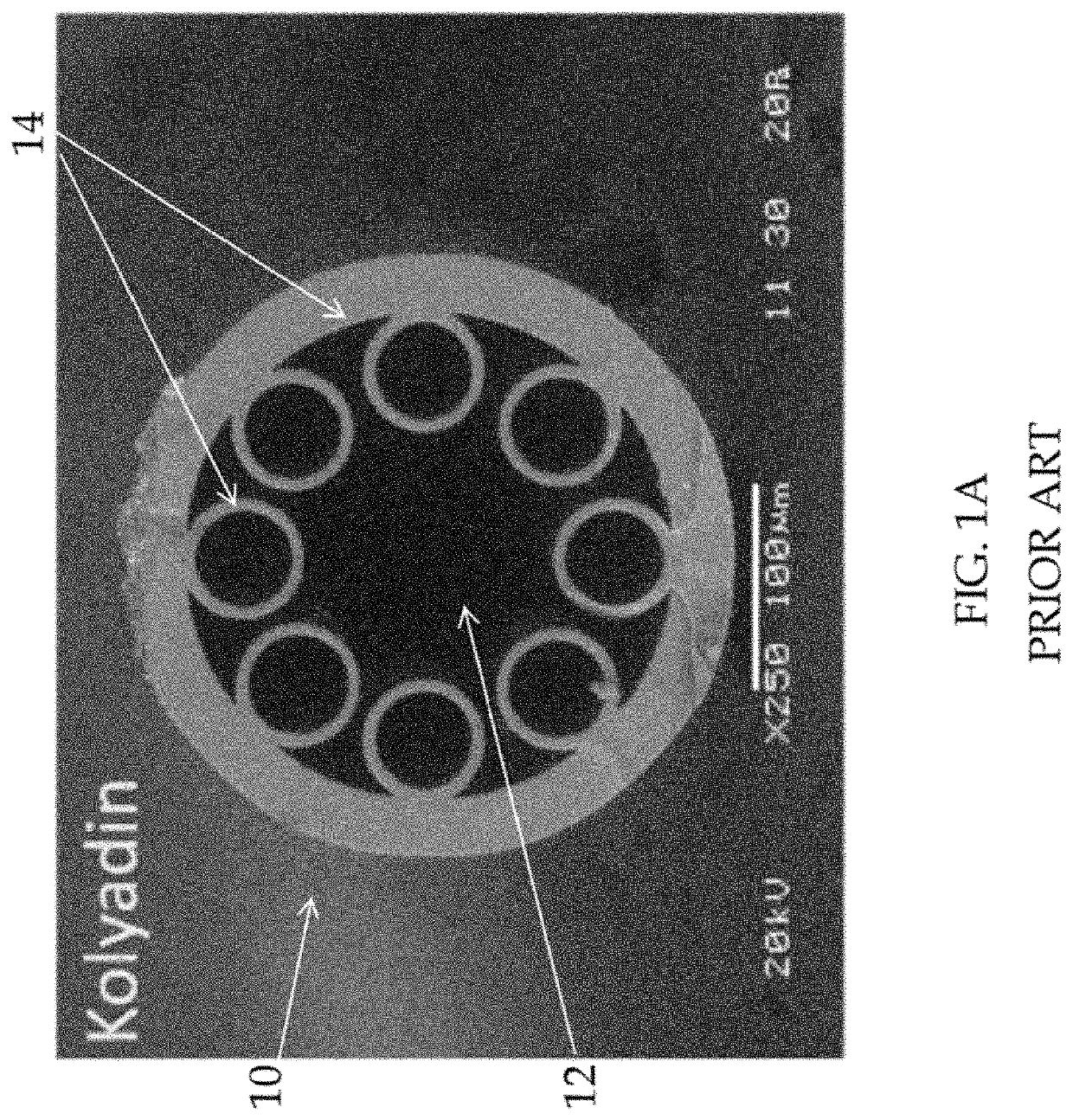
Figure 1 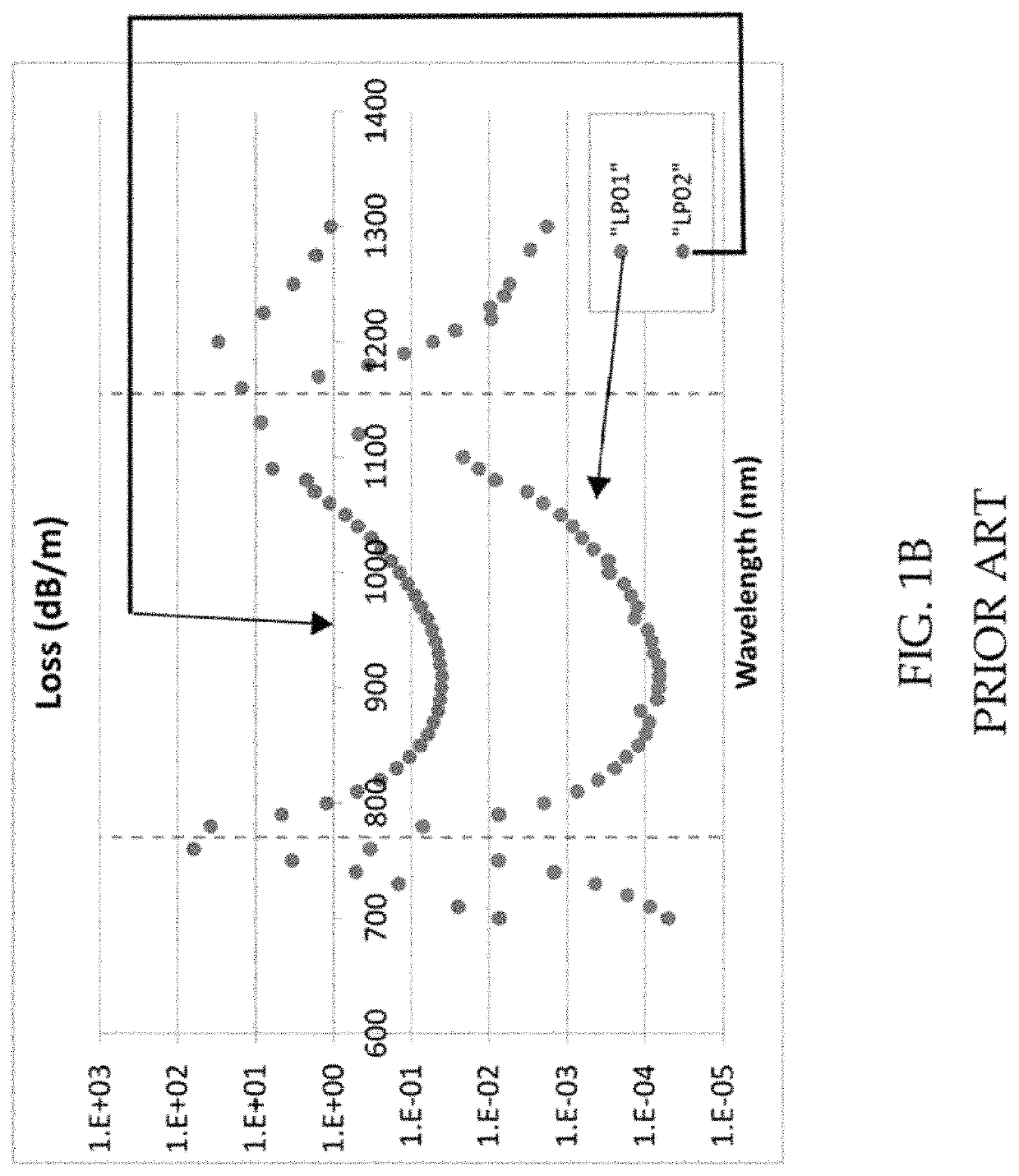
Figure 2 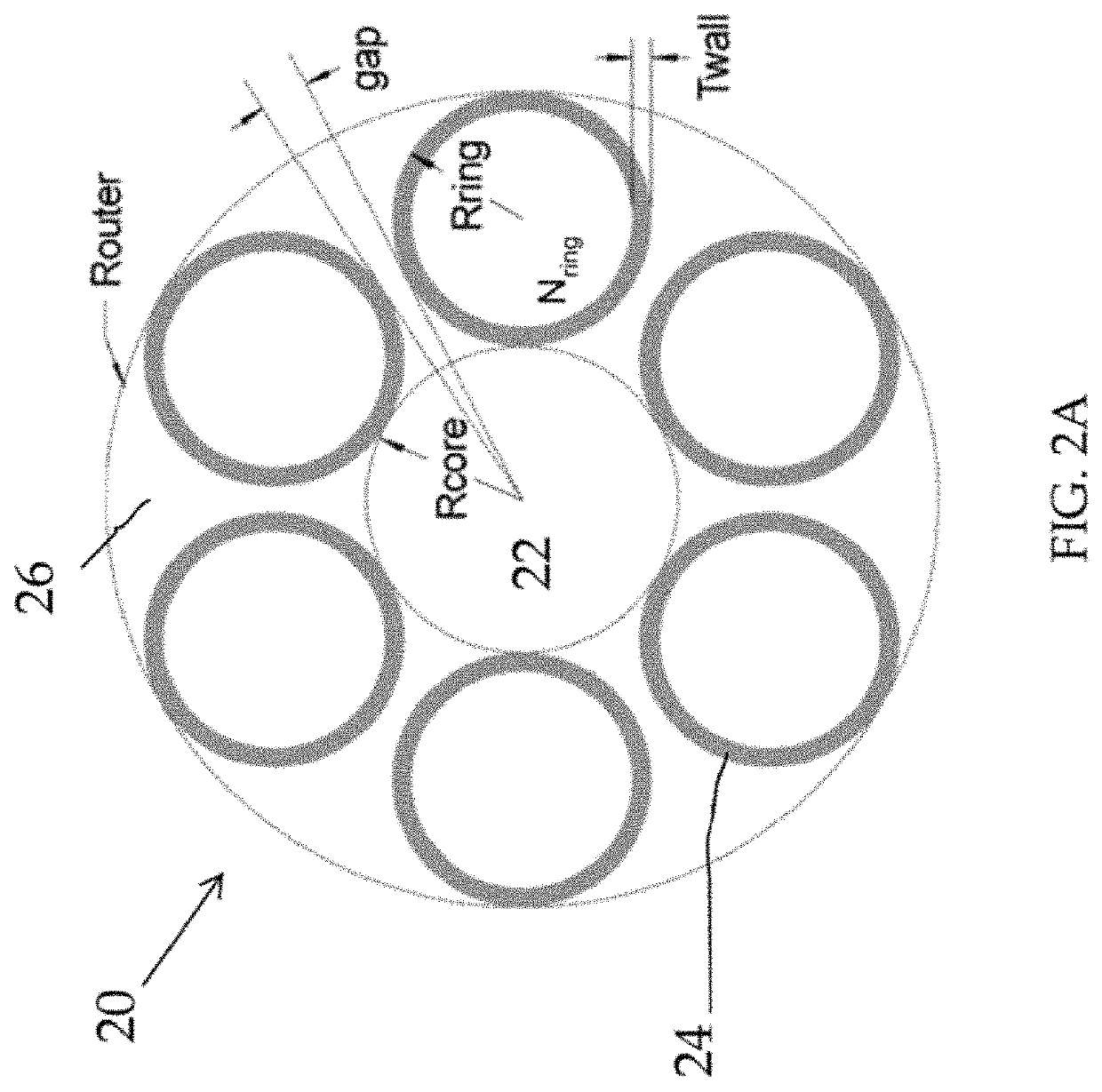
Figure 3
Abstract
Description
CROSS-REFERENCE TO RELATED APPLICATIONS
[0001] This application claims the benefit of U.S. Provisional Patent Application No. 62 / 851,798 titled “All Solid Hybrid Arrow Fiber,” filed May 23, 2019, incorporated herein by reference.STATEMENT AS TO RIGHT'S TO INVENTIONS MADE UNDER FEDERALLY SPONSORED RESEARCH OR DEVELOPMENT
[0002] The United States Government has rights in this invention pursuant to Contract No. DE-AC52-07NA27344 between the United States Department of Energy and Lawrence Livermore National Security, LLC, for the operation of Lawrence Livermore National Laboratory.BACKGROUNDField
[0003] The present technology relates to waveguide designs, and more specifically, it relates to waveguide designs that increase the threshold for transverse modal instability.Description of Related Art
[0004] High power fiber amplifiers currently face a power limit of a few kilowatts of output due to transverse modal instability (TMI). TMI is caused by a dynamic coupling between the desired mode of th...
Examples
Embodiment Construction
[0028]This technology relates to a basic design for solid optical fibers with features that are beneficial to high power rare-earth doped fiber lasers and amplifiers. The design derives from a prior art design for hollow optical fibers, the so-called negative curvature hollow core fiber discussed above. As noted, these fibers do not support true bound modes in the core. The present technology also achieves core confinement by utilizing a convenient ARROW design rule (constraint) on the ring wall at the operating wavelength λ to obtain minimum losses in the core:
2tNA=(m+½)λ
NA=√{square root over (nring2−nbg2)}
Here, t is the ring wall thickness, m represents an integer, and the ring material is specified by NA, a function of its index of refraction nring and that of the background nbg. For a hollow fiber, nbg=1. Note that in the context of the present technology, the term “ring” refers to an outer ring of material of a solid strand of glass, where the outer ring's index is different fr...