
Charge-modified dye absorption media
a technology of dye absorption media and charge-modifying polyester, which is applied in the direction of detergent compositions, detergent compounding agents, chemistry apparatus and processes, etc., can solve the problems of difficult prior art development of a solution, difficulty in preventing the adverse effects of dye bleed, and particularly problematic dye bleeding, etc., to improve the control of dye transfer, high charge, and high retention capacity
Patent Information
- Authority / Receiving Office
- US · United States
- Patent Type
- Applications(United States)
- Current Assignee / Owner
- Publication Date
- 2002-10-03
- Estimated Expiration
- Not applicable · inactive patent
Smart Images
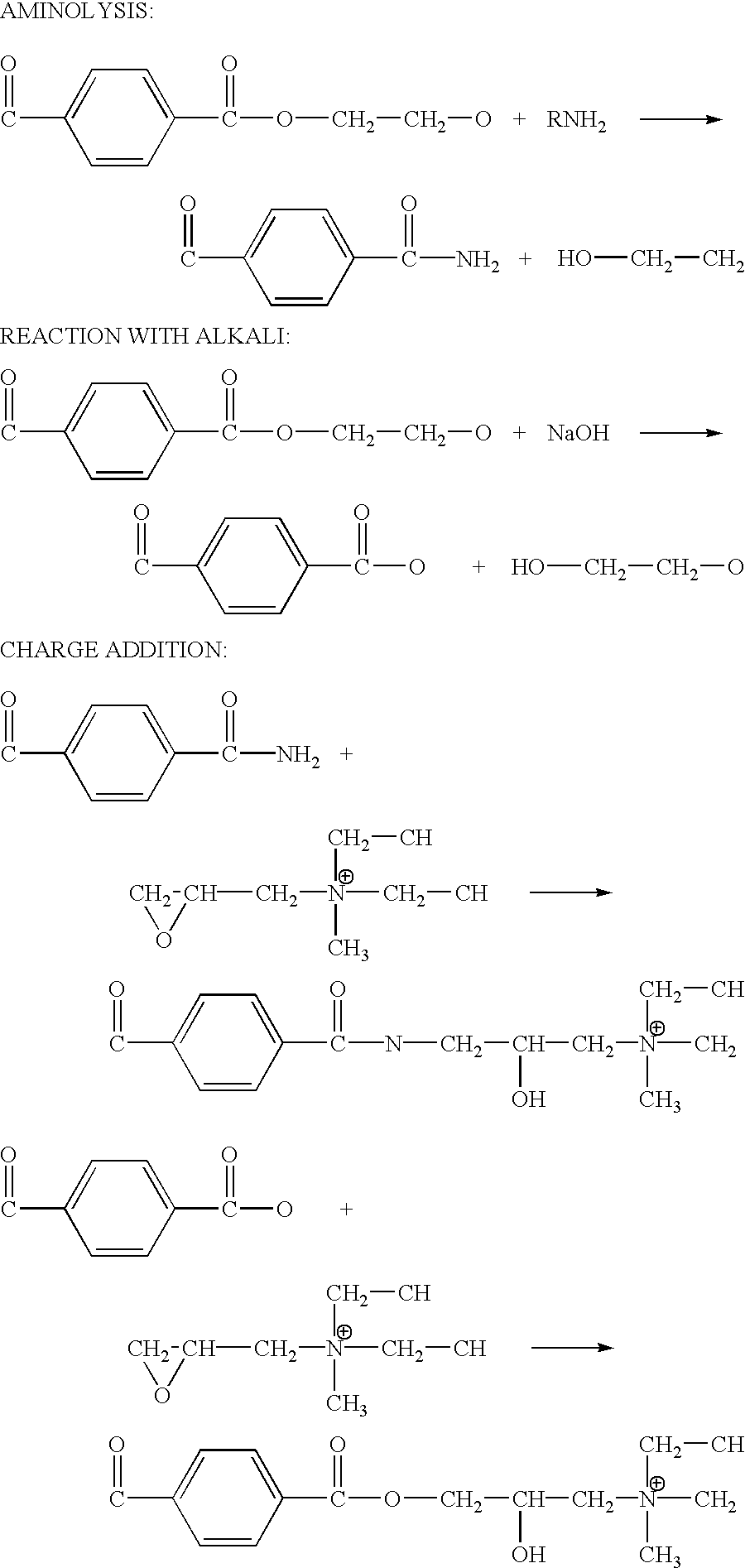
Figure 1 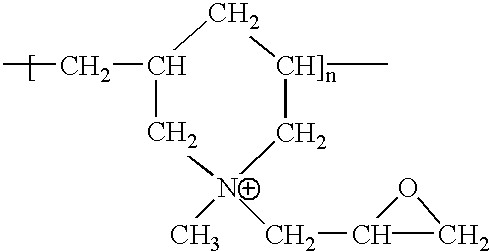
Figure 2 
Figure 3
Abstract
Description
[0001] This application is a continuation-in-part of commonly owned U.S. Provisional Patent Application Serial No. 60 / 223,184 of Yeh, et al., filed Aug. 4, 2000, entitled "CHARGE-MODIFYIED DYE ABSORPTION MEDIA" and related to partially commonly owned U.S. Provisional Patent Application Serial No. 60 / 223,183 of Bucholz, et al, filed Aug. 4, 2000, entitled "METHOD FOR CHARGE-MODIFYING POLYESTER," the disclosures of which are incorporated herein by reference to the extent not inconsistent with the present application.BACKGROUND OF THE DISCLOSURE
[0002] The present invention relates to charge-modifying polyester for use in a wide variety of applications, such as a laundry product for inhibiting the deposition of dye onto fabric. More particularly, the present invention is directed to compositions and methods useful for inhibiting the transfer of dyes. The products and processes of the present invention find particular use in inhibiting the transfer of the dye from one fabric to another f...
Examples
first embodiment
[0043] surface modification in accordance with this invention is through the chemical reaction between the epoxy groups of the surface modifying agent and the hydroxyl, carboxylic, or amino groups generated from the hydrolysis of polyester fibers.
[0044] Hydrolysis reveals functional groups on polyester for further reactions. Reactions can be conducted in either alkaline or amine solutions. A sample of proper size is pre-wetted prior to hydrolysis. Wetting can be conducted either by using a wetting agent, a surfactant, or simply by dipping the sample in an aqueous alcohol solution. Wetting and hydrolysis can be a two-step process or can be processed in one step. In this embodiment of the invention, a sample of Reemay2295 is soaked in a solution that contains from 20-25% methanol, preferably 23% methanol, 0.1-0.3% sodium hydroxide, preferably 0.2% sodium hydroxide. The reaction temperature can be from room temperature to the boiling point of the solution. However, the temperature must...
example 1
Charge Capacities
[0087] Each charged sheet, along with an untreated sheet made from Reemay 2295, was cut into 4-2.25" squares for metanil yellow (M-Y) dye capacity testing. Duplicate samples were used in the following manner to perform a static M-Y dye test. Two sets of 2 squares were weighed and placed in disposable Petri dishes. A 10-ml solution of 10 ppm of M-Y in pH 9 buffer was pipetted into the dishes and swirled. After one minute, the samples were removed, and the absorbance of the supernatant liquid and the unused dye solution read on the LKB Ultrospec II spectrometer at 430 nm in the standard 1-cm cuvette. Calculations were then performed to determine the sample's capacity for dye.
[0088] The mg dye in offered volume is calculated as follows:
[0089] For 10 ppm=10 mg / l=10 mg / 1000 ml.
[0090] As only 10 mls is being used, 10 ml / 1000 ml=0.01*10 mg=0.1 mg in 10 mls
[0091] For a typical test, where the blank absorbance of a 10-ppm solution is 0.533 and the absorbance of the test samp...
example 2
Preparation of Charge-Modified Polyester via Amine Hydrolysis
[0094] A piece of 2".times.21 / 4" Hollytex 3257 (a PET spunbond) was wet with 10% methanol and then treated with a 1% tetraethylene pentamine at 70.degree. C. for 30 seconds. The material was then flushed with tap water to remove the excess amount of tetraethylene pentamine. The wet fabric was subsequently dipped into a 2% Rescart-E (poly(N-methyl diallyl amine) epichlorohydrin adduct--Ciba-Geigy) solution for about 5 seconds. The fabric was then dried at 90.degree. C. for thirty minutes.
[0095] The treated fabric was then washed in a typical laundry wash containing Tide.RTM. detergent and Clorox.RTM. at 85.degree. C. for thirty minutes. The fabric was then challenged with Metanil yellow dye and the dye uptake determined. The dye capacity of the fabric was determined to be 0.005 mg / g of polyester substrate.