
Mechanical advantage tourniquet
a technology of tourniquets and tourniquets, applied in the field of tourniquets, can solve the problems of affecting the efficiency with which a tourniquet can be applied to an injured appendage, affecting the efficiency of the tourniquet application, and without experience in the level of medical care to properly apply the tourniquet and effectively restrict the flow of blood, etc., to achieve efficient and effective compression of an injured appendage, fast and easy application, and quick and easy application
Patent Information
- Authority / Receiving Office
- US · United States
- Current Assignee / Owner
- Publication Date
- 2005-05-26
- Estimated Expiration
- Not applicable · inactive patent
Smart Images
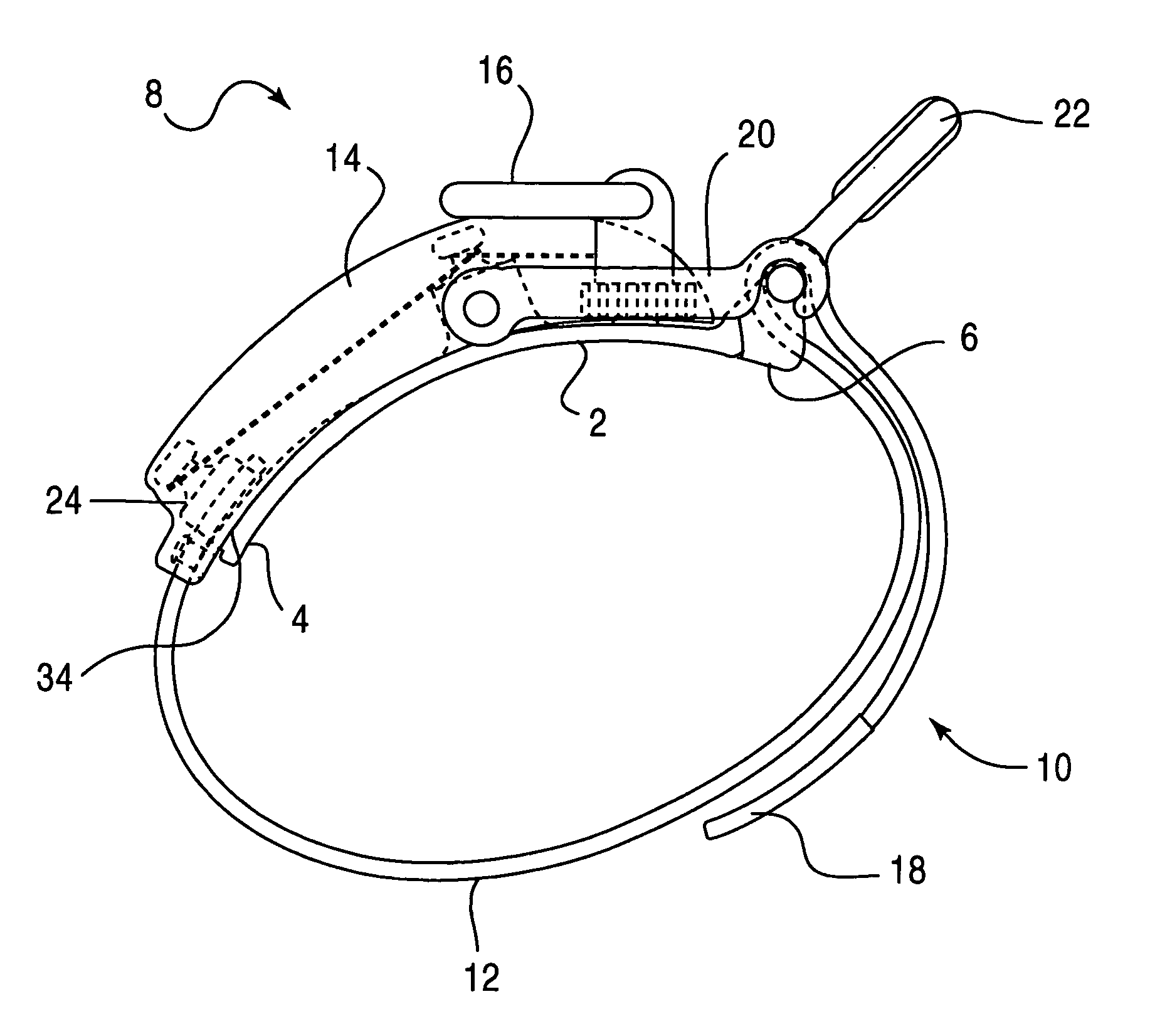
Figure 1 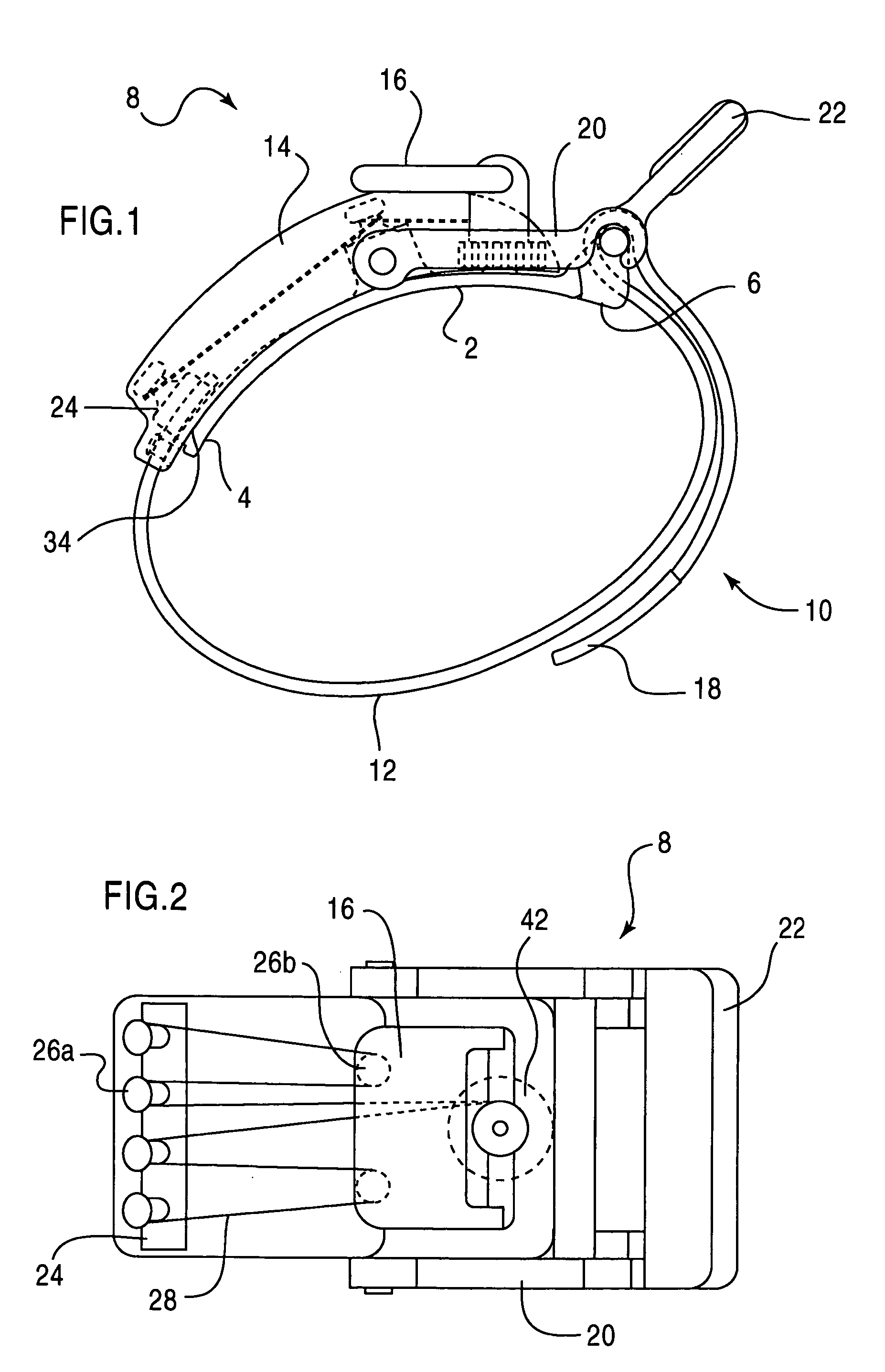
Figure 2 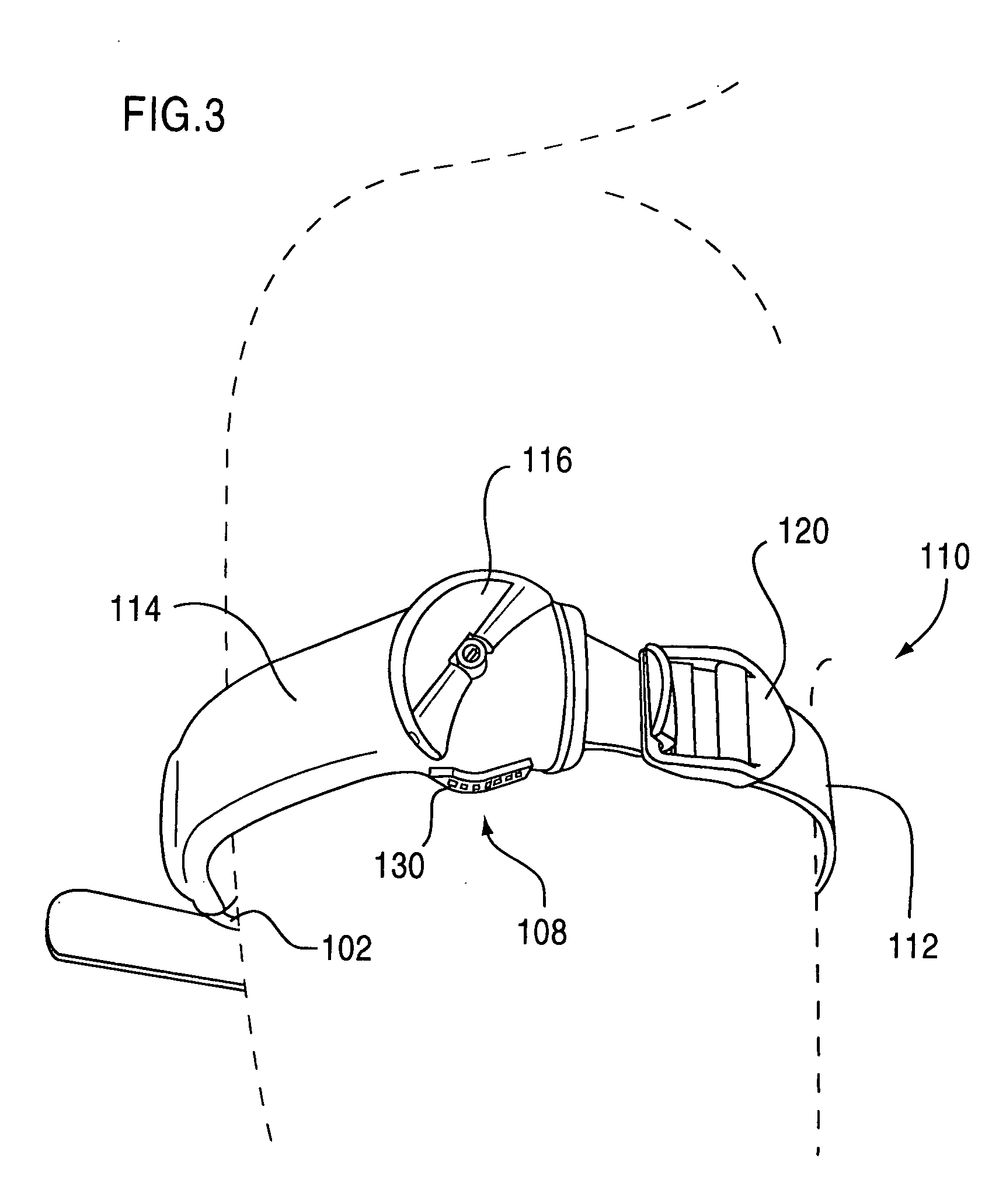
Figure 3
Abstract
Description
[0001] This application claims priority to applicants' copending U.S. Provisional Application Ser. No. 60 / 509,917 entitled “MECHANICAL ADVANTAGE TOURNIQUET” filed Oct. 10, 2003, and copending U.S. Provisional Application entitled “MECHANICAL ADVANTAGE TOURNIQUET III” filed Oct. 4, 2004. The entirety of these patent applications is incorporated herein by reference.BACKGROUND OF THE INVENTION
[0002] 1. Field of the Invention
[0003] The present invention relates to a tourniquet with an improved tightening system that provides a mechanical advantage for applying a compression force to an appendage.
[0004] 2. Description of the Related Art
[0005] A tourniquet is a device for temporarily controlling the flow of blood through or from a large artery in an appendage under emergency conditions as the tourniquet cuts off the blood supply to the appendage for a period of time. Although primarily used as a first-aid or triage measure, tourniquets can also be used in a medical facility during sur...
Examples
first embodiment
[0027]FIG. 1 illustrates a side view of the mechanical advantage tourniquet 10 according to the present invention. As shown in FIG. 1, the tourniquet 10 includes a mechanical advantage power system 8, an arcuate member or base 2, a strap 12, and a locking member 20.
[0028] The base 2 has a first end 4 and a second end 6, and serves as a mounting means for mounting the tourniquet 10 onto the injured appendage. The base 2 can be formed from a flexible material, including but not limited to, a polymeric material such as acetal or nylon.
[0029] The strap 12, such as a cinch strap is an elongated member that can also be formed from any suitably flexible material including, but not limited to, nylon. The strap 12 extends from the first end 4 of the base 2 around the injured appendage where it is threaded through and locked into place by the locking member 20. In combination, the strap 12, along with the mechanical advantage power system 8, serve as tightening means for tightening the tourn...
second embodiment
[0038]FIGS. 3-6 illustrate the mechanical advantage tourniquet 110 according to the present invention, which includes components designed to apply a controlled pressure to the injured appendage and thereby restrict the flow of blood through or from the injury. As disclosed above, the mechanical advantage is a device that can multiply an output force while reducing an input force needed to create the output force. FIG. 3 illustrates the mechanical advantage tourniquet 110 as it can be applied to an injured appendage. The tourniquet 110 includes an arcuate member or C-clip 102 on which is mounted a mechanical advantage power system 108 having a tightening turnkey 116 for activating the mechanical advantage, and a release button 130 for canceling the mechanical advantage, a strap 112, and a locking member 120.
[0039] A shroud 114, shown in FIG. 3, is a sleeve-like member that extends circumferentially around an outer surface of the C-clip 102 and acts as a barrier to prevent foreign ele...