
Immunosorbent blood tests for assessing paroxysmal cerebral discharges
a paroxysmal cerebral discharge and immunosorbent technology, applied in the field of invitro diagnostic tests, can solve the problems of difficult to distinguish between epileptic seizures, begin to destroy the components of the cell membrane, and difficult to distinguish between these types of seizures, and achieve rapid and inexpensive immunoassays and effective therapeutic interventions.
Patent Information
- Authority / Receiving Office
- US · United States
- Patent Type
- Applications(United States)
- Current Assignee / Owner
- Publication Date
- 2005-08-18
- Estimated Expiration
- Not applicable · inactive patent
Smart Images
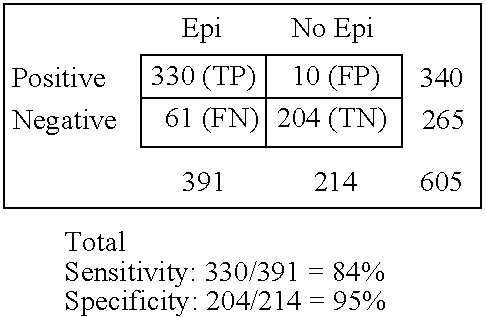
Figure 1 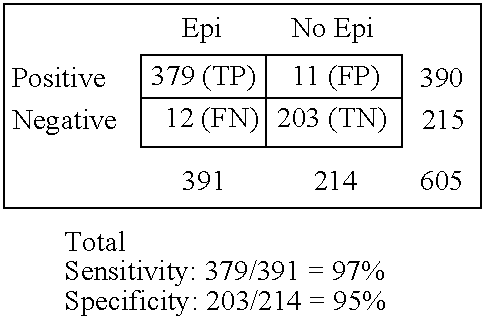
Figure 2 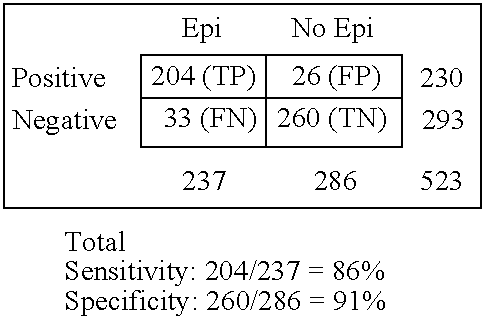
Figure 3
Abstract
Description
RELATION TO PRIOR APPLICATIONS
[0001] This application claims priority to U.S. Provisional Application No. 60 / 517,671, filed Nov. 6, 2003.FIELD OF THE INVENTION
[0002] The present invention relates to clinical in-vitro diagnostic tests, particularly immuno- and proteomic tests, for diagnosing and assessing the risk associated with nervous and mental diseases. The tests detect specific brain markers of neurotoxicity, evaluate toxicological and neurological brain damage, and assist in the diagnosis, therapy and management of brain disorders. BACKGROUND
[0003] Epilepsy is a disease characterized by epileptic seizures—generally defined as those seizures caused by a brief disruption of brain function involving temporary abnormal electrical activity in the nerve cells. The location of this disruption in the brain determines the type of seizure. Epilepsy should be contrasted with syncope which, although both frequently result in unconsciousness, syncope refers to a loss of consciousness du...
Examples
example 1
Clinical Assessment of Epilepsy in Children
[0075] This randomized and double-blinded trial was conducted at 4 Children Epilepsy Centers in Moscow and St. Petersburg (Russia) from, January 1995 through December 1999. Although our study is not strictly population-based, we recruited individuals to achieve a group representative of children with epilepsy in the western part of the country.
[0076] Eligible for the trials patients were at 4 mo.-14 years of age and had been diagnosed with epilepsy syndromes and seizures that were classified based on all information available at diagnosis and according to International League Against Epilepsy's (ILAE) guidelines by four pediatric epilepsy specialists. These include the localization-related and generalized idiopathic syndromes (e.g., benign rolandic and childhood absence epilepsy), and the cryptogenic and symptomatic generalized syndromes. The symptomatic and cryptogenic localization-related epilepsies represent a broad spectrum of syndrom...
example 2
Clinical Assessment of Adult Epilepsy
[0091] Double-blinded trial was conducted at Dept. of Epilepsy, V.M Bechterev's Institute on Psychiatry and Neurology and Dept. of Neurology, Russian Military Medical Academy in St. Petersburg (Russia) from February 1994 to December 1997. Two hundred thirty seven consecutive patients with epilepsy aged 18 to 40 years (130 women, 107 men) admitted to hospitals of aforementioned institutions due to increased frequency of seizures were considered for participation. Epilepsy was classified according to ILAE guidelines and the following inclusion criteria were considered in the protocol: the duration of disorder from 1 year to 20 years; the frequency of seizures from 1 per day to one per a year; type of seizures: partial simple, partial multiple, generalized with absences, generalized tonic-clonic of different etiology (e.g., history of bacterial meningitis, stroke, cerebral palsy, prenatal trauma etc.). A definite diagnosis of epilepsy was based on ...
example 3
GRACE-NeuroTest-Epilepsy ELISA Tests Performance
[0099] The GRACE-NeuroTest-Epilepsy ELISA kits for detecting GluR1 antibodies comprises (i) an immunosorbent for GluR1 peptide or antibodies to GluR1; and (ii) an indicator reagent comprising secondary antibodies attached to a signal-generating compound. The test intended to be used to assess persons undergoing paroxysmal cerebral discharges and epilepsy.
[0100] The quality of microplates covered by GluR1 peptide or antibodies to GluR1 was controlled by use of calibrators and sera specimens from healthy persons in presence and absence of calibrators (Gromova et al., Neirokhimiia. 1997, 1:23-7). The assessments of intra-assay variability, batch-to-batch variation and stability of the ELISA reaction for antibody or GluR1 calibrators were performed at various storage conditions (temperature, type of packing, storage duration). Kinetic of reaction was studies to reach optimal characteristics of variables. The concentrations of GluR1 pepti...