
Titanium dioxide complex having molecule distinguishability
a technology of titanium dioxide and complexes, which is applied in the field of titanium dioxide composites having molecular recognition capacity, can solve the problems of inability to selectively remove or degrade bound endocrine disrupting chemicals, limited cleaning capacity, and inability to achieve selective binding and degradation of only endocrine disrupting chemicals, so as to achieve accurate recognition and capture a target molecule, high degradation activity, and high photocatalytic activity
Patent Information
- Authority / Receiving Office
- US · United States
- Current Assignee / Owner
- Publication Date
- 2006-12-14
- Estimated Expiration
- Not applicable · inactive patent
Smart Images
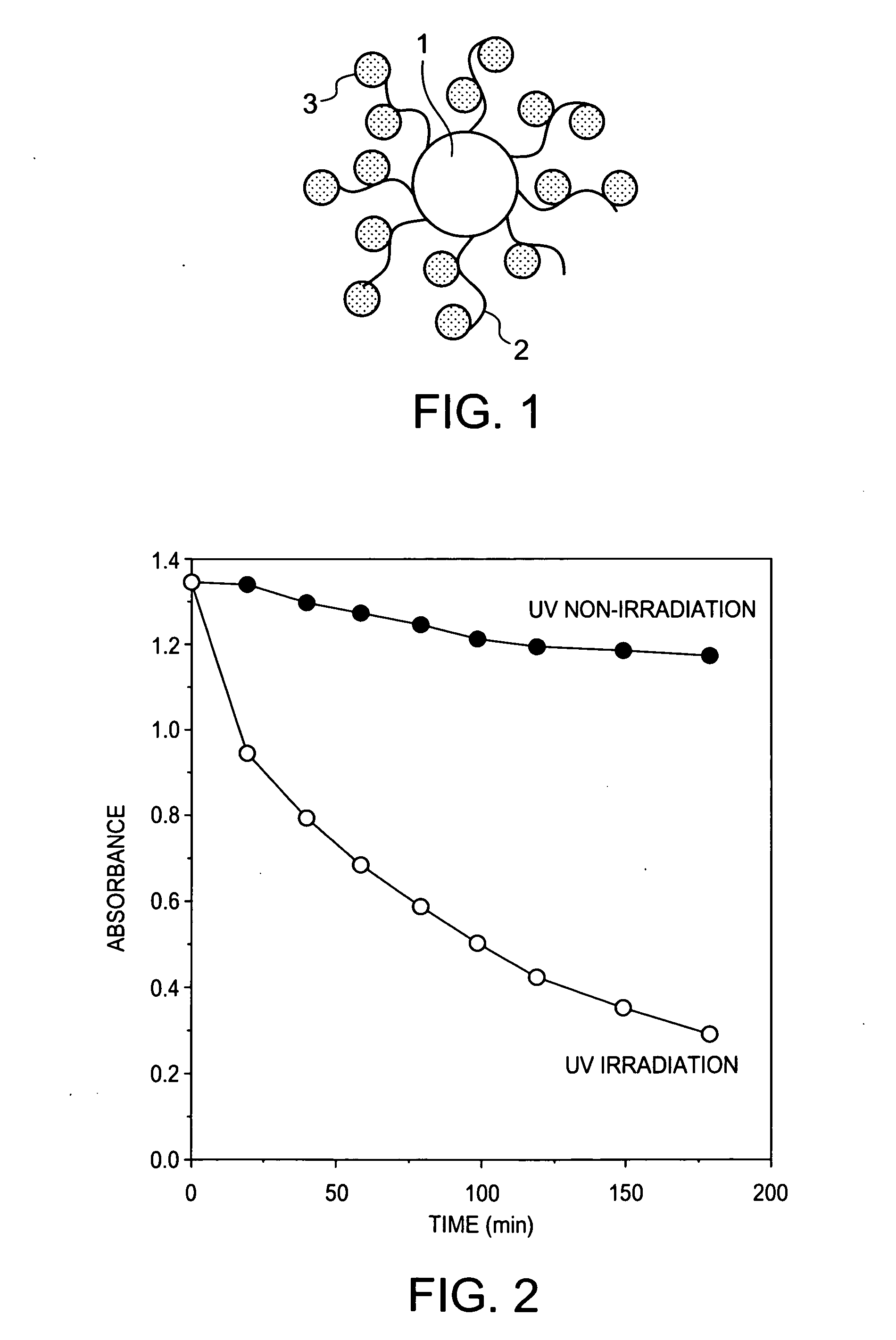
Figure 1 
Figure 2
Abstract
Description
TECHNICAL FIELD
[0001] The present invention relates to a titanium dioxide composite having a molecular recognition capacity, comprising a molecule having a binding capacity specific for endocrine disrupting chemicals, etiological substances, cancer cells and the like immobilized thereon, which titanium dioxide composite can specifically bind to these substances, molecules, and cells and can degrade them, for example, upon exposure to ultraviolet light. BACKGROUND ART
[0002] In recent years, a material is proposed as an environment cleaning material and the material comprises a biological molecule such as DNA, having a molecular recognition capacity for endocrine disrupting chemicals, immobilized on a support to impart a selective binding property has been proposed (see, for example, Japanese Patent Laid-Open No. 81098 / 2001). Further, it is known that an anatase form of titanium dioxide has photocatalytic activity, and its strong oxidizing power can degrade organic matter such as mi...
Examples
example 1
[0028] Introduction of Polyacrylic Acid into Titanium Dioxide Particles
[0029] Titanium tetraisopropoxide (3.6 g) and 3.6 g of isopropanol were mixed together, and the mixture was added dropwise to 60 ml of ultrapure water under ice cooling for hydrolysis. After the completion of the dropwise addition, the reaction solution was stirred at room temperature for 30 min. After the stirring, 1 ml of 12 N nitric acid was added dropwise thereto, and the mixture was stirred at 80° C. for 8 hr for peptization. After the completion of the peptization, the reaction solution was filtered through a 0.45-μm filter, followed by solution exchange through a desalination column (PD10; Amersham Biosciences K.K.) to prepare an anatase-form titanium dioxide sol having a solid content of 1%. This dispersion liquid was placed in a 100 ml-volume vial bottle and was ultrasonicated at 200 Hz for 30 min. The average diameter of the dispersed particles before the ultrasonication and the average diameter of the...
example 2
[0031] Immobilization of Anti-AFP Antibody Molecule on Polyacrylic Acid-Modified Titanium Dioxide Fine Particles
[0032] The polyacrylic acid-modified titanium dioxide sol (anatase form) (1 ml) prepared in Example 1 was subjected to solution exchange through a desalination column PD10 to prepare 3 ml of a polyacrylic acid-modified titanium dioxide sol dispersed in water. A mixed liquid (O.1 ml) composed of 200 mM 1-ethyl-3-(3-dimethylaminopropyl)carbodiimide and 50 mM N-hydroxysuccinimide (NHS) was added to 1.5 ml of this solution. The mixture was stirred for 10 min to activate the carboxyl groups. After the stirring, the reaction solution was subjected to solution exchange through PD10 equilibrated with a 10 mM acetate buffer solution (pH 5.0) to give 3 ml of a carboxyl-activated polyacrylic acid-modified titanium dioxide sol dispersed in a 10 mM acetate buffer solution (pH 5.0). An anti-α-fetoprotein (anti-AFP) polyclonal antibody (goat IgG, SC-8108; Cosmo-Bio Co., Ltd.) prepared u...
example 3
[0033] Immobilization of Anti-HSA Antibody Molecule on Polyacrylic Acid-Modified Titanium Dioxide Fine Particles
[0034] The polyacrylic acid-modified titanium dioxide sol (anatase form) (1 ml) prepared in Example 1 was subjected to solution exchange through a desalination column PD10 to prepare 3 ml of a polyacrylic acid-modified titanium dioxide sol dispersed in water. A mixed liquid (0.1 ml) composed of 200 mM 1-ethyl-3-(3-dimethylaminopropyl)carbodiimide and 50 mM N-hydroxysuccinimide (NHS) was added to 1.5 ml of this solution. The mixture was stirred for 10 min to activate the carboxyl groups. After the stirring, the reaction solution was subjected to solution exchange through PD10 equilibrated with a 10 mM acetate buffer solution (pH 5.0) to give 3 ml of a carboxyl-activated polyacrylic acid-modified titanium dioxide sol dispersed in a 10 mM acetate buffer solution (pH 5.0). An anti-human serum albumin (anti-HSA) monoclonal antibody (mouse IgG, MSU-304; Cosmo-Bio Co., Ltd.) pre...