
Single piece rotary wrenching tool
a rotary wrench and single-piece technology, applied in the field of single-piece rotary wrenching tools, can solve the problems of inefficient torquing ability and decrease the deformation of the fastener, and achieve the effects of reducing the number of wrenches, tightening the space, and reducing the depth of the crown
Patent Information
- Authority / Receiving Office
- US · United States
- Patent Type
- Applications(United States)
- Current Assignee / Owner
- Publication Date
- 2008-05-08
- Estimated Expiration
- Not applicable · inactive patent
Smart Images
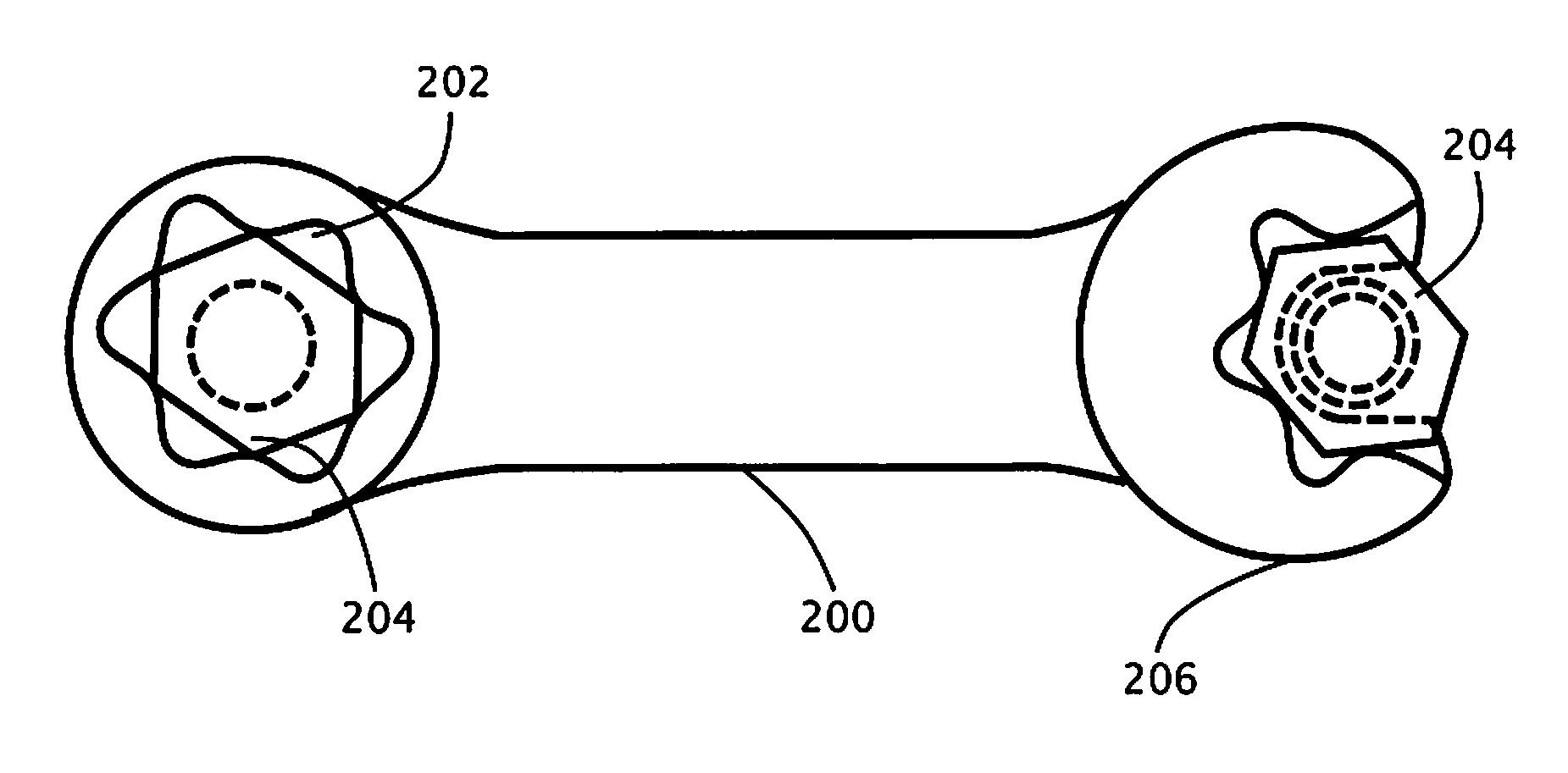
Figure 1 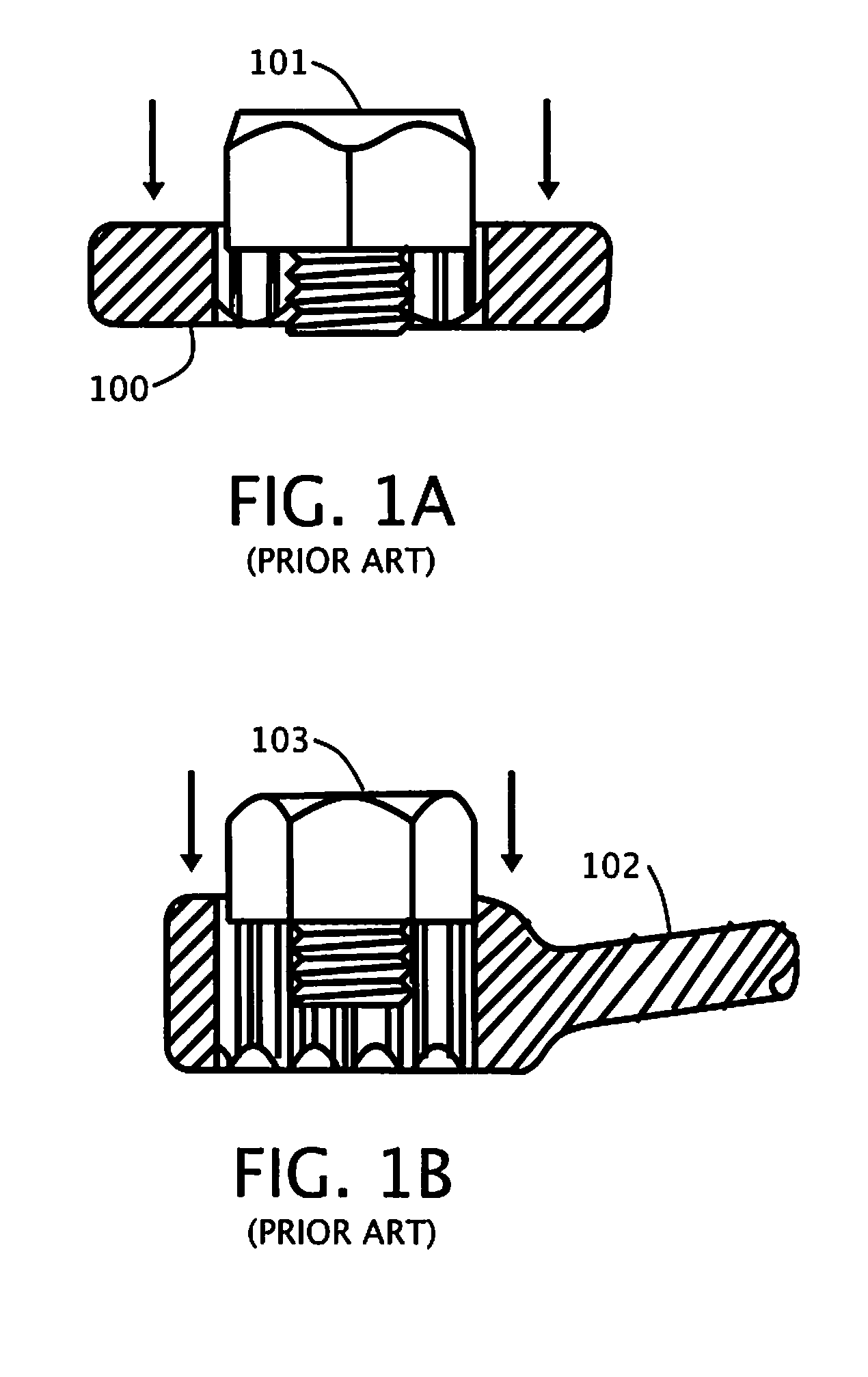
Figure 2 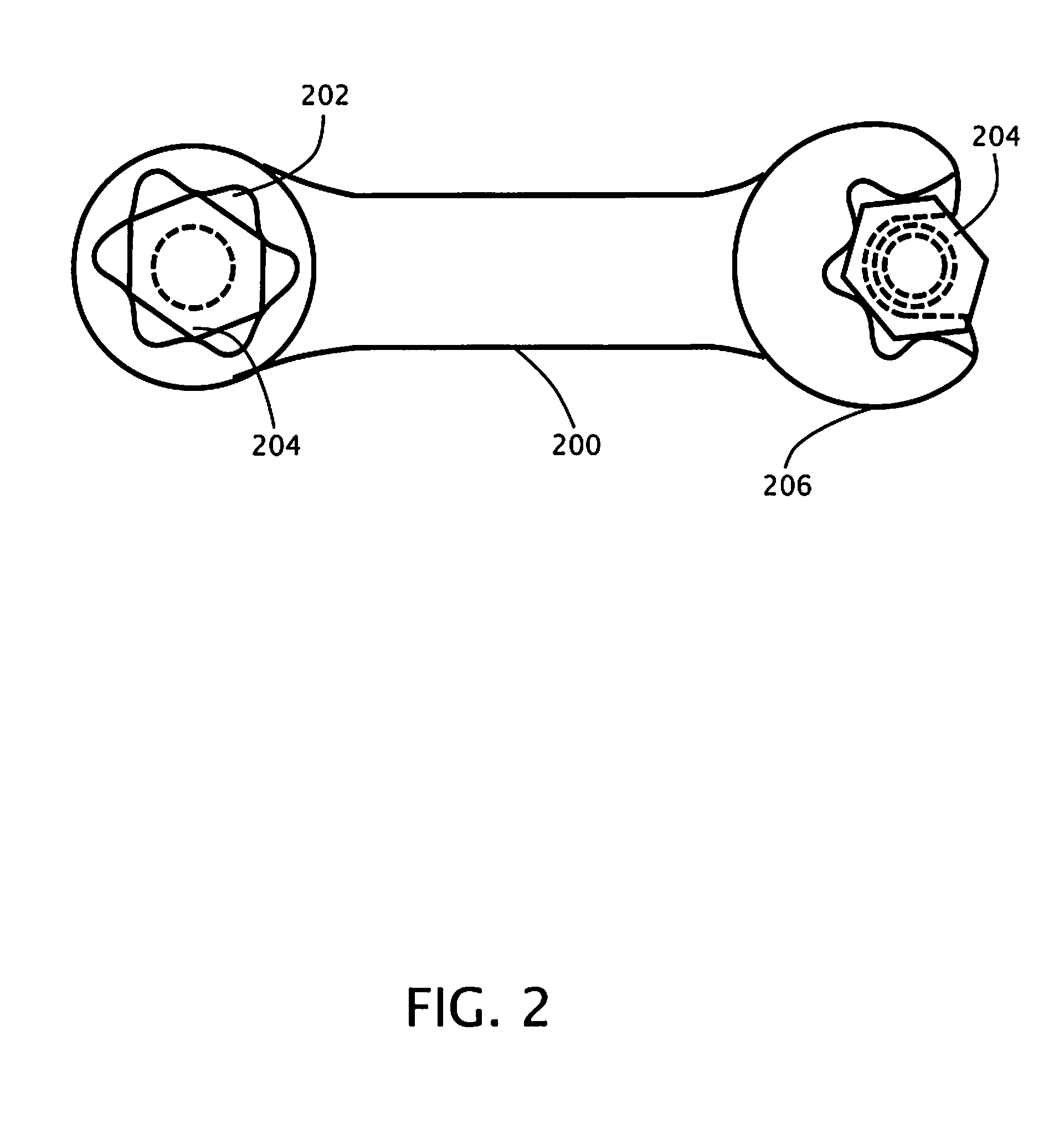
Figure 3
Abstract
Description
CROSS REFERENCE TO RELATED APPLICATIONS
[0001] The present application claims priority to U.S. provisional patent application No. 60 / 797,190 filed May 2, 2006, which is incorporated by reference in its entirety.BACKGROUND OF THE INVENTION
[0002] For many years, traditional wrenches have been widely used. Traditional wrenches are frequently found inconvenient, inefficient, cumbersome and new wrenches are highly demanded. For instance, wrenches having closed openings with planar engagement surfaces often result in the stress applied to the hexagonal fastener and thus cause deformation of the fastener and inefficient torquing ability. In order to overcome the problems, prior art wrenches having closed openings with curved engagement surfaces were invented. U.S. Pat. No. 4,930,378 Colvin. Although the prior art wrenches are constructed six-point or twelve-point versions, problems with distributing the stresses are not resolved. Furthermore, the twelve-point version is only on either metric ...
Examples
Embodiment Construction
[0024]FIG. 1A depicts a traditional open end wrench. A traditional open end wrench 100 slips by when the user applies it on a hex fastener 101.
[0025]FIG. 1B depicts a traditional box wrench. A traditional box wrench 102 makes a partial contact with a hex fastener 103.
[0026]FIG. 2 illustrates a schematic view of a duplex open wrench 200 according to one embodiment of the present invention. In FIG. 2, six inwardly projecting lobes of the same size 202 within a uniform interior of the duplex wrench 200 enable the wrench 200 to exert pressure on the flats of hexagonal object 204 away from the flats. The crown 206 in the duplex open wrench has four faces to contact the hexagonal object 204 and thus distributes the stresses over four hex flats of hexagonal object 204.
[0027]FIG. 3 illustrates a schematic view of a duplex box wrench according to one embodiment of the present invention. A wrench with a two-sided crown 300, a tapered internal guide 302, a head 304, and a shank 306 are disclos...