
Hybrid polymer electrolyte, a lithium secondary battery comprising the hybrid polymer electrolyte and their fabrication methods
a polymer electrolyte and hybrid technology, applied in the direction of wound/folded electrode electrodes, cell components, non-metal conductors, etc., can solve the problems of battery instability, inconvenient fabrication process, restriction of battery shape, etc., to achieve good mechanical strength, good low- and high-temperature characteristics, good adhesion with electrodes
Patent Information
- Authority / Receiving Office
- US · United States
- Patent Type
- Applications(United States)
- Current Assignee / Owner
- Publication Date
- 2009-01-29
- Estimated Expiration
- Not applicable · inactive patent
Smart Images
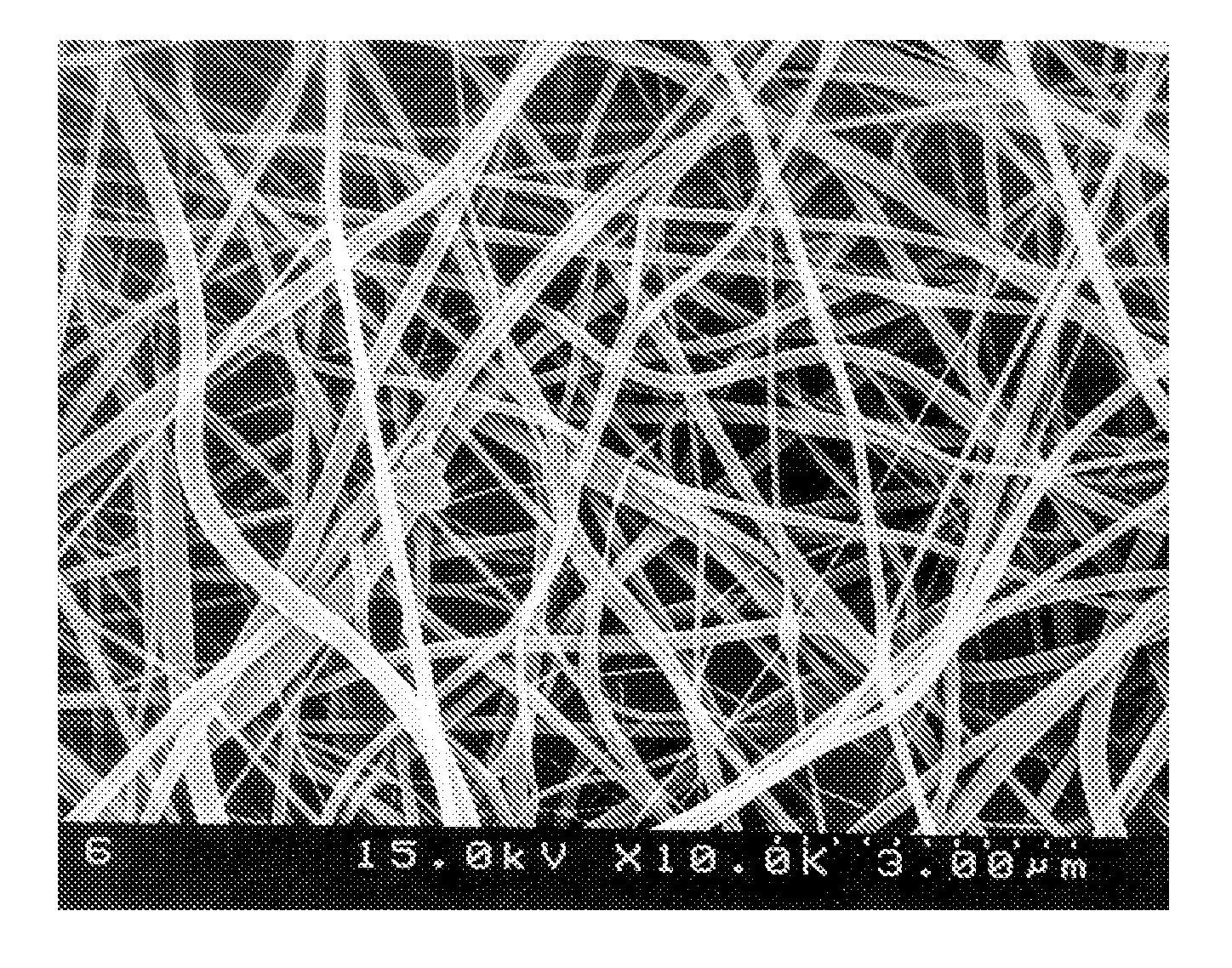
Figure 1 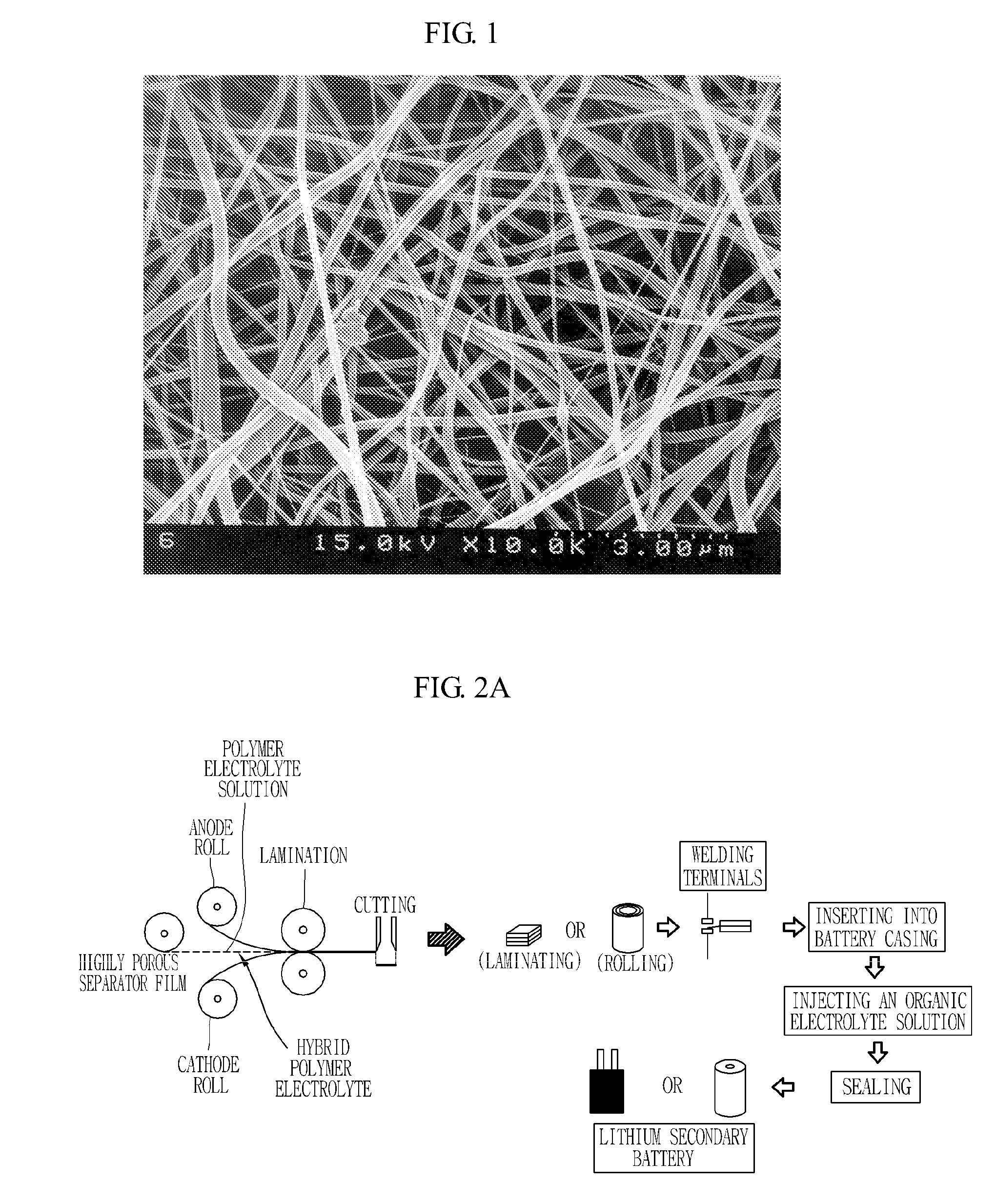
Figure 2 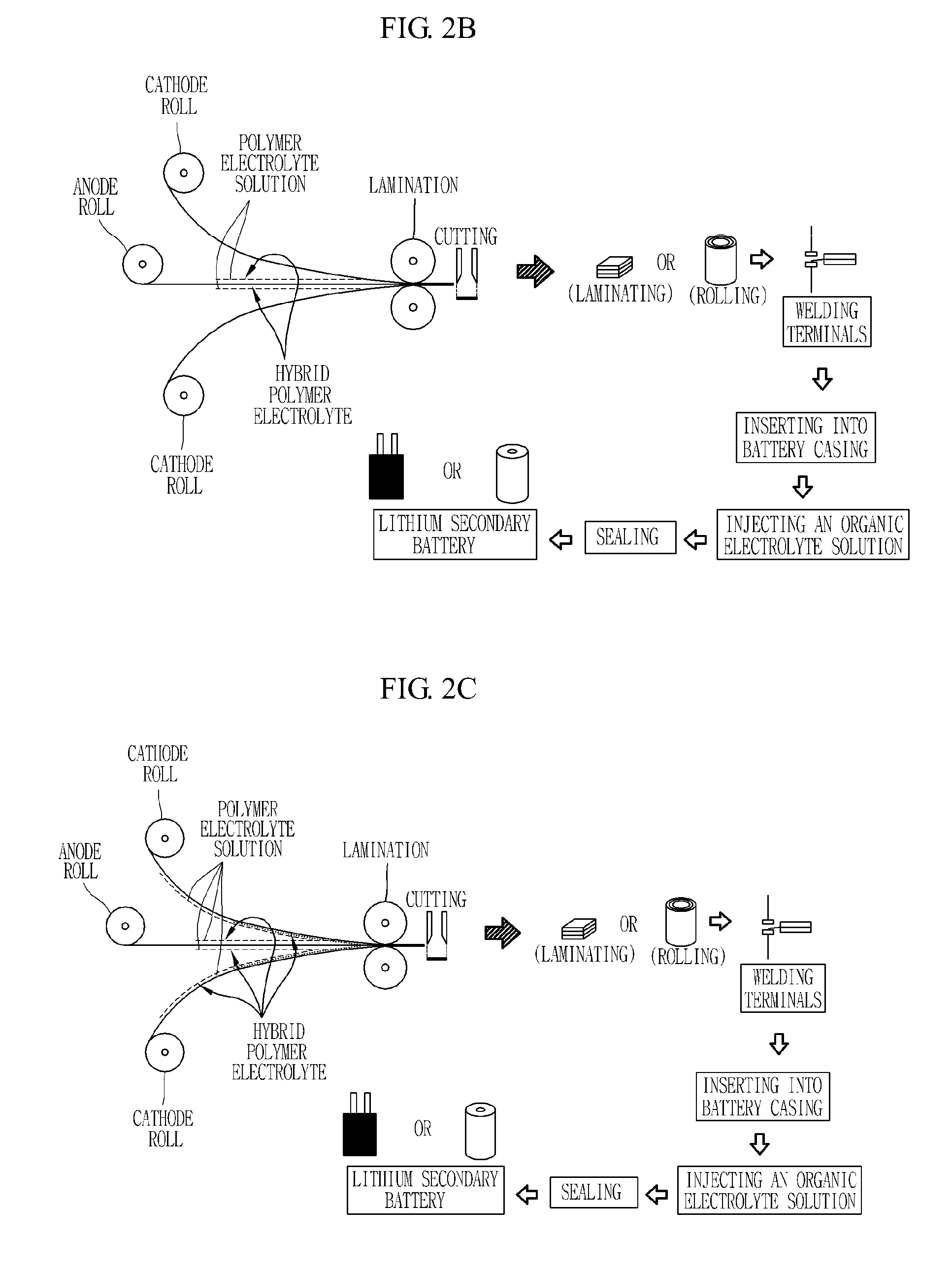
Figure 3
Abstract
Description
TECHNICAL FIELD
[0001] The present invention relates to a hybrid polymer electrolyte, a lithium secondary battery using the same, and to the fabrication method thereof.BACKGROUND ART
[0002] Lithium secondary batteries are typified by a lithium ion battery and a lithium polymer battery. A lithium ion battery uses a polyethylene (hereinafter referred to as “PE”) or polypropylene (hereinafter referred to as “PP”) separator film besides an electrolyte. In the fabrication of the lithium ion battery, because it is difficult to fabricate the battery by laminating electrodes and separator films in a flat-plate shape, it is fabricated by rolling the electrodes and separator films, and then inserting the rolled electrodes and separator films into a cylindrical or rectangular casing (D. Linden, Handbook of Batteries, McGraw-Hill Inc., New York (1995)). The lithium ion battery was developed by SONY Company in Japan at first and has been widely used all over the world; however, it has problems such ...
Examples
example 1
[0037]1-1) Fabrication of a Porous Polymer Matrix
[0038]20 g of polyvinylidenefluoride (Kynar 761) was added to 100 g of dimethylacetamide, and the resulting mixture was stirred at room temperature for 24 hours to give a clear polymeric solution. The resulting polymeric solution was filled into the barrel of an electrospinning apparatus and discharged onto a metal plate at a constant rate using a nozzle charged with 9 kV, to fabricate a porous polymer matrix film having a thickness of 50 μm.
[0039]1-2) Fabrication of a Hybrid Polymer Electrolyte
[0040]0.5 g of PAN (prepared by Polyscience Company, molecular weight of about 150,000), 2 g of PVdF (Atochem Kynar 761) and 0.5 g of PMMA (prepared by Polyscience Company) were added to a mixture of 15 g of 1M LiPF6 solution in EC-DMC and 1 g of DMA solution (as a plasticizer), and the resulting mixture was blended for 12 hours. After blending, the resulting mixture was heated at 130° C. for one hour to give a clear polymer electrolyte solutio...
example 2
[0043]2-1) 20 g of polyvinylidenefluoride (Kynar 761) was added to 100 g of dimethylacetamide, and the resulting mixture was stirred at room temperature for 24 hours to give a clear polymeric solution. The resulting polymeric solution was filled into the barrel of an electrospinning apparatus and discharged onto both sides of a graphite anode at a constant rate using a nozzle charged with 9 kV, to fabricate a graphite anode coated with a porous polymer matrix film having a thickness of 50 μm.
[0044]2-2) 0.5 g of PAN (prepared by Polyscience Company, molecular weight of about 150,000), 2 g of PVdF (Atochem Kynar 761) and 0.5 g of PMMA (prepared by Polyscience Company) were added to a mixture of 15 g of 1M LiPF6 solution in EC-DMC and 1 g of DMA solution (as a plasticizer). The resulting mixture was blended for 12 hours and then heated at 130° C. for one hour to give a clear polymer electrolyte solution. When a viscosity of several thousands cps suitable for casting was obtained, the r...
example 3
[0046]3-1) 20 g of polyvinylidenefluoride (Kynar 761) was added to 100 g of dimethylacetamide, and the mixture was stirred at room temperature for 24 hours to give a clear polymeric solution. The resulting polymeric solution was filled into the barrel of an electrospinning apparatus and discharged onto one side of a LiCoO2 cathode at a constant rate using a nozzle charged with 9 kV, to fabricate a LiCoO2 cathode coated with a porous polymer matrix film having a thickness of 50 μm on one side of it.
[0047]3-2) 0.5 g of PAN (prepared by Polyscience Company, molecular weight of about 150,000), 2 g of PVdF (Atochem Kynar 761) and 0.5 g of PMMA (prepared by Polyscience Company) were added to a mixture of 15 g of 1M LiPF6 solution in EC-DMC and 1 g of DMA solution (as a plasticizer). The resulting mixture was blended for 12 hours and then heated at 130° C. for one hour to give a clear polymer electrolyte solution. When a viscosity of several thousands cps suitable for casting was obtained,...