
Men1 gene for diagnosis and treatment of diabetes
a technology of men1 and diabetes, applied in the field of men1 gene for diagnosis and treatment of diabetes, can solve the problems of difficult to study the acute effect of deletion of men1 on the proliferation of pancreatic islet cells, the state of impaired glucose tolerance develops, and the difficulty of determining how to achieve the effect of reducing blood sugar level and increasing insulin production
Patent Information
- Authority / Receiving Office
- US · United States
- Patent Type
- Applications(United States)
- Current Assignee / Owner
- Publication Date
- 2009-07-16
Smart Images
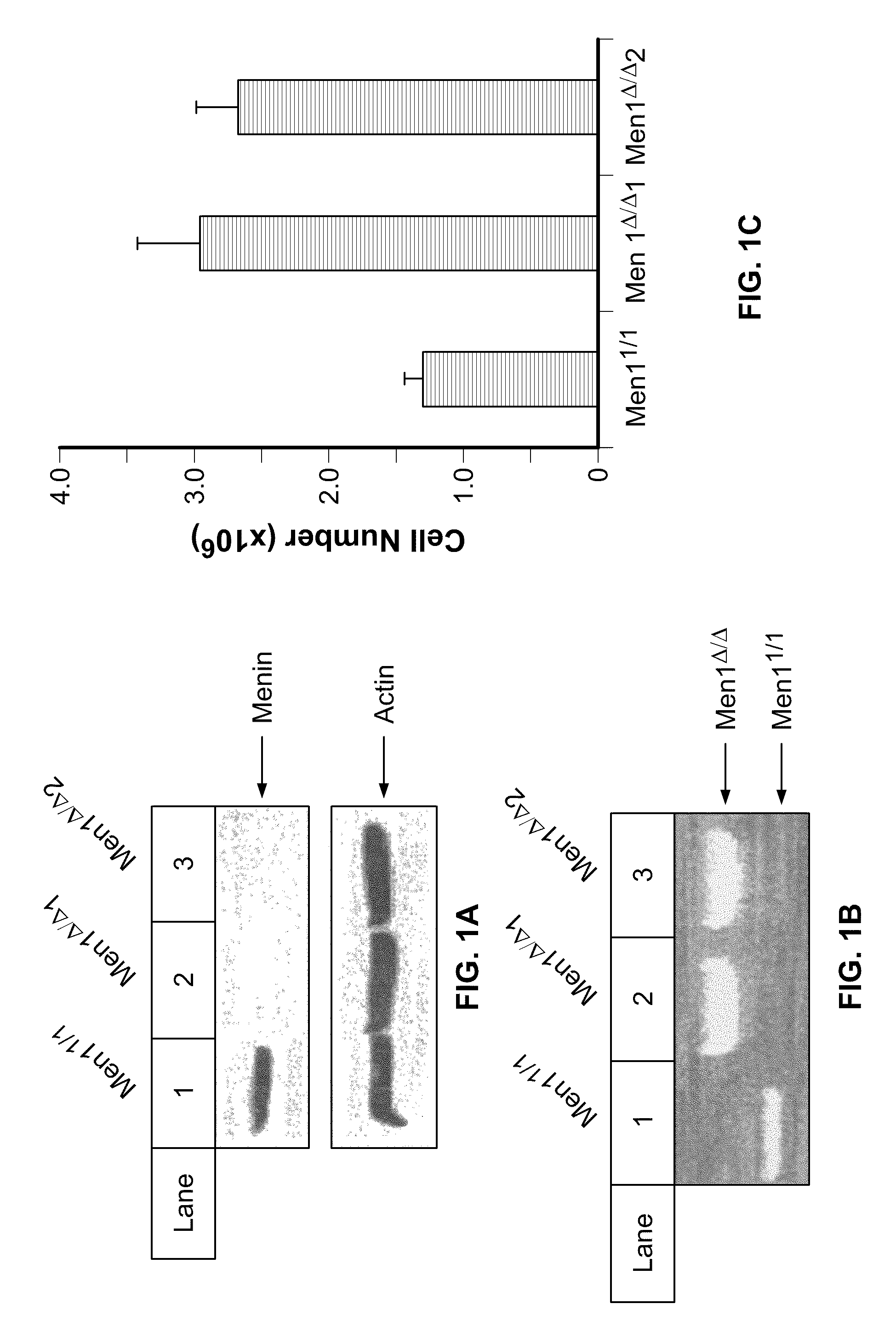
Figure 1 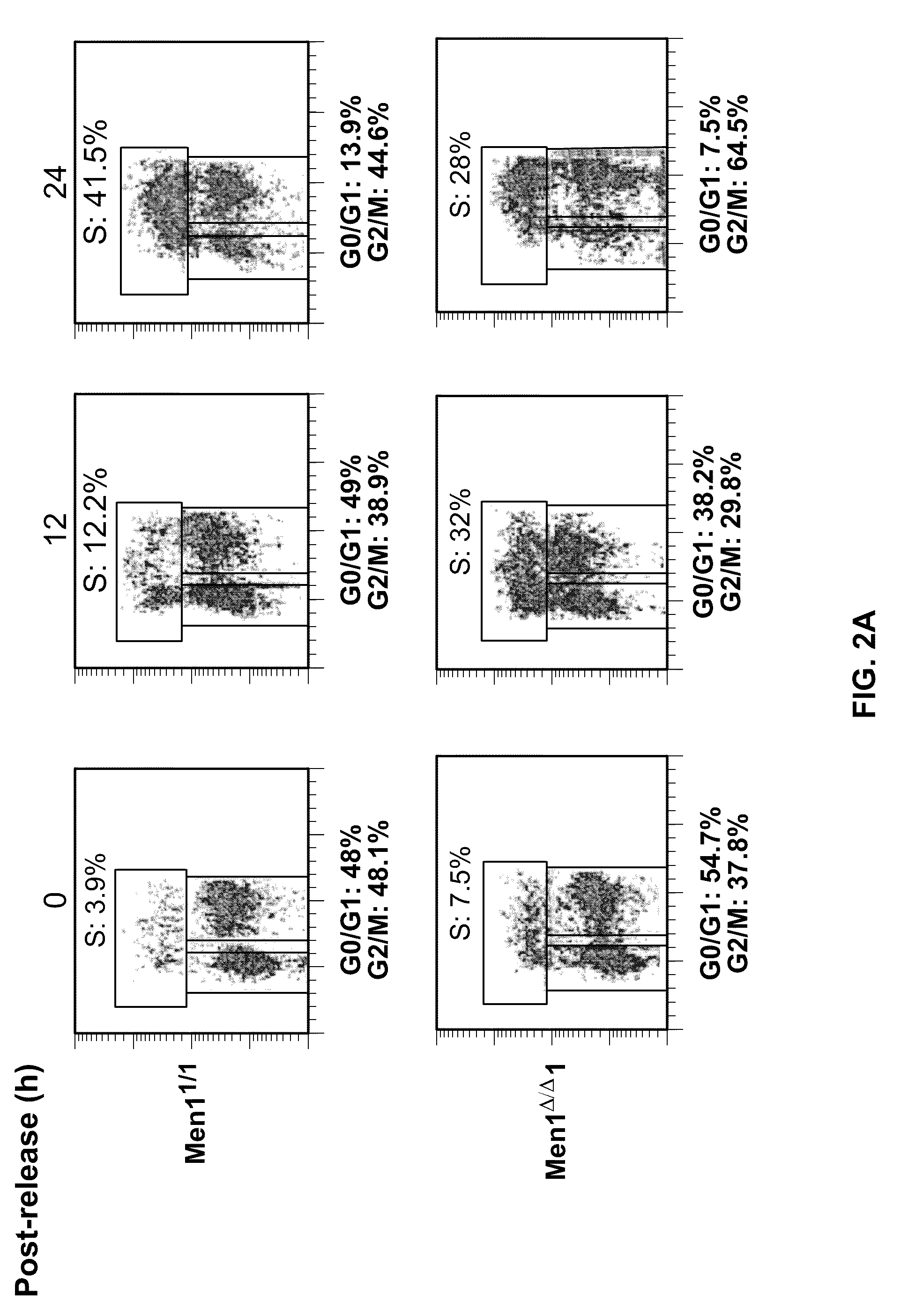
Figure 2 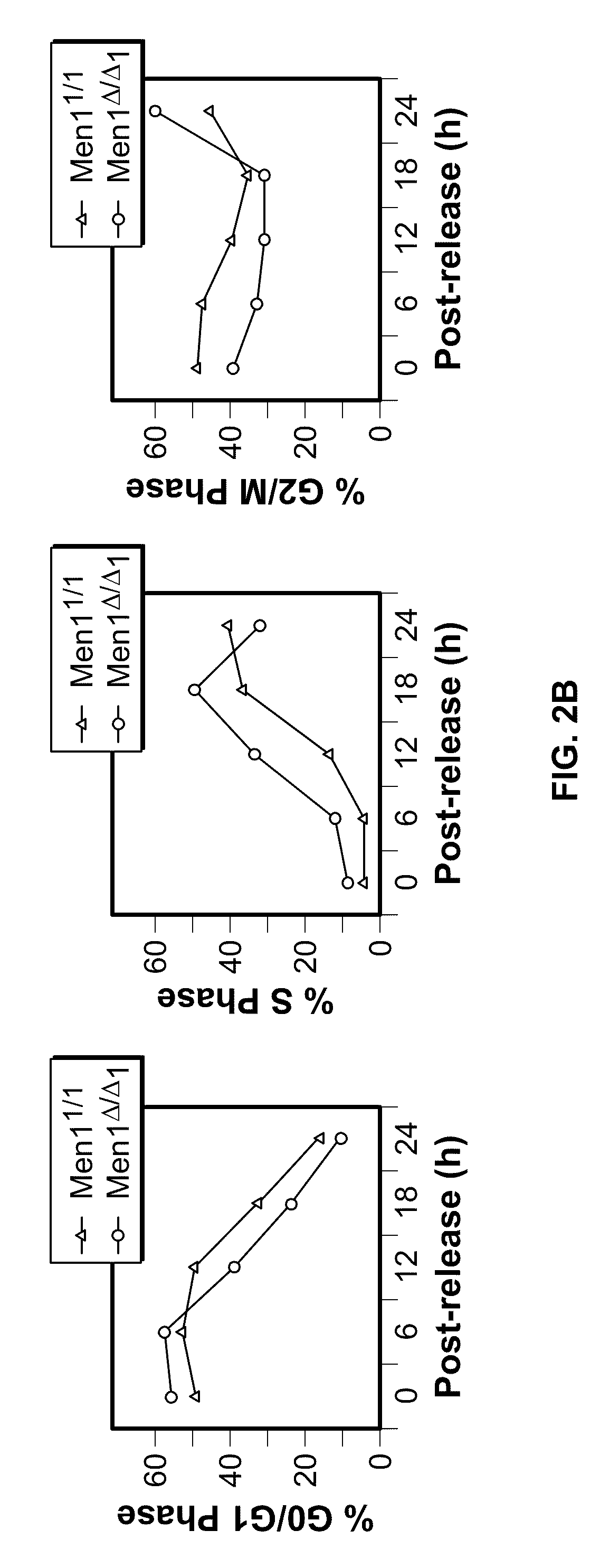
Figure 3
Abstract
Description
CROSS REFERENCE TO RELATED APPLICATIONS
[0001] This application is a Continuation-In-Part of PCT International Application No. PCT / US07 / 12557, International Filing Date May 29, 2007, claiming priority of United States Provisional Patent Applications, 60 / 808,556, filed May 26, 2006, and 60 / 881,153, filed Jan. 19, 2007, all which are incorporated herein by reference in their entirety.FIELD OF INVENTION
[0002] This invention is directed to the role of Men1 gene in the treatment of diabetes. Specifically, the invention relates to the inhibition of expression or function of Men1 gene or its encoded proteins including menin for the purpose of treating diabetes and screening and researching agents capable of inhibiting expression or function of Men1 gene or its encoded proteins for use in treating diabetes.BACKGROUND OF THE INVENTION
[0003] Diabetes mellitus (DM) describes several syndromes of abnormal carbohydrate metabolism, characterized by hyperglycemia. It is associated with a relative or a...
Examples
example 1
Ablation of Men1In Vitro Increases Cell Proliferation and Transition from G0 / G1 to S Phase
[0142]MEFs from mouse embryos were immortalized with the floxed Men1 using the 3T9 protocol, and then infected the cells with recombinant adenoviruses expressing either GFP (Ad-GFP) or Cre (Ad-Cre) that could excise the floxed Men1 from the genome. The cell lysates from the infected cells were subjected to Western blotting analysis. Ad-Cre (lanes 2 and 3), but not Ad-GFP (lane 1), abrogated expression of menin (FIG. 1A). Men1 excision was also confirmed by genotyping (FIG. 1B) because Men1 excision yielded a PCR fragment of the increased size. The Men1Δ / Δ1 cells and the Men1Δ / Δ2 cells, two independent pools of the MEFs infected by Ad-Cre, proliferated more quickly than the menin-expressing Men11 / 1 cells (2.7 and 2.9×10⁶ versus 1.3×10⁶ cells; P1 / 1 versus Men1Δ / Δ1; P1 / 1 versus Men1Δ / Δ2; FIG. 1C). To further confirm this difference in cell proliferation in vitro, Men11 / 1 was excised from one addit...
example 2
Ablation of Men1Increases Cdk2 Activity But Decreases p18Ink4c and p27Kip1 RNA and Protein Levels
[0144]The cell cycle is positively regulated by various CDKs and CDK2 plays a crucial role in controlling G0 / G1 to S transition. Thus, a determination whether menin inhibits CDK2 activity was made. Lysates from Men11 / 1 cells and Men1Δ / Δ1 cells, at various time points of cell cycle progression, were immunoprecipitated with an anti-CDK2 antibody, and the precipitated kinase activity was detected using histone H1 as a substrate. FIG. 3A (top) shows that CDK2 activity, as indicated by the amount of phosphorylation of histone H1, increased after Men1 was excised (lanes 5-7). Quantification of phosphorylation shows that the CDK2 activity was 2-fold higher in Men1Δ / Δ1 cells than in Men11 / 1 cells at each corresponding time point (FIG. 3A, bottom). Menin expression did not alter the phosphorylation of the inhibitory Y15 residue nor the activating T160 residue of CD 2 This result suggests that los...
example 3
Complementation of Men1Δ / Δ1 Cells with Wild-Type Menin Inhibits Cell Proliferation and G0 / G1 to S Phase Progression and Restores p18Ink4c and p27Kip1 Protein and RNA Levels
[0146]If Men1 excision leads to enhanced cell proliferation and G0 / G1 to S phase transition, complementation of menin-null cells with menin should suppress cell proliferation and G0 / G1 to S phase progression. Thus, Men1Δ / Δ1 cells was infected with control vector retroviruses or retroviruses encoding wild-type menin, and the resulting cells were monitored for cell growth, expression of p18Ink4c and p27Kip1, and G0 / G1 to S progression. By day 4, there were 2.5×10⁶ vector-complemented cells versus 1.3×10⁶ menin-complemented cells (FIG. 4A); these differences were significant (PInk4c and p27Kip1 was higher in menin-complemented cells than in vector complemented cells at both the protein and mRNA (FIGS. 4B and C) levels, consistent with a previous report that menin is crucial for optimal expression of p27Kip1 (PInk4c (...