
Ouput Torque Modulation Control of a Transmission in a Hybrid Electric Vehicle
a technology of transmission and modulation control, applied in the field of powertrain, can solve the problems of severe deformation of shift quality, driveline disturbance, and driveline disturbance, and achieve the effect of avoiding crankshaft torque reduction delays, optimum shift quality, and accurate torque modulation
Patent Information
- Authority / Receiving Office
- US · United States
- Patent Type
- Applications(United States)
- Current Assignee / Owner
- Publication Date
- 2009-12-31
Smart Images
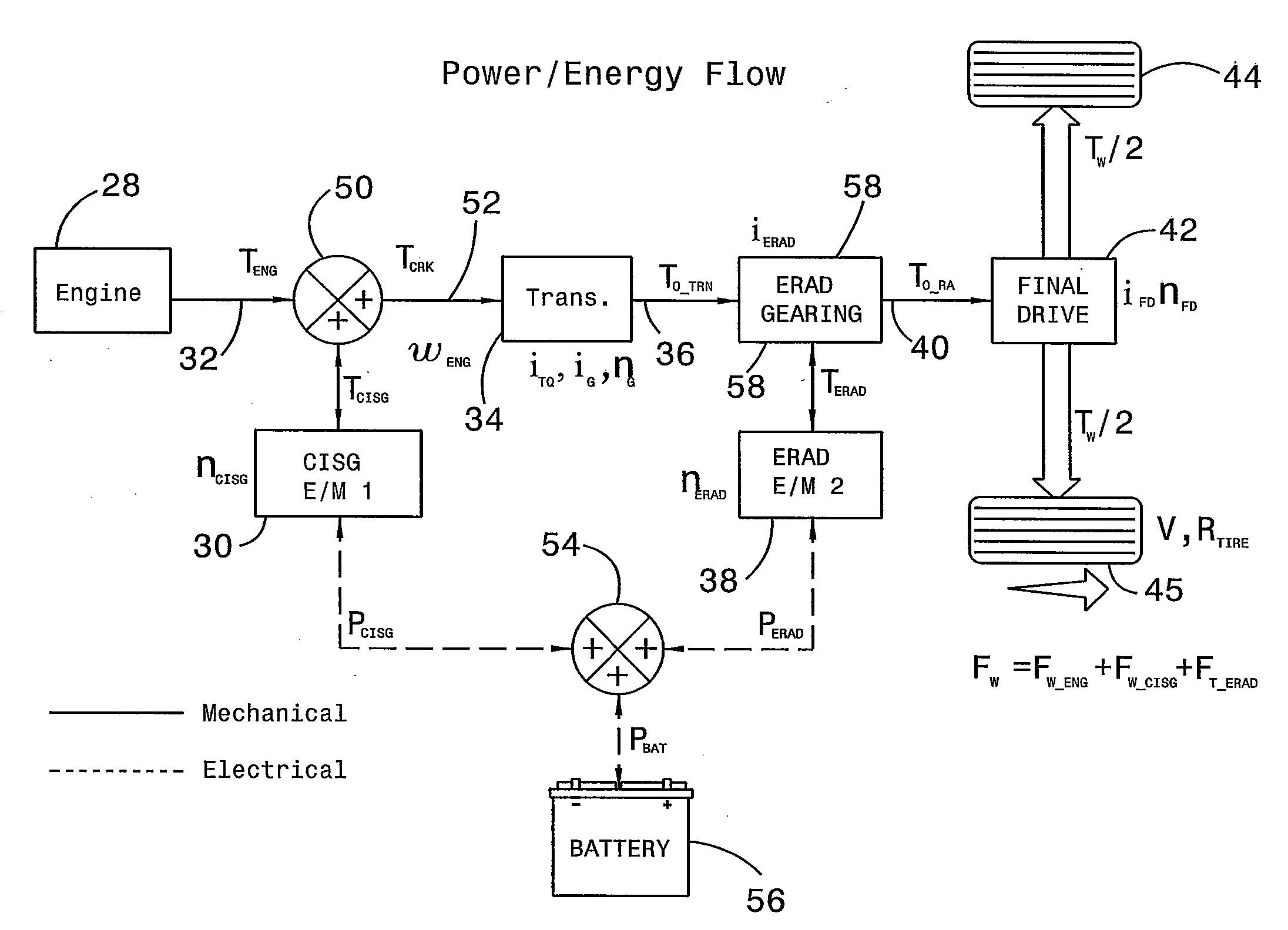
Figure 1 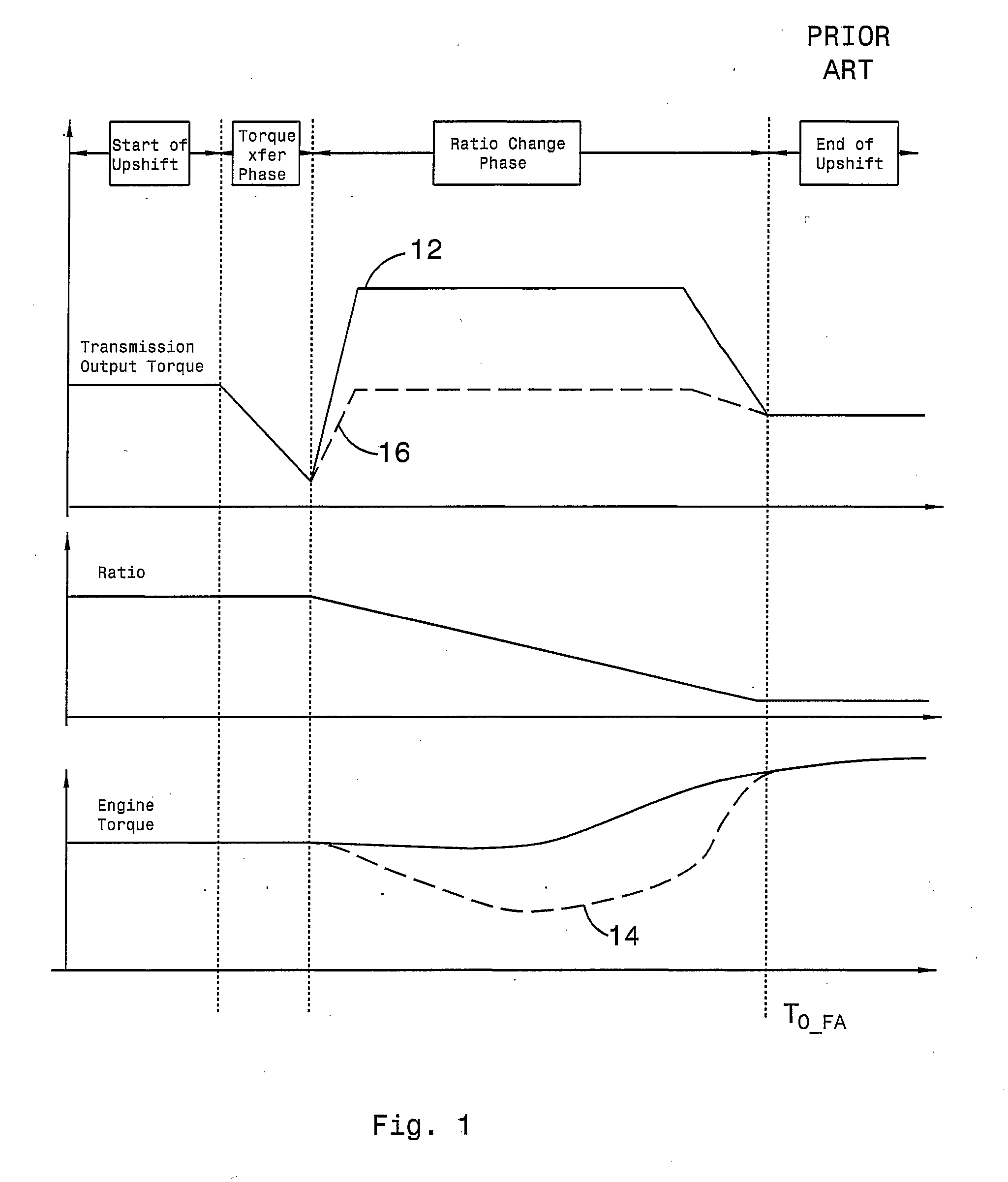
Figure 2 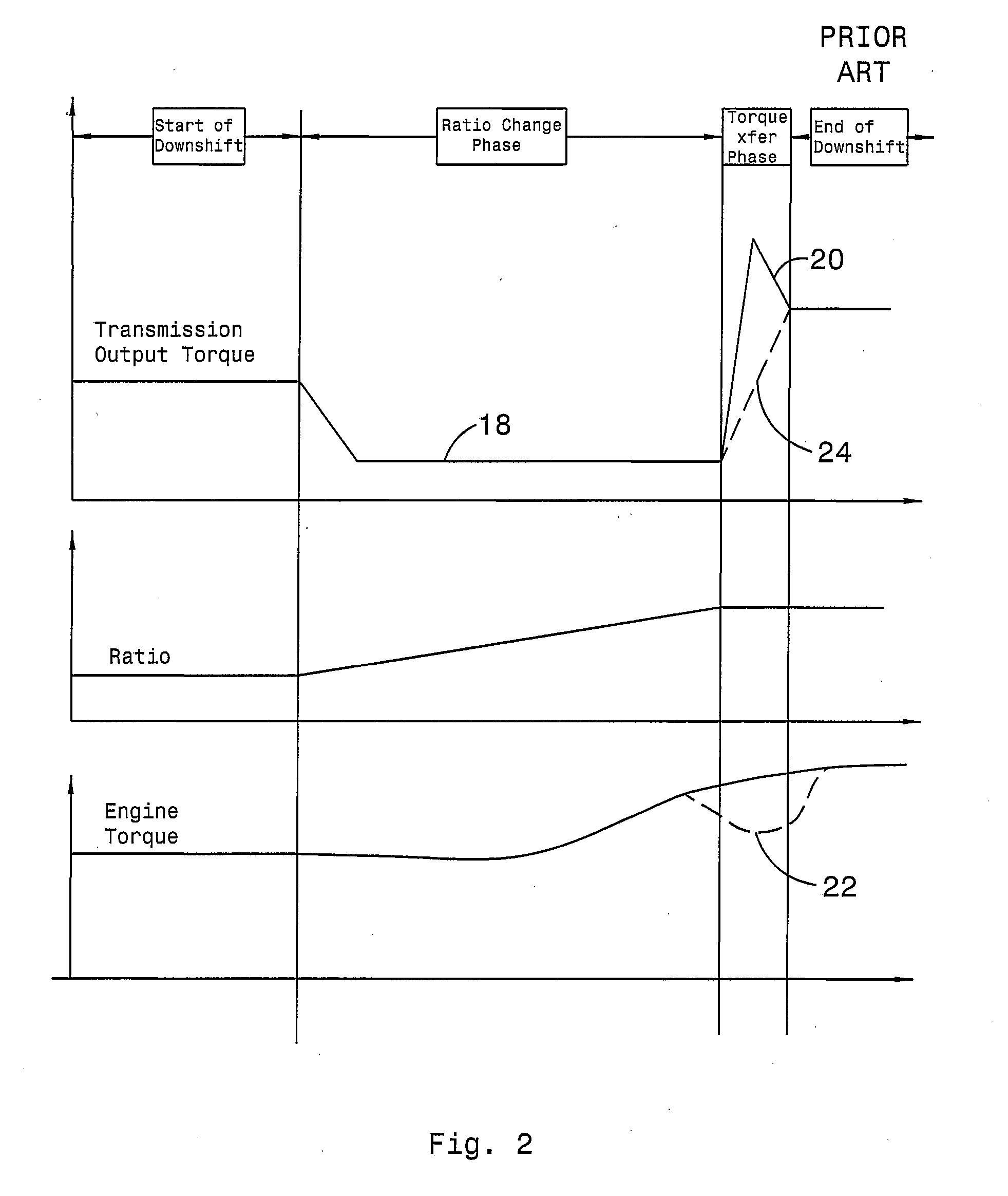
Figure 3
Abstract
Description
BACKGROUND OF THE INVENTION
[0001] 1. Field of the Invention
[0002] This invention relates generally to a powertrain for a hybrid electric vehicle (HEV), and in particular to controlling torque transmitted by the output of the powertrain to the vehicle wheels while executing a gear shift.
[0003] 2. Description of the Prior Art In a conventional vehicle with a fixed-ratio transmission, the driver can experience driveline disturbances during a transmission shift event, i.e., an upshift or a downshift. The driveline disturbances occur due to the acceleration and deceleration of engine and transmission components, which acceleration and deceleration produce an inertial torque during the shift event. In the case of an upshift, the transmission output torque increases during the ratio change phase, i.e., inertia phase, of the shift as a result of the engine speed changing, as shown in FIG. 1 at point 12. This output torque disturbance is felt by the vehicle's occupants and severely degrades shi...
Examples
Embodiment Construction
[0024]FIG. 3 illustrates a powertrain 26 for a hybrid electric vehicle that includes an internal combustion engine (ICE) 28, preferably an Atkinson cycle ICE; a first electric machine 30, preferably a crank integrated starter generator (CISG)driveably connected to the engine crankshaft 32 and able to function alternately as a motor and a generator; a fixed-ratio automatic transmission 34, a second electric machine 38 such as an electric rear axle drive (ERAD) or electric front axle drive (EFAD) driveably connected to transmission output shaft 36 and able to function alternately as a motor and a generator; adriveline output shaft 40, driveably connected to the second electric machine 38; a differential mechanism 42; and wheels 44, 45, driveably connected to the differential 42.
[0025]During a transmission shift event, the electric machine 38 that is coupled to the transmission output can be controlled to achieve accurately the transmission torque modulation request and reduce the driv...