

Solutions of anhydrous lanthanide salts and its preparation
Patent Information
- Authority / Receiving Office
- US · United States
- Current Assignee / Owner
- Publication Date
- 2009-12-31
Smart Images

Figure 1 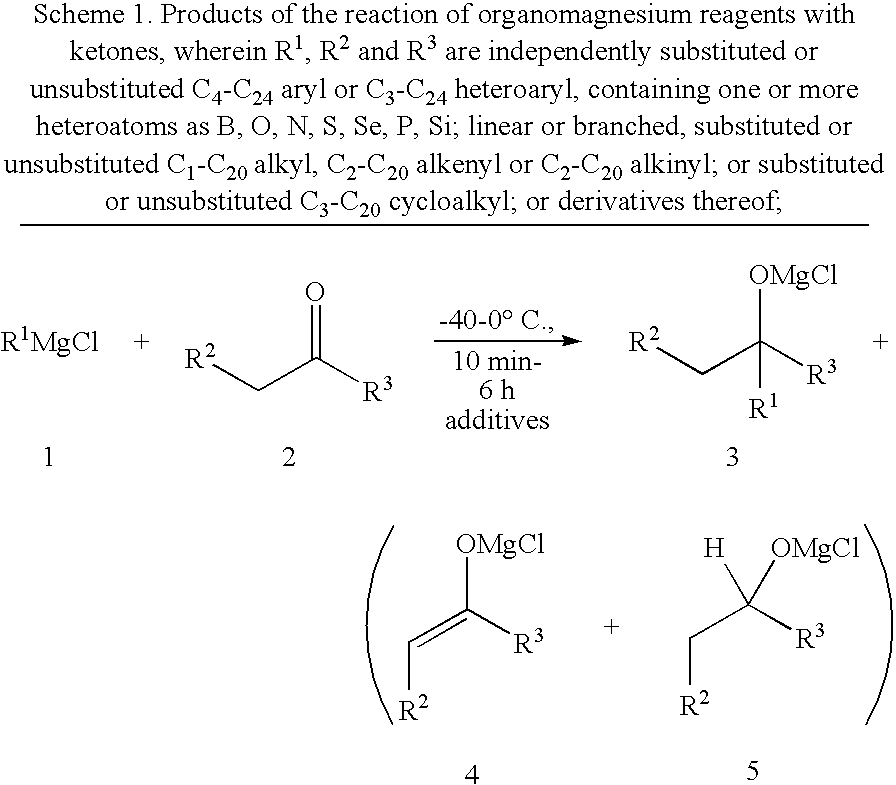
Figure 2 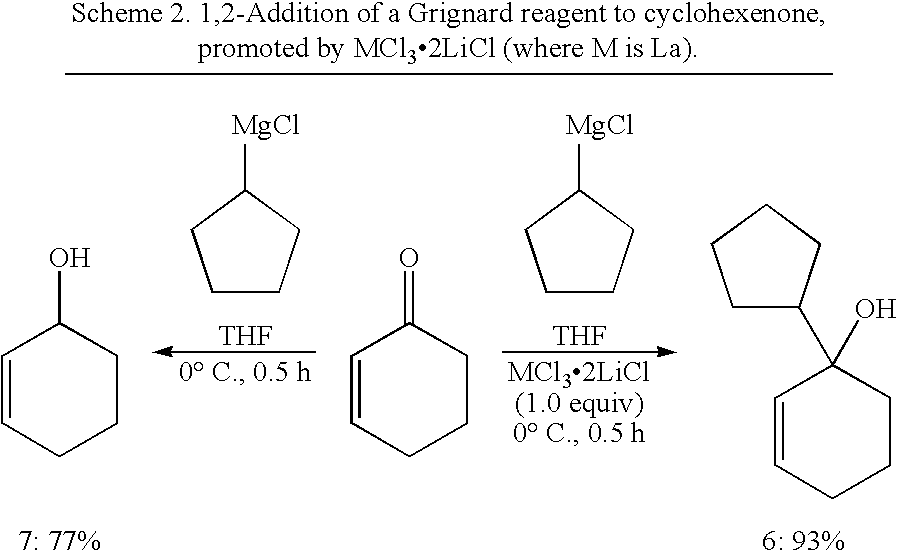
Figure 3
Abstract
Description
[0001] The present application relates to anhydrous solutions of lanthanide salts, its preparation and its use.
[0002] Lanthanide(III) salts have been intensively used to activate carbonyl compounds or imine derivatives towards the 1,2-addition of organometallics.[1a] The oxophilic nature of lanthanide salts favors the 1,2-addition reaction comparatively to competitive reactions such as enolization or reduction (by β-hydride transfer).[2a] The 1,2-addition of complex hydrides to carbonyl functions can also be promoted and the presence of lanthanide salts can dramatically reduce competitive reduction e.g. of double bonds.[2d,e] Further applications were published on the field of lewis acid catalyzed cycloaddition reactions.[1b] The activity of the catalyst strongly depends on its drying[3] and especially on its solubility.[4] Only few lanthanide salts are soluble in appreciable amounts in organic solvents.[5]
[0003] So far, the Imamoto method (using CeCl3) was used to promote the addition...
Examples
example 1
Preparation of a Solution of LaCl3.2LiCl in THF
[0041]In a round bottom flask commercially available LaCl3.6H2O (0.10 Mol, 35.3 g) was mixed with LiCl (0.20 Mol, 8.40 g) and water (100 mL) was slowly added with vigorous stirring. The resulting slurry was stirred in high vacuum (0.01 mm Hg) at RT for 4 h. Stirring was continued 4 h at 40° C., 4 h at 60° C., 4 h at 80° C., 4 h at 100° C., 4 h at 120° C., 4 h at 140° C. and finally 4 h at 160° C. The slow increase of temperature and highly efficient stirring are essential. The resulting solid was cooled to room temperature and THF was added until a total volume of 333 mL was reached. Then, molecular sieves (4 Å) were added and the resulting mixture was stirred vigorously for 1d at RT. Finally, all unsoluble material (mostly crushed molecular sieves) was filtered over a combined filter system (fresh molecular sieves / paper) under an argon atmosphere. By this procedure, a clear and colorless solution of LaCl3.2LiCl was obtained that was st...
example 2
General Procedure for the Reactions with Ketones and Imines (A)
[0044]In a flame dried, argon-flushed Schlenk tube equipped with a septum and a magnetic stirring bar was placed LaCl3.2LiCl in THF (0.33 M; 6.06 mL, 2.00 mmol, 1.00 equiv; In the case of imines, only 10 mol-% of LaCl3.2LiCl in THF were used the missing volume was filled up with absolute THF). The ketone (2.00 mmol) was added neat and the resulting mixture was stirred for 1 h at RT. The reaction mixture was cooled to 0° C. and the Grignard reagent (solution in THF, 2.10 mmol, 1.05 equiv.) was added dropwise and the reaction mixture was allowed to stir at the same temperature. The reaction conversion was monitored by GC-analysis of reaction aliquots. After a complete conversion was reached, sat. aq. NH4Cl (2 mL) and water (2 mL) was added. The aqueous layer was extracted with ether (4×10 mL), the combined extracts were dried (Na2SO4) and evaporated in vacuo. The crude residue was purified by flash column chromatography.
example 3
General Procedure for the Reactions with Ketones (B)
[0045]In a flame dried, argon-flushed Schlenk tube equipped with a septum and a magnetic stirring bar was placed LaCl3.2LiCl in THF (0.33 M; 6.06 mL, 2.00 mmol, 1.00 equiv) at 0° C. Then, the Grignard reagent (solution in THF, 2.10 mmol, 1.05 equiv.) was added dropwise and the mixture was allowed to stir at the same temperature for 1 h. The ketone (2.00 mmol) was then added neat and the resulting mixture was allowed to warm up to 25° C. and stirred for 1 h at this temperature. The reaction conversion was monitored by GC-analysis of reaction aliquots. After a complete conversion was reached, sat. aq. NH4Cl (2 mL) and water (2 mL) was added. The aqueous layer was extracted with ether (4×10 mL), the combined extracts were dried (Na2SO4) and evaporated in vacuo and the crude residue was purified by flash column chromatography.
TABLE 1Comparative reactions of ketones 2 with Grignard reagents 1 without additives andin the presence of CeCl...