
Polyhedral polysiloxane modified product and composition using the modified product
Patent Information
- Authority / Receiving Office
- US · United States
- Current Assignee / Owner
- Publication Date
- 2010-04-22
Smart Images
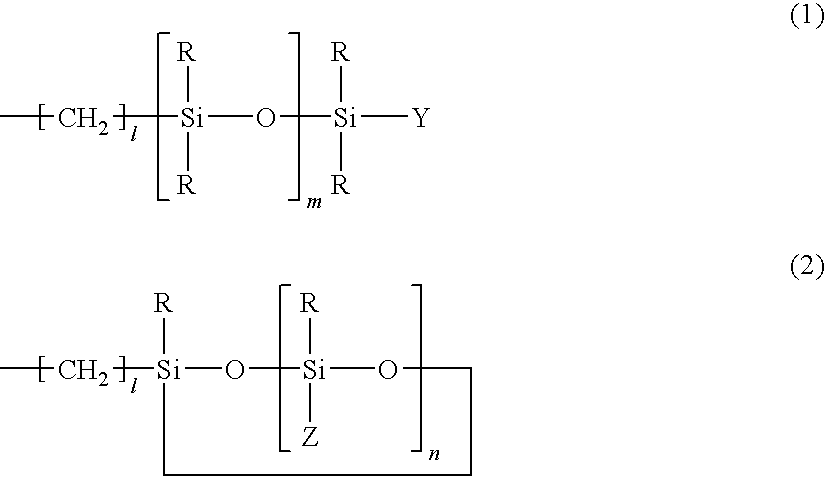
Figure 1 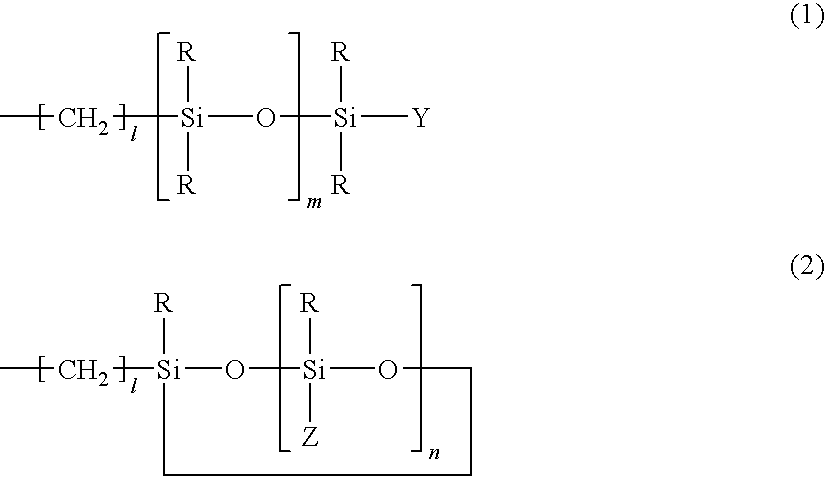
Figure 2 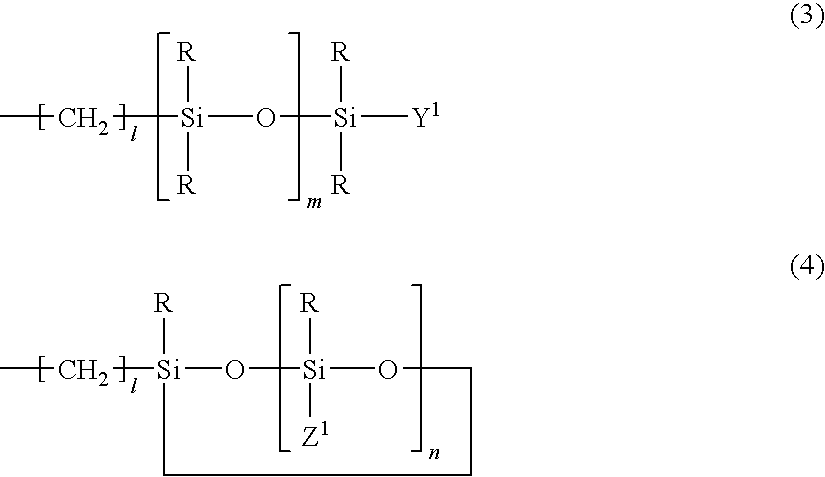
Figure 3
Abstract
Description
TECHNICAL FIELD
[0001] The present invention relates to a modified product, particularly in liquid form, of polyhedral polysiloxane which is excellent in moldability, transparency, and heat and light resistances. The present invention also relates to a composition comprising the modified product.BACKGROUND ART
[0002] Polysiloxane compositions are excellent in heat resistance, cold resistance, weather resistance, light resistance, chemical stability, electrical characteristics, flame retardancy, water resistance, transparency, colorability, anti-stick properties, and anti-corrosion properties, and thus have been utilized in various industrial fields. In particular, it is known that polyhedral polysiloxanes are more excellent in various properties such as heat resistance, light resistance, chemical stability, and low dielectricity owing to their unique chemical structure. On the other hand, a polyhedral polysiloxane is generally a polyfunctional solid compound, and thereby the polyhedral ...
Examples
example 1
[0511]At 70° C. for 3 hours, a mixed solution containing 2.0 g of octa(dimethylsiloxy)octasilsesquioxane (produced by Mayaterials, Inc.) as a dimethylsiloxy group-containing polyhedral polysiloxane compound, 4.0 g of toluene, 1.75 g of vinyltrimethoxysilane, and 1.18 μL of a platinum-vinylsiloxane complex (Pt-VTSC-3.0×, produced by NEM Cat) was reacted. Toluene was distilled off after the reaction to provide 3.7 g of a modified polyhedral polysiloxane (intermediate) that had six alkoxysilyl groups and two dimethylsiloxy groups on average.
[0512]Then, 50 g of methanol and 1.8 g of water were added to 2.5 g of the modified polyhedral polysiloxane (intermediate).
[0513]The resultant mixture was stirred at room temperature for 6 hours, and the solvents were distilled off to give the target silanol group-containing modified polyhedral polysiloxane (compound I). It was visually observed that the compound I was dissolved in a 25% tetramethylammonium hydroxide aqueous solution.
example 2
[0514]To 1 g of the compound I obtained in Example 1 was added 0.005 g of RHODORSIL-PI2074 (onium salt as a photo-curing initiator, produced by Rhodia), and then stirred for mixing. The composition thus obtained was applied to a 0.7 mm-thick glass substrate. About half of the glass substrate dimension was covered with a 3-mm-thick black plastic board, and the glass substrate was irradiated for 50 seconds by using a radiation delivery apparatus (produced by Eye Graphics Co., Ltd., irradiation distance: 80 mm, with a 3000-W metal halide lamp). The sample obtained was immersed in a 25% tetramethylammonium hydroxide aqueous solution for 1 minute, and thereafter sufficiently washed with water.
[0515]The sample thus obtained was observed. The part of the sample covered with the black plastic board at the time of radiation irradiation had no resin attached thereto, and thus the composition applied thereto was dissolved in the alkaline aqueous solution. On the other hand, the composition app...
production example 1
[0518]Tetraalkoxysilane (1354 g) was added to 1674 g of a 48% choline aqueous solution, and vigorously stirred at room temperature for 2 hours. Stirring was slowed down when heat was generated in the reaction system to give a homogeneous solution; and then the solution was further reacted for 12 hours. Subsequently, methanol (1400 mL) was added to a solid (hereinafter, also referred to as the compound II) generated in the reaction system to give a homogeneous solution.
[0519]The methanol solution of the compound II was slowly added dropwise to a solution of 1569 g of dimethylvinylchlorosilane and 1000 mL of hexane under vigorous stirring. After the dropwise addition, the resultant mixture was reacted for 1 hour. Thereafter, an organic layer was extracted therefrom and condensed to give a solid. Subsequently, the generated solid was vigorously stirred in methanol to be washed, and filtered, so that 740 g of octa(vinyldimethylsiloxy)octasilsesquioxane was obtained as a white solid.