
Aqueous dispersion of surface-treated carbon black and method of producing the same
a carbon black and surface-treated technology, applied in the field of surface-treated carbon black aqueous dispersion, can solve the problem that the water medium cannot be used as the reaction solvent, and achieve the effects of reducing side reactions, excellent image density, and high-quality images
Patent Information
- Authority / Receiving Office
- US · United States
- Patent Type
- Applications(United States)
- Current Assignee / Owner
- Publication Date
- 2010-10-28
- Estimated Expiration
- Not applicable · inactive patent
Smart Images
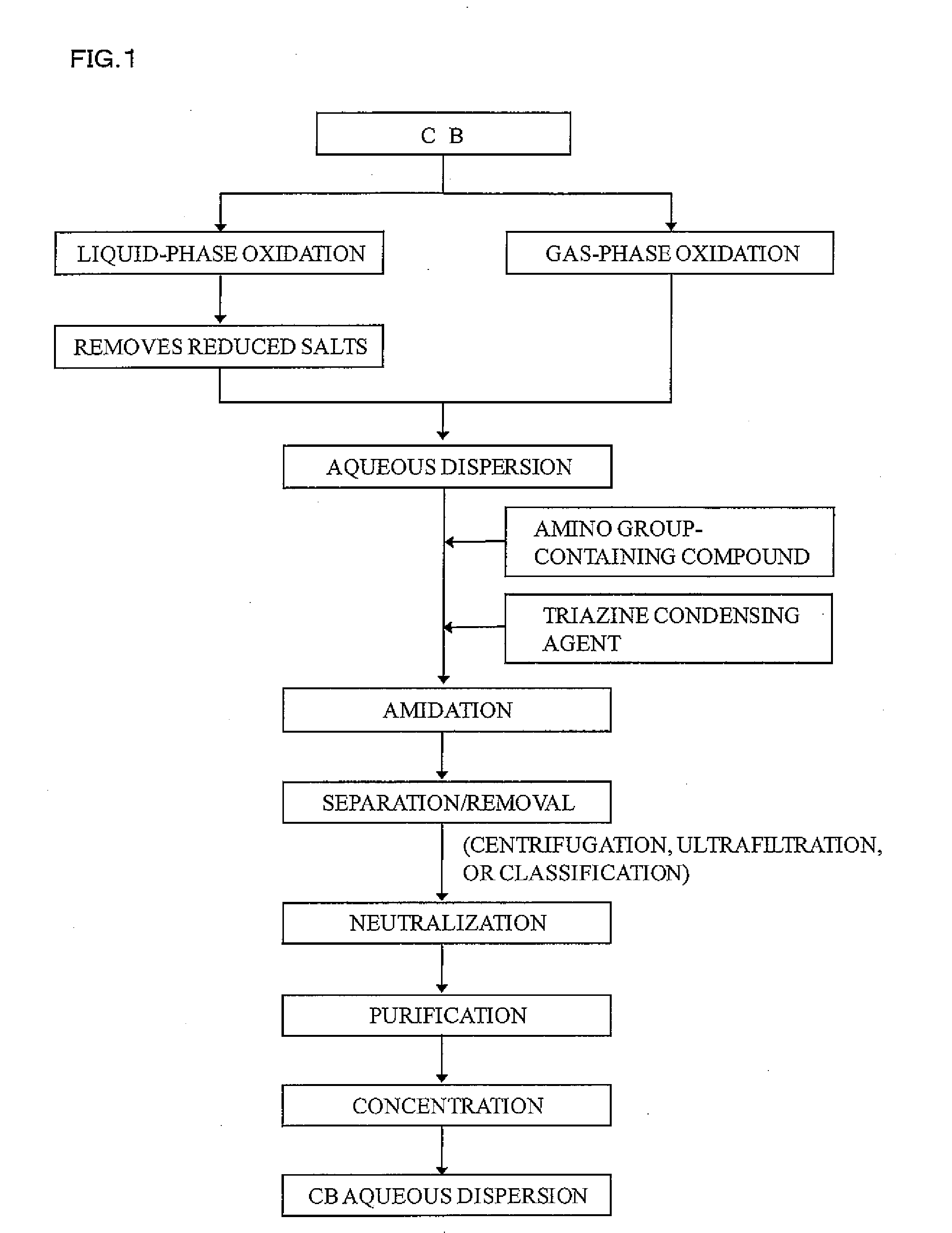
Figure 1 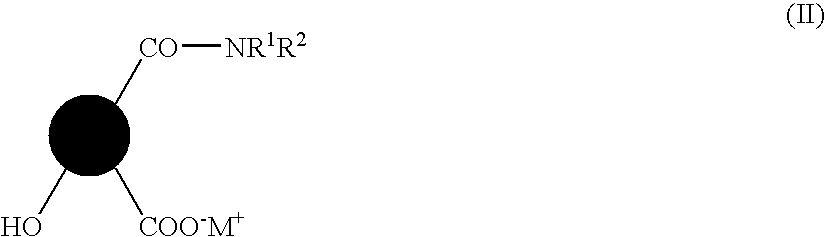
Figure 2 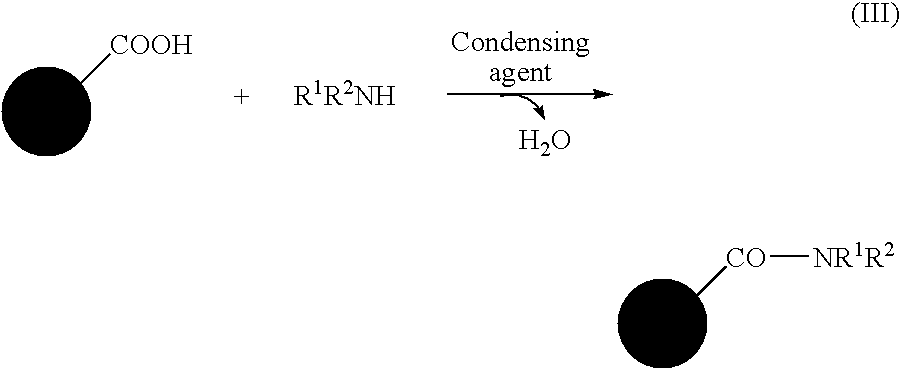
Figure 3
Abstract
Description
TECHNICAL FIELD
[0001] The present invention relates to a surface-treated carbon black aqueous dispersion that may be used as an aqueous black ink for inkjet printers or the like, and a method of producing the same. More particularly, the present invention relates to a surface-treated carbon black aqueous dispersion that may be suitably used as an aqueous black ink for line-head printers in which inkjet heads are secured vertically with respect to the transfer direction of a recording medium, and a method of producing the same.BACKGROUND ART
[0002] An inkjet printer discharges ink droplets from a minute nozzle head to record characters or figures on the surface of a recording medium such as paper. Typical inkjet printing methods include a Bubble Jet (registered trademark) method and a piezo method. In recent years, color development, gamut, durability, and discharge capability have been significantly improved along with an increase in the number of application fields, so that high-quali...
Examples
example 1
[0078]Carbon black (“Seast 9H” manufactured by Tokai Carbon Co., Ltd., specific surface area by nitrogen adsorption: 142 m2 / g, DBP absorption: 130 cm3 / 100 g, pH: 6.0) was oxidized with ozone for 8.5 hours at a pressure of 0.02 MPa and a flow rate of 5 l / min using an ozone generator (“CO-101” manufactured by Yamato Scientific Co., Ltd.). After the addition of purified water, the mixture was stirred to prepare a slurry having a carbon black concentration of 5 wt %.
[0079]The carboxyl group content and the hydroxyl group content of the oxidized carbon black were measured using the following methods, and found to be 560 μmol / g and 118 μmol / g, respectively.
[0080]About 2 to 5 g of the oxidized carbon black was added to a 0.976 N sodium hydrogen carbonate aqueous solution. The mixture was shaken for about 6 hours, and filtered. The carboxyl group content was measured by titration.
[0081]2,2′-Diphenyl-1-picrylhydrazyl (DPPH) was dissolved in carbon tetrachloride to prepare a 5×10⁻⁴ mol / l solu...
example 2
[0083]Carbon black (“Seast 9H” manufactured by Tokai Carbon Co., Ltd.) was oxidized with ozone for 8.2 hours at a pressure of 0.02 MPa and a flow rate of 5 l / min using an ozone generator (“CO-101” manufactured by Yamato Scientific Co., Ltd.). After the addition of purified water, the mixture was stirred to prepare a slurry having a carbon black concentration of 5 wt %.
[0084]2.75 g of a 10 wt % aqueous solution of ethanolamine (Mw: 61.08), 40.7 g of a 10 wt % aqueous solution of benzylamine (Mw: 107.15), and 11.1 g of DMT-MM (triazine condensing agent) (powder) were added to 1 kg of the slurry. The mixture was stirred at room temperature for 20 hours. The resulting dispersion was centrifuged at 6000 rpm to remove large particles. The supernatant liquid was subjected to ultrafiltration, purification, and concentration to obtain an aqueous dispersion having a carbon black concentration of 15 wt %.
example 3
[0085]Carbon black (“Seast 911” manufactured by Tokai Carbon Co., Ltd.) was oxidized with ozone for 7.5 hours at a pressure of 0.02 MPa and a flow rate of 5 l / min using an ozone generator (“CO-101” manufactured by Yamato Scientific Co., Ltd.). After the addition of purified water, the mixture was stirred to prepare a slurry having a carbon black concentration of 10 wt %.
[0086]1.5 g of a 10 wt % aqueous solution of bis(2-methoxyethyl)amine (Mw: 133.19), 6.4 g of a 10 wt % aqueous solution of N-benzylethanolamine (Mw: 150.22), 37.5 g of a 10 wt % aqueous solution of benzylamine (Mw: 107.15), and 11.1 g of DMT-MM (triazine condensing agent) (powder) were added to 1 kg of the slurry. The mixture was stirred at room temperature for 20 hours. The dispersion was centrifuged at 6000 rpm. The supernatant liquid was subjected to ultrafiltration, purification, and concentration to obtain an aqueous dispersion having a carbon black concentration of 15 wt %.
[0087]The dispersion was subjected to ...