
High-stability light source system and method of manufacturing
a light source and high-stability technology, applied in the field of light source systems, can solve the problems of general increase in the size and cost of devices, decrease in the output intensities of semiconductor light emitters typically used for this purpose, and decrease in light source stability, so as to minimize the temperature sensitivity of light output and minimize the effect of light output temperature sensitivity
Patent Information
- Authority / Receiving Office
- US · United States
- Patent Type
- Applications(United States)
- Current Assignee / Owner
- Publication Date
- 2012-02-02
- Estimated Expiration
- Not applicable · inactive patent
Smart Images
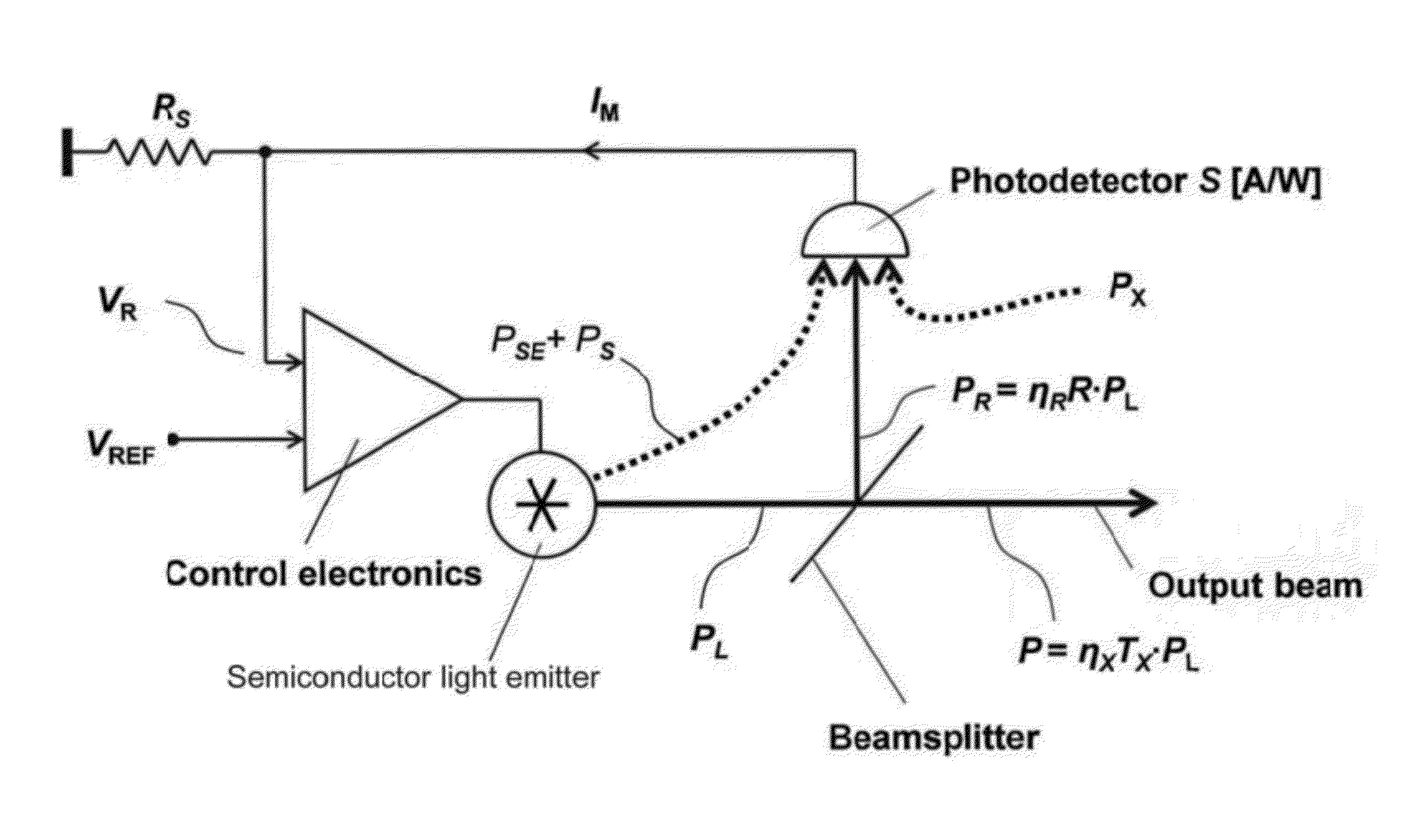
Figure 1 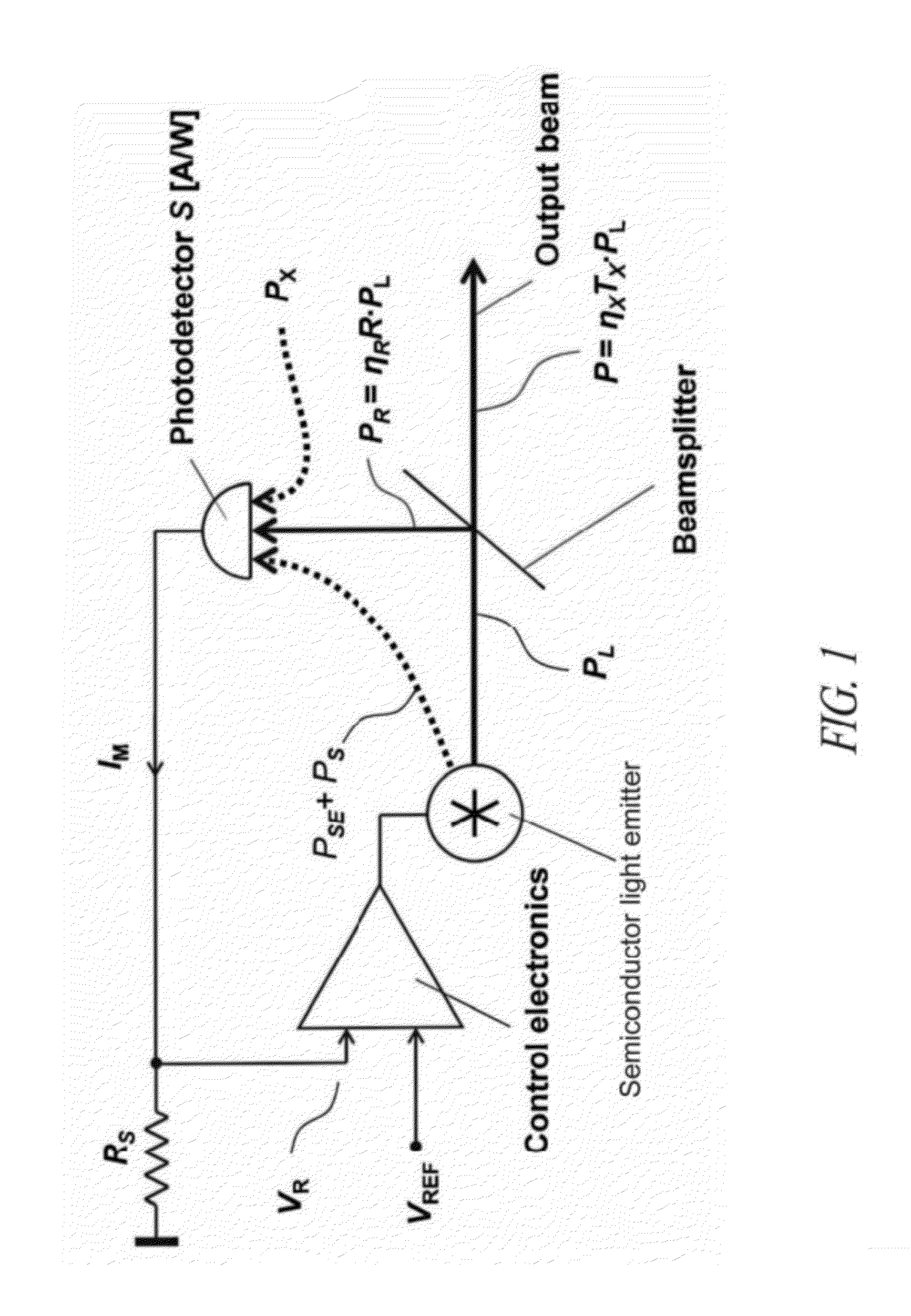
Figure 2 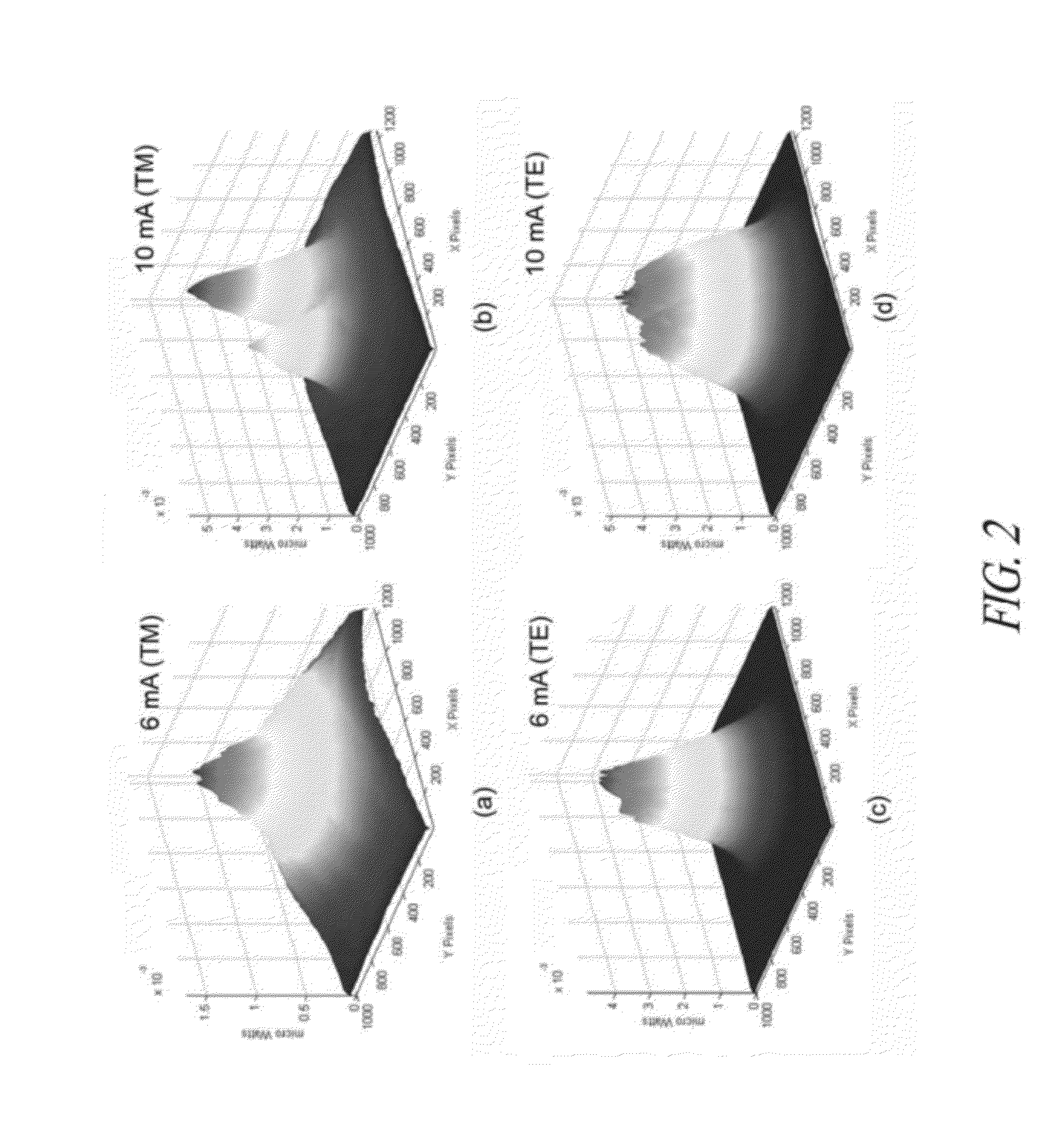
Figure 3
Abstract
Description
BACKGROUND
[0001] 1. Technical Field
[0002] The present disclosure pertains to the generation of light and, more particularly, to a light source system that generates stable optical power over time and temperature.
[0003] 2. Description of the Related Art
[0004] Constant-intensity light sources are commonly used in industrial applications where the light intensity has to remain unchanged under varying ambient conditions, such as temperature, pressure, and humidity. Since the optical and electrical properties of all light-emitting semiconductors and optical materials vary with temperature and other ambient conditions, an absolutely stable light source does not exist. Instead, conventional sources of varying stability are developed for specific applications.
[0005] Attributes of light sources that are critical for specific applications may include wavelength, line width, stability, power consumption, size and cost. When size and cost are the primary concerns, semiconductor lasers and light-emit...
Examples
first embodiment
[0146]11) The light-source system is built and the semiconductor light emitter is positioned with its polarization axis relative to the beamsplitter determined by φ0 in a
Design and Adjustment of High-Stability Source Made with an Emitter of Unpolarized Light:
[0147]In another embodiment of the preferred method of high-stability light-source made with an emitter of unpolarized light, a RCLED in exemplary system, is as follows:
[0148]1) The range of peak wavelengths (λMIN and λMAX) and the change in peak wavelength with the temperature of the semiconductor light emitter dλ / dT are measured or obtained from data supplied by the manufacturer for the semiconductor light emitter.
[0149]2) The variation of beam divergence with the temperature and drive current of the semiconductor light emitter are measured or obtained from data supplied by the manufacturer for the semiconductor light emitter.
[0150]3) The wavelength and temperature dependence of the photodetector responsivity, ∂S / ∂λ and ∂S / ∂T,...
second embodiment
[0170]As shown in FIG. 16A a stable light source 30 includes a housing 230 having an emitter cavity 232 with a base 234 comprising a pedestal 236 upon which is mounted a semiconductor light emitter 238 that projects an emitter beam 240 through a first aperture 242. The emitter beam 240 has a divergence angle that contains substantially all of the coherent optical power emitted by the semiconductor light emitter 238. The emitter beam 240 is incident on first collimating lens 244 having first antireflection coating 246 and second antireflection coating 248, which focuses the emitter beam 240 into a collimated beam 250 comprised of light rays that are substantially parallel to one another. The collimated beam 250 is incident upon the first surface 252 of a beamsplitter 254. The beamsplitter 254 is aligned with respect to the emitter beam 240 by a beamsplitter shoulder 256 in a beamsplitter cavity 258. The first surface 252 reflects a portion of the collimated beam 250 to form a reflect...