

Liquid crystal composition, antioxidant and liquid crystal display device
a liquid crystal display and antioxidant technology, applied in liquid crystal compositions, organic chemistry, chemistry apparatus and processes, etc., can solve the problems of long service life of the device, large contrast ratio and short response time in the device, and generation of poor display by a change over time, etc., to achieve high UV light stability, small viscosity, and large specific resistance
Patent Information
- Authority / Receiving Office
- US · United States
- Current Assignee / Owner
- Publication Date
- 2014-01-30
- Estimated Expiration
- Not applicable · inactive patent
Smart Images
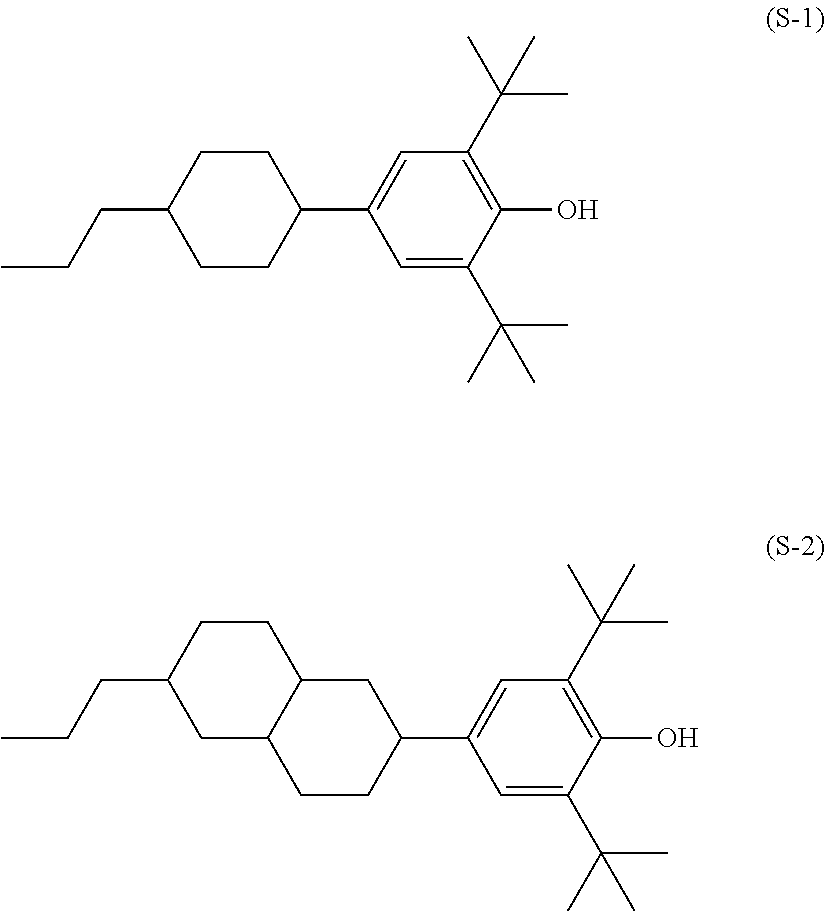
Figure 1 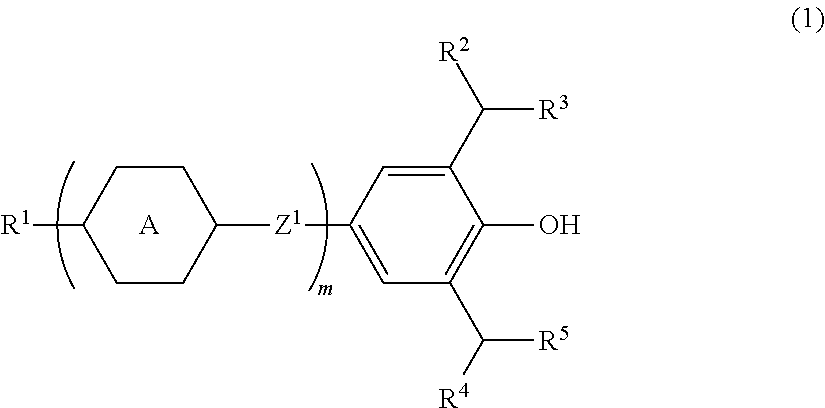
Figure 2 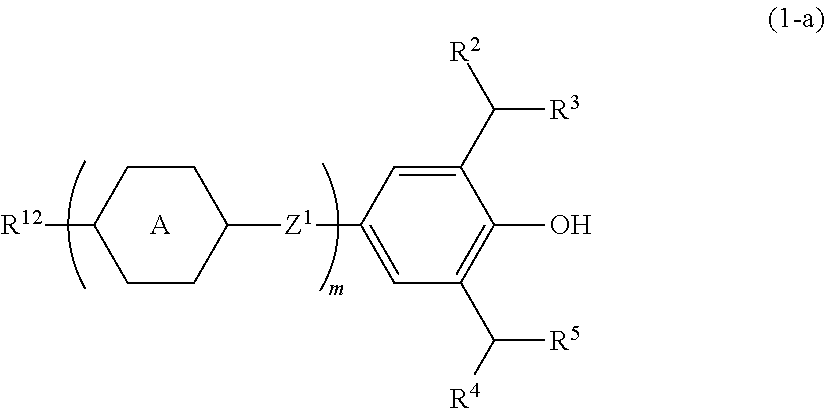
Figure 3
Abstract
Description
CROSS-REFERENCE TO RELATED APPLICATIONS
[0001] This application claims the priority benefit of Japan Application serial No. 2012-168460, filed on Jul. 30, 2012. The entirety of the above-mentioned patent application is hereby incorporated by reference herein and made a part of this specification.TECHNICAL FIELD
[0002] The invention relates to a liquid crystal composition mainly suitable for use in an active matrix (AM) device and so forth, and an AM device and so forth including the composition. In particular, the invention relates to a device that includes the composition and has a mode such as a twisted nematic (TN) mode, an electrically controlled birefringence (ECB) mode, an optically compensated bend (OCB) mode, a vertical alignment (VA) mode, an in-plane switching (IPS) mode, a fringe field switching (FFS) mode, a polymer sustained alignment (PSA) mode or a field induced photo-reactive alignment (FPA) mode.BACKGROUND ART
[0003] In a liquid crystal display device, a classification ba...
Examples
example 1
[0116]Compound (1-a-1) was prepared according to the synthetic scheme shown below.
First Step: Synthesis of Compound (T-1)
[0117]Then, 2,6-dimethyl-4-bromoanisole (200 g) was dissolved into methylene chloride (1 L), and the resultant mixture was cooled at −30° C. under a nitrogen atmosphere. Bromine (240 g) was added dropwise while keeping a temperature of −30° C., and then the resultant mixture was stirred for 2 hours. After reaction completion, a sodium sulfite aqueous solution was added thereto, and an aqueous layer was extracted with methylene chloride (using 200 mL, twice). Combined organic layers were washed with a saturated aqueous solution of sodium chloride (300 mL), a saturated aqueous solution of sodium hydrogencarbonate (300 mL) and water (300 mL), and then dried over anhydrous magnesium sulfate and concentrated under reduced pressure, and thus compound (T-1) was obtained as colorless oily matter (280 g)
Second Step: Synthesis of Compound (T-2)
[0118]Compound (T-1) (140 g) o...
example 2
[0121]Then, 2,6-diisopropylanisole was used as a raw material, operations were performed in a manner similar to the operations represented in Example 1 and in the synthetic method described therein, and thus 2,6-diisopropyl-4-(4-pentyl-trans-cyclohexyl)phenol (1-a-63) was obtained as colorless needles.
example 3
[0122]Compound (1-a-13) was prepared according to the synthetic scheme shown below.
First Step: Synthesis of Compound (T-4)
[0123]Aluminum chloride (147 g) was suspended into methylene chloride (700 mL), and the resultant mixture was cooled at 0° C. under a nitrogen atmosphere. Then, 3-chloropropionyl chloride (152 g), and subsequently 2,6-dimethylanisole (136 g) were added dropwise thereto while keeping a temperature of 0° C., and the resultant mixture was stirred for 2 hours. A reaction mixture was poured into ice water, and an aqueous layer was extracted with methylene chloride (using 200 mL, twice). Combined organic layers were washed with a saturated aqueous solution of sodium chloride (200 mL), a saturated aqueous solution of sodium hydrogencarbonate (200 mL) and water (200 mL), and then dried over anhydrous magnesium sulfate, concentrated under reduced pressure, and thus compound (T-4) (290 g) was obtained.
Second Step: Synthesis of Compound (T-5)
[0124]Compound (T-4) (50 g), val...