
Hearing aid system and a method of programming a hearing aid device
a hearing aid and programming technology, applied in the field of hearing aid systems, can solve the problems of not always being able to achieve high frequency amplification, and may not contribute to better audibility and speech intelligibility, and achieve the effect of maximizing speech intelligibility and improving audibility of high frequency sound
Patent Information
- Authority / Receiving Office
- US · United States
- Patent Type
- Applications(United States)
- Current Assignee / Owner
- Publication Date
- 2017-05-04
Smart Images
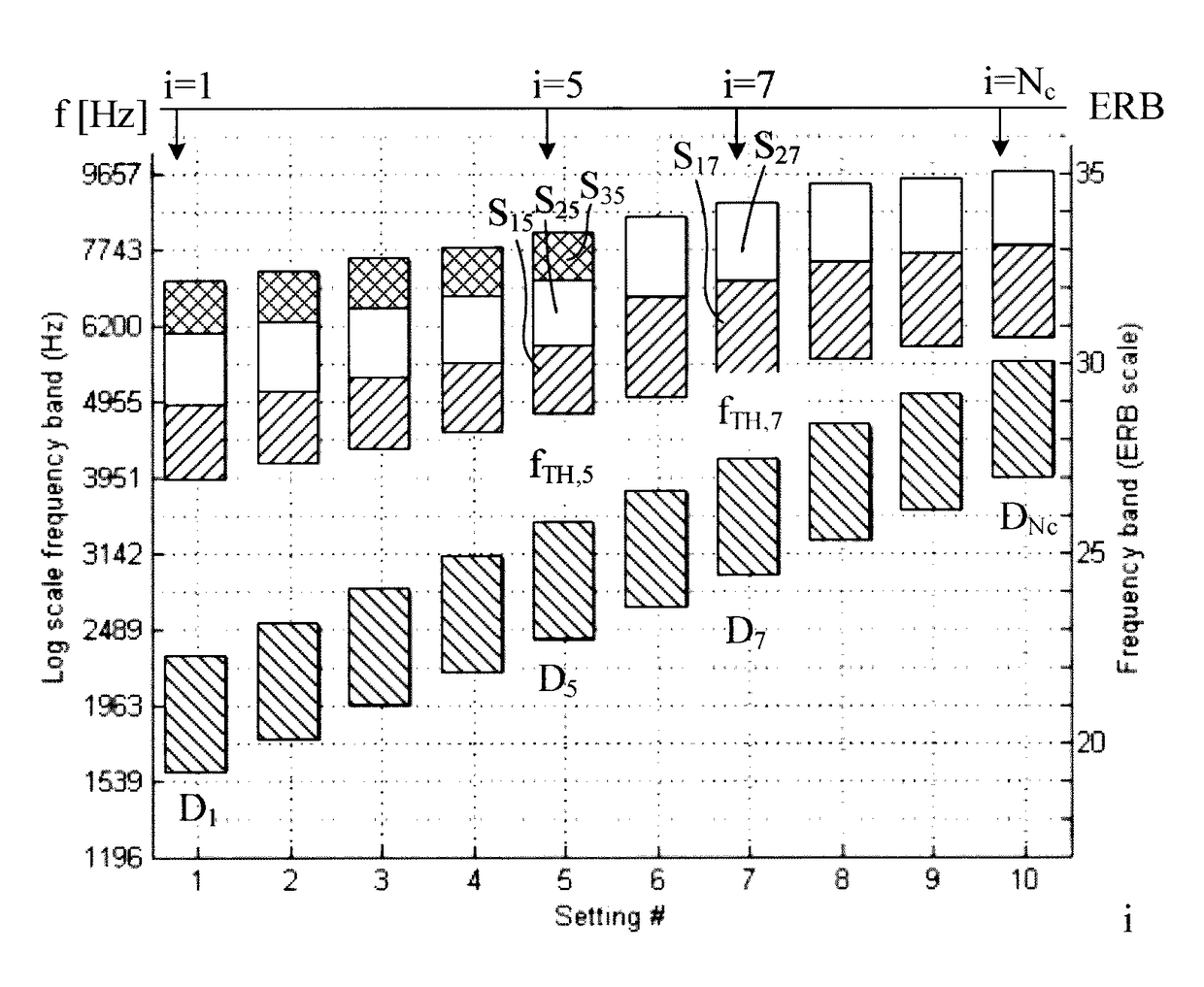
Figure 1 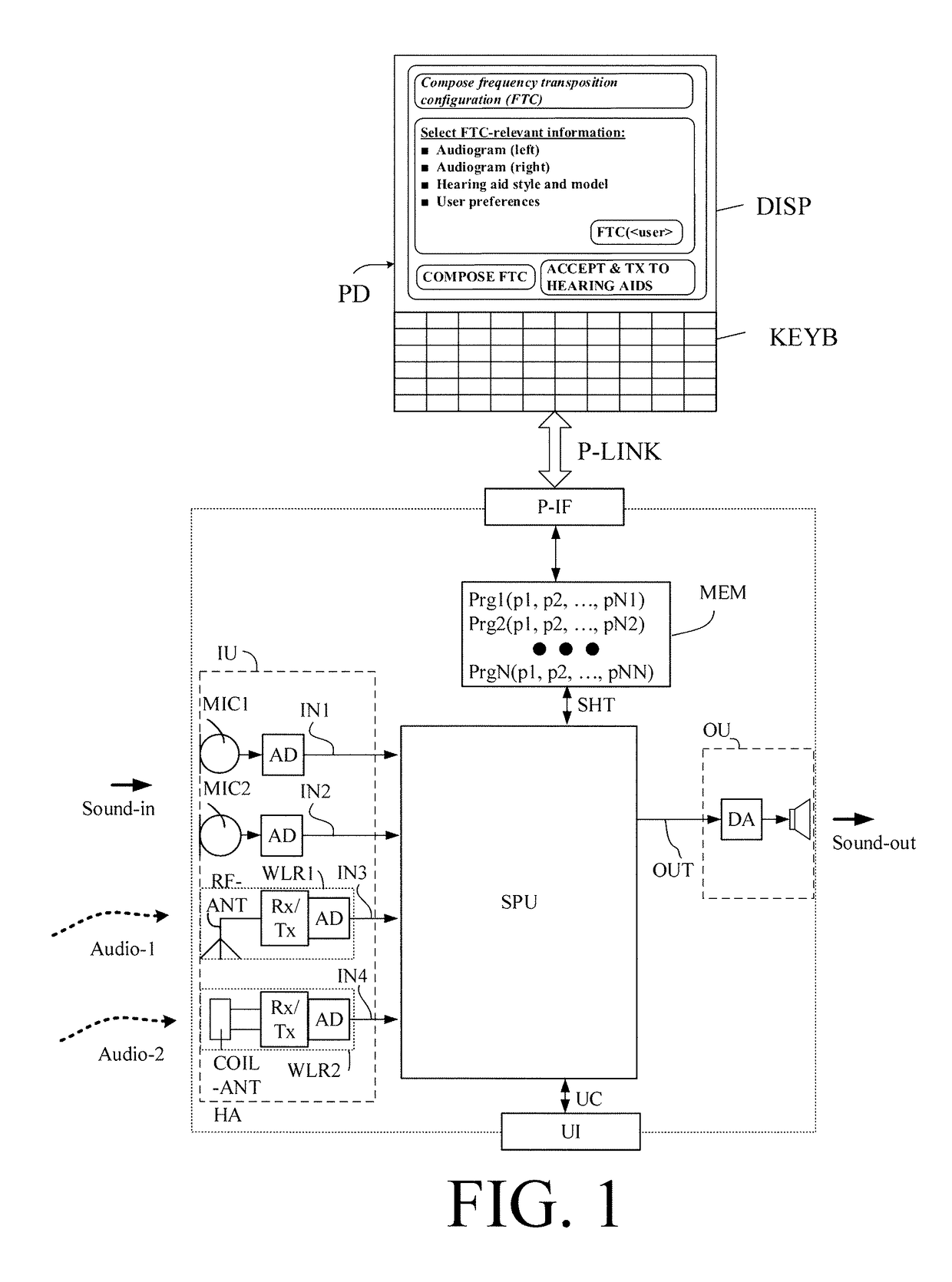
Figure 2 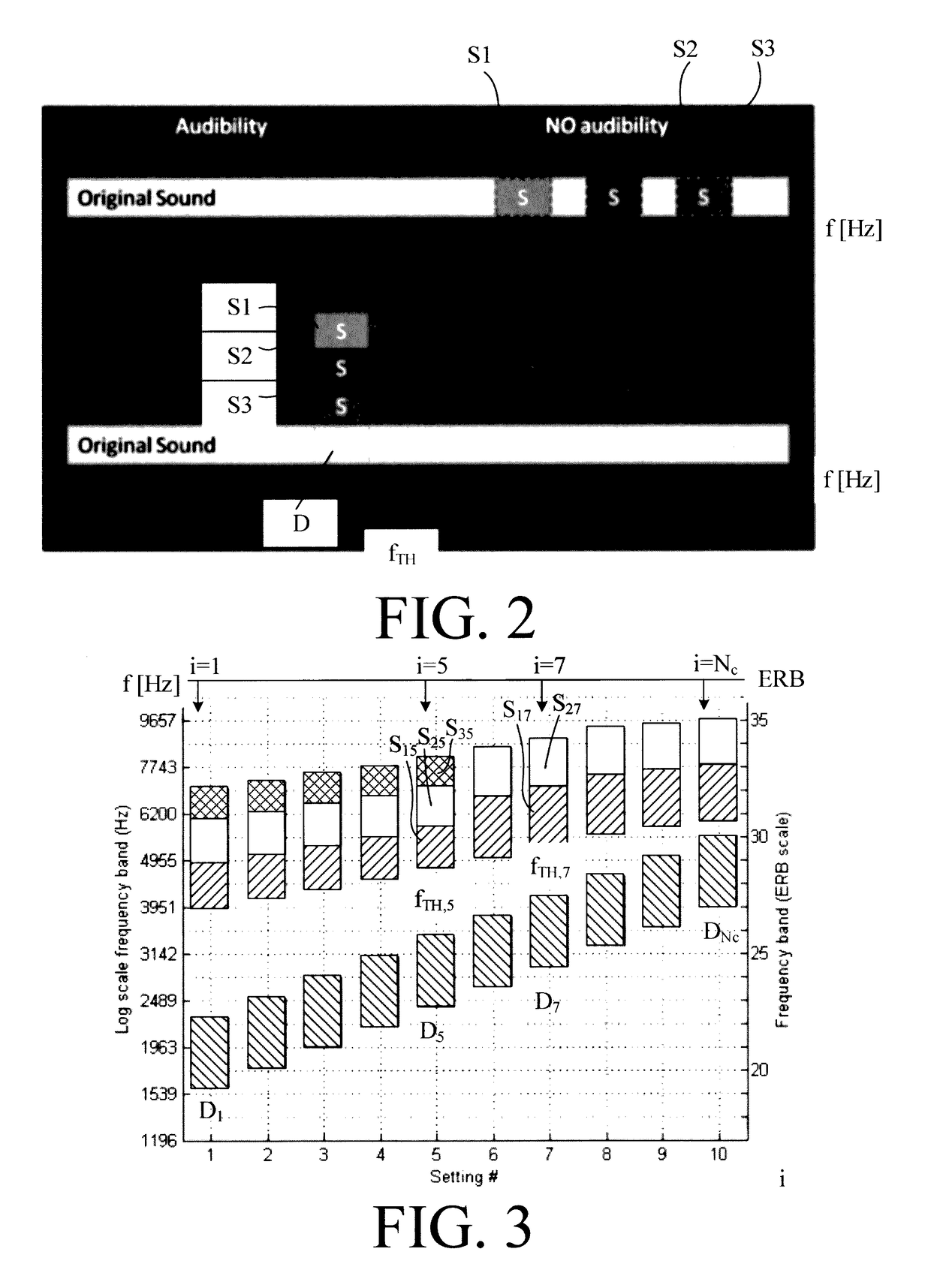
Figure 3
Abstract
Description
[0001] This application is a Continuation-in-Part of copending application Ser. No. 14 / 931,792, filed on Nov. 3, 2015, and claims priority under 35 U.S.C. §119(a) to Application No. EP 15193081.5, filed in Europe on Nov. 4, 2015, all of which are hereby expressly incorporated by reference into the present application.SUMMARY
[0002] The present application relates to a hearing aid system and to a method of operating (e.g. programming) a hearing aid system. In an embodiment, the disclosure relates to a hearing aid system configured to make high frequency (sound) information available for a user, preferably optimized individually for a particular user to improve audibility of high frequency sound, e.g. to maximize speech intelligibility in a hearing aid device, e.g. a hearing aid.
[0003] For severe-to-profound hearing losses (in particular severe-to-profound high frequency hearing losses) it is not always possible—with a given hearing aid style and model—to supply sufficient amplification a...
Examples
example
[0115]The general fitting concept (prescription algorithm) regarding the frequency lowering feature of the present disclosure is to identify the frequency above which speech—after having been subject to the gain of the hearing aid device—cannot be perceived by the user. This frequency, termed the Maximum Audible Output Frequency (MAOF) decides the upper limit of the destination region (fmax(D)). On a linear scale, (each of) the source bands and the destination band may be of equal width. The 10 fixed frequency transposition configurations each have one specific destination band (different for each configuration) and two or three specific source bands (see e.g. FIG. 3). The configurations are e.g. arranged (designed) so that on a logarithmic scale one or more of the following criteria are fulfilled:[0116]the difference between destination and source bands decrease for increasing (e.g. center) frequency of the destination band (e.g. fcenter(D)=(fmin(D)+fmax(D)) / 2);[0117]the width Δf(S...