
Nrf2 Activating Compounds and Uses Thereof
a technology of activating compounds and nrf2, which is applied in the field of nrf2 activating compounds, can solve problems such as disrupting the ability of parts of the nervous system to communicate, and achieve the effect of increasing the activity of nrf2
Patent Information
- Authority / Receiving Office
- US · United States
- Patent Type
- Applications(United States)
- Current Assignee / Owner
- Publication Date
- 2017-08-03
Smart Images
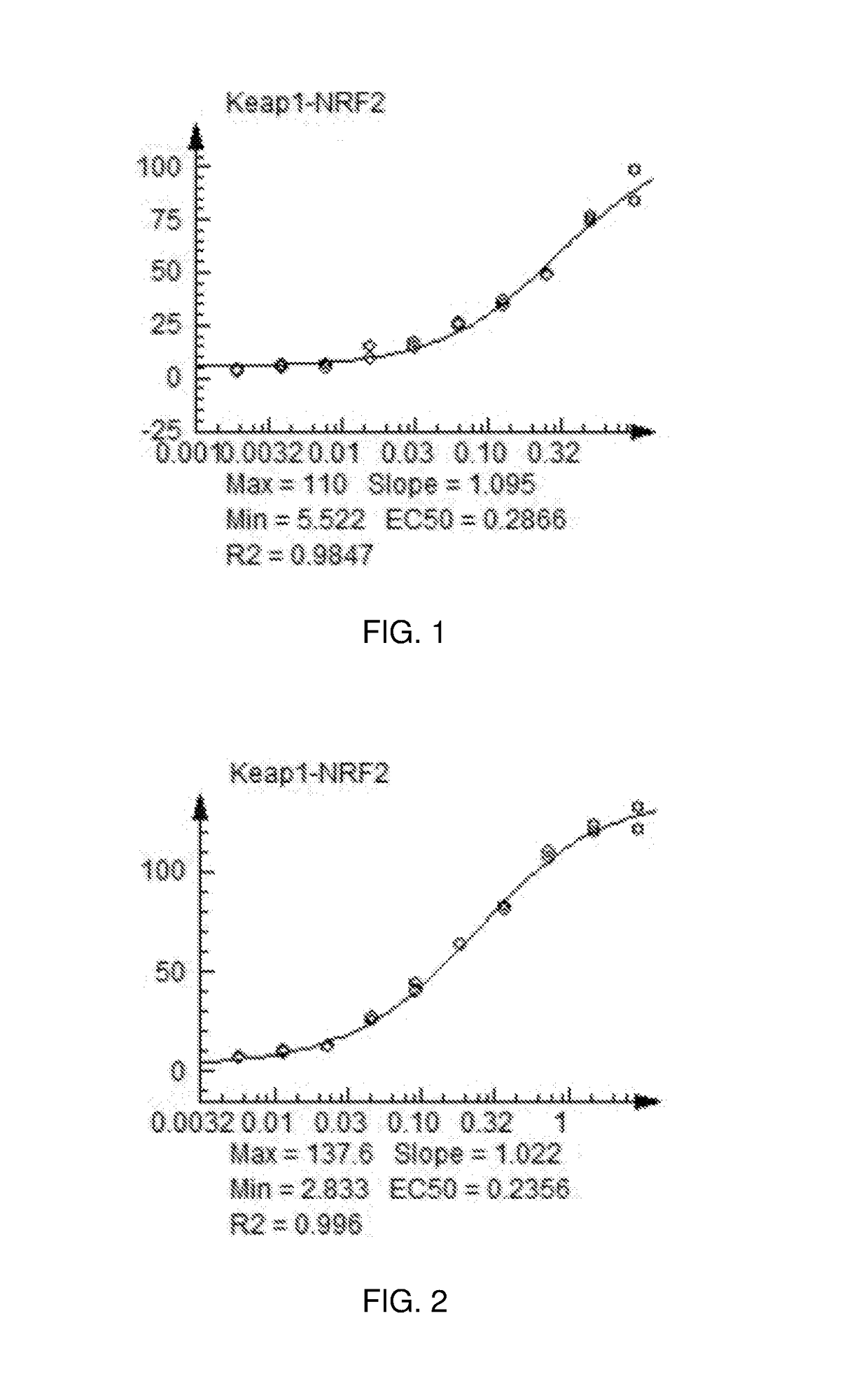
Figure 1 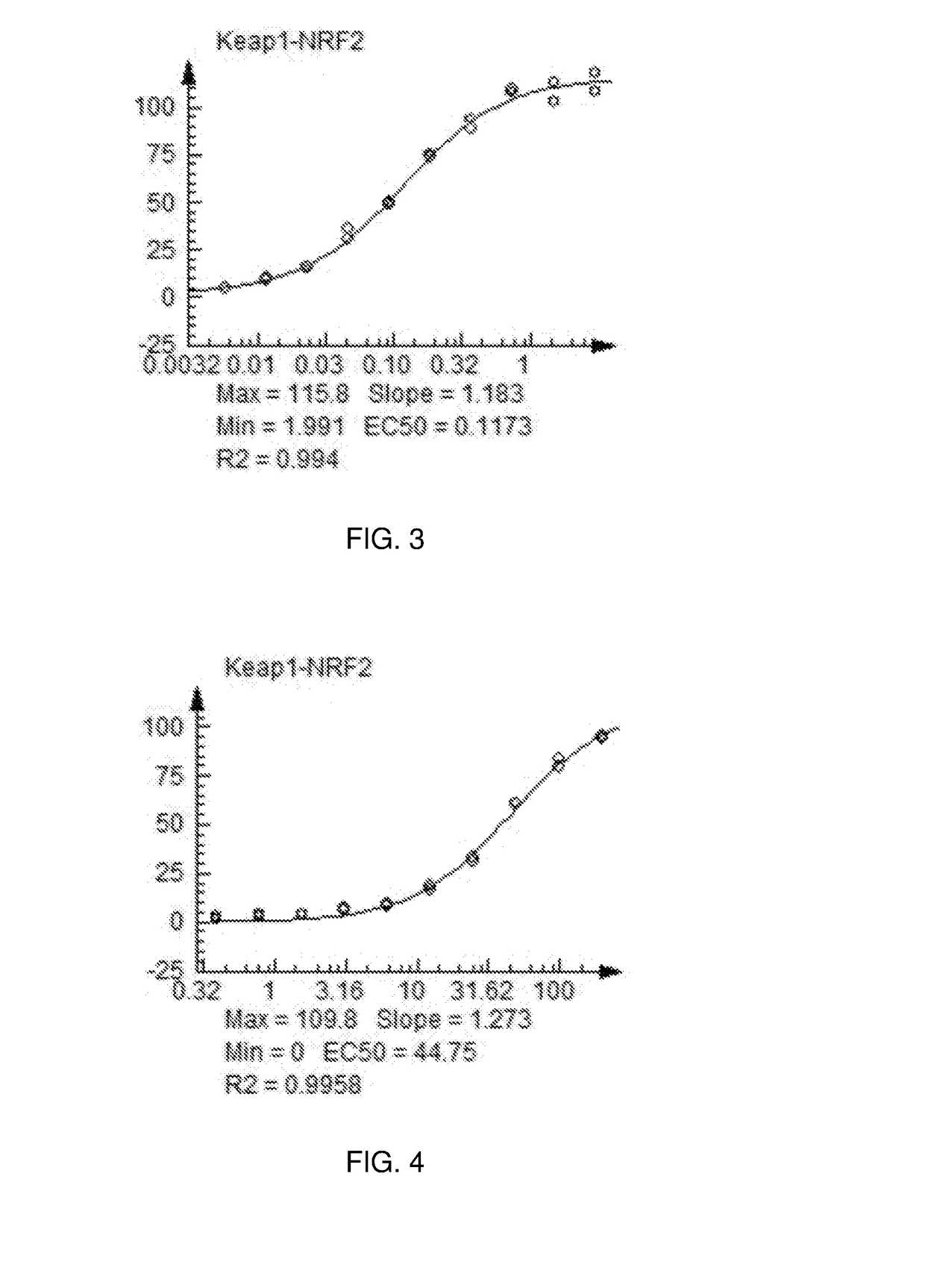
Figure 2 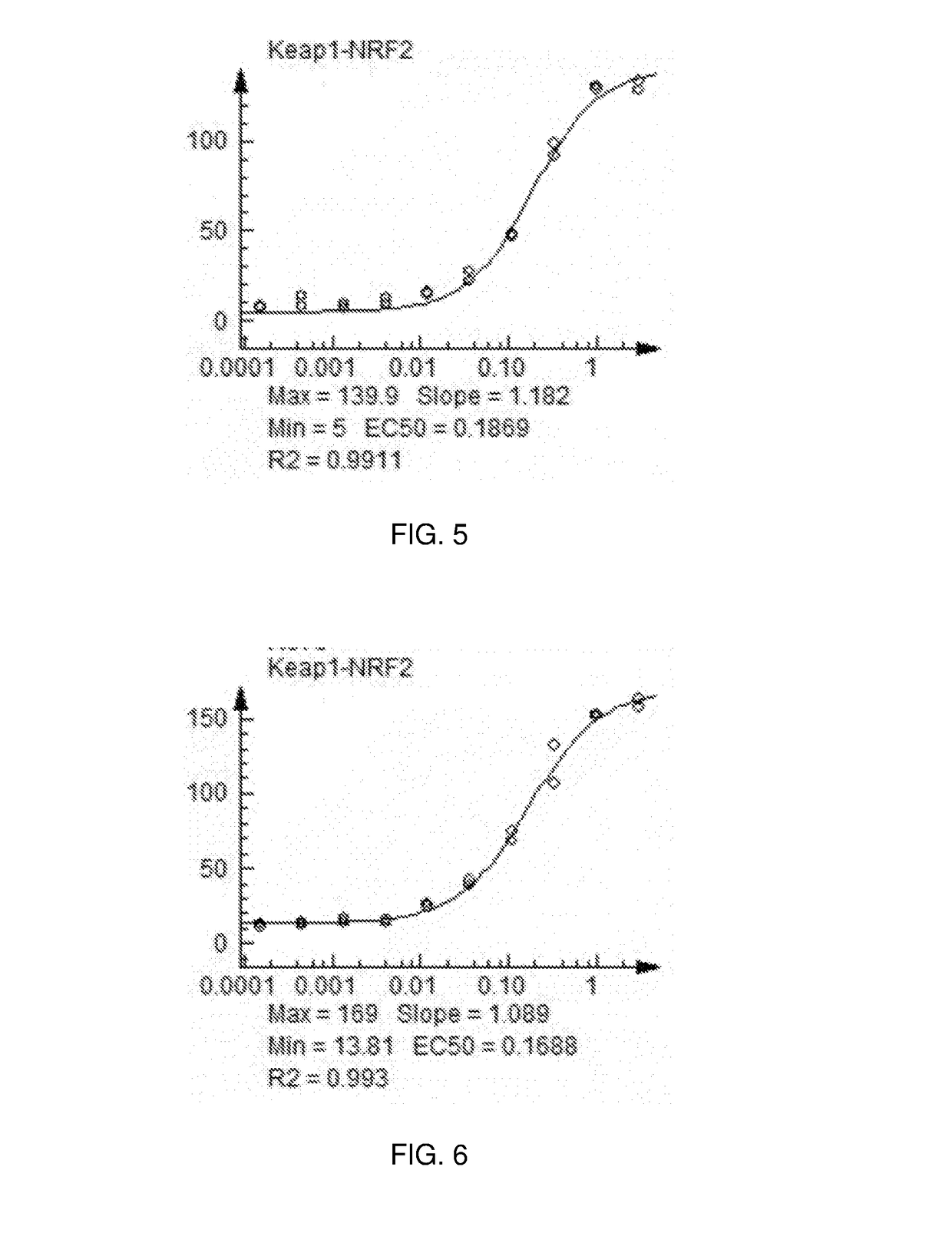
Figure 3
Abstract
Description
CROSS-REFERENCE TO RELATED APPLICATIONS
[0001] This application claims priority pursuant to 35 U.S.C.§119(e) to the filing date of U.S. Provisional Application No. 62 / 290,748, filed Feb. 3, 2016, the disclosure of which is herein incorporated by reference.INTRODUCTION
[0002] Nuclear factor (erythroid-derived 2)-like 2, also known as NFE2L2 or Nrf2, is a transcription factor that in humans is encoded by the NFE2L2 gene. Nrf2 is a basic leucine zipper (bZIP) protein that regulates the expression of antioxidant proteins that protect against oxidative damage triggered by injury and inflammation.
[0003] Fumaric acid is an intermediate product of the citric acid cycle. Fumaric acid is a source of intracellular energy in the form of adenosine triphosphate (ATP), and is generated by oxidation of adenylsuccinate by the enzyme succinate dehydrogenase which is then converted to maleate by the enzyme fumarase. Fumaric acid esters (FAE), such as dimethylfumarate (DMF) have been used in the treatment o...
Examples
example 1
on of (E)-1-(pyridin-3-yl)-4-(2-tosylvinyl)-1,4-dihydro-5H-tetrazol-5-one (Compound 1)
[0506]
[0507]1,8-Diazabicyclo[2.2.2]octane (449 mg, 4.0 mmol) in MeCN (5 mL) was added over ca. 5 min to a stirred solution of 1-(pyridin-3-yl)-1,4-dihydro-5H-tetrazol-5-one hydrochloride (400 mg, 2.0 mmol) and 1-(ethynylsulfonyl)-4-methylbenzene (TCI America; 360 mg, 2.0 mmol) in MeCN (10 mL) at 0° C. under an atmosphere of nitrogen. The mixture was then allowed to warm from 0° C. to room temperature and stirred overnight. The mixture was then concentrated under vacuum and dry-loaded on to silica gel. Purification by silica gel chromatography (40 g ISCO Cartridge) using hexanes / EtOAc (1:0 to 2:8) as eluent gave the product (186 mg, 27%) as a solid. Additional product may be recovered from side fractions on either-side of the center fractions.
[0508]1H NMR (CDCl3, 400 MHz): δ 9.17 (s, 1H), 8.67 (d, J=3.6 Hz, 1H), 8.21 (d, J=8.0 Hz, 1H), 7.97 (d, J=14.0 Hz, 1H), 7.81 (d, J=8.0 Hz, 2H), 7.47 (dd, J=8.0...
example 2
on of (E)-1-methyl-4-(2-tosylvinyl)-1,4-dihydro-5H-tetrazol-5-one (Compound 2)
[0513]
[0514]1,8-Diazabicyclo[2.2.2]octane (449 mg, 4.0 mmol) in MeCN (5 mL) was added over ca. 5 min to a stirred solution of 1-methyl-1,4-dihydro-5H-tetrazol-5-one (200 mg, 2.0 mol) and 1-(ethynylsulfonyl)-4-methylbenzene (TCI America; 360 mg, 2.0 mmol) in MeCN (10 mL) at 0° C. under an atmosphere of nitrogen. The mixture was then allowed to warm from 0° C. to room temperature and stirred overnight. The mixture was then concentrated under vacuum and dry-loaded on to silica gel. Purification by silica gel chromatography (40 g ISCO Cartridge) using hexanes / EtOAc (1:0 to 4:6) as eluent gave the product (356 mg, 63%) as a solid.
[0515]1H NMR (CDCl3, 400 MHz): δ 7.89 (d, J=14.0 Hz, 1H), 7.78 (dd, J=8.4 Hz, 2H), 7.34 (d, J=Hz, 2H), 7.21 (d, J=8.4 Hz, 1H), 3.63 (s, 3H), 2.44 (s, 3H)
[0516]13C NMR (CDCl3, 100 MHz): δ 148.5, 145.1, 137.3, 130.2, 130.2, 127.9, 119.5, 31.7, 21.8
[0517]m / z=281.17 [M+H]+ and 322.18 [M+Me...
example 3
on of (E)-1-(2-(methylsulfonyl)vinyl)-4-(pyridin-3-yl)-1,4-dihydro-5H-tetrazol-5-one (Compound 3)
[0520]
Preparation of (E)-1,2-bis(methylthio)ethane
[0521](E)-1,2-bis(methylthio)ethane was prepared according to Tiecco et al., J. Org. Chem. 1983, 48, 4795-4800, the disclosure of which is incorporated herein by reference, except 1,3-dimethyl-3,4,5,6-tetrahydro-2-pyrimidinone (DMPU) was used as solvent, rather than hexamethylphosphoramide (HMPA).
[0522]Sodium thiomethoxide (ca. 90% purity, Aldrich; 2.34 g, 30.0 mmol) was added in one portion to a stirred solution of trans-1,2-dichloroethylene (0.97 g, 10.0 mmol) in DMPU (25 mL) under an atmosphere of nitrogen at room temperature. The reaction became mildly exothermic and was stirred at room temperature for 2 hr. The mixture was then poured in to H2O (150 mL) and Et2O (75 mL). The aqueous and organic layers were partitioned and the organic layer was washed with H2O (1×50 mL), then dried (Na2SO4), filtered and the solvent removed under vacu...