
Negative electrode active material having high output characteristics and lithium secondary battery including the same
Patent Information
- Authority / Receiving Office
- US · United States
- Current Assignee / Owner
- Publication Date
- 2020-02-13
Smart Images
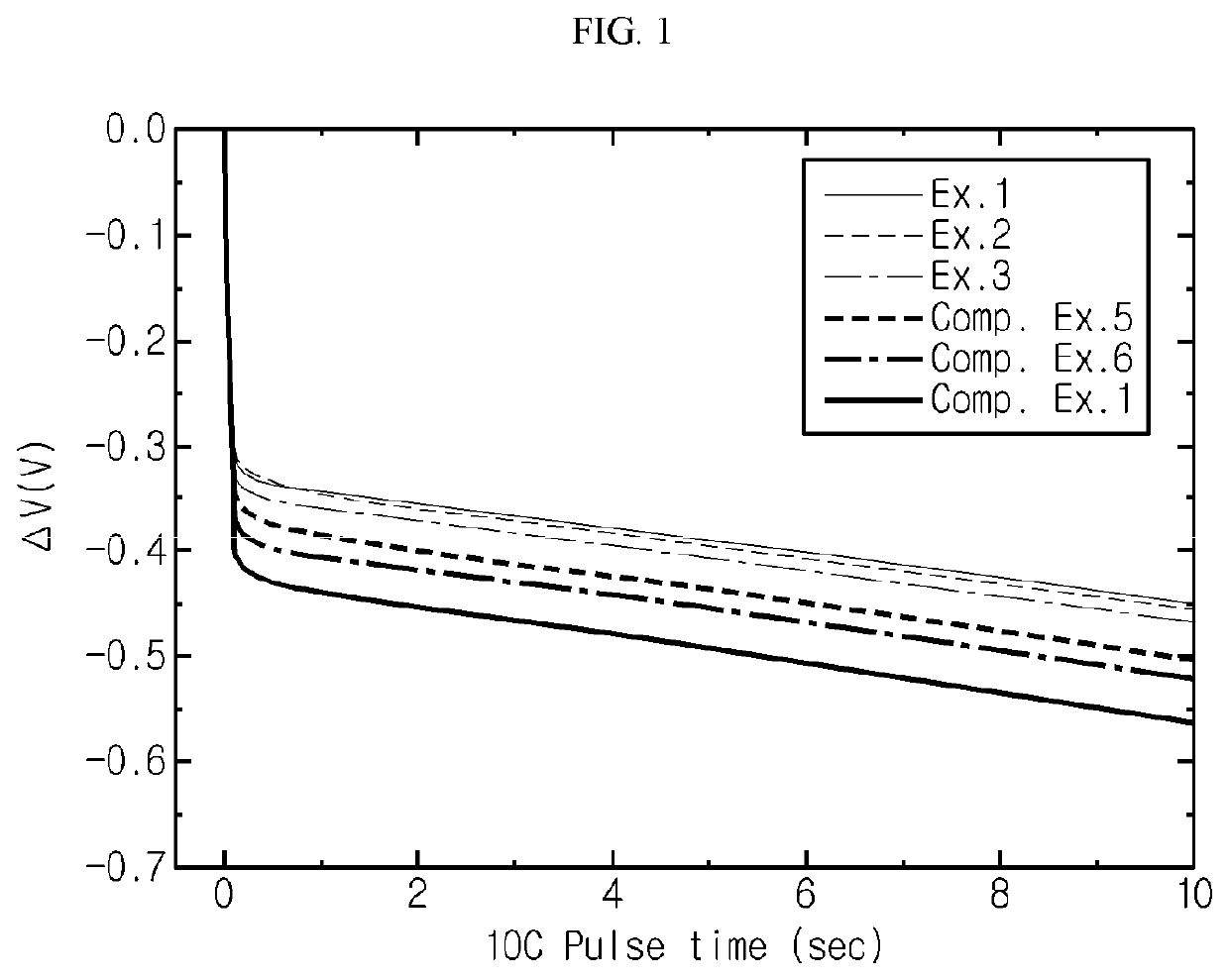
Figure 1
Abstract
Description
TECHNICAL FIELD
[0001] The present disclosure relates to a negative electrode active material having high output characteristics and a lithium secondary battery including the same.
[0002] The present application claims priority to Korean Patent Application No. 10-2017-0031306 filed on Mar. 13, 2017 in the Republic of Korea, the disclosures of which are incorporated herein by reference.BACKGROUND ART
[0003] A need for an eco-friendly substitute energy source has become an essential factor for the future life, as the cost of energy sources has been increased due to the depletion of fossil fuel and the interest about environmental pollution has been increased.
[0004] Efforts into research and development of electrochemical devices have been activated gradually, as the application spectrum of electrochemical devices have been extended to cellular phones, camcorders and notebook computers, and to energy sources for electric vehicles.
[0005] In this context, electrochemical devices have been most s...
Examples
examples 2-5
[0114]Each of Li4Ti5O12 powder, a negative electrode, a lithium secondary battery and a half-cell was obtained in the same manner as descried in Example 1, except that LiOH as a lithium-containing precursor, TiO2 as a titanium-containing precursor, NaOH as a sodium source and KOH as a potassium source were mixed in a solid phase according to the mixing ratio as shown in the following Table 1.