

Method for preventing a risk of freezing in a reducing-agent feeding device of a selective catalytic reduction system
a catalytic reduction and reducing agent technology, applied in the direction of engines, mechanical equipment, machines/engines, etc., can solve the problems of reducing the protection against potential consuming electrical energy, and limiting the diagnosis of freezing by the controller processor, so as to avoid the freezing of the reducing agent and prolong the interval between waking up. , the effect of preventing the risk of freezing
Patent Information
- Authority / Receiving Office
- US · United States
- Patent Type
- Applications(United States)
- Current Assignee / Owner
- Publication Date
- 2020-09-10
Smart Images
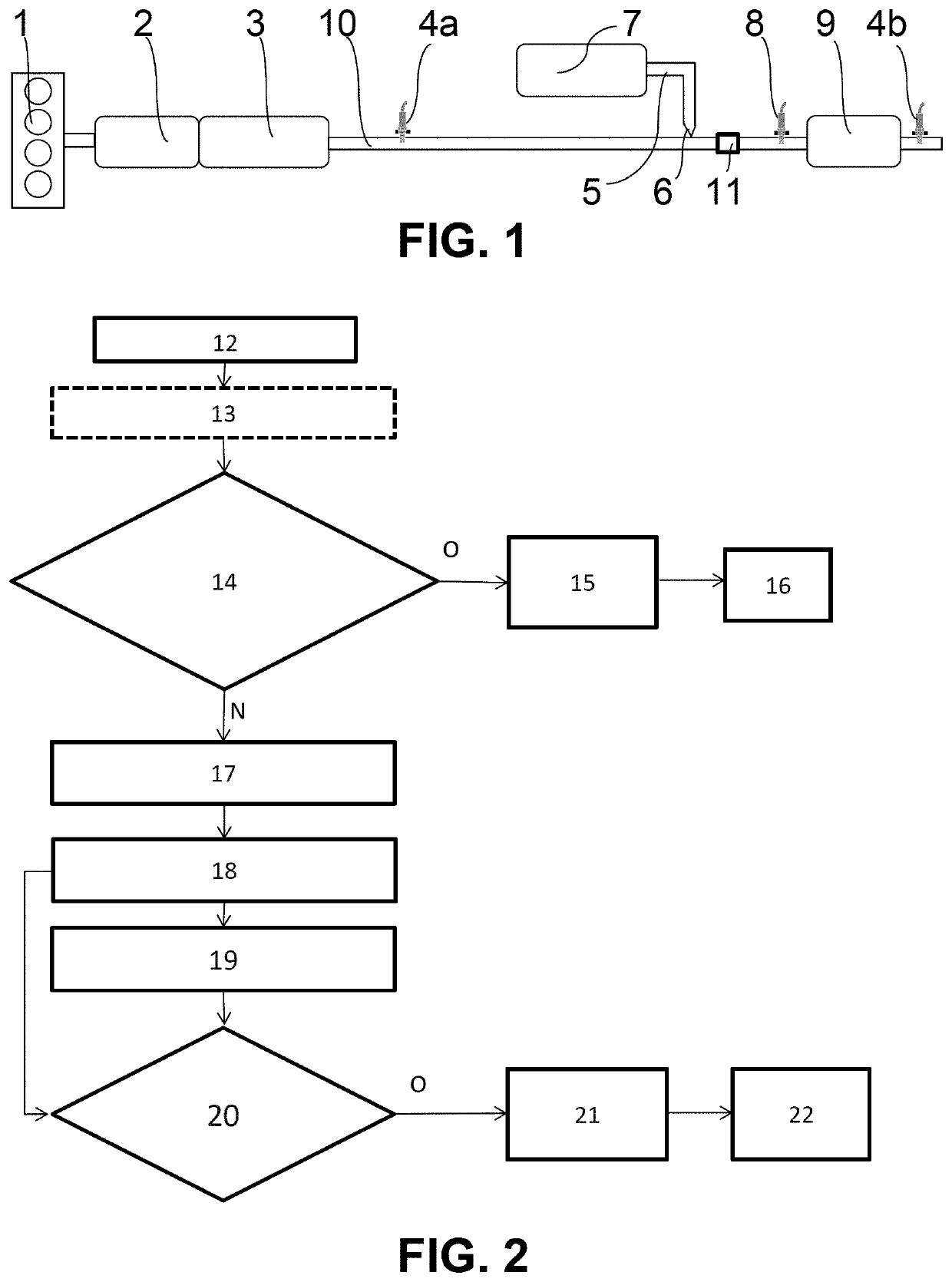
Figure 1
Abstract
Description
BACKGROUND OF THE INVENTIONField of the Invention
[0001] The present invention relates to a method for preventing a risk of freezing in a device for supplying reducing agent to a selective catalytic reduction system in an exhaust line of a motor vehicle combustion engine, the removal of nitrogen oxides being carried out using selective catalytic reduction by injecting a quantity of reducing agent into the line.Description of the Related Art
[0002] More than 95% of diesel engines will be equipped with a device for treating nitrogen oxides in the exhaust line. This could apply in the very near future to gasoline fueled engines.
[0003] In order to do this, in motor vehicles, in particular with a diesel engine, it is known practice to equip an internal combustion engine exhaust line with a selective catalytic reduction system having injection of reducing agent into the line, the monitoring-control unit receiving the estimates or measurements of quantities of nitrogen oxides exiting through th...
Examples
Embodiment Construction
[0033]In what follows, upstream and downstream are to be considered in the sense of a flow of exhaust gases along an exhaust line.
[0034]Reference is made to FIG. 1 which shows a combustion engine 1 and an exhaust line 10 for removing the exhaust gases originating from combustion in the combustion engine 1. The exhaust line 10 may comprise, in the vicinity of an exhaust manifold of the engine 1, an oxidation catalytic converter 2 and a particulate filter 3, for a compression-ignition engine 1, notably a diesel engine 1 or engine running on gas oil.
[0035]In the case of a controlled-ignition combustion engine, notably an engine running on gasoline or on a mixture containing gasoline, the line 10 may comprise a three-way catalytic converter and a gasoline particulate filter.
[0036]An upstream nitrogen oxides probe 4a, also referred to as an upstream NOx probe is positioned downstream of the particulate filter 3. All the features relating to the reduction catalytic converter 2, to the par...