
Tire with sidewall rubber insert
Patent Information
- Authority / Receiving Office
- US · United States
- Current Assignee / Owner
- Publication Date
- 2001-03-20
- Estimated Expiration
- Not applicable · inactive patent
Smart Images
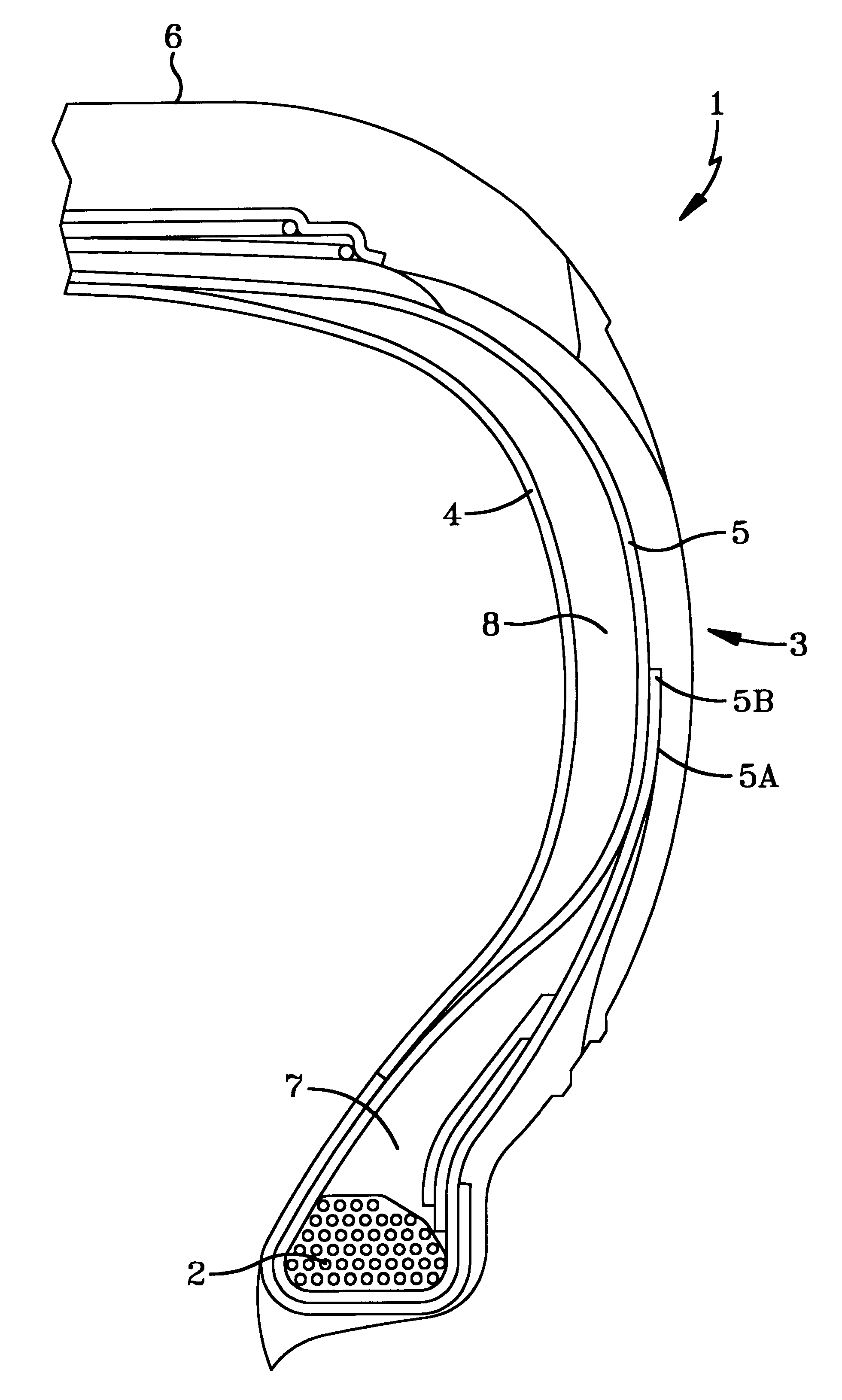
Figure 1 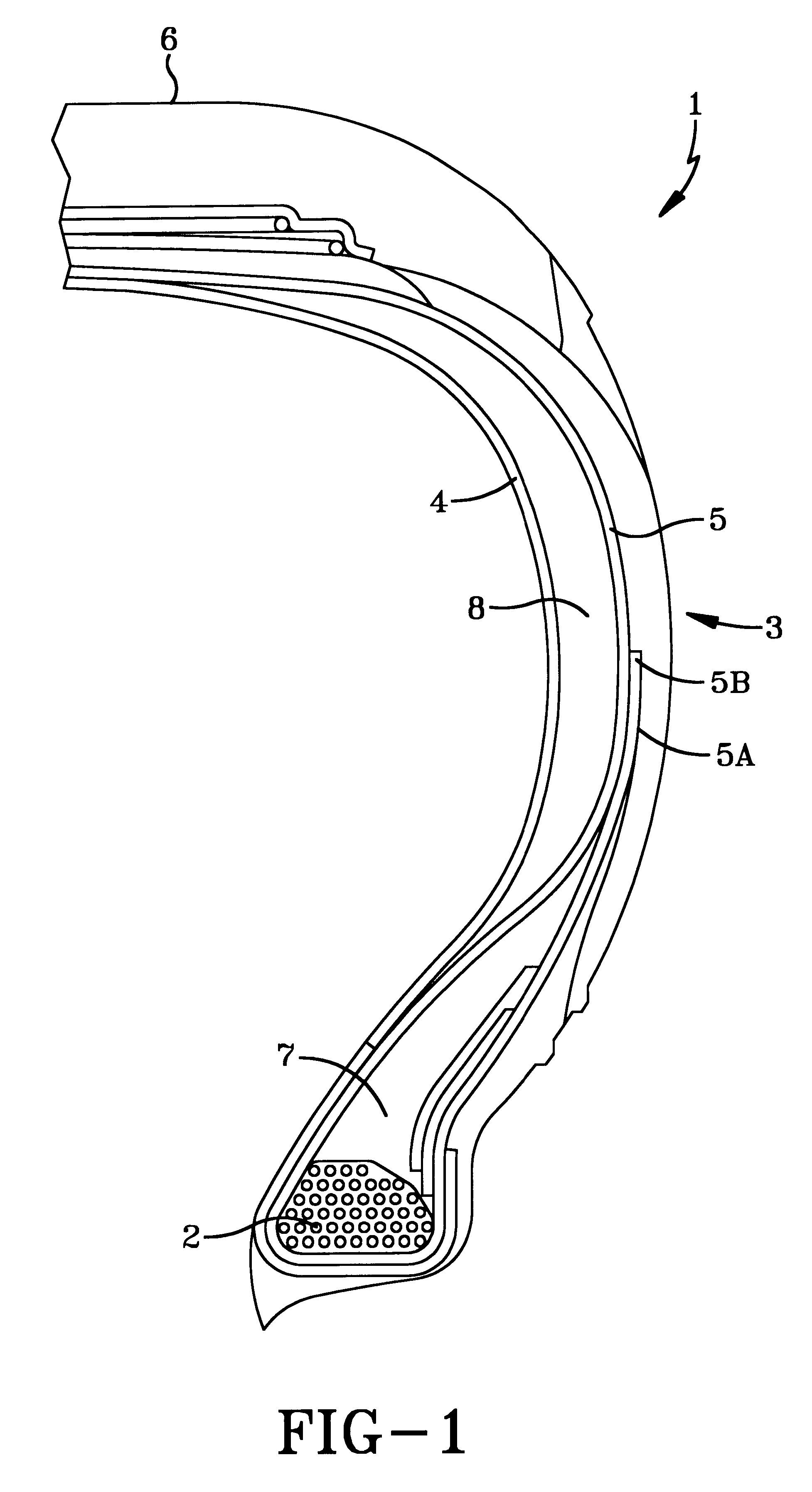
Figure 2
Abstract
Description
FIELDThis invention relates to a pneumatic tire having a rubber insert in its sidewall axially inward of at least one carcass ply. Such insert may be, for example, an apex in extending radially outward from a bead core of a tire into its sidewall. Alternatively, the insert may be positioned higher in the sidewall portion of the tire and away from the bead core. Such insert is a rubber composition containing a dispersion of an ultra high molecular weight polyethylene and a dispersion of a starch composite.It is sometimes desired to provide a tire having a sidewall of a relatively high stiffness to enhance a tire's handling, for example its cornering stability, when mounted on a rigid rim as a part of a wheel of a vehicle. For example, see U.S. Pat. Nos. 4,024,901 and 4,067,373.Often, a resin is added to an apex portion of a tire sidewall to make it stiffer. However, addition of a resin for such purpose, while increasing hardness for the rubber composition, may also adversely affect t...
Examples
Embodiment Construction
Rubber compositions are prepared which contain the materials shown in Table 1 which recite a Control rubber composition as Sample A as well as experimental rubber compositions as Samples B, C and D which contain, variously, a dispersion of a particulate ultra high molecular weight polyethylene (UHMWPE) and starch composite.
Ingredients, other than sulfur and accelerator(s), are mixed in sequential two non-productive mixing stages to a temperature of about 170.degree. C. for about 5 minutes for each stage in an internal rubber mixer. All of the non-productive ingredients were introduced in the first non-productive mixing stage, or operation. The term "non-productive" means without sulfur curatives and is a term well known to those skilled in such art.
Sulfur and cure accelerator(s) were then mixed in a subsequent mix stage, often referred to as a "productive" mixing stage, in an internal rubber mixer for about 2 minutes to a temperature of about 115.degree. C.
Table 2 reports the cure b...