
Light absorbent agent polymer useful for organic anti-reflective coating, its preparation method and organic anti-reflective coating composition comprising the same
a light absorbent agent and polymer technology, applied in the field of light absorbent agent polymer, can solve the problems of cd (critical dimension) alteration, affecting the fine processing of the photoresist, and standing waves and reflective notching inevitably occur, so as to prevent diffused light reflection
Patent Information
- Authority / Receiving Office
- US · United States
- Patent Type
- Patents(United States)
- Current Assignee / Owner
- Publication Date
- 2007-10-23
- Estimated Expiration
- Not applicable · inactive patent
Smart Images
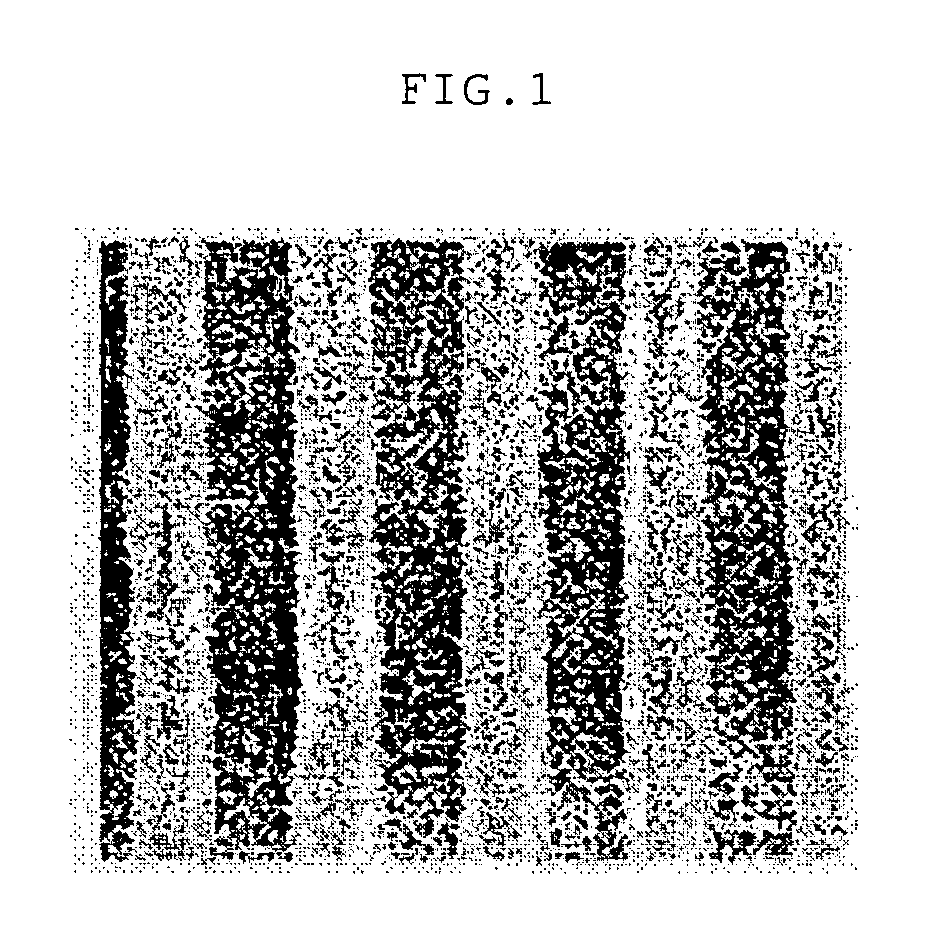
Figure 1 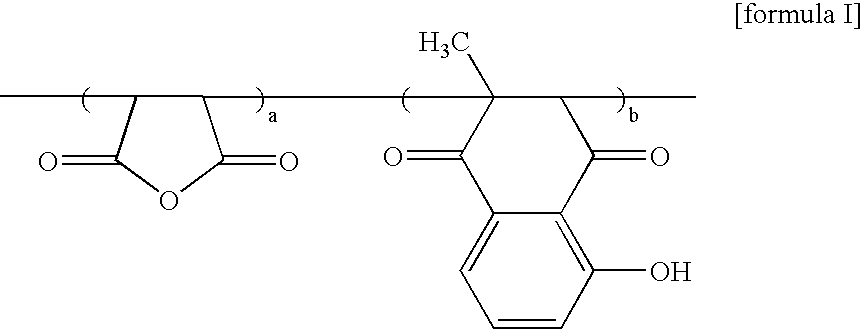
Figure 2 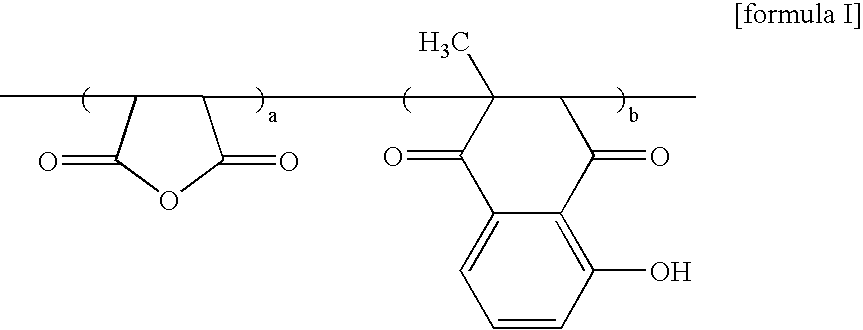
Figure 3
Abstract
Description
BACKGROUND OF THE INVENTION
[0001] 1. Field of the Invention
[0002] The present invention relates to a light absorbent agent polymer useful for organic anti-reflective coatings which can prevent diffused light reflection of the bottom film layer or substrate and reduce standing waves caused by a variation of thickness of the photoresist itself, thereby, increasing uniformity of the photoresist pattern, in a process for forming ultra-fine patterns of photoresist for photolithography by using 193 nm ArF among various processes for manufacturing semiconductor device, and its preparation method.
[0003] Also, the present invention provides an organic anti-reflective coating composition (hereinafter abbreviated as “the coating composition”) comprising the light absorbent agent polymer for the organic anti-reflective coating (hereinafter abbreviated as “the coating polymer”) and a pattern formation process using the coating composition.
[0004] 2. Description of the Related Art
[0005] In a fabricatio...
Examples
example 1
Synthesis of Light Absorbent Agent Polymer
[0052]20 g of maleic anhydride and 19 g of 5-hydroxy-2-methyl-1,4-naphthoquinone (0.5% by mole per maleic anhydride) were dissolved in 26 g of PGMEA. The dissolved mixture was added with 0.5 g of AIBN to form a vacuum condition then reacted at 65° C. for 7 hours. After completing the reaction, the solvent was removed from the obtained solution by means of an evaporator. Thereafter, the treated solution was under deposition and filtration processes in distilled water, then washed by using ethylether several times to produce the light absorbent agent polymer of formula I (yield 40%).
[0053]Molecular weight: 7,000
example 2
Preparation of Organic Anti-Reflective Coating Composition
[0054]1 g of the light absorbent agent polymer prepared from Example 1 and 0.4 g of the cross-linking agent polymer of formula III were dissolved in a solvent mixture comprising 4 g of propylene glycol methylether acetate solvent; 10 g of methyl 3-methoxy propionate solvent; 10 g of 2-heptanone solvent; and 7 g of tetrahydrofurane solvent. After adding 0.1 g of the thermal acid generator having the structure represented by the formula VII to the resultant material to be dissolved, the dissolved mixture passed through a filter to produce the desired organic anti-reflective coating composition.
[0055]
example 3
Formation of Organic Anti-Reflective Coating and Photoresist Pattern
[0056]On a silicone wafer, a spin-coating was carried out with the organic anti-reflective coating composition prepared in Example 2, then a baking process was conducted for the obtained material at 215° C. for 2 minutes to generate a cross-linkage bond and form the desirable anti-reflective coating. Thereafter, the obtained anti-reflective coating was put under a coating process with a so-called Keum Ho petroleum photosensitive agent (the name of generally used photoresist materials) and another baking process at 110° C. for 90 seconds. After conducting the above baking process, the baked product was exposed to a light source by means of ASML / 900 scanner apparatus, then, under an additional baking process at 130° C. for 90 seconds. The exposed wafer was developed using an aqueous solution of 2.38% by weight of TMAH. From the developed material produced was the pattern shown in FIG. 1.
[0057]As above mentioned, the p...