
Multidentate arrays
a multi-dentate array and array technology, applied in the field of arrays, to achieve the effect of simple fabrication and good binding affinity for the targ
Patent Information
- Authority / Receiving Office
- US · United States
- Patent Type
- Patents(United States)
- Current Assignee / Owner
- Publication Date
- 2009-02-10
- Estimated Expiration
- Not applicable · inactive patent
Smart Images
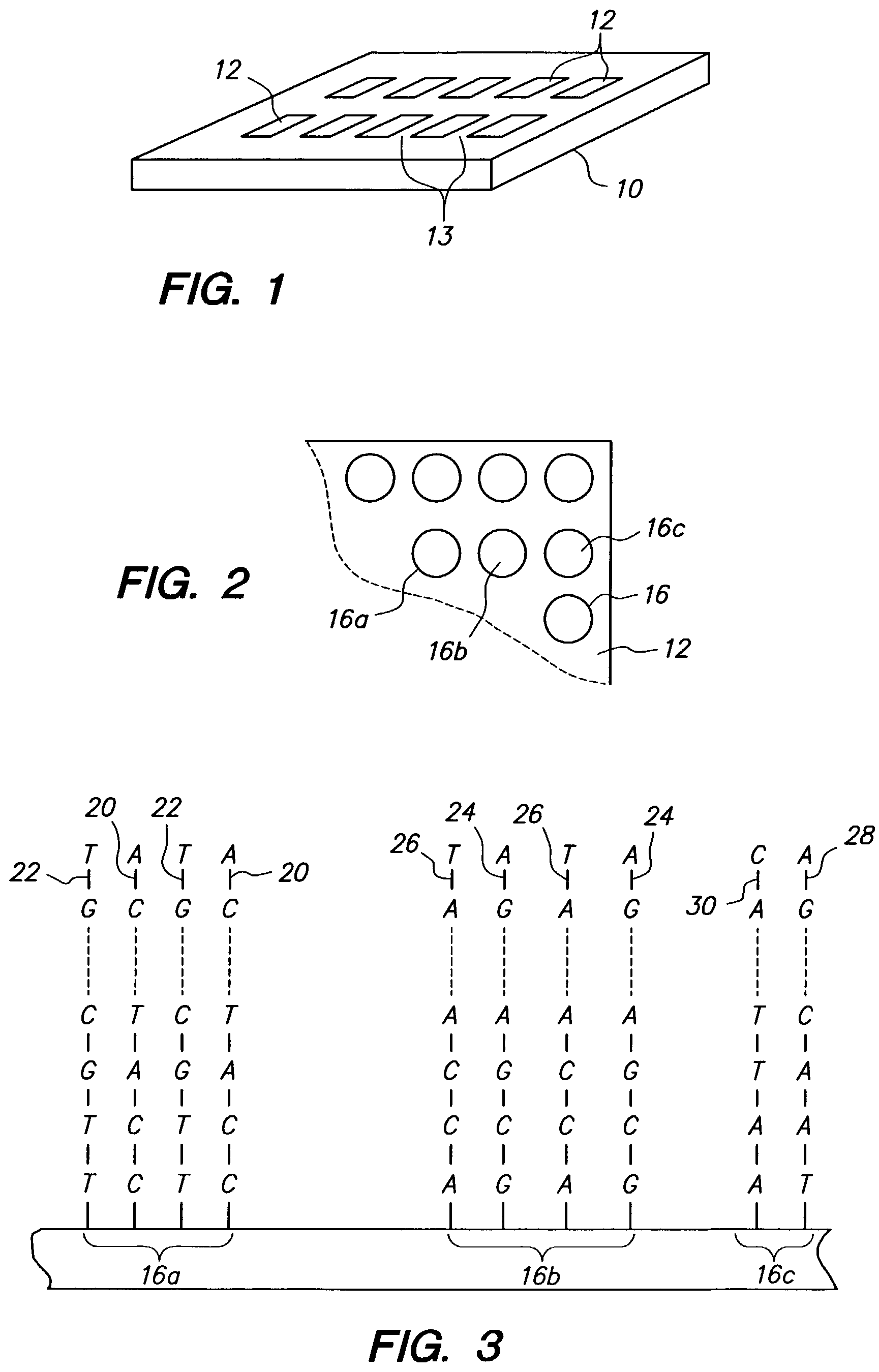
Figure 1 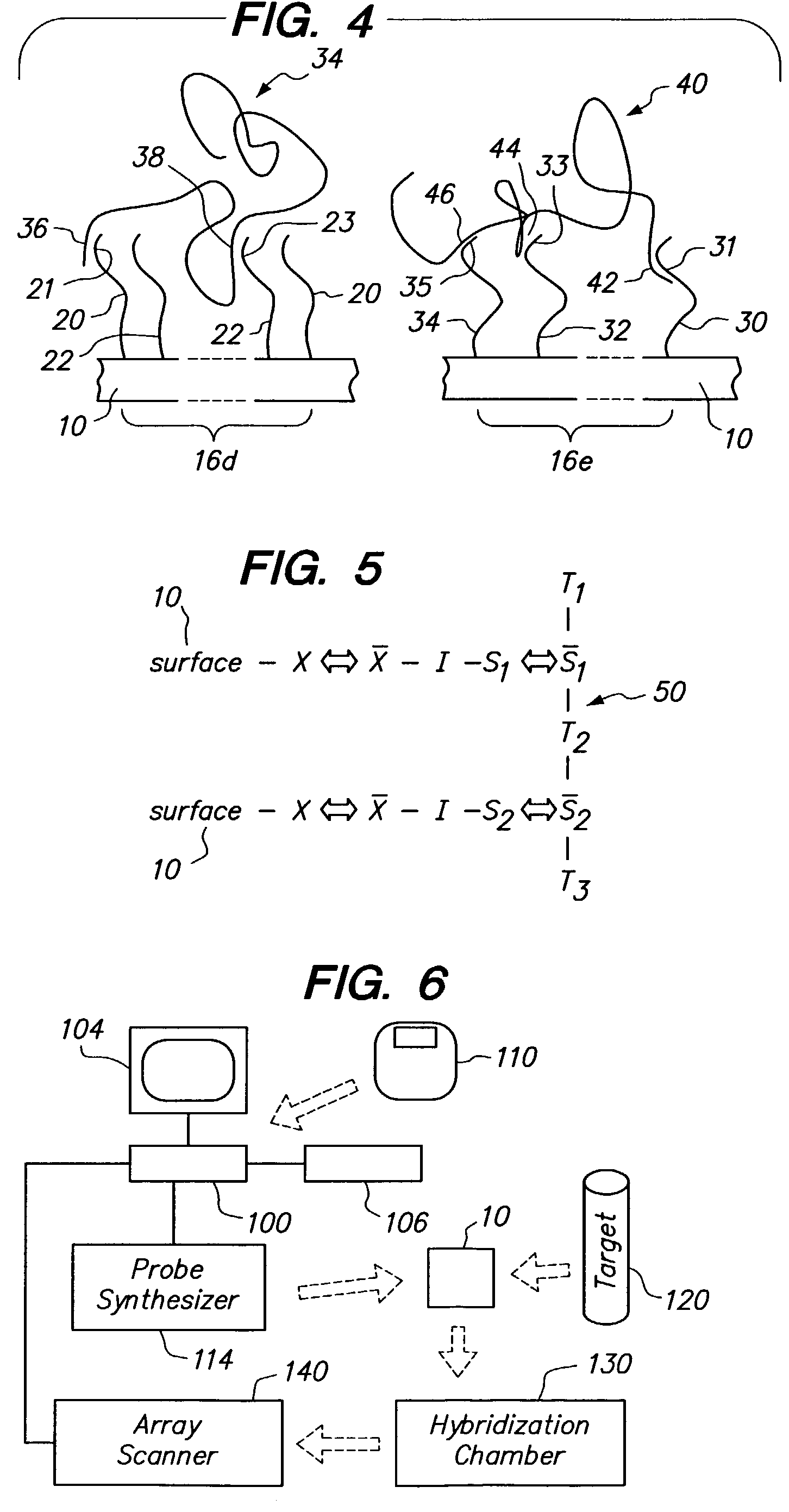
Figure 2 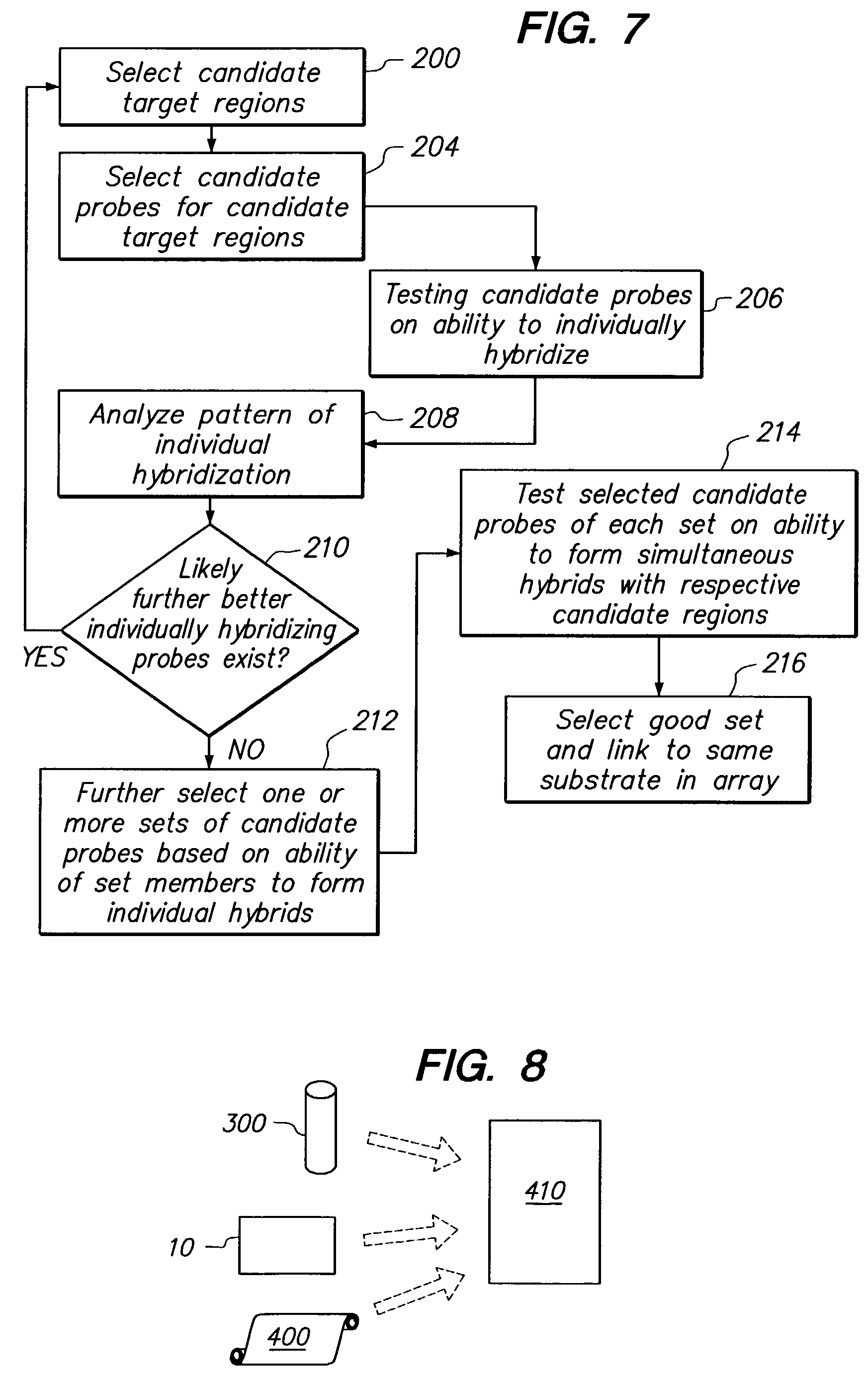
Figure 3
Abstract
Description
[0001] This is a Divisional application Ser. No. 09 / 346,655, filed on Jul. 01, 1999 now U.S. Pat. No. 6,465,183, the entire disclosure of which is incorporated herein by reference.FIELD OF THE INVENTION
[0002] This invention relates to arrays, particularly biopolymer arrays such polynucleotide arrays, which are useful in diagnostic, screening, gene expression analysis, and other applications.BACKGROUND OF THE INVENTION
[0003] Arrays of biopolymers, such as arrays of peptides or polynucleotides (such as DNA or RNA), are known and are used, for example, as diagnostic or screening tools. Such arrays include regions (sometimes referenced as features or spots) of usually different sequence biopolymers arranged in a predetermined configuration on a substrate. The arrays, when exposed to a sample, will exhibit a pattern of binding which is indicative of the presence and / or concentration of one or more components of the sample, such as an antigen in the case of a peptide array or a polynucleotid...
Examples
example
[0062]A specific example of the process of selecting a simultaneously hybridizing probe set, will now be described.
Selection of Successful Individually Hybridizing Candidate Probes
[0063]Highly sensitive probe sequences specific to the cab, cor47 and sig1 genes of Arabidopsis thaliana and a portion of the pbpC gene of E. coli were determined by two-step iterative refinement. In the first step, every 10th possible 25-mer probe to each target was synthesized on an oligonucleotide array. Arrays were hybridized to rhodamine-6-G-labeled complementary RNA (cRNA) derived from each target. Labeled cRNA was produced by transcribing a template that placed a T7 RNA polymerase promoter at the 3′ end of a given gene; rhodamine-6-G (R6G) was introduced by adding R6G-CTP (New England Nuclear, Boston, Mass.) to the nucleotide triphosphate mixture.
[0064]Hybridizations were performed overnight, at 37° C., in a solution containing 6×SSPE (900 mM sodium chloride / 60 mM sodium phosphate / 6 mM EDTA, pH 7.5)...