
Medical device and its manufacture
a technology of medical devices and manufacturing, applied in the field of medical devices and their manufacture, can solve the problems of inability to detect defects, increase the tension of the device joining the parts of the fracture, and so as to reduce the tension, increase the fixation tension, and restore the fixation tension
Patent Information
- Authority / Receiving Office
- US · United States
- Patent Type
- Patents(United States)
- Current Assignee / Owner
- Publication Date
- 2016-07-19
Smart Images
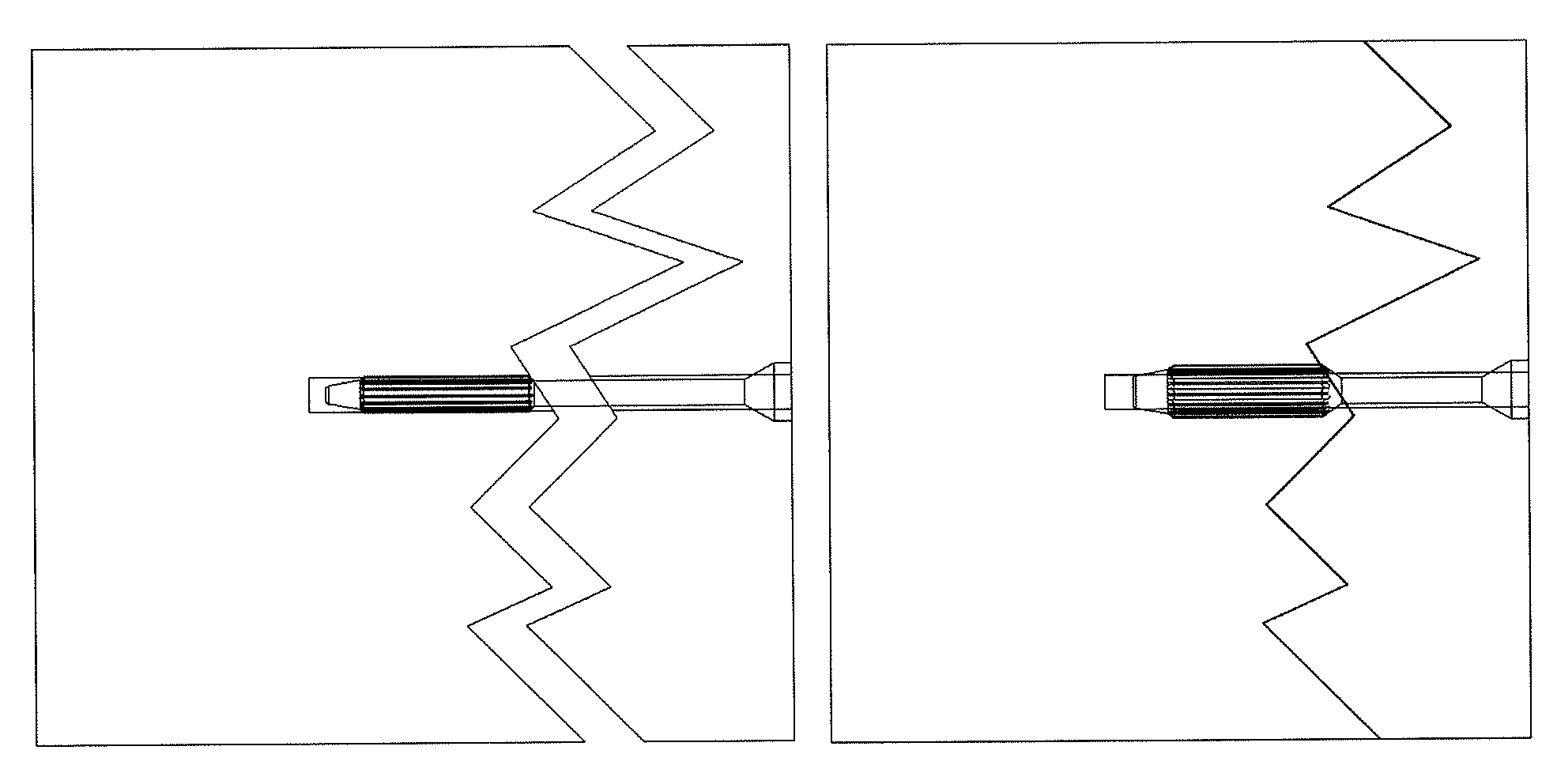
Figure 1 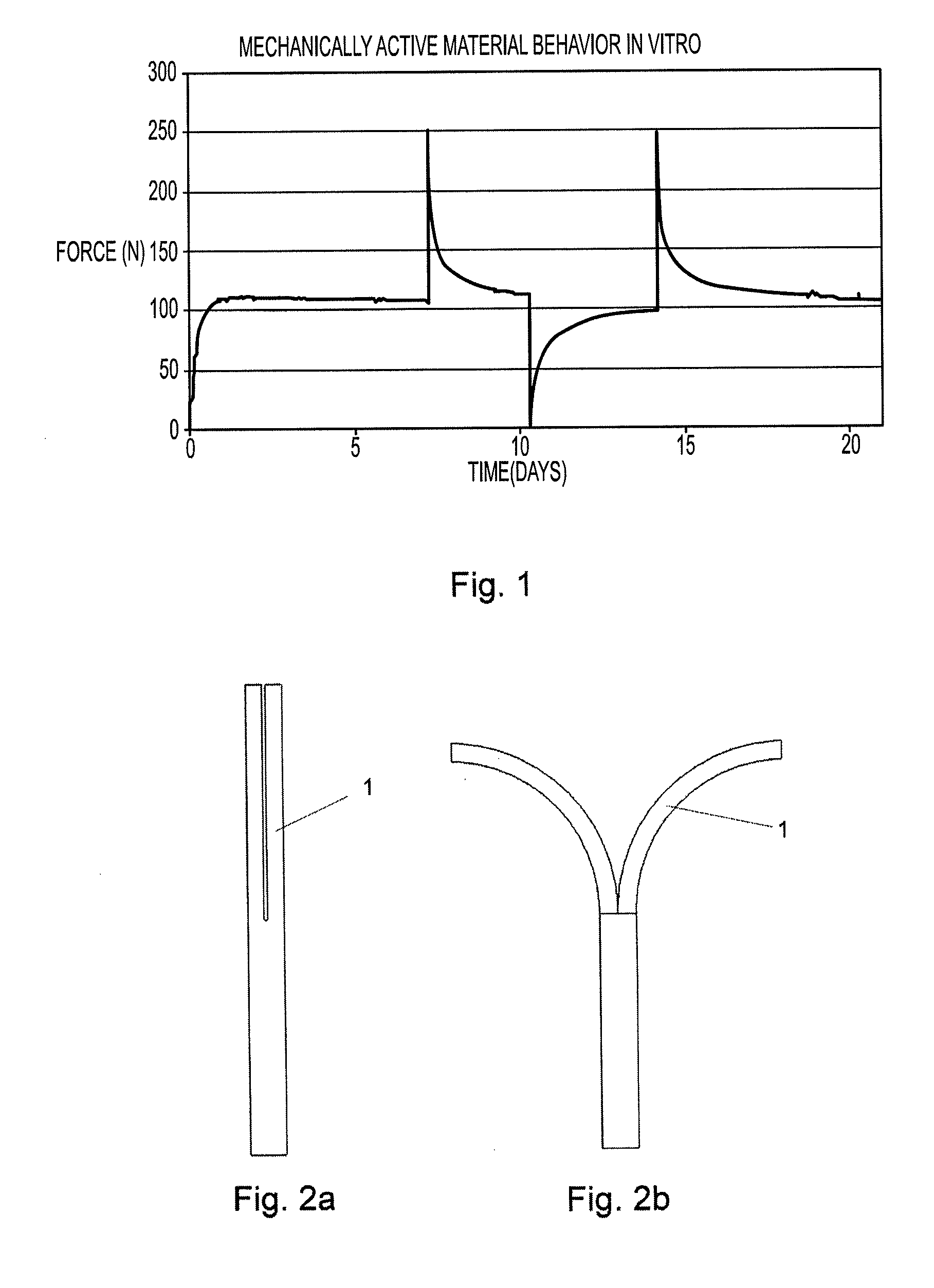
Figure 2 
Figure 3
Abstract
Description
CROSS-REFERENCE TO RELATED APPLICATIONS
[0001] This application claims priority to Finnish patent application 20075881 filed 5 Dec. 2007.BACKGROUND
[0002] H. Heino, P. Törmälä, J. Ilomäki: “Influence of Self-Reinforcing on In Vitro Stress Relaxation of 70L / 30D,L PLA”, Conference abstract (oral presentation): 7th World Biomaterials Congress 16-21 May 2004, Sydney, Australia, discloses not self-reinforced (not oriented) samples and self-reinforced (oriented) samples made 70L / 30D,L PLA which were fixed to a sample holder and placed in phosphate buffer solution at 37° C. The self-reinforced samples tended to keep a certain level of stress after 7 days testing period, whereas the not oriented samples had no significant residual stress left after 1 day.
[0003] Publication US 2005 / 0033295 discloses implants formed of shape memory polymeric material for spinal fixation. The shape memory polymeric material may be biodegradable or non-biodegradable. The polymeric material tends to assume its memory...
Examples
example 1
[0092]PLA 50D / 50L is melt extruded to a round profile having a diameter of 6.45 mm using a 20 mm twin screw extruder. The extrusion temperatures are between 50° C. and 280° C. The throughput is 700 g / h. The 6.45 mm rod is then die drawn at 80° C. to a 3.40 mm rod having a grooved surface and subsequently cooled down to room temperature. The resulting draw ratio is 4. The billet has now the mechanical activity properties described in FIG. 1. A medical device represented in FIG. 18 and FIG. 19 is made out of this billet. First, a 30 mm long piece is cut out of this billet and one end is machined to form a sharp angle. The thinner section is made by machining. The head is compression molded at 110° C. and subsequently cooled down to room temperature. The function of this medical device in bone fixation application is represented in FIGS. 20 and 21.
example 2
[0093]A blend of PLGA 85L / 15G and PLA 50D / 50L is injection molded to a predefined shape for a biodegradable band for closure of sternotomy. The pre-shape is then free drawn at 78° C., wherein this temperature lies between the glass transition temperature and the melting temperature of the material. The final shape and details are machined after the orientation process. The oriented band is implanted around the sternum to close the sternotomy. The compression of the polymer band generates a predefined compression force in the sternotomy as shown in FIG. 1. Five to seven such bands are used in one sternotomy closure. The mechanism for the contraction of the band is shown in FIG. 23.
example 3
[0094]A device for distraction osteogenesis is shown in FIG. 16 and in FIG. 17. The frame structure is extruded and machined or injection molded from PLA 96L / 4D and a contractile and expandable active component having mechanical activity shown in FIG. 1 is extruded and drawn from PLA 70L / 30DL with L-lactide auxiliary component. The device is implanted to the distraction site and fixed to the bone using bioabsorbable screws. The device generates a predefined force level as described in FIG. 1 and a predefined contraction-expansion behavior as described in FIG. 28, FIG. 29 and FIG. 30.