
Anode-Free Solid-State Supplier Qualification Checklist
SEP 1, 20259 MIN READ
Generate Your Research Report Instantly with AI Agent
Patsnap Eureka helps you evaluate technical feasibility & market potential.
Anode-Free Battery Technology Background and Objectives
Anode-free battery technology represents a significant evolution in energy storage systems, emerging from decades of lithium-ion battery development. This revolutionary approach eliminates the traditional graphite or silicon anode, allowing lithium metal to plate directly onto the current collector during charging. The concept dates back to the 1970s, but has gained substantial momentum in the past decade due to increasing demands for higher energy density batteries.
The primary objective of anode-free solid-state battery technology is to achieve unprecedented energy density—potentially exceeding 500 Wh/kg at the cell level—while maintaining safety and longevity. This represents a theoretical improvement of 50-70% over conventional lithium-ion batteries, addressing the critical need for extended range in electric vehicles and longer operation time in portable electronics.
The technology evolution pathway shows a clear progression from liquid electrolyte systems toward solid-state configurations, which are essential for stabilizing the lithium metal interface. This transition aims to overcome the persistent challenges of dendrite formation and electrolyte decomposition that have historically limited lithium metal battery commercialization.
Current research focuses on developing compatible solid electrolytes with sufficient ionic conductivity and mechanical strength to withstand volume changes during cycling. The qualification of suppliers in this space requires rigorous assessment of material consistency, scalability, and compatibility with existing manufacturing infrastructure.
Industry projections suggest that anode-free solid-state batteries could enter commercial production within the next 3-5 years, with initial applications in premium electronic devices before scaling to electric vehicles. This timeline is contingent upon solving remaining technical challenges, particularly around cycle life and manufacturing cost.
The environmental implications of this technology are significant, as the elimination of anode materials like graphite could reduce the carbon footprint of battery production by approximately 15-20%. Additionally, the higher energy density translates to more efficient resource utilization across the battery lifecycle.
For supplier qualification, key technical parameters include ionic conductivity (target >1 mS/cm at room temperature), interfacial stability with lithium metal, mechanical properties to prevent dendrite penetration, and demonstrated cycle life exceeding 500 cycles with less than 20% capacity degradation. These metrics form the foundation of any comprehensive supplier assessment framework.
The primary objective of anode-free solid-state battery technology is to achieve unprecedented energy density—potentially exceeding 500 Wh/kg at the cell level—while maintaining safety and longevity. This represents a theoretical improvement of 50-70% over conventional lithium-ion batteries, addressing the critical need for extended range in electric vehicles and longer operation time in portable electronics.
The technology evolution pathway shows a clear progression from liquid electrolyte systems toward solid-state configurations, which are essential for stabilizing the lithium metal interface. This transition aims to overcome the persistent challenges of dendrite formation and electrolyte decomposition that have historically limited lithium metal battery commercialization.
Current research focuses on developing compatible solid electrolytes with sufficient ionic conductivity and mechanical strength to withstand volume changes during cycling. The qualification of suppliers in this space requires rigorous assessment of material consistency, scalability, and compatibility with existing manufacturing infrastructure.
Industry projections suggest that anode-free solid-state batteries could enter commercial production within the next 3-5 years, with initial applications in premium electronic devices before scaling to electric vehicles. This timeline is contingent upon solving remaining technical challenges, particularly around cycle life and manufacturing cost.
The environmental implications of this technology are significant, as the elimination of anode materials like graphite could reduce the carbon footprint of battery production by approximately 15-20%. Additionally, the higher energy density translates to more efficient resource utilization across the battery lifecycle.
For supplier qualification, key technical parameters include ionic conductivity (target >1 mS/cm at room temperature), interfacial stability with lithium metal, mechanical properties to prevent dendrite penetration, and demonstrated cycle life exceeding 500 cycles with less than 20% capacity degradation. These metrics form the foundation of any comprehensive supplier assessment framework.
Market Analysis for Solid-State Battery Demand
The solid-state battery market is experiencing unprecedented growth, driven by increasing demand for electric vehicles (EVs), consumer electronics, and energy storage systems. Current market projections indicate that the global solid-state battery market will reach approximately $8 billion by 2030, with a compound annual growth rate exceeding 34% between 2023 and 2030. This remarkable growth trajectory is primarily fueled by the automotive sector's aggressive electrification targets and stringent safety regulations.
The EV segment represents the largest demand driver, with major automakers including Toyota, Volkswagen, and BMW investing heavily in solid-state technology. These manufacturers are targeting commercial deployment between 2025 and 2028, creating significant market pull. Industry analysts predict that by 2035, solid-state batteries could capture up to 25% of the total EV battery market.
Consumer electronics manufacturers are also showing increased interest in solid-state technology, particularly for high-end smartphones, wearables, and portable computing devices. This segment values the enhanced energy density and safety profiles of solid-state batteries, with companies like Samsung and Apple reportedly developing prototype devices with solid-state power sources.
Regional analysis reveals that Asia-Pacific currently dominates solid-state battery development and manufacturing capacity, with Japan and South Korea leading in patent filings and commercial partnerships. However, North America and Europe are rapidly expanding their capabilities through substantial government funding initiatives and strategic industrial policies aimed at securing domestic battery supply chains.
Market adoption faces several demand-side challenges, including cost premiums estimated at 2-3 times that of conventional lithium-ion batteries. This price differential is expected to decrease as manufacturing scales, with cost parity potentially achievable by 2028-2030 according to industry forecasts.
Customer requirements are evolving rapidly, with automotive OEMs particularly focused on cycle life (demanding 1,000+ cycles), fast charging capabilities (80% charge in under 15 minutes), and operation across wide temperature ranges (-20°C to 60°C). These performance metrics are becoming standardized in supplier qualification processes across the industry.
The anode-free solid-state battery configuration is gaining particular attention due to its potential for higher energy density and reduced material costs. Market research indicates that approximately 40% of solid-state battery development programs are exploring anode-free or anode-light architectures, representing a significant subset of the overall market demand.
The EV segment represents the largest demand driver, with major automakers including Toyota, Volkswagen, and BMW investing heavily in solid-state technology. These manufacturers are targeting commercial deployment between 2025 and 2028, creating significant market pull. Industry analysts predict that by 2035, solid-state batteries could capture up to 25% of the total EV battery market.
Consumer electronics manufacturers are also showing increased interest in solid-state technology, particularly for high-end smartphones, wearables, and portable computing devices. This segment values the enhanced energy density and safety profiles of solid-state batteries, with companies like Samsung and Apple reportedly developing prototype devices with solid-state power sources.
Regional analysis reveals that Asia-Pacific currently dominates solid-state battery development and manufacturing capacity, with Japan and South Korea leading in patent filings and commercial partnerships. However, North America and Europe are rapidly expanding their capabilities through substantial government funding initiatives and strategic industrial policies aimed at securing domestic battery supply chains.
Market adoption faces several demand-side challenges, including cost premiums estimated at 2-3 times that of conventional lithium-ion batteries. This price differential is expected to decrease as manufacturing scales, with cost parity potentially achievable by 2028-2030 according to industry forecasts.
Customer requirements are evolving rapidly, with automotive OEMs particularly focused on cycle life (demanding 1,000+ cycles), fast charging capabilities (80% charge in under 15 minutes), and operation across wide temperature ranges (-20°C to 60°C). These performance metrics are becoming standardized in supplier qualification processes across the industry.
The anode-free solid-state battery configuration is gaining particular attention due to its potential for higher energy density and reduced material costs. Market research indicates that approximately 40% of solid-state battery development programs are exploring anode-free or anode-light architectures, representing a significant subset of the overall market demand.
Current Challenges in Anode-Free Solid-State Technology
Despite significant advancements in solid-state battery technology, anode-free solid-state batteries face several critical challenges that hinder their commercial viability. The most prominent issue is the lithium metal interface stability, where the solid electrolyte struggles to maintain consistent contact with the in-situ formed lithium metal anode during cycling. This interface degradation leads to increased impedance and accelerated capacity fade, severely limiting cycle life.
Dendrite formation presents another major obstacle. Without traditional graphite or silicon anodes to buffer lithium deposition, lithium tends to plate unevenly during charging, creating dendrites that can penetrate the solid electrolyte. These dendrites not only compromise battery safety but can eventually cause internal short circuits, leading to catastrophic failure.
Manufacturing scalability remains problematic for anode-free solid-state batteries. Current production methods are predominantly laboratory-scale processes that don't translate efficiently to mass production. The precise control required for electrolyte thickness, uniformity, and interface quality presents significant engineering challenges when scaling to commercial volumes.
Material cost considerations also impede widespread adoption. High-performance solid electrolytes often contain expensive elements like germanium, tantalum, or rare earth metals. Without anode materials to offset some functionality, the electrolyte must perform multiple roles, often requiring more sophisticated and costly compositions.
Energy density optimization continues to challenge researchers. While removing the anode theoretically increases energy density, practical implementations often require thicker electrolytes or additional interface layers to maintain stability, partially negating the density advantages.
Pressure requirements represent a significant engineering hurdle. Many solid-state systems require substantial stack pressure to maintain intimate contact between components, especially as lithium is deposited and consumed. This necessitates complex mechanical engineering solutions that add weight, cost, and complexity to cell and pack designs.
Temperature sensitivity further complicates implementation. Anode-free solid-state batteries typically exhibit narrow operating temperature windows, with performance degrading significantly at low temperatures due to reduced ionic conductivity and at high temperatures due to accelerated side reactions at the lithium metal interface.
Qualification standards remain underdeveloped for this emerging technology. Without established testing protocols specifically designed for anode-free configurations, suppliers struggle to demonstrate reliability and performance in standardized ways that enable meaningful comparison between different solutions.
Dendrite formation presents another major obstacle. Without traditional graphite or silicon anodes to buffer lithium deposition, lithium tends to plate unevenly during charging, creating dendrites that can penetrate the solid electrolyte. These dendrites not only compromise battery safety but can eventually cause internal short circuits, leading to catastrophic failure.
Manufacturing scalability remains problematic for anode-free solid-state batteries. Current production methods are predominantly laboratory-scale processes that don't translate efficiently to mass production. The precise control required for electrolyte thickness, uniformity, and interface quality presents significant engineering challenges when scaling to commercial volumes.
Material cost considerations also impede widespread adoption. High-performance solid electrolytes often contain expensive elements like germanium, tantalum, or rare earth metals. Without anode materials to offset some functionality, the electrolyte must perform multiple roles, often requiring more sophisticated and costly compositions.
Energy density optimization continues to challenge researchers. While removing the anode theoretically increases energy density, practical implementations often require thicker electrolytes or additional interface layers to maintain stability, partially negating the density advantages.
Pressure requirements represent a significant engineering hurdle. Many solid-state systems require substantial stack pressure to maintain intimate contact between components, especially as lithium is deposited and consumed. This necessitates complex mechanical engineering solutions that add weight, cost, and complexity to cell and pack designs.
Temperature sensitivity further complicates implementation. Anode-free solid-state batteries typically exhibit narrow operating temperature windows, with performance degrading significantly at low temperatures due to reduced ionic conductivity and at high temperatures due to accelerated side reactions at the lithium metal interface.
Qualification standards remain underdeveloped for this emerging technology. Without established testing protocols specifically designed for anode-free configurations, suppliers struggle to demonstrate reliability and performance in standardized ways that enable meaningful comparison between different solutions.
Current Qualification Methods for Anode-Free Battery Suppliers
01 Anode-free solid-state battery design and materials
Anode-free solid-state batteries represent an innovative design approach where the anode is formed in situ during the first charge cycle, rather than being pre-installed during manufacturing. These designs typically use lithium metal that plates onto a current collector during charging. Key materials include specialized solid electrolytes that prevent dendrite formation and enable stable lithium plating/stripping. This approach offers advantages in energy density by eliminating the need for a dedicated anode material and substrate.- Anode-free solid-state battery design and materials: Anode-free solid-state batteries represent an innovative design approach where the anode is formed in situ during the first charging cycle, rather than being pre-installed during manufacturing. These designs typically use lithium metal that plates onto a current collector during charging. Key materials include specialized solid electrolytes with high ionic conductivity and mechanical stability to prevent dendrite formation. This approach offers advantages in energy density by eliminating the need for a dedicated anode material and substrate.
- Supplier qualification processes and quality control: Qualifying suppliers for anode-free solid-state batteries involves rigorous evaluation protocols to ensure consistent quality and performance. This includes assessment of manufacturing capabilities, material purity standards, process controls, and quality management systems. Suppliers must demonstrate the ability to produce components that meet strict specifications for chemical composition, dimensional accuracy, and electrochemical performance. Qualification typically involves sample testing, facility audits, and ongoing monitoring to maintain quality standards throughout the supply relationship.
- Performance testing and validation methods: Comprehensive testing protocols are essential for validating anode-free solid-state batteries from potential suppliers. These include electrochemical performance tests (capacity, cycling stability, rate capability), safety evaluations (thermal stability, short-circuit resistance), and accelerated aging tests to predict long-term performance. Advanced characterization techniques such as impedance spectroscopy, X-ray diffraction, and electron microscopy are employed to analyze material interfaces and degradation mechanisms. Standardized testing procedures ensure consistent evaluation across different suppliers and battery designs.
- Manufacturing processes and scalability assessment: Evaluating suppliers for anode-free solid-state batteries requires assessment of their manufacturing processes and scalability potential. This includes examining production techniques for solid electrolytes, current collectors, and cathode materials, as well as assembly methods that ensure proper interfacial contact between components. Key considerations include process repeatability, yield rates, equipment capabilities, and ability to scale production volumes while maintaining quality. Advanced manufacturing techniques such as dry coating processes and specialized assembly methods may be required to produce these complex battery systems at commercial scale.
- Supply chain and raw material considerations: Supplier qualification for anode-free solid-state batteries must address supply chain resilience and raw material sourcing. This includes evaluating suppliers' access to critical materials, geographic diversification of material sources, and strategies for mitigating supply disruptions. Considerations include the sustainability of material extraction practices, compliance with environmental regulations, and ethical sourcing standards. Suppliers may need to demonstrate traceability systems for raw materials and components throughout the supply chain, particularly for critical elements used in solid electrolytes and cathode materials.
02 Supplier qualification processes for solid-state battery components
Qualifying suppliers for anode-free solid-state battery components involves rigorous evaluation protocols to ensure consistent quality and performance. This includes assessment of manufacturing capabilities, quality control systems, material purity standards, and production scalability. Supplier qualification typically requires extensive testing of material samples, auditing of production facilities, and verification of compliance with industry standards. Establishing reliable supply chains is critical for commercial viability of these advanced battery technologies.Expand Specific Solutions03 Performance testing and validation methods
Specialized testing protocols are essential for validating anode-free solid-state batteries and qualifying suppliers. These include electrochemical performance testing (cycling stability, rate capability, coulombic efficiency), safety testing (thermal stability, short-circuit resistance), and accelerated aging tests. Advanced characterization techniques such as impedance spectroscopy and in-situ microscopy are employed to evaluate interface stability and lithium plating behavior. Standardized testing enables objective comparison between different suppliers and technologies.Expand Specific Solutions04 Manufacturing processes and quality control
Manufacturing anode-free solid-state batteries requires specialized processes including dry-room assembly, precise control of material interfaces, and innovative cell stacking techniques. Quality control measures focus on electrolyte uniformity, interface cleanliness, and moisture exclusion. Advanced manufacturing techniques such as thin-film deposition and roll-to-roll processing are being adapted for solid-state battery production. Supplier qualification includes assessment of manufacturing consistency, defect rates, and process control capabilities.Expand Specific Solutions05 Integration and system-level considerations
Qualifying suppliers for anode-free solid-state batteries requires evaluation of how components integrate into complete battery systems. This includes assessment of thermal management compatibility, battery management system integration, and mechanical packaging considerations. System-level testing evaluates performance under various operating conditions, including temperature extremes and high-power demands. Suppliers must demonstrate capability to meet specifications for cell-to-cell consistency and module-level performance to ensure reliable operation in end applications.Expand Specific Solutions
Key Suppliers and Manufacturers in Solid-State Battery Industry
The anode-free solid-state battery market is in an early growth phase, characterized by significant R&D investment but limited commercial deployment. The global market is projected to expand rapidly as automotive manufacturers like Hyundai, GM, and Kia pursue next-generation battery technologies. Technical maturity varies considerably among key players, with established battery manufacturers such as CATL, Samsung SDI, and Panasonic leading development alongside specialized materials suppliers like Capchem and Do-Fluoride. Chinese companies demonstrate strong positioning in materials supply chains, while automotive OEMs are actively securing technology through partnerships and acquisitions. The competitive landscape features both vertical integration strategies and specialized component development approaches, with increasing collaboration between battery manufacturers, materials suppliers, and automotive companies.
Panasonic Intellectual Property Management Co. Ltd.
Technical Solution: Panasonic's anode-free solid-state battery technology centers on their proprietary ceramic-polymer composite electrolyte system. Their approach utilizes a lithium metal-free initial state where lithium is sourced entirely from a lithium-rich cathode during first charge. Panasonic has developed specialized current collectors with three-dimensional nanostructured surfaces that provide controlled nucleation sites for lithium deposition, significantly reducing dendrite formation risk. Their manufacturing process incorporates dry-room assembly techniques with specialized electrolyte deposition methods achieving uniform layers below 20μm thickness. Panasonic's cells have demonstrated fast-charging capabilities (80% in 15 minutes) while maintaining thermal stability under high current operations. Their qualification process includes extensive testing under varied pressure conditions to ensure consistent performance across different application scenarios.
Strengths: Established mass-production expertise, excellent thermal safety profile, and proven integration with automotive battery management systems. Weaknesses: Lower cycle life compared to some competitors (currently ~400 cycles to 80% capacity) and challenges with electrolyte-electrode interface stability over extended storage periods.
Hyundai Motor Co., Ltd.
Technical Solution: Hyundai's anode-free solid-state battery technology employs a multi-layer electrolyte architecture with gradient compositions optimized for both lithium metal interface stability and bulk ionic conductivity. Their approach incorporates a specialized current collector with nanopatterned surfaces that promote uniform lithium deposition during charging cycles. Hyundai has developed proprietary cathode formulations with higher lithium content specifically designed for anode-free configurations, enabling first-cycle efficiencies exceeding 90%. Their battery design includes innovative pressure distribution systems integrated into the cell housing to maintain optimal component contact throughout battery life. Hyundai's manufacturing process utilizes semi-automated assembly techniques in ultra-dry environments, with specialized quality control measures for electrolyte uniformity verification. Their prototype cells have demonstrated energy densities approximately 30% higher than conventional lithium-ion batteries while maintaining comparable power capabilities.
Strengths: Excellent integration with vehicle thermal management systems, balanced performance across energy density and power capability metrics, and advanced battery management algorithms specifically optimized for solid-state chemistry. Weaknesses: More limited in-house electrolyte production capabilities compared to dedicated battery manufacturers and higher unit costs in current prototype phases.
Critical Technical Parameters for Supplier Assessment
Anode-free solid-state battery and method of battery fabrication
PatentActiveUS11824159B2
Innovation
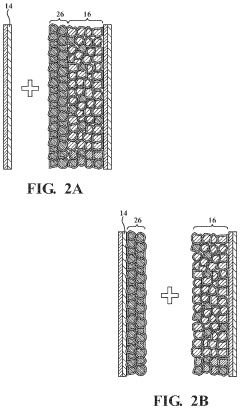
- An anode-free solid-state battery design that uses a cathode layer with transient anode elements, a bare current collector, and a gelled solid-state electrolyte layer to facilitate ionic conduction, eliminating the need for a permanent anode and simplifying the battery structure.



Active material-free composite anode for all-solid-state battery and method of manufacturing same
PatentActiveUS12322789B2
Innovation
- A composite anode is developed, comprising an anode current collector with a protective layer made of a metallic compound (such as TiO2 or ZrC) and a metal alloyable with lithium (like silver or gold), which promotes uniform lithium precipitation.


Supply Chain Risk Management for Solid-State Battery Production
Supply chain risk management is critical for the successful commercialization of anode-free solid-state battery technology. The qualification of suppliers for this emerging technology requires a comprehensive approach to identify, assess, and mitigate potential risks throughout the supply chain. Companies developing anode-free solid-state batteries must establish robust supplier qualification processes that address the unique challenges of this technology.
Material sourcing represents a significant risk factor, particularly for specialized components such as solid electrolytes and current collectors that must meet stringent performance requirements. Geographic concentration of critical materials like lithium, sulfur, and ceramic electrolyte precursors can create supply vulnerabilities. Companies should implement multi-sourcing strategies where possible and develop contingency plans for single-source materials.
Manufacturing process capability assessment is essential when qualifying suppliers for anode-free solid-state battery components. The precision required for manufacturing these batteries exceeds that of conventional lithium-ion batteries, particularly regarding moisture control, interface engineering, and pressure application during assembly. Suppliers must demonstrate consistent quality control measures and statistical process control capabilities specific to solid-state battery requirements.
Regulatory compliance presents another significant risk dimension. As anode-free solid-state battery technology evolves, regulations regarding safety testing, transportation, and recycling continue to develop. Supplier qualification should include verification of compliance with current regulations and assessment of suppliers' ability to adapt to evolving regulatory frameworks across global markets.
Technology obsolescence risk is particularly relevant in this rapidly evolving field. Suppliers should demonstrate research and development capabilities and technology roadmaps aligned with industry trends. Qualification processes should evaluate suppliers' innovation potential and ability to scale production as technology matures, ensuring long-term viability of the supply relationship.
Financial stability assessment of suppliers is crucial given the capital-intensive nature of advanced battery manufacturing. The qualification process should include financial health metrics, investment capacity evaluation, and business continuity planning. This becomes especially important for startups and smaller companies developing novel solid-state battery components.
Intellectual property considerations must be addressed through comprehensive supplier agreements that clearly define ownership of jointly developed technologies, confidentiality provisions, and licensing terms. This protects both parties while enabling collaborative innovation necessary for advancing anode-free solid-state battery technology.
Material sourcing represents a significant risk factor, particularly for specialized components such as solid electrolytes and current collectors that must meet stringent performance requirements. Geographic concentration of critical materials like lithium, sulfur, and ceramic electrolyte precursors can create supply vulnerabilities. Companies should implement multi-sourcing strategies where possible and develop contingency plans for single-source materials.
Manufacturing process capability assessment is essential when qualifying suppliers for anode-free solid-state battery components. The precision required for manufacturing these batteries exceeds that of conventional lithium-ion batteries, particularly regarding moisture control, interface engineering, and pressure application during assembly. Suppliers must demonstrate consistent quality control measures and statistical process control capabilities specific to solid-state battery requirements.
Regulatory compliance presents another significant risk dimension. As anode-free solid-state battery technology evolves, regulations regarding safety testing, transportation, and recycling continue to develop. Supplier qualification should include verification of compliance with current regulations and assessment of suppliers' ability to adapt to evolving regulatory frameworks across global markets.
Technology obsolescence risk is particularly relevant in this rapidly evolving field. Suppliers should demonstrate research and development capabilities and technology roadmaps aligned with industry trends. Qualification processes should evaluate suppliers' innovation potential and ability to scale production as technology matures, ensuring long-term viability of the supply relationship.
Financial stability assessment of suppliers is crucial given the capital-intensive nature of advanced battery manufacturing. The qualification process should include financial health metrics, investment capacity evaluation, and business continuity planning. This becomes especially important for startups and smaller companies developing novel solid-state battery components.
Intellectual property considerations must be addressed through comprehensive supplier agreements that clearly define ownership of jointly developed technologies, confidentiality provisions, and licensing terms. This protects both parties while enabling collaborative innovation necessary for advancing anode-free solid-state battery technology.
Quality Assurance Standards for Anode-Free Battery Components
Quality assurance standards for anode-free battery components must be rigorously established to ensure the reliability and performance of next-generation solid-state batteries. These standards should encompass comprehensive testing protocols for material purity, structural integrity, and electrochemical performance. The absence of a traditional anode in these systems places greater demands on the quality of other components, particularly the solid electrolyte and current collectors.
Material purity verification represents a critical first step in the quality assurance process. Suppliers must demonstrate consistent chemical composition with impurity levels below established thresholds, typically in the parts-per-million range. Advanced analytical techniques such as ICP-MS (Inductively Coupled Plasma Mass Spectrometry) and XPS (X-ray Photoelectron Spectroscopy) should be employed to verify compliance with these stringent requirements.
Dimensional and structural consistency must be maintained across production batches. This includes thickness uniformity, surface roughness parameters, and mechanical properties such as flexibility and tensile strength. Statistical process control methods should be implemented to monitor these attributes, with clear acceptance criteria defined for each parameter.
Electrochemical performance testing constitutes another essential component of the quality assurance framework. Suppliers should provide documentation of ionic conductivity measurements, interfacial resistance characteristics, and cycling stability under standardized conditions. These tests must be conducted at various temperatures to ensure performance across the intended operating range.
Manufacturing process validation is equally important for ensuring component quality. Suppliers should maintain detailed records of production parameters, environmental conditions, and in-process testing results. Regular audits of these records, combined with on-site inspections, help verify adherence to established manufacturing protocols.
Traceability systems must be implemented to track components from raw materials through production to final delivery. Each batch should carry unique identifiers linking to comprehensive documentation of test results and production parameters. This enables rapid identification and isolation of potentially problematic components should issues arise during battery assembly or operation.
Certification requirements should align with international standards such as ISO 9001 for quality management systems and industry-specific standards like those developed by organizations such as the International Electrotechnical Commission (IEC). Suppliers should demonstrate compliance through third-party verification and regular recertification processes.
Material purity verification represents a critical first step in the quality assurance process. Suppliers must demonstrate consistent chemical composition with impurity levels below established thresholds, typically in the parts-per-million range. Advanced analytical techniques such as ICP-MS (Inductively Coupled Plasma Mass Spectrometry) and XPS (X-ray Photoelectron Spectroscopy) should be employed to verify compliance with these stringent requirements.
Dimensional and structural consistency must be maintained across production batches. This includes thickness uniformity, surface roughness parameters, and mechanical properties such as flexibility and tensile strength. Statistical process control methods should be implemented to monitor these attributes, with clear acceptance criteria defined for each parameter.
Electrochemical performance testing constitutes another essential component of the quality assurance framework. Suppliers should provide documentation of ionic conductivity measurements, interfacial resistance characteristics, and cycling stability under standardized conditions. These tests must be conducted at various temperatures to ensure performance across the intended operating range.
Manufacturing process validation is equally important for ensuring component quality. Suppliers should maintain detailed records of production parameters, environmental conditions, and in-process testing results. Regular audits of these records, combined with on-site inspections, help verify adherence to established manufacturing protocols.
Traceability systems must be implemented to track components from raw materials through production to final delivery. Each batch should carry unique identifiers linking to comprehensive documentation of test results and production parameters. This enables rapid identification and isolation of potentially problematic components should issues arise during battery assembly or operation.
Certification requirements should align with international standards such as ISO 9001 for quality management systems and industry-specific standards like those developed by organizations such as the International Electrotechnical Commission (IEC). Suppliers should demonstrate compliance through third-party verification and regular recertification processes.
Unlock deeper insights with Patsnap Eureka Quick Research — get a full tech report to explore trends and direct your research. Try now!
Generate Your Research Report Instantly with AI Agent
Supercharge your innovation with Patsnap Eureka AI Agent Platform!