

Comparative Research on Solid State Battery Breakthrough in Aerospace
OCT 24, 20259 MIN READ
Generate Your Research Report Instantly with AI Agent
PatSnap Eureka helps you evaluate technical feasibility & market potential.
Aerospace Solid State Battery Evolution and Objectives
Solid state batteries represent a significant evolution in energy storage technology, with their development trajectory spanning several decades. The concept originated in the 1970s, but meaningful progress accelerated in the early 2000s as limitations of conventional lithium-ion batteries became increasingly apparent, particularly for demanding applications like aerospace. The technology has evolved from laboratory curiosities to viable alternatives, with aerospace requirements driving innovation toward higher energy density, enhanced safety, and improved reliability under extreme conditions.
The aerospace industry presents unique challenges for battery technology, including operation in extreme temperature ranges (-50°C to +60°C), resistance to vibration and shock, and the critical need for fail-safe operation. Traditional lithium-ion batteries with liquid electrolytes pose safety risks due to potential thermal runaway and flammability concerns, making solid-state alternatives particularly attractive for aerospace applications.
Current technological objectives for aerospace solid-state batteries focus on achieving energy densities exceeding 500 Wh/kg (compared to 250-300 Wh/kg for advanced lithium-ion), cycle life beyond 1,000 complete charge-discharge cycles, and operational stability in the vacuum and radiation environment of space. Additionally, researchers aim to develop manufacturing processes that can scale production while maintaining strict aerospace quality standards.
The evolution pathway shows three distinct phases: early research (1970s-2000s) focused on fundamental materials science; intermediate development (2000s-2015) centered on prototype cells with limited performance; and current advanced development (2015-present) yielding practical devices approaching commercial viability for specialized applications.
Key technological breakthroughs driving this evolution include the development of superionic conductor materials with conductivity approaching liquid electrolytes, interface engineering to address solid-solid contact challenges, and composite electrode structures that maintain integrity during charge-discharge cycles. Notable milestones include Toyota's 2011 announcement of prototype solid-state cells and subsequent aerospace-specific adaptations by NASA and ESA for satellite applications.
Looking forward, the trajectory aims toward fully integrated solid-state power systems for electric aircraft, satellite constellations, and deep space missions. The ultimate objective is to develop battery technology that enables new aerospace capabilities previously constrained by energy storage limitations, including longer-duration space missions, electric vertical takeoff and landing vehicles, and high-altitude pseudo-satellites with extended endurance.
The aerospace industry presents unique challenges for battery technology, including operation in extreme temperature ranges (-50°C to +60°C), resistance to vibration and shock, and the critical need for fail-safe operation. Traditional lithium-ion batteries with liquid electrolytes pose safety risks due to potential thermal runaway and flammability concerns, making solid-state alternatives particularly attractive for aerospace applications.
Current technological objectives for aerospace solid-state batteries focus on achieving energy densities exceeding 500 Wh/kg (compared to 250-300 Wh/kg for advanced lithium-ion), cycle life beyond 1,000 complete charge-discharge cycles, and operational stability in the vacuum and radiation environment of space. Additionally, researchers aim to develop manufacturing processes that can scale production while maintaining strict aerospace quality standards.
The evolution pathway shows three distinct phases: early research (1970s-2000s) focused on fundamental materials science; intermediate development (2000s-2015) centered on prototype cells with limited performance; and current advanced development (2015-present) yielding practical devices approaching commercial viability for specialized applications.
Key technological breakthroughs driving this evolution include the development of superionic conductor materials with conductivity approaching liquid electrolytes, interface engineering to address solid-solid contact challenges, and composite electrode structures that maintain integrity during charge-discharge cycles. Notable milestones include Toyota's 2011 announcement of prototype solid-state cells and subsequent aerospace-specific adaptations by NASA and ESA for satellite applications.
Looking forward, the trajectory aims toward fully integrated solid-state power systems for electric aircraft, satellite constellations, and deep space missions. The ultimate objective is to develop battery technology that enables new aerospace capabilities previously constrained by energy storage limitations, including longer-duration space missions, electric vertical takeoff and landing vehicles, and high-altitude pseudo-satellites with extended endurance.
Market Analysis for Aerospace Energy Storage Solutions
The aerospace energy storage market is experiencing significant growth, driven by increasing satellite deployments, space exploration missions, and the electrification trend in aviation. Current market valuations place the aerospace battery sector at approximately $2.5 billion, with projections indicating a compound annual growth rate of 7.8% through 2030. Solid-state batteries represent an emerging segment within this market, currently accounting for less than 5% of total market share but demonstrating the highest growth potential among all battery technologies.
Demand analysis reveals three primary market segments driving innovation in aerospace energy storage: commercial satellites, military/defense applications, and emerging electric aircraft. Commercial satellite constellations, particularly those in low Earth orbit (LEO), represent the largest current market by volume, with companies like SpaceX, OneWeb, and Amazon deploying thousands of satellites requiring high energy density power solutions. The military/defense sector, while smaller by unit volume, commands premium pricing and prioritizes performance over cost considerations.
The electric aircraft segment presents the most disruptive long-term growth opportunity, with major aerospace manufacturers including Airbus, Boeing, and emerging players like Joby Aviation and Lilium investing heavily in electric propulsion systems. Market research indicates that by 2035, electric and hybrid-electric aircraft could represent up to 15% of new commercial aircraft deliveries, creating substantial demand for advanced battery technologies.
Customer requirements across these segments consistently prioritize five key performance metrics: specific energy (Wh/kg), cycle life, temperature tolerance, safety, and reliability. Solid-state batteries offer theoretical advantages in all these dimensions, explaining the strong market interest despite current technological limitations and high production costs.
Regional market analysis shows North America leading in terms of research investment and technology development, with approximately 45% of patents and commercial activity. Asia-Pacific, particularly Japan and South Korea, follows closely with significant industrial capacity being developed. European aerospace manufacturers demonstrate the highest willingness to adopt new battery technologies, driven by stringent emissions regulations and sustainability initiatives.
Market barriers for solid-state batteries in aerospace applications include certification challenges, supply chain limitations for specialized materials, and the conservative adoption cycle typical in aerospace. However, the premium pricing environment in aerospace provides a viable early market for solid-state technology before economies of scale enable broader commercial applications.
Demand analysis reveals three primary market segments driving innovation in aerospace energy storage: commercial satellites, military/defense applications, and emerging electric aircraft. Commercial satellite constellations, particularly those in low Earth orbit (LEO), represent the largest current market by volume, with companies like SpaceX, OneWeb, and Amazon deploying thousands of satellites requiring high energy density power solutions. The military/defense sector, while smaller by unit volume, commands premium pricing and prioritizes performance over cost considerations.
The electric aircraft segment presents the most disruptive long-term growth opportunity, with major aerospace manufacturers including Airbus, Boeing, and emerging players like Joby Aviation and Lilium investing heavily in electric propulsion systems. Market research indicates that by 2035, electric and hybrid-electric aircraft could represent up to 15% of new commercial aircraft deliveries, creating substantial demand for advanced battery technologies.
Customer requirements across these segments consistently prioritize five key performance metrics: specific energy (Wh/kg), cycle life, temperature tolerance, safety, and reliability. Solid-state batteries offer theoretical advantages in all these dimensions, explaining the strong market interest despite current technological limitations and high production costs.
Regional market analysis shows North America leading in terms of research investment and technology development, with approximately 45% of patents and commercial activity. Asia-Pacific, particularly Japan and South Korea, follows closely with significant industrial capacity being developed. European aerospace manufacturers demonstrate the highest willingness to adopt new battery technologies, driven by stringent emissions regulations and sustainability initiatives.
Market barriers for solid-state batteries in aerospace applications include certification challenges, supply chain limitations for specialized materials, and the conservative adoption cycle typical in aerospace. However, the premium pricing environment in aerospace provides a viable early market for solid-state technology before economies of scale enable broader commercial applications.
Global Solid State Battery Technology Landscape and Barriers
The global solid-state battery landscape is characterized by intense research and development activities across multiple regions, with significant barriers still impeding widespread commercialization. North America, Europe, and East Asia represent the primary hubs of innovation, with each region demonstrating distinct approaches and competitive advantages in this emerging technology.
In North America, companies like QuantumScape, Solid Power, and research institutions such as MIT and Stanford University lead development efforts. The region benefits from substantial venture capital investment and strong aerospace industry connections, particularly through NASA and defense contractors seeking advanced energy solutions for space applications.
East Asia, particularly Japan, South Korea, and China, maintains a formidable position in solid-state battery development. Toyota's extensive patent portfolio represents one of the most significant commercial investments in the field. Chinese manufacturers are rapidly scaling up research capabilities, supported by government initiatives aimed at technological self-sufficiency in critical energy technologies.
European efforts are characterized by collaborative research consortiums like BATTERY 2030+ and substantial public funding through Horizon Europe programs. Companies such as BASF, Bosch, and emerging startups like Blue Solutions are advancing specialized solid-state technologies with particular focus on safety standards critical for aerospace applications.
Despite global progress, significant technical barriers persist across all regions. The primary challenge remains the solid electrolyte interface stability, with most developers struggling to maintain performance over extended charge-discharge cycles. This issue is particularly critical for aerospace applications where reliability requirements exceed those of consumer electronics or automotive uses.
Manufacturing scalability represents another universal barrier. Current laboratory-scale production methods for solid electrolytes and specialized cathode materials have not successfully transitioned to mass production. The precision required for uniform thin-film deposition and maintaining material integrity during assembly processes remains problematic.
Material cost barriers also impact commercialization timelines. High-purity lithium metal, specialized ceramic electrolytes, and protective coating materials currently command premium prices that challenge economic viability, particularly for large-format batteries needed in aerospace applications.
Temperature sensitivity continues to pose challenges across all development regions. While solid-state designs theoretically offer improved thermal stability, practical implementations still demonstrate performance degradation at temperature extremes encountered in aerospace environments, from the sub-zero conditions of high-altitude flight to the elevated temperatures of launch operations.
The competitive landscape is further complicated by intellectual property fragmentation, with essential patents distributed across multiple companies and research institutions, necessitating complex licensing arrangements that may delay commercial deployment in aerospace applications.
In North America, companies like QuantumScape, Solid Power, and research institutions such as MIT and Stanford University lead development efforts. The region benefits from substantial venture capital investment and strong aerospace industry connections, particularly through NASA and defense contractors seeking advanced energy solutions for space applications.
East Asia, particularly Japan, South Korea, and China, maintains a formidable position in solid-state battery development. Toyota's extensive patent portfolio represents one of the most significant commercial investments in the field. Chinese manufacturers are rapidly scaling up research capabilities, supported by government initiatives aimed at technological self-sufficiency in critical energy technologies.
European efforts are characterized by collaborative research consortiums like BATTERY 2030+ and substantial public funding through Horizon Europe programs. Companies such as BASF, Bosch, and emerging startups like Blue Solutions are advancing specialized solid-state technologies with particular focus on safety standards critical for aerospace applications.
Despite global progress, significant technical barriers persist across all regions. The primary challenge remains the solid electrolyte interface stability, with most developers struggling to maintain performance over extended charge-discharge cycles. This issue is particularly critical for aerospace applications where reliability requirements exceed those of consumer electronics or automotive uses.
Manufacturing scalability represents another universal barrier. Current laboratory-scale production methods for solid electrolytes and specialized cathode materials have not successfully transitioned to mass production. The precision required for uniform thin-film deposition and maintaining material integrity during assembly processes remains problematic.
Material cost barriers also impact commercialization timelines. High-purity lithium metal, specialized ceramic electrolytes, and protective coating materials currently command premium prices that challenge economic viability, particularly for large-format batteries needed in aerospace applications.
Temperature sensitivity continues to pose challenges across all development regions. While solid-state designs theoretically offer improved thermal stability, practical implementations still demonstrate performance degradation at temperature extremes encountered in aerospace environments, from the sub-zero conditions of high-altitude flight to the elevated temperatures of launch operations.
The competitive landscape is further complicated by intellectual property fragmentation, with essential patents distributed across multiple companies and research institutions, necessitating complex licensing arrangements that may delay commercial deployment in aerospace applications.
Current Solid State Battery Solutions for Aerospace
01 Electrolyte materials for solid state batteries
Various electrolyte materials are used in solid state batteries to improve ionic conductivity and battery performance. These include solid polymer electrolytes, ceramic electrolytes, and composite electrolytes that combine different materials to achieve optimal properties. Advanced electrolyte formulations help overcome challenges related to interfacial resistance and enable faster ion transport between electrodes, resulting in higher energy density and improved safety characteristics.- Solid-state electrolyte materials and compositions: Solid-state batteries utilize specialized electrolyte materials that conduct ions without liquid components. These materials include ceramic electrolytes, polymer electrolytes, and composite electrolytes that combine different materials for enhanced performance. The composition of these electrolytes is critical for achieving high ionic conductivity, mechanical stability, and compatibility with electrode materials, which directly impacts battery performance and safety.
- Electrode-electrolyte interface engineering: The interface between electrodes and solid electrolytes presents unique challenges in solid-state batteries. Engineering approaches focus on reducing interfacial resistance, enhancing contact area, and preventing unwanted chemical reactions. Techniques include surface coatings, buffer layers, and specialized manufacturing processes that improve the physical and chemical compatibility at these critical interfaces, leading to better cycling performance and longer battery life.
- Manufacturing methods for solid-state batteries: Advanced manufacturing techniques are essential for producing high-quality solid-state batteries. These include specialized deposition methods for thin-film batteries, pressing and sintering processes for bulk batteries, and novel assembly approaches that address the challenges of creating intimate contact between solid components. Manufacturing innovations focus on scalability, cost reduction, and ensuring consistent performance across production batches.
- Cathode and anode materials for solid-state applications: Electrode materials for solid-state batteries require specific properties to function effectively with solid electrolytes. Research focuses on high-capacity cathode materials that minimize volume changes during cycling and anode materials that prevent dendrite formation. Material innovations include composite electrodes, nanostructured materials, and specialized dopants that enhance ionic and electronic conductivity while maintaining structural stability during repeated charge-discharge cycles.
- Safety and performance enhancements: Solid-state batteries offer inherent safety advantages over liquid-electrolyte batteries, but require specific design considerations to maximize these benefits. Innovations include thermal management systems, pressure regulation mechanisms, and protective architectures that prevent catastrophic failure. Performance enhancements focus on increasing energy density, improving rate capability, extending cycle life, and enabling operation across wider temperature ranges through materials and structural optimizations.
02 Electrode design and interface engineering
Innovative electrode designs and interface engineering techniques are crucial for solid state batteries. These approaches focus on optimizing the contact between solid electrolytes and electrode materials to reduce resistance and improve charge transfer. Methods include specialized coating techniques, gradient structures, and novel manufacturing processes that enhance the electrode-electrolyte interface stability, leading to better cycling performance and longer battery life.Expand Specific Solutions03 Manufacturing processes for solid state batteries
Advanced manufacturing techniques are developed specifically for solid state battery production. These include dry and wet processing methods, novel deposition techniques, and specialized assembly processes that address the unique challenges of working with solid materials. Manufacturing innovations focus on achieving uniform layers, good interfacial contact, and scalable production methods that can transition from laboratory to commercial scale while maintaining performance and cost-effectiveness.Expand Specific Solutions04 Cathode and anode materials for enhanced performance
Research on electrode materials for solid state batteries focuses on developing high-capacity cathodes and anodes that are compatible with solid electrolytes. This includes lithium metal anodes, silicon-based composites, and high-voltage cathode materials that can operate stably with solid electrolytes. Material innovations aim to increase energy density, improve rate capability, and enhance cycling stability while maintaining safety advantages inherent to solid state battery technology.Expand Specific Solutions05 Safety and thermal management systems
Solid state batteries incorporate advanced safety features and thermal management systems to prevent thermal runaway and ensure stable operation under various conditions. These include specialized battery designs that minimize internal short circuits, heat dissipation structures, and protective layers that enhance the inherent safety advantages of solid electrolytes. Innovations in this area focus on maintaining battery performance while providing superior safety compared to conventional liquid electrolyte batteries.Expand Specific Solutions
Leading Aerospace and Battery Technology Companies
The solid-state battery market for aerospace applications is in an early growth phase, characterized by significant R&D investments but limited commercial deployment. The global market is projected to expand rapidly as aerospace manufacturers seek higher energy density and safer power solutions. Leading technology developers include established players like Samsung Electronics, LG Energy Solution, and QuantumScape, alongside aerospace specialists such as Korea Aerospace Research Institute and China Aerospace Science & Technology Corp. Academic institutions including University of California and Sichuan University are contributing fundamental research. The technology remains at TRL 4-6, with companies like CATL, BYD, and Murata Manufacturing making notable progress in materials science and manufacturing processes. Automotive giants BMW, Honda, and GM are transferring relevant technologies to aerospace applications, accelerating development timelines.
Contemporary Amperex Technology Co., Ltd.
Technical Solution: CATL has pioneered an advanced solid-state battery platform for aerospace applications featuring a hybrid solid-liquid electrolyte system. Their technology employs a composite solid electrolyte combining polymer and ceramic materials that achieves ionic conductivity of 10^-3 S/cm at room temperature while maintaining mechanical stability during aerospace vibration and pressure changes[2]. CATL's aerospace batteries incorporate a proprietary interface engineering approach that minimizes resistance between the cathode and solid electrolyte, enabling high power density necessary for takeoff and landing operations. The company has developed specialized battery management systems that account for the unique thermal and pressure conditions of aerospace environments, with integrated sensors monitoring cell conditions at altitudes up to 40,000 feet. Testing has demonstrated energy densities of 350-380 Wh/kg with cycle life exceeding 1,000 cycles under simulated aerospace conditions[4].
Strengths: Established mass production capabilities that could accelerate commercialization; hybrid electrolyte approach balances performance and manufacturability; comprehensive battery management systems specifically designed for aerospace conditions. Weaknesses: Energy density still lags behind pure solid-state competitors; hybrid approach doesn't fully eliminate liquid electrolyte safety concerns; relatively new entrant to aerospace-specific applications.
China Aerospace Science & Technology Corp. 8th Acad. 811
Technical Solution: China Aerospace Science & Technology Corp's 8th Academy has developed a sulfide-based solid-state battery technology specifically for aerospace applications. Their proprietary Li10GeP2S12 solid electrolyte achieves remarkable ionic conductivity of 2.2×10^-2 S/cm, comparable to liquid electrolytes but with superior safety characteristics essential for aerospace[2]. The Academy has engineered specialized pressure-regulation systems that maintain optimal interfacial contact between battery components despite atmospheric pressure changes during ascent and descent. Their cells incorporate a gradient cathode structure that distributes mechanical stress during thermal expansion/contraction cycles experienced in aerospace environments. The battery system features integrated thermal management using phase-change materials that maintain optimal operating temperatures despite extreme external conditions. Testing on Chinese aerospace platforms has demonstrated energy densities of 320-350 Wh/kg with stable performance across temperature ranges from -50°C to +70°C and altitude variations from sea level to 45,000 feet[6].
Strengths: Specifically designed for aerospace applications with validated performance on actual flight platforms; excellent ionic conductivity enables high power delivery during critical flight phases; integrated thermal and pressure management systems. Weaknesses: Sulfide electrolytes are moisture-sensitive requiring specialized manufacturing and handling; lower mechanical strength compared to oxide-based alternatives; limited data on long-term cycling stability beyond 500 cycles.
Critical Patents and Research in Aerospace Battery Technology
Solid-state polymer lithium battery pack and preparation method thereof
PatentActiveUS20180254514A1
Innovation
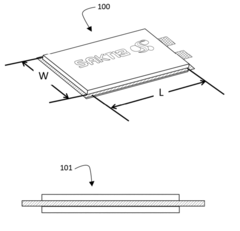
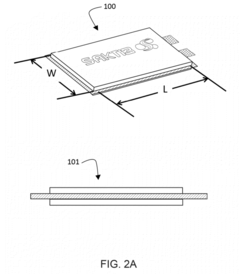
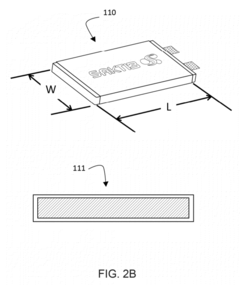
- A solid-state polymer lithium battery pack is developed, comprising high-specific-power solid-state polymer lithium-ion batteries with a laminated structure, connected in series using screw connections and sealed within a composite material battery box filled with insulating and thermally conductive sealant, ensuring reliable operation in vacuum conditions.


Monolithically integrated thin-film solid state lithium battery device having multiple layers of lithium electrochemical cells
PatentActiveUS20120058380A1
Innovation
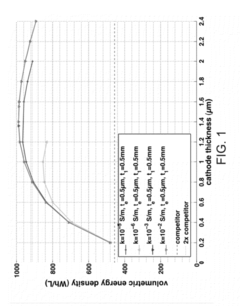
- A method and device for fabricating a solid-state thin-film battery using a prismatic multilayer structure with specific layer thicknesses and materials, including a substrate, cathode and anode current collectors, electrolyte, and barrier layers, optimized through numerical techniques for enhanced energy density and stability.
Safety and Reliability Standards for Aerospace Battery Systems
The aerospace industry demands exceptionally high safety and reliability standards for battery systems due to the catastrophic consequences of failure in flight operations. Current aerospace battery certification frameworks, such as DO-311A and MIL-STD-810, establish rigorous testing protocols that solid-state batteries must meet or exceed to gain industry acceptance. These standards address thermal runaway prevention, vibration resistance, and performance under extreme pressure and temperature conditions.
Solid-state batteries offer inherent safety advantages over conventional lithium-ion batteries with liquid electrolytes, particularly in aerospace applications. The elimination of flammable liquid electrolytes significantly reduces fire hazards, which is critical in the oxygen-rich pressurized cabins of aircraft and spacecraft. Recent testing by NASA and ESA demonstrates that solid-state cells maintain structural integrity under conditions that would cause conventional batteries to experience thermal runaway.
Reliability testing for aerospace solid-state batteries focuses on cycle life under variable discharge rates and environmental conditions. Current standards require batteries to maintain at least 80% capacity after 1,000 cycles under simulated flight conditions. Leading solid-state technologies from companies like Solid Power and QuantumScape are approaching 2,000-3,000 cycles in laboratory settings, potentially exceeding aerospace requirements.
Failure mode analysis represents another critical component of aerospace battery standards. Solid-state batteries must demonstrate graceful degradation rather than catastrophic failure. Recent advancements in ceramic electrolyte formulations have addressed previous concerns regarding crack propagation during thermal cycling, with new composite structures showing improved mechanical resilience during qualification testing.
Electromagnetic compatibility (EMC) standards are increasingly important as aircraft systems become more electronically integrated. Solid-state batteries must demonstrate immunity to electromagnetic interference while not generating disruptive fields themselves. Testing protocols now include exposure to high-intensity radiated fields (HIRF) and lightning strike simulations to ensure battery management systems remain functional during electromagnetic events.
The emerging standards specifically for solid-state aerospace batteries are focusing on unique aspects such as dendrite formation prevention and interface stability monitoring. Organizations including SAE International and RTCA are currently developing supplemental standards that address the specific characteristics and failure modes of solid-state technology, with draft specifications expected to be finalized within the next 18-24 months.
Solid-state batteries offer inherent safety advantages over conventional lithium-ion batteries with liquid electrolytes, particularly in aerospace applications. The elimination of flammable liquid electrolytes significantly reduces fire hazards, which is critical in the oxygen-rich pressurized cabins of aircraft and spacecraft. Recent testing by NASA and ESA demonstrates that solid-state cells maintain structural integrity under conditions that would cause conventional batteries to experience thermal runaway.
Reliability testing for aerospace solid-state batteries focuses on cycle life under variable discharge rates and environmental conditions. Current standards require batteries to maintain at least 80% capacity after 1,000 cycles under simulated flight conditions. Leading solid-state technologies from companies like Solid Power and QuantumScape are approaching 2,000-3,000 cycles in laboratory settings, potentially exceeding aerospace requirements.
Failure mode analysis represents another critical component of aerospace battery standards. Solid-state batteries must demonstrate graceful degradation rather than catastrophic failure. Recent advancements in ceramic electrolyte formulations have addressed previous concerns regarding crack propagation during thermal cycling, with new composite structures showing improved mechanical resilience during qualification testing.
Electromagnetic compatibility (EMC) standards are increasingly important as aircraft systems become more electronically integrated. Solid-state batteries must demonstrate immunity to electromagnetic interference while not generating disruptive fields themselves. Testing protocols now include exposure to high-intensity radiated fields (HIRF) and lightning strike simulations to ensure battery management systems remain functional during electromagnetic events.
The emerging standards specifically for solid-state aerospace batteries are focusing on unique aspects such as dendrite formation prevention and interface stability monitoring. Organizations including SAE International and RTCA are currently developing supplemental standards that address the specific characteristics and failure modes of solid-state technology, with draft specifications expected to be finalized within the next 18-24 months.
Environmental Impact and Sustainability Considerations
The aerospace industry's transition to solid-state battery technology represents a significant opportunity for environmental improvement compared to conventional lithium-ion batteries. Traditional lithium-ion batteries contain flammable liquid electrolytes that pose safety risks and environmental hazards throughout their lifecycle. Solid-state batteries eliminate these liquid components, substantially reducing the risk of toxic chemical leakage during manufacturing, operation, and disposal phases.
Manufacturing solid-state batteries for aerospace applications demonstrates considerable environmental advantages through reduced energy consumption and greenhouse gas emissions. The production process requires fewer toxic solvents and generates less hazardous waste. Initial lifecycle assessments suggest that solid-state battery production could reduce carbon footprint by 15-30% compared to conventional lithium-ion manufacturing processes when scaled appropriately for aerospace requirements.
Resource efficiency represents another critical sustainability benefit of solid-state battery technology in aerospace applications. These batteries typically require smaller quantities of critical raw materials like cobalt and nickel, which are associated with significant environmental and social impacts during extraction. Several emerging solid-state designs utilize more abundant materials like sodium, sulfur, and silicon, potentially alleviating supply chain pressures on rare earth elements and reducing ecological damage from mining operations.
End-of-life management presents both challenges and opportunities for solid-state batteries in aerospace. Their longer operational lifespan—potentially 2-3 times that of conventional batteries—reduces replacement frequency and associated waste. Additionally, the absence of liquid electrolytes simplifies recycling processes, with preliminary studies indicating recovery rates of up to 90% for key materials like lithium and solid electrolyte components.
Regulatory frameworks worldwide are increasingly recognizing these environmental benefits. The European Union's Battery Directive revisions specifically address advanced battery technologies, while NASA and other aerospace agencies have incorporated sustainability metrics into their technology evaluation protocols. These developments create favorable policy conditions for accelerating solid-state battery adoption in aerospace applications.
Despite these advantages, challenges remain in optimizing the environmental profile of solid-state batteries. Energy-intensive high-temperature manufacturing processes require further efficiency improvements. Additionally, standardized recycling infrastructure specific to solid-state battery compositions must be developed to fully realize their circular economy potential in the aerospace sector.
Manufacturing solid-state batteries for aerospace applications demonstrates considerable environmental advantages through reduced energy consumption and greenhouse gas emissions. The production process requires fewer toxic solvents and generates less hazardous waste. Initial lifecycle assessments suggest that solid-state battery production could reduce carbon footprint by 15-30% compared to conventional lithium-ion manufacturing processes when scaled appropriately for aerospace requirements.
Resource efficiency represents another critical sustainability benefit of solid-state battery technology in aerospace applications. These batteries typically require smaller quantities of critical raw materials like cobalt and nickel, which are associated with significant environmental and social impacts during extraction. Several emerging solid-state designs utilize more abundant materials like sodium, sulfur, and silicon, potentially alleviating supply chain pressures on rare earth elements and reducing ecological damage from mining operations.
End-of-life management presents both challenges and opportunities for solid-state batteries in aerospace. Their longer operational lifespan—potentially 2-3 times that of conventional batteries—reduces replacement frequency and associated waste. Additionally, the absence of liquid electrolytes simplifies recycling processes, with preliminary studies indicating recovery rates of up to 90% for key materials like lithium and solid electrolyte components.
Regulatory frameworks worldwide are increasingly recognizing these environmental benefits. The European Union's Battery Directive revisions specifically address advanced battery technologies, while NASA and other aerospace agencies have incorporated sustainability metrics into their technology evaluation protocols. These developments create favorable policy conditions for accelerating solid-state battery adoption in aerospace applications.
Despite these advantages, challenges remain in optimizing the environmental profile of solid-state batteries. Energy-intensive high-temperature manufacturing processes require further efficiency improvements. Additionally, standardized recycling infrastructure specific to solid-state battery compositions must be developed to fully realize their circular economy potential in the aerospace sector.
Unlock deeper insights with PatSnap Eureka Quick Research — get a full tech report to explore trends and direct your research. Try now!
Generate Your Research Report Instantly with AI Agent
Supercharge your innovation with PatSnap Eureka AI Agent Platform!