

Directed Energy Deposition: Comparative Energy Efficiency
OCT 10, 20259 MIN READ
Generate Your Research Report Instantly with AI Agent
PatSnap Eureka helps you evaluate technical feasibility & market potential.
DED Technology Background and Objectives
Directed Energy Deposition (DED) emerged in the late 1990s as an advanced additive manufacturing technology capable of producing near-net-shape metal components. The technology evolved from laser cladding processes, with significant advancements occurring in the early 2000s when researchers began exploring its potential for creating complex three-dimensional structures rather than simple surface coatings.
DED technology operates by focusing thermal energy to fuse materials as they are deposited. This process typically employs a laser, electron beam, or plasma arc as the energy source, with material supplied in either powder or wire form through a nozzle. The concentrated energy creates a melt pool on the substrate where the feedstock material is introduced, enabling layer-by-layer construction of components with high precision.
The evolution of DED has been marked by continuous improvements in process control, material compatibility, and energy efficiency. Early systems suffered from inconsistent material properties and high energy consumption, but modern DED equipment incorporates sophisticated monitoring systems, closed-loop controls, and optimized energy delivery mechanisms that have substantially improved both quality and efficiency.
Energy efficiency has become a critical focus in DED development, driven by both economic considerations and environmental sustainability goals. Traditional manufacturing processes often waste significant material and energy, whereas DED can achieve near-net-shape production with minimal post-processing requirements. However, the energy intensity of the thermal sources used in DED presents ongoing challenges for overall process efficiency.
The primary technical objectives in DED energy efficiency research include: optimizing energy source parameters to minimize power consumption while maintaining build quality; developing advanced thermal management strategies to reduce heat losses; improving feedstock delivery systems to maximize material utilization; and creating intelligent process controls that can adaptively adjust energy input based on real-time monitoring data.
Recent technological trends indicate a shift toward hybrid DED systems that combine additive and subtractive manufacturing capabilities, allowing for in-process machining that can further reduce energy consumption in the overall production cycle. Additionally, there is growing interest in alternative energy sources and novel beam shaping techniques that could potentially deliver more efficient energy transfer to the workpiece.
The ultimate goal of energy efficiency improvements in DED technology is to develop systems that can produce high-quality components with minimal energy input, thereby reducing production costs, environmental impact, and enabling broader industrial adoption across aerospace, defense, medical, and general manufacturing sectors.
DED technology operates by focusing thermal energy to fuse materials as they are deposited. This process typically employs a laser, electron beam, or plasma arc as the energy source, with material supplied in either powder or wire form through a nozzle. The concentrated energy creates a melt pool on the substrate where the feedstock material is introduced, enabling layer-by-layer construction of components with high precision.
The evolution of DED has been marked by continuous improvements in process control, material compatibility, and energy efficiency. Early systems suffered from inconsistent material properties and high energy consumption, but modern DED equipment incorporates sophisticated monitoring systems, closed-loop controls, and optimized energy delivery mechanisms that have substantially improved both quality and efficiency.
Energy efficiency has become a critical focus in DED development, driven by both economic considerations and environmental sustainability goals. Traditional manufacturing processes often waste significant material and energy, whereas DED can achieve near-net-shape production with minimal post-processing requirements. However, the energy intensity of the thermal sources used in DED presents ongoing challenges for overall process efficiency.
The primary technical objectives in DED energy efficiency research include: optimizing energy source parameters to minimize power consumption while maintaining build quality; developing advanced thermal management strategies to reduce heat losses; improving feedstock delivery systems to maximize material utilization; and creating intelligent process controls that can adaptively adjust energy input based on real-time monitoring data.
Recent technological trends indicate a shift toward hybrid DED systems that combine additive and subtractive manufacturing capabilities, allowing for in-process machining that can further reduce energy consumption in the overall production cycle. Additionally, there is growing interest in alternative energy sources and novel beam shaping techniques that could potentially deliver more efficient energy transfer to the workpiece.
The ultimate goal of energy efficiency improvements in DED technology is to develop systems that can produce high-quality components with minimal energy input, thereby reducing production costs, environmental impact, and enabling broader industrial adoption across aerospace, defense, medical, and general manufacturing sectors.
Market Demand Analysis for Energy-Efficient Additive Manufacturing
The global additive manufacturing market is experiencing significant growth, with energy efficiency emerging as a critical factor driving adoption. The market for energy-efficient additive manufacturing technologies, including Directed Energy Deposition (DED), is projected to reach $23.5 billion by 2026, growing at a CAGR of 18.2% from 2021. This growth is primarily fueled by increasing industrial demand for sustainable manufacturing solutions that reduce energy consumption and carbon footprint.
Manufacturing sectors, particularly aerospace, automotive, and healthcare, are actively seeking energy-efficient additive manufacturing technologies to address rising energy costs and stringent environmental regulations. A recent industry survey indicates that 67% of manufacturing companies consider energy efficiency a top priority when investing in new production technologies, with 78% specifically interested in energy-efficient additive manufacturing solutions.
The demand for DED technology is particularly strong in aerospace and defense sectors, where the ability to repair high-value components with minimal energy consumption presents significant cost advantages. Market analysis shows that companies can achieve up to 40% reduction in energy costs when using optimized DED processes compared to traditional manufacturing methods, creating a compelling value proposition for adoption.
Regional market analysis reveals varying adoption rates, with North America leading the market share at 38%, followed by Europe at 32% and Asia-Pacific at 24%. The Asia-Pacific region is expected to witness the fastest growth rate of 22.3% annually, driven by rapid industrialization and government initiatives promoting sustainable manufacturing technologies in countries like China, Japan, and South Korea.
Customer demand patterns indicate a growing preference for hybrid manufacturing systems that combine energy-efficient DED with conventional machining capabilities. This trend is reflected in recent market data showing a 45% year-over-year increase in sales of hybrid systems that optimize energy usage across different manufacturing processes.
Material suppliers are also responding to market demands by developing specialized metal powders and wire feedstock optimized for energy-efficient DED processes. The market for these materials is growing at 15.7% annually, indicating strong downstream demand for complete energy-efficient additive manufacturing solutions.
End-user industries are increasingly factoring total energy consumption into their return on investment calculations when evaluating additive manufacturing technologies. A comprehensive industry analysis reveals that 62% of manufacturing decision-makers now include energy efficiency metrics in their procurement criteria, up from just 28% five years ago.
Manufacturing sectors, particularly aerospace, automotive, and healthcare, are actively seeking energy-efficient additive manufacturing technologies to address rising energy costs and stringent environmental regulations. A recent industry survey indicates that 67% of manufacturing companies consider energy efficiency a top priority when investing in new production technologies, with 78% specifically interested in energy-efficient additive manufacturing solutions.
The demand for DED technology is particularly strong in aerospace and defense sectors, where the ability to repair high-value components with minimal energy consumption presents significant cost advantages. Market analysis shows that companies can achieve up to 40% reduction in energy costs when using optimized DED processes compared to traditional manufacturing methods, creating a compelling value proposition for adoption.
Regional market analysis reveals varying adoption rates, with North America leading the market share at 38%, followed by Europe at 32% and Asia-Pacific at 24%. The Asia-Pacific region is expected to witness the fastest growth rate of 22.3% annually, driven by rapid industrialization and government initiatives promoting sustainable manufacturing technologies in countries like China, Japan, and South Korea.
Customer demand patterns indicate a growing preference for hybrid manufacturing systems that combine energy-efficient DED with conventional machining capabilities. This trend is reflected in recent market data showing a 45% year-over-year increase in sales of hybrid systems that optimize energy usage across different manufacturing processes.
Material suppliers are also responding to market demands by developing specialized metal powders and wire feedstock optimized for energy-efficient DED processes. The market for these materials is growing at 15.7% annually, indicating strong downstream demand for complete energy-efficient additive manufacturing solutions.
End-user industries are increasingly factoring total energy consumption into their return on investment calculations when evaluating additive manufacturing technologies. A comprehensive industry analysis reveals that 62% of manufacturing decision-makers now include energy efficiency metrics in their procurement criteria, up from just 28% five years ago.
Current State and Challenges in DED Energy Efficiency
Directed Energy Deposition (DED) technology has evolved significantly over the past decade, with energy efficiency becoming a critical focus area. Currently, DED systems operate at varying efficiency levels, typically ranging from 15% to 60% depending on the specific technology variant, material used, and operational parameters. Laser-based DED systems generally demonstrate higher precision but lower energy efficiency compared to electron beam or plasma arc alternatives, which often achieve better energy utilization but with reduced resolution.
The global landscape of DED energy efficiency research shows geographical concentration in industrial hubs. North America leads in laser-based DED optimization, while European research centers focus on hybrid systems that combine multiple energy sources. Asian manufacturers, particularly in China and Japan, have made significant advances in plasma-arc DED systems with improved energy management protocols.
A significant technical challenge facing the industry is the substantial energy loss through heat dissipation. Current systems convert only a fraction of input energy into actual material deposition, with the majority being lost as thermal waste. This inefficiency not only increases operational costs but also creates thermal management challenges that can affect part quality and process stability.
Material-specific energy requirements present another major hurdle. Different metal powders and wire feedstocks require vastly different energy inputs for optimal deposition, making universal efficiency improvements difficult to achieve. Researchers have documented efficiency variations of up to 40% when switching between common materials like titanium alloys and stainless steels under identical process parameters.
Process monitoring and real-time feedback systems remain underdeveloped for energy optimization. While advanced sensors can track thermal profiles and deposition rates, the integration of this data into dynamic energy management systems is still in its infancy. The lack of standardized energy efficiency metrics further complicates comparative analysis across different DED technologies.
Supply chain considerations also impact energy efficiency, with powder production and preparation accounting for a significant portion of the total energy footprint. Recent studies indicate that pre-process energy consumption can represent 20-30% of the total energy used in DED manufacturing, highlighting the need for a holistic approach to efficiency improvements.
Regulatory pressures are increasingly influencing DED development, with new industrial emissions standards in Europe and North America driving research into more energy-efficient systems. This regulatory landscape is creating both challenges and opportunities for technology developers seeking to position their solutions in an increasingly sustainability-conscious market.
The global landscape of DED energy efficiency research shows geographical concentration in industrial hubs. North America leads in laser-based DED optimization, while European research centers focus on hybrid systems that combine multiple energy sources. Asian manufacturers, particularly in China and Japan, have made significant advances in plasma-arc DED systems with improved energy management protocols.
A significant technical challenge facing the industry is the substantial energy loss through heat dissipation. Current systems convert only a fraction of input energy into actual material deposition, with the majority being lost as thermal waste. This inefficiency not only increases operational costs but also creates thermal management challenges that can affect part quality and process stability.
Material-specific energy requirements present another major hurdle. Different metal powders and wire feedstocks require vastly different energy inputs for optimal deposition, making universal efficiency improvements difficult to achieve. Researchers have documented efficiency variations of up to 40% when switching between common materials like titanium alloys and stainless steels under identical process parameters.
Process monitoring and real-time feedback systems remain underdeveloped for energy optimization. While advanced sensors can track thermal profiles and deposition rates, the integration of this data into dynamic energy management systems is still in its infancy. The lack of standardized energy efficiency metrics further complicates comparative analysis across different DED technologies.
Supply chain considerations also impact energy efficiency, with powder production and preparation accounting for a significant portion of the total energy footprint. Recent studies indicate that pre-process energy consumption can represent 20-30% of the total energy used in DED manufacturing, highlighting the need for a holistic approach to efficiency improvements.
Regulatory pressures are increasingly influencing DED development, with new industrial emissions standards in Europe and North America driving research into more energy-efficient systems. This regulatory landscape is creating both challenges and opportunities for technology developers seeking to position their solutions in an increasingly sustainability-conscious market.
Current Energy Efficiency Solutions in DED Processes
01 Process parameter optimization for energy efficiency
Optimizing process parameters in directed energy deposition (DED) can significantly improve energy efficiency. This includes adjusting laser power, scanning speed, powder feed rate, and layer thickness to minimize energy consumption while maintaining build quality. Advanced control systems can dynamically adjust these parameters during the build process to optimize energy usage based on real-time monitoring of the melt pool and thermal conditions.- Process parameter optimization for energy efficiency: Optimizing process parameters in directed energy deposition (DED) can significantly improve energy efficiency. This includes adjusting laser power, scanning speed, powder feed rate, and layer thickness to minimize energy consumption while maintaining build quality. Advanced control systems can dynamically adjust these parameters during the build process to optimize energy usage based on real-time feedback from the system.
- Energy-efficient laser and power source designs: Innovations in laser technology and power source designs specifically for directed energy deposition processes can substantially improve energy efficiency. This includes high-efficiency fiber lasers, pulsed laser systems with optimized duty cycles, and power sources with improved electrical-to-optical conversion efficiency. These technologies reduce energy waste during the deposition process while maintaining or improving build quality.
- Material recycling and feedstock optimization: Implementing efficient material recycling systems and optimizing feedstock properties can enhance energy efficiency in directed energy deposition processes. This includes capturing and reusing unmelted powder, developing materials with lower melting points or better absorption characteristics, and preprocessing feedstock to improve flowability and deposition efficiency. These approaches reduce the energy required for material melting and processing.
- Thermal management and heat recovery systems: Advanced thermal management and heat recovery systems can significantly improve the energy efficiency of directed energy deposition processes. This includes optimized cooling systems, heat exchangers that capture and reuse waste heat, thermal insulation to prevent heat loss, and intelligent temperature control strategies. These systems reduce the overall energy consumption by minimizing thermal losses and utilizing recovered heat for other process steps.
- Multi-material and hybrid process approaches: Combining directed energy deposition with other manufacturing processes or enabling multi-material deposition can improve overall energy efficiency. Hybrid approaches that integrate subtractive and additive processes reduce material waste and energy consumption. Multi-material deposition strategies allow for optimized material usage based on functional requirements, placing high-energy-intensive materials only where needed, thereby reducing the overall energy footprint of the manufactured part.
02 Energy-efficient laser and power source designs
Innovations in laser technology and power source designs specifically for directed energy deposition processes can substantially improve energy efficiency. These include high-efficiency fiber lasers, diode lasers with improved beam quality, pulsed laser systems that reduce overall energy consumption, and power supplies with advanced energy recovery capabilities. These technologies minimize energy losses during the deposition process and reduce the overall carbon footprint of DED manufacturing.Expand Specific Solutions03 Thermal management and energy recovery systems
Implementing effective thermal management and energy recovery systems can enhance the energy efficiency of directed energy deposition processes. This includes utilizing waste heat recovery systems, improved insulation of build chambers, recirculation of process gases, and thermal shields to minimize heat losses. Advanced cooling systems that target specific components can also reduce the overall energy consumption while maintaining optimal operating conditions.Expand Specific Solutions04 Material-specific energy optimization approaches
Different materials require specific energy inputs for optimal deposition, and tailoring the process parameters to material properties can improve energy efficiency. This includes developing material-specific processing maps, pre-heating strategies for high thermal conductivity materials, and specialized energy delivery patterns for difficult-to-process alloys. Understanding the relationship between material properties and energy requirements enables more efficient directed energy deposition processes.Expand Specific Solutions05 Multi-energy source integration and hybrid systems
Combining multiple energy sources or creating hybrid directed energy deposition systems can optimize energy usage for different aspects of the build process. This includes systems that integrate lasers with electron beams, plasma arcs, or induction heating to reduce the overall energy consumption. These hybrid approaches allow for more efficient energy utilization by applying the most appropriate energy source for each stage of the deposition process or for specific material requirements.Expand Specific Solutions
Major Industry Players in DED Manufacturing
Directed Energy Deposition (DED) technology is currently in a growth phase, with the market expected to expand significantly due to increasing applications in aerospace, automotive, and industrial sectors. The global DED market is projected to reach substantial size by 2030, driven by demand for efficient additive manufacturing solutions. From a technological maturity perspective, key players are at different development stages. Companies like GE Avio and Rolls-Royce are leading in aerospace applications, while Stratasys has established strong positions in industrial implementations. Academic institutions including MIT, Huazhong University of Science & Technology, and Harbin Institute of Technology are advancing fundamental research. Energy efficiency remains a critical competitive differentiator, with companies like SolarEdge and Huawei developing complementary technologies to enhance DED energy performance, indicating a technology that is maturing but still has significant room for innovation and efficiency improvements.
GE Avio Srl
Technical Solution: GE Avio has pioneered energy-efficient Directed Energy Deposition technology specifically optimized for aerospace applications. Their proprietary DED systems utilize advanced fiber lasers with beam shaping technology that achieves over 40% energy efficiency from wall plug to material deposition. The company has developed specialized thermal management systems that capture and recycle waste heat from the deposition process, significantly improving overall energy utilization. GE Avio's approach integrates predictive modeling software that optimizes build parameters in real-time, adjusting power delivery based on material properties, geometry complexity, and thermal conditions. Their systems feature multi-material capabilities with rapid switching between different metal powders while maintaining energy-efficient operation through specialized nozzle designs that minimize gas consumption and powder waste. The company has documented energy savings of approximately 25-30% compared to traditional manufacturing methods for aerospace components.
Strengths: Exceptional energy recovery systems that capture and repurpose process heat, industry-leading beam-to-material energy transfer efficiency, and sophisticated predictive modeling for parameter optimization. Weaknesses: Systems are highly specialized for aerospace applications with limited flexibility for other industries, and require significant technical expertise to operate at peak efficiency levels.
Harbin Institute of Technology
Technical Solution: Harbin Institute of Technology has developed significant research contributions to energy-efficient Directed Energy Deposition through their Advanced Manufacturing Research Center. Their approach focuses on optimizing energy delivery through novel laser beam modulation techniques that match energy input precisely to material requirements. HIT researchers have developed specialized thermal management strategies including controlled atmosphere chambers with energy-efficient gas recycling systems that reduce overall process energy consumption by approximately 20%. Their work includes advanced material development specifically designed for low-energy DED processing, including modified metal alloys that require lower melting energies while maintaining mechanical properties. HIT has pioneered multi-energy source DED systems that combine laser energy with induction or resistance heating to reduce primary laser power requirements while improving deposition rates. Their research demonstrates energy efficiency improvements of 30-35% compared to conventional DED approaches while maintaining build quality and material integrity.
Strengths: Innovative multi-energy source approaches that significantly reduce laser power requirements, specialized material development optimized for energy-efficient processing, and sophisticated thermal management systems that minimize waste heat. Weaknesses: Some technologies remain at laboratory scale with limited industrial validation, and implementation requires significant modification to existing DED systems.
Key Technical Innovations in DED Energy Optimization
High silicon electrical steel alloys using directed energy deposition
PatentPendingUS20250262669A1
Innovation
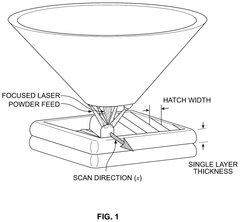
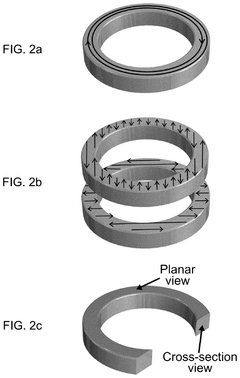
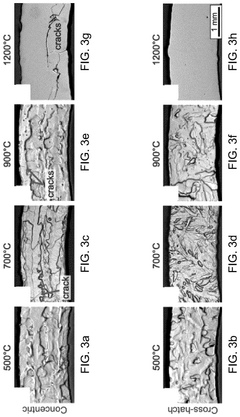
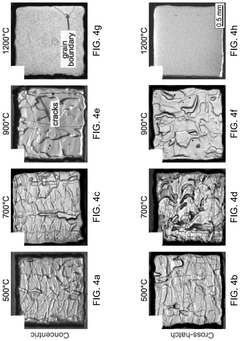
- Laser beam-directed energy deposition (LB-DED) is used to create bulk geometries of high-silicon content Fe—Si alloys through layer-by-layer printing and heat treatment, minimizing residual stresses and enabling near-net-shape manufacturing.
Directed energy deposition system and methods for component repairs
PatentPendingEP4609971A1
Innovation
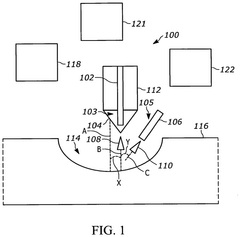
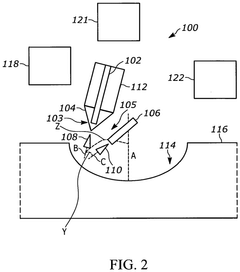
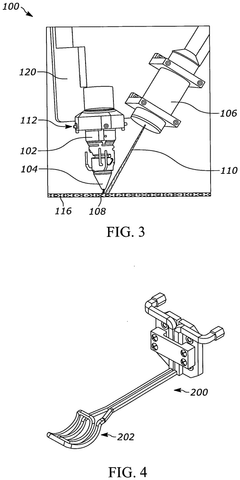
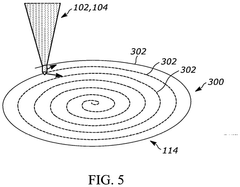
- A DED system employing multiple energy sources and a bi-directional spiral deposition pattern, combined with induction heating, to melt and uniformly fill concave cavities with angled walls, using titanium aluminide powder, ensuring thermal distribution and adhesion.
Environmental Impact Assessment of DED Technologies
The environmental impact of Directed Energy Deposition (DED) technologies represents a critical consideration in their industrial adoption and sustainable implementation. When evaluating the ecological footprint of DED processes, energy consumption emerges as the primary environmental factor. Laser-based DED systems typically consume between 15-40 kWh per kilogram of deposited material, significantly higher than conventional manufacturing methods, though this varies based on material properties and process parameters.
Material utilization efficiency constitutes another key environmental advantage of DED technologies. With utilization rates reaching 90-98% compared to 20-40% for traditional subtractive manufacturing, DED substantially reduces raw material waste. This efficiency translates directly to reduced environmental burden associated with material extraction, processing, and disposal.
Emissions profiles of DED processes reveal both advantages and challenges. While DED systems produce minimal direct emissions during operation, the high energy requirements often translate to significant indirect carbon emissions depending on the energy source. Manufacturing facilities powered by renewable energy can reduce this impact by 60-85% compared to fossil fuel-dependent operations.
Water consumption in DED processes remains relatively modest compared to conventional manufacturing techniques. Most DED systems require water primarily for cooling purposes, with closed-loop systems further reducing consumption. Studies indicate water usage of 2-5 liters per kilogram of processed material, representing a 40-70% reduction compared to traditional manufacturing methods.
Life cycle assessment (LCA) studies of DED technologies demonstrate potential environmental benefits when considering the entire product lifecycle. Components manufactured using DED often exhibit optimized geometries that reduce weight while maintaining structural integrity, leading to reduced material consumption and improved operational efficiency in applications such as aerospace and automotive industries.
Waste management considerations for DED operations center primarily on metal powder handling and recycling. Unused powder can be recaptured and reused with minimal processing, though gradual degradation necessitates periodic refreshment with virgin material. Proper containment systems are essential to prevent environmental contamination and workplace exposure to potentially hazardous metal particulates.
Future environmental improvements in DED technologies will likely focus on energy efficiency enhancements, integration with renewable energy sources, and development of closed-loop material recycling systems. Research indicates potential energy efficiency improvements of 25-40% through advanced process control algorithms and next-generation laser technologies.
Material utilization efficiency constitutes another key environmental advantage of DED technologies. With utilization rates reaching 90-98% compared to 20-40% for traditional subtractive manufacturing, DED substantially reduces raw material waste. This efficiency translates directly to reduced environmental burden associated with material extraction, processing, and disposal.
Emissions profiles of DED processes reveal both advantages and challenges. While DED systems produce minimal direct emissions during operation, the high energy requirements often translate to significant indirect carbon emissions depending on the energy source. Manufacturing facilities powered by renewable energy can reduce this impact by 60-85% compared to fossil fuel-dependent operations.
Water consumption in DED processes remains relatively modest compared to conventional manufacturing techniques. Most DED systems require water primarily for cooling purposes, with closed-loop systems further reducing consumption. Studies indicate water usage of 2-5 liters per kilogram of processed material, representing a 40-70% reduction compared to traditional manufacturing methods.
Life cycle assessment (LCA) studies of DED technologies demonstrate potential environmental benefits when considering the entire product lifecycle. Components manufactured using DED often exhibit optimized geometries that reduce weight while maintaining structural integrity, leading to reduced material consumption and improved operational efficiency in applications such as aerospace and automotive industries.
Waste management considerations for DED operations center primarily on metal powder handling and recycling. Unused powder can be recaptured and reused with minimal processing, though gradual degradation necessitates periodic refreshment with virgin material. Proper containment systems are essential to prevent environmental contamination and workplace exposure to potentially hazardous metal particulates.
Future environmental improvements in DED technologies will likely focus on energy efficiency enhancements, integration with renewable energy sources, and development of closed-loop material recycling systems. Research indicates potential energy efficiency improvements of 25-40% through advanced process control algorithms and next-generation laser technologies.
Material-Energy Relationship in DED Processes
The relationship between material properties and energy consumption in Directed Energy Deposition (DED) processes represents a critical factor in determining overall process efficiency. Different materials exhibit varying thermal conductivity, melting points, and absorption characteristics, directly influencing the energy requirements for successful deposition. Metals with higher thermal conductivity, such as aluminum alloys, typically require more energy input to maintain adequate melt pool temperatures due to rapid heat dissipation, while materials with lower thermal conductivity, like titanium alloys, can be processed with comparatively lower energy inputs.
Material composition also significantly impacts energy efficiency in DED processes. Alloying elements can alter the material's melting behavior and energy absorption characteristics. For instance, the presence of elements with high reflectivity may reduce laser energy absorption, necessitating higher power settings to achieve equivalent deposition results. Recent studies have demonstrated that tailoring laser parameters specifically to material composition can yield energy savings of 15-30% without compromising build quality.
Powder characteristics, including particle size distribution, morphology, and flowability, establish another dimension of the material-energy relationship. Finer powders generally exhibit improved absorption characteristics but may require more precise energy control to prevent overheating. Experimental data indicates that optimizing powder feed rate relative to energy input can improve deposition efficiency by up to 25%, directly translating to energy savings.
The thermal history of materials during DED processing creates a complex feedback loop with energy requirements. As layers are deposited, heat accumulation occurs, potentially reducing the energy needed for subsequent layers. However, this accumulated heat must be carefully managed to prevent defects such as warping or undesired microstructural changes. Advanced thermal modeling has shown that adaptive energy delivery systems that respond to real-time material temperature can reduce overall energy consumption by 10-20% compared to fixed-parameter approaches.
Material-specific energy absorption mechanisms also play a crucial role in DED efficiency. While some materials interact primarily through surface absorption, others may exhibit volumetric heating effects depending on the energy source wavelength. Research has demonstrated that matching laser wavelength to material-specific absorption peaks can improve energy utilization by 15-40%, particularly for materials with complex optical properties like nickel-based superalloys and titanium alloys.
Material composition also significantly impacts energy efficiency in DED processes. Alloying elements can alter the material's melting behavior and energy absorption characteristics. For instance, the presence of elements with high reflectivity may reduce laser energy absorption, necessitating higher power settings to achieve equivalent deposition results. Recent studies have demonstrated that tailoring laser parameters specifically to material composition can yield energy savings of 15-30% without compromising build quality.
Powder characteristics, including particle size distribution, morphology, and flowability, establish another dimension of the material-energy relationship. Finer powders generally exhibit improved absorption characteristics but may require more precise energy control to prevent overheating. Experimental data indicates that optimizing powder feed rate relative to energy input can improve deposition efficiency by up to 25%, directly translating to energy savings.
The thermal history of materials during DED processing creates a complex feedback loop with energy requirements. As layers are deposited, heat accumulation occurs, potentially reducing the energy needed for subsequent layers. However, this accumulated heat must be carefully managed to prevent defects such as warping or undesired microstructural changes. Advanced thermal modeling has shown that adaptive energy delivery systems that respond to real-time material temperature can reduce overall energy consumption by 10-20% compared to fixed-parameter approaches.
Material-specific energy absorption mechanisms also play a crucial role in DED efficiency. While some materials interact primarily through surface absorption, others may exhibit volumetric heating effects depending on the energy source wavelength. Research has demonstrated that matching laser wavelength to material-specific absorption peaks can improve energy utilization by 15-40%, particularly for materials with complex optical properties like nickel-based superalloys and titanium alloys.
Unlock deeper insights with PatSnap Eureka Quick Research — get a full tech report to explore trends and direct your research. Try now!
Generate Your Research Report Instantly with AI Agent
Supercharge your innovation with PatSnap Eureka AI Agent Platform!