Directed Energy Deposition Processes: A Comparative Study
OCT 10, 20259 MIN READ
Generate Your Research Report Instantly with AI Agent
Patsnap Eureka helps you evaluate technical feasibility & market potential.
DED Technology Background and Objectives
Directed Energy Deposition (DED) has emerged as a transformative additive manufacturing technology over the past three decades, evolving from its origins in laser cladding processes developed in the 1980s. This metal additive manufacturing method involves the simultaneous deposition and fusion of material through a focused energy source, creating complex three-dimensional structures directly from digital models without the need for traditional tooling or molds.
The technology has progressed through several distinct evolutionary phases, beginning with early laser-based systems primarily used for surface coating and repair applications. By the early 2000s, advancements in control systems, material delivery mechanisms, and energy sources expanded DED capabilities toward full component manufacturing. Recent developments have focused on multi-material processing, in-situ monitoring, and closed-loop control systems that significantly enhance process reliability and part quality.
Current DED systems utilize various energy sources including laser beams, electron beams, plasma arcs, and electric arcs, each offering distinct advantages for specific applications. Laser-based systems dominate the high-precision market segment, while arc-based technologies provide higher deposition rates at lower capital costs. This diversity of approaches has enabled DED to address a wide spectrum of industrial needs across aerospace, defense, medical, and heavy equipment sectors.
The primary technical objectives driving DED development include achieving higher material deposition rates while maintaining dimensional accuracy, expanding the range of compatible materials, improving surface finish quality, and enhancing process monitoring capabilities. Particular emphasis is being placed on developing hybrid systems that combine DED with subtractive manufacturing processes to leverage the advantages of both approaches.
Material efficiency represents another critical objective, with DED offering significant advantages over traditional manufacturing methods by reducing material waste to less than 10% in many applications. This aspect, combined with the ability to repair high-value components rather than replacing them, positions DED as an environmentally sustainable manufacturing technology aligned with circular economy principles.
Looking forward, the technology roadmap for DED focuses on several key objectives: increasing process stability through advanced sensing and control systems, expanding multi-material capabilities for functionally graded components, developing specialized alloys optimized for DED processes, and establishing comprehensive standards and certification protocols to facilitate broader industrial adoption. These advancements aim to position DED as a mainstream manufacturing technology capable of addressing increasingly complex industrial challenges.
The technology has progressed through several distinct evolutionary phases, beginning with early laser-based systems primarily used for surface coating and repair applications. By the early 2000s, advancements in control systems, material delivery mechanisms, and energy sources expanded DED capabilities toward full component manufacturing. Recent developments have focused on multi-material processing, in-situ monitoring, and closed-loop control systems that significantly enhance process reliability and part quality.
Current DED systems utilize various energy sources including laser beams, electron beams, plasma arcs, and electric arcs, each offering distinct advantages for specific applications. Laser-based systems dominate the high-precision market segment, while arc-based technologies provide higher deposition rates at lower capital costs. This diversity of approaches has enabled DED to address a wide spectrum of industrial needs across aerospace, defense, medical, and heavy equipment sectors.
The primary technical objectives driving DED development include achieving higher material deposition rates while maintaining dimensional accuracy, expanding the range of compatible materials, improving surface finish quality, and enhancing process monitoring capabilities. Particular emphasis is being placed on developing hybrid systems that combine DED with subtractive manufacturing processes to leverage the advantages of both approaches.
Material efficiency represents another critical objective, with DED offering significant advantages over traditional manufacturing methods by reducing material waste to less than 10% in many applications. This aspect, combined with the ability to repair high-value components rather than replacing them, positions DED as an environmentally sustainable manufacturing technology aligned with circular economy principles.
Looking forward, the technology roadmap for DED focuses on several key objectives: increasing process stability through advanced sensing and control systems, expanding multi-material capabilities for functionally graded components, developing specialized alloys optimized for DED processes, and establishing comprehensive standards and certification protocols to facilitate broader industrial adoption. These advancements aim to position DED as a mainstream manufacturing technology capable of addressing increasingly complex industrial challenges.
Market Applications and Demand Analysis
The Directed Energy Deposition (DED) market has experienced significant growth in recent years, driven by increasing demand across multiple industrial sectors. The global market for DED technologies was valued at approximately 500 million USD in 2022 and is projected to reach 1.2 billion USD by 2028, representing a compound annual growth rate of 15.7%. This growth trajectory is primarily fueled by the aerospace, defense, and medical industries, which collectively account for over 60% of the current market share.
In the aerospace sector, DED processes have gained substantial traction for manufacturing and repairing high-value components such as turbine blades, structural elements, and complex geometrical parts. The ability to produce parts with superior mechanical properties while reducing material waste has positioned DED as a preferred manufacturing method for lightweight, high-strength components essential for next-generation aircraft.
The medical industry represents another significant market for DED technologies, particularly in the production of customized implants and prosthetics. The market demand in this sector is driven by the growing need for patient-specific medical devices that offer improved biocompatibility and functional integration. Current estimates suggest that the medical applications of DED will grow at a rate of 18.3% annually through 2027, outpacing the overall market growth.
Defense applications constitute a substantial portion of the DED market, with emphasis on rapid field repairs, spare parts manufacturing, and development of specialized equipment. The ability to deploy DED systems in remote locations for on-demand manufacturing represents a strategic advantage that defense organizations worldwide are increasingly investing in.
Regional analysis reveals that North America currently leads the DED market with approximately 38% market share, followed by Europe (29%) and Asia-Pacific (24%). However, the Asia-Pacific region is expected to witness the fastest growth rate in the coming years due to increasing industrialization, government initiatives supporting advanced manufacturing technologies, and rising adoption in countries like China, Japan, and South Korea.
End-user surveys indicate that the primary drivers for DED adoption include reduced lead times (cited by 78% of respondents), design freedom (65%), and material efficiency (59%). Conversely, the main barriers to wider market penetration remain high initial investment costs, limited material options compared to traditional manufacturing, and the need for specialized technical expertise.
The market is also witnessing a shift toward hybrid manufacturing systems that combine DED with traditional machining capabilities, addressing the growing demand for complete manufacturing solutions that can produce finished parts with minimal post-processing requirements.
In the aerospace sector, DED processes have gained substantial traction for manufacturing and repairing high-value components such as turbine blades, structural elements, and complex geometrical parts. The ability to produce parts with superior mechanical properties while reducing material waste has positioned DED as a preferred manufacturing method for lightweight, high-strength components essential for next-generation aircraft.
The medical industry represents another significant market for DED technologies, particularly in the production of customized implants and prosthetics. The market demand in this sector is driven by the growing need for patient-specific medical devices that offer improved biocompatibility and functional integration. Current estimates suggest that the medical applications of DED will grow at a rate of 18.3% annually through 2027, outpacing the overall market growth.
Defense applications constitute a substantial portion of the DED market, with emphasis on rapid field repairs, spare parts manufacturing, and development of specialized equipment. The ability to deploy DED systems in remote locations for on-demand manufacturing represents a strategic advantage that defense organizations worldwide are increasingly investing in.
Regional analysis reveals that North America currently leads the DED market with approximately 38% market share, followed by Europe (29%) and Asia-Pacific (24%). However, the Asia-Pacific region is expected to witness the fastest growth rate in the coming years due to increasing industrialization, government initiatives supporting advanced manufacturing technologies, and rising adoption in countries like China, Japan, and South Korea.
End-user surveys indicate that the primary drivers for DED adoption include reduced lead times (cited by 78% of respondents), design freedom (65%), and material efficiency (59%). Conversely, the main barriers to wider market penetration remain high initial investment costs, limited material options compared to traditional manufacturing, and the need for specialized technical expertise.
The market is also witnessing a shift toward hybrid manufacturing systems that combine DED with traditional machining capabilities, addressing the growing demand for complete manufacturing solutions that can produce finished parts with minimal post-processing requirements.
Global DED Technology Landscape and Challenges
Directed Energy Deposition (DED) technology has evolved significantly over the past decade, establishing itself as a critical additive manufacturing process across various industrial sectors. The global landscape of DED technology reveals distinct regional concentrations of expertise and implementation. North America, particularly the United States, leads in DED research and commercialization, with significant investments from aerospace and defense sectors driving innovation. Europe follows closely, with countries like Germany, France, and the UK developing specialized applications in automotive and medical industries.
Asia-Pacific represents the fastest-growing region for DED adoption, with China making substantial investments in both research infrastructure and industrial applications. Japan and South Korea focus on high-precision DED systems for electronics and automotive components. This geographical distribution reflects not only technological capabilities but also regional industrial priorities and funding mechanisms.
Despite its promising trajectory, DED technology faces several critical challenges that impede wider adoption. Material compatibility remains a significant hurdle, as not all metal powders or wire feedstock perform consistently across different DED systems. Process stability and repeatability continue to challenge manufacturers, particularly when scaling from prototype to production volumes. The need for real-time monitoring and closed-loop control systems represents another technological gap that researchers worldwide are actively addressing.
Quality assurance presents a complex challenge, as standardized testing protocols and certification pathways for DED-manufactured parts remain underdeveloped compared to traditional manufacturing methods. This regulatory uncertainty creates barriers to adoption in highly regulated industries such as aerospace and medical devices. Additionally, the high initial investment costs for DED equipment and the specialized knowledge required for operation limit accessibility for small and medium enterprises.
Energy efficiency concerns have emerged as environmental considerations gain prominence in manufacturing decisions. Current DED systems, particularly laser-based ones, consume significant energy, prompting research into more sustainable approaches. The development of hybrid systems that combine DED with conventional manufacturing techniques represents an emerging trend to address some of these limitations while leveraging the unique capabilities of directed energy deposition.
Cross-border collaboration through international research consortia and industry partnerships is accelerating solutions to these challenges, though intellectual property considerations sometimes hinder open innovation. The global DED landscape thus reflects a technology at an inflection point—proven in capability but requiring further refinement to achieve mainstream industrial adoption across diverse geographical and application contexts.
Asia-Pacific represents the fastest-growing region for DED adoption, with China making substantial investments in both research infrastructure and industrial applications. Japan and South Korea focus on high-precision DED systems for electronics and automotive components. This geographical distribution reflects not only technological capabilities but also regional industrial priorities and funding mechanisms.
Despite its promising trajectory, DED technology faces several critical challenges that impede wider adoption. Material compatibility remains a significant hurdle, as not all metal powders or wire feedstock perform consistently across different DED systems. Process stability and repeatability continue to challenge manufacturers, particularly when scaling from prototype to production volumes. The need for real-time monitoring and closed-loop control systems represents another technological gap that researchers worldwide are actively addressing.
Quality assurance presents a complex challenge, as standardized testing protocols and certification pathways for DED-manufactured parts remain underdeveloped compared to traditional manufacturing methods. This regulatory uncertainty creates barriers to adoption in highly regulated industries such as aerospace and medical devices. Additionally, the high initial investment costs for DED equipment and the specialized knowledge required for operation limit accessibility for small and medium enterprises.
Energy efficiency concerns have emerged as environmental considerations gain prominence in manufacturing decisions. Current DED systems, particularly laser-based ones, consume significant energy, prompting research into more sustainable approaches. The development of hybrid systems that combine DED with conventional manufacturing techniques represents an emerging trend to address some of these limitations while leveraging the unique capabilities of directed energy deposition.
Cross-border collaboration through international research consortia and industry partnerships is accelerating solutions to these challenges, though intellectual property considerations sometimes hinder open innovation. The global DED landscape thus reflects a technology at an inflection point—proven in capability but requiring further refinement to achieve mainstream industrial adoption across diverse geographical and application contexts.
Current DED Process Methodologies
01 Laser-based directed energy deposition techniques
Laser-based directed energy deposition involves using laser energy to melt metallic powders or wire feedstock as they are being deposited. This process allows for precise control of the energy input and deposition rate, resulting in high-quality metal parts with good mechanical properties. The technique is particularly useful for creating complex geometries, repair applications, and functionally graded materials where composition can be varied throughout the build.- Laser-based directed energy deposition techniques: Laser-based directed energy deposition processes use high-powered lasers to melt metallic powders or wire feedstock as they are being deposited layer by layer. This technique allows for precise control of the energy input and deposition rate, resulting in high-quality parts with good mechanical properties. The process can be used for both additive manufacturing of new components and repair of existing parts, particularly in aerospace and automotive industries.
- Material feedstock systems for directed energy deposition: Various material delivery systems are employed in directed energy deposition processes, including powder-based and wire-based feedstock mechanisms. These systems control the flow rate, distribution, and positioning of the material being deposited. Advanced feedstock systems incorporate features such as multi-material capability, powder recycling, and precise wire feeding mechanisms to improve process efficiency and part quality. The choice of feedstock system significantly impacts the microstructure and properties of the final component.
- Process monitoring and control systems: Sophisticated monitoring and control systems are essential for directed energy deposition processes to ensure consistent part quality. These systems utilize sensors, cameras, and advanced algorithms to monitor parameters such as melt pool temperature, dimensions, and cooling rates in real-time. Closed-loop control systems can automatically adjust process parameters like laser power, travel speed, and material feed rate based on the monitored data. This enables adaptive manufacturing capabilities and helps maintain dimensional accuracy and material properties throughout the build process.
- Multi-axis deposition strategies: Advanced directed energy deposition systems employ multi-axis deposition strategies to overcome limitations of traditional layer-by-layer approaches. By utilizing 5-axis or even 7-axis motion systems, these processes can deposit material along complex curved paths and build overhanging features without support structures. This capability enables the fabrication of complex geometries with improved mechanical properties due to optimized material deposition directions. Multi-axis strategies also allow for hybrid manufacturing approaches that combine additive and subtractive processes in a single setup.
- Post-processing treatments for DED components: Components manufactured using directed energy deposition often require post-processing treatments to achieve desired surface finish, dimensional accuracy, and mechanical properties. These treatments include heat treatment to relieve residual stresses and homogenize microstructure, machining to improve dimensional accuracy and surface finish, and surface treatments to enhance wear or corrosion resistance. Advanced post-processing techniques specifically developed for DED parts help address common issues such as porosity, anisotropic properties, and microstructural heterogeneity.
02 Process control and monitoring systems for DED
Advanced control and monitoring systems are essential for directed energy deposition processes to ensure consistent quality and properties. These systems typically include real-time feedback mechanisms that monitor parameters such as melt pool temperature, deposition rate, and dimensional accuracy. Adaptive control algorithms can adjust process parameters on-the-fly to maintain optimal conditions and compensate for variations in material properties or environmental conditions.Expand Specific Solutions03 Multi-material and functionally graded DED applications
Directed energy deposition processes excel at creating components with varying material compositions throughout the part. This capability enables the production of functionally graded materials where properties can be tailored to specific requirements in different regions of the same component. Applications include wear-resistant coatings, thermal barrier layers, and components with optimized mechanical properties in critical areas while maintaining weight reduction in non-critical sections.Expand Specific Solutions04 Wire-feed directed energy deposition systems
Wire-feed directed energy deposition systems use metal wire as feedstock instead of powder, offering advantages in material efficiency and deposition rates. These systems typically employ either laser, electron beam, or arc-based energy sources to melt the wire as it is fed into the deposition zone. Wire-feed DED is particularly suitable for large-scale components and repair applications where high deposition rates are required, though it may offer less geometric complexity than powder-based systems.Expand Specific Solutions05 Hybrid manufacturing combining DED with machining
Hybrid manufacturing systems integrate directed energy deposition with subtractive processes like CNC machining in a single platform. This combination allows for deposition of material followed by precision machining to achieve final dimensional accuracy and surface finish. The hybrid approach overcomes limitations of standalone additive manufacturing by enabling the production of components with complex internal features and tight tolerances while maintaining the design freedom of additive processes.Expand Specific Solutions
Leading DED Technology Providers and Competitors
Directed Energy Deposition (DED) processes are currently in a growth phase, with the market expanding as industries recognize its potential for complex metal part fabrication. The global market is projected to reach significant scale as adoption increases across aerospace, automotive, and medical sectors. Technologically, DED sits at varying maturity levels across applications, with companies demonstrating different specialization focuses. Leading players like Siemens AG and Rolls-Royce Corp. are advancing industrial applications, while research institutions such as MIT and Fraunhofer-Gesellschaft drive fundamental innovation. Applied Materials and ASML contribute precision manufacturing expertise, with aerospace specialists like GE Avio and Mitsubishi Heavy Industries developing specialized implementations. The competitive landscape shows a blend of established industrial giants and specialized technology providers working to overcome material, process control, and standardization challenges.
Siemens AG
Technical Solution: Siemens has developed an integrated DED solution called "Siemens Additive Manufacturing Network" that combines hardware, software, and digital workflow management. Their DED process utilizes a high-power fiber laser system with precision powder delivery mechanisms optimized for industrial-scale production. A distinguishing feature of Siemens' approach is their comprehensive digital twin implementation that simulates the entire DED process before physical production, predicting thermal gradients, residual stresses, and potential defects. This allows for pre-emptive process optimization. Their system incorporates adaptive slicing algorithms that automatically adjust layer thickness based on part geometry, optimizing both build time and surface quality. Siemens has also developed specialized DED configurations for large-scale components, particularly for energy sector applications like turbine components and industrial tooling. Their process includes multi-material capabilities with controlled transition zones, allowing for functionally graded components that transition from one alloy to another. The system is integrated with Siemens' industrial automation platforms, enabling seamless incorporation into existing manufacturing environments.
Strengths: Comprehensive digital twin capabilities for process simulation and optimization; excellent integration with existing industrial automation systems; advanced adaptive slicing algorithms for optimized builds; proven capability for large-scale industrial components. Weaknesses: Complex software ecosystem requires significant training; higher initial investment compared to standalone DED systems; optimization process can be time-consuming for new materials or geometries.
GE Avio Srl
Technical Solution: GE Avio has pioneered a high-precision DED process specifically optimized for aerospace components, particularly turbine blades and combustion components. Their DMLM (Direct Metal Laser Melting) technology incorporates a multi-axis deposition system that allows for complex geometries without support structures. The process utilizes a proprietary powder delivery system that maintains consistent powder flow rates even during rapid directional changes, addressing a common challenge in DED processes. GE Avio's implementation includes adaptive layer thickness control that varies deposition parameters based on feature size and geometry, enabling fine details and bulk sections within the same component. Their system incorporates real-time spectroscopic analysis of the melt pool to detect and correct material anomalies during the build process. This technology has been particularly successful in repair applications for high-value aerospace components, where their directed energy process can precisely rebuild worn or damaged areas with minimal heat-affected zone.
Strengths: Exceptional precision for aerospace applications; advanced multi-axis capability allowing complex geometries without supports; superior material properties meeting aerospace certification requirements; excellent for repair applications. Weaknesses: Relatively slow deposition rates compared to other DED technologies; high equipment and operational costs; requires specialized training and expertise to operate effectively.
Critical Patents and Technical Innovations in DED
Method and aparatus for direct energy deposition of metal
PatentWO2025174719A1
Innovation
- A method and apparatus that utilize cryogenic coolant jets directed at an acute angle to the deposition path, combining multiple jets to enhance cooling efficiency and minimize interference with the energy input, thereby reducing stress development and increasing productivity.


Directed energy deposition system and methods for component repairs
PatentPendingEP4609971A1
Innovation
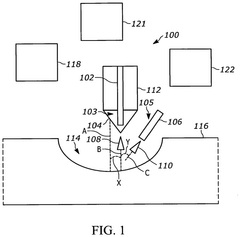
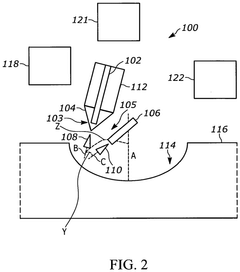
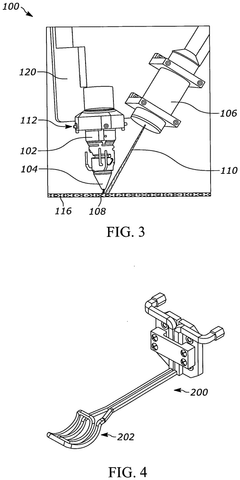
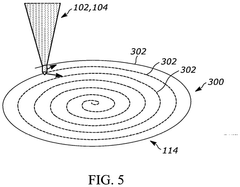
- A DED system employing multiple energy sources and a bi-directional spiral deposition pattern, combined with induction heating, to melt and uniformly fill concave cavities with angled walls, using titanium aluminide powder, ensuring thermal distribution and adhesion.
Material Compatibility and Process Parameters
Material compatibility represents a critical factor in the successful implementation of Directed Energy Deposition (DED) processes. Different DED technologies exhibit varying degrees of compatibility with metallic alloys, ceramics, polymers, and composites. Laser-based DED systems demonstrate exceptional versatility with a wide range of metal powders, particularly excelling with nickel-based superalloys, titanium alloys, and stainless steels. In contrast, electron beam-based systems show superior performance with reactive metals but face limitations with ceramics due to conductivity requirements.
Process parameters significantly influence the final quality and properties of DED-manufactured components. Laser power density typically ranges from 10^2 to 10^6 W/cm², with optimal settings dependent on material thermal properties. Deposition rates vary considerably across DED variants, from 10-100 g/hour for precision applications to 2-4 kg/hour for industrial-scale production systems. The relationship between travel speed and layer thickness follows an inverse correlation, with faster speeds generally producing thinner layers and finer microstructures.
Thermal management emerges as a paramount concern in DED processes, with substrate preheating temperatures ranging from 200°C to 800°C depending on material composition. The cooling rate, typically between 10^3 to 10^6 K/s, directly impacts crystallization behavior and resultant mechanical properties. Recent studies indicate that controlled atmosphere conditions with oxygen levels below 100 ppm are essential for reactive materials, while less sensitive alloys can tolerate up to 1000 ppm without significant property degradation.
Parameter optimization studies reveal that the powder feed rate must be precisely calibrated to the energy input, with typical ratios ranging from 0.1-0.5 g/kW for fine features to 1-3 g/kW for bulk deposition. The standoff distance—the gap between the deposition head and substrate—critically affects deposition efficiency, with optimal ranges typically between 8-15 mm for powder-based systems and 3-8 mm for wire-fed variants.
Comparative analysis of different DED technologies shows that LENS (Laser Engineered Net Shaping) processes offer superior dimensional accuracy (±0.125 mm) but limited build volumes, while DMD (Direct Metal Deposition) systems provide larger build envelopes at the cost of reduced precision (±0.25 mm). EBAM (Electron Beam Additive Manufacturing) demonstrates the highest deposition rates but requires more stringent vacuum conditions and exhibits coarser surface finishes compared to laser-based alternatives.
Process parameters significantly influence the final quality and properties of DED-manufactured components. Laser power density typically ranges from 10^2 to 10^6 W/cm², with optimal settings dependent on material thermal properties. Deposition rates vary considerably across DED variants, from 10-100 g/hour for precision applications to 2-4 kg/hour for industrial-scale production systems. The relationship between travel speed and layer thickness follows an inverse correlation, with faster speeds generally producing thinner layers and finer microstructures.
Thermal management emerges as a paramount concern in DED processes, with substrate preheating temperatures ranging from 200°C to 800°C depending on material composition. The cooling rate, typically between 10^3 to 10^6 K/s, directly impacts crystallization behavior and resultant mechanical properties. Recent studies indicate that controlled atmosphere conditions with oxygen levels below 100 ppm are essential for reactive materials, while less sensitive alloys can tolerate up to 1000 ppm without significant property degradation.
Parameter optimization studies reveal that the powder feed rate must be precisely calibrated to the energy input, with typical ratios ranging from 0.1-0.5 g/kW for fine features to 1-3 g/kW for bulk deposition. The standoff distance—the gap between the deposition head and substrate—critically affects deposition efficiency, with optimal ranges typically between 8-15 mm for powder-based systems and 3-8 mm for wire-fed variants.
Comparative analysis of different DED technologies shows that LENS (Laser Engineered Net Shaping) processes offer superior dimensional accuracy (±0.125 mm) but limited build volumes, while DMD (Direct Metal Deposition) systems provide larger build envelopes at the cost of reduced precision (±0.25 mm). EBAM (Electron Beam Additive Manufacturing) demonstrates the highest deposition rates but requires more stringent vacuum conditions and exhibits coarser surface finishes compared to laser-based alternatives.
Quality Control and Certification Standards
Quality control in Directed Energy Deposition (DED) processes represents a critical challenge due to the complex nature of these additive manufacturing techniques. Current certification standards for DED technologies vary significantly across different industries and geographical regions, creating a fragmented regulatory landscape. The American Society for Testing and Materials (ASTM) and the International Organization for Standardization (ISO) have developed several standards specifically addressing metal additive manufacturing processes, including DED, with ASTM F3187 and ISO/ASTM 52900 serving as foundational documents.
In-process monitoring systems have emerged as essential components for quality assurance in DED operations. These systems typically incorporate multiple sensor arrays that track critical parameters such as melt pool temperature, dimensions, cooling rates, and material feed rates in real-time. Advanced systems utilize machine learning algorithms to detect anomalies and predict potential defects before they manifest in the final product, significantly reducing waste and rework requirements.
Post-process inspection techniques for DED-manufactured components include computed tomography (CT) scanning, ultrasonic testing, and X-ray diffraction analysis. These non-destructive testing methods allow for comprehensive evaluation of internal structures and material properties without compromising the integrity of the manufactured parts. Recent advancements in digital twin technology have enabled more accurate prediction of mechanical properties based on process parameters and material characteristics.
Certification pathways for DED processes in aerospace applications are particularly stringent, with organizations like the Federal Aviation Administration (FAA) and European Union Aviation Safety Agency (EASA) requiring extensive documentation and testing. The aerospace industry has pioneered the development of specialized quality management systems for additive manufacturing, establishing protocols that are gradually being adopted across other sectors including medical device manufacturing and automotive industries.
Material traceability represents another crucial aspect of quality control in DED processes. Current standards mandate comprehensive documentation of powder or wire feedstock properties, including chemical composition, particle size distribution, and mechanical characteristics. This information must be preserved throughout the manufacturing process chain to ensure complete traceability from raw material to finished component, particularly critical for applications in regulated industries.
Emerging certification approaches are increasingly focusing on process qualification rather than part qualification, recognizing that consistent process control leads to consistent part quality. This paradigm shift is driving the development of more sophisticated process monitoring tools and statistical process control methodologies specifically tailored to the unique characteristics of directed energy deposition technologies.
In-process monitoring systems have emerged as essential components for quality assurance in DED operations. These systems typically incorporate multiple sensor arrays that track critical parameters such as melt pool temperature, dimensions, cooling rates, and material feed rates in real-time. Advanced systems utilize machine learning algorithms to detect anomalies and predict potential defects before they manifest in the final product, significantly reducing waste and rework requirements.
Post-process inspection techniques for DED-manufactured components include computed tomography (CT) scanning, ultrasonic testing, and X-ray diffraction analysis. These non-destructive testing methods allow for comprehensive evaluation of internal structures and material properties without compromising the integrity of the manufactured parts. Recent advancements in digital twin technology have enabled more accurate prediction of mechanical properties based on process parameters and material characteristics.
Certification pathways for DED processes in aerospace applications are particularly stringent, with organizations like the Federal Aviation Administration (FAA) and European Union Aviation Safety Agency (EASA) requiring extensive documentation and testing. The aerospace industry has pioneered the development of specialized quality management systems for additive manufacturing, establishing protocols that are gradually being adopted across other sectors including medical device manufacturing and automotive industries.
Material traceability represents another crucial aspect of quality control in DED processes. Current standards mandate comprehensive documentation of powder or wire feedstock properties, including chemical composition, particle size distribution, and mechanical characteristics. This information must be preserved throughout the manufacturing process chain to ensure complete traceability from raw material to finished component, particularly critical for applications in regulated industries.
Emerging certification approaches are increasingly focusing on process qualification rather than part qualification, recognizing that consistent process control leads to consistent part quality. This paradigm shift is driving the development of more sophisticated process monitoring tools and statistical process control methodologies specifically tailored to the unique characteristics of directed energy deposition technologies.
Unlock deeper insights with Patsnap Eureka Quick Research — get a full tech report to explore trends and direct your research. Try now!
Generate Your Research Report Instantly with AI Agent
Supercharge your innovation with Patsnap Eureka AI Agent Platform!