

FOAK To NOAK Roadmap For Anode-Free Solid-State
SEP 1, 20259 MIN READ
Generate Your Research Report Instantly with AI Agent
PatSnap Eureka helps you evaluate technical feasibility & market potential.
Anode-Free SSB Technology Background and Objectives
Solid-state batteries (SSBs) represent a revolutionary advancement in energy storage technology, promising significant improvements over conventional lithium-ion batteries. The anode-free configuration of SSBs has emerged as a particularly promising approach, offering potential for higher energy density, enhanced safety, and reduced manufacturing complexity. The evolution of this technology can be traced back to early research on solid electrolytes in the 1970s, with significant acceleration in development occurring over the past decade as limitations of conventional lithium-ion batteries became increasingly apparent.
The technological trajectory of anode-free solid-state batteries has been characterized by progressive improvements in solid electrolyte materials, interface engineering, and manufacturing processes. Initial research focused primarily on ceramic and polymer electrolytes, with recent breakthroughs in composite and hybrid electrolyte systems demonstrating superior ionic conductivity and mechanical properties. The elimination of the traditional graphite anode represents a paradigm shift in battery design, allowing for direct lithium plating during charging and potentially increasing energy density by 30-50% compared to conventional designs.
Current technological objectives for anode-free SSBs center on addressing several critical challenges. Primary among these is improving cycle life, as lithium dendrite formation at the lithium metal-electrolyte interface remains a significant barrier to commercialization. Research aims to achieve stable cycling performance exceeding 1,000 cycles while maintaining 80% capacity retention. Additionally, enhancing rate capability for fast charging applications represents another key objective, with targets of achieving 80% charge in under 15 minutes without compromising safety or longevity.
The transition from First-Of-A-Kind (FOAK) to Nth-Of-A-Kind (NOAK) production represents a critical evolutionary pathway for anode-free SSBs. This roadmap encompasses progressive scaling of manufacturing processes, cost reduction strategies, and performance optimization techniques. The FOAK phase typically involves small-scale production with emphasis on proof-of-concept and performance validation, while the NOAK phase focuses on manufacturing optimization, supply chain development, and cost reduction through economies of scale.
Industry projections suggest that anode-free SSB technology could reach commercial viability for specialized applications by 2025-2026, with broader market penetration expected by 2028-2030. The technology is anticipated to follow an S-curve adoption pattern, with initial deployment in premium electronic devices and electric vehicles, followed by expansion into grid storage and other applications as manufacturing scales and costs decrease.
The technological trajectory of anode-free solid-state batteries has been characterized by progressive improvements in solid electrolyte materials, interface engineering, and manufacturing processes. Initial research focused primarily on ceramic and polymer electrolytes, with recent breakthroughs in composite and hybrid electrolyte systems demonstrating superior ionic conductivity and mechanical properties. The elimination of the traditional graphite anode represents a paradigm shift in battery design, allowing for direct lithium plating during charging and potentially increasing energy density by 30-50% compared to conventional designs.
Current technological objectives for anode-free SSBs center on addressing several critical challenges. Primary among these is improving cycle life, as lithium dendrite formation at the lithium metal-electrolyte interface remains a significant barrier to commercialization. Research aims to achieve stable cycling performance exceeding 1,000 cycles while maintaining 80% capacity retention. Additionally, enhancing rate capability for fast charging applications represents another key objective, with targets of achieving 80% charge in under 15 minutes without compromising safety or longevity.
The transition from First-Of-A-Kind (FOAK) to Nth-Of-A-Kind (NOAK) production represents a critical evolutionary pathway for anode-free SSBs. This roadmap encompasses progressive scaling of manufacturing processes, cost reduction strategies, and performance optimization techniques. The FOAK phase typically involves small-scale production with emphasis on proof-of-concept and performance validation, while the NOAK phase focuses on manufacturing optimization, supply chain development, and cost reduction through economies of scale.
Industry projections suggest that anode-free SSB technology could reach commercial viability for specialized applications by 2025-2026, with broader market penetration expected by 2028-2030. The technology is anticipated to follow an S-curve adoption pattern, with initial deployment in premium electronic devices and electric vehicles, followed by expansion into grid storage and other applications as manufacturing scales and costs decrease.
Market Demand Analysis for Next-Generation Battery Technologies
The global battery market is experiencing unprecedented growth, driven primarily by the rapid expansion of electric vehicles (EVs), renewable energy storage systems, and portable electronics. Current projections indicate the global battery market will reach approximately $310 billion by 2030, with advanced battery technologies accounting for an increasingly significant portion of this value. Within this landscape, solid-state batteries represent one of the most promising next-generation technologies, with market forecasts suggesting they could capture 15-20% of the premium battery market by 2035.
Anode-free solid-state batteries specifically address several critical market demands that conventional lithium-ion batteries cannot satisfy. The automotive sector demonstrates the most urgent need, as OEMs seek battery technologies that can enable longer driving ranges exceeding 500 miles, faster charging capabilities under 15 minutes, and enhanced safety profiles. Consumer surveys indicate that 67% of potential EV buyers cite range anxiety as their primary concern, while 58% mention charging time as a significant barrier to adoption.
The aerospace and defense sectors are emerging as secondary but high-value markets for anode-free solid-state technology. These applications require energy storage solutions with exceptional energy density, operational safety under extreme conditions, and long cycle life. Market analysis reveals a compound annual growth rate of 24% for specialized battery technologies in these sectors through 2028.
Consumer electronics manufacturers are increasingly seeking differentiation through battery performance, with industry reports highlighting that devices featuring next-generation battery technology command premium pricing 30% higher than comparable products with conventional batteries. The ability to create ultra-thin, flexible, and high-capacity power sources represents a significant competitive advantage in this saturated market.
Grid-scale energy storage represents another substantial market opportunity, particularly as renewable energy penetration increases globally. Utility companies require storage solutions with improved safety profiles, longer duration capabilities, and reduced maintenance requirements. The stationary storage market is projected to require over 2,500 GWh of capacity by 2030, with advanced battery technologies expected to fulfill approximately 40% of this demand.
Regional market analysis reveals varying adoption timelines, with East Asian markets (particularly Japan and South Korea) demonstrating the most aggressive investment in solid-state technology, followed by North America and Europe. China maintains dominance in conventional lithium-ion production but is rapidly increasing R&D investment in next-generation technologies, including anode-free designs.
The transition from First-Of-A-Kind (FOAK) to Nth-Of-A-Kind (NOAK) production for anode-free solid-state batteries will be primarily driven by these market demands, with initial premium applications establishing the technology before economies of scale enable broader market penetration.
Anode-free solid-state batteries specifically address several critical market demands that conventional lithium-ion batteries cannot satisfy. The automotive sector demonstrates the most urgent need, as OEMs seek battery technologies that can enable longer driving ranges exceeding 500 miles, faster charging capabilities under 15 minutes, and enhanced safety profiles. Consumer surveys indicate that 67% of potential EV buyers cite range anxiety as their primary concern, while 58% mention charging time as a significant barrier to adoption.
The aerospace and defense sectors are emerging as secondary but high-value markets for anode-free solid-state technology. These applications require energy storage solutions with exceptional energy density, operational safety under extreme conditions, and long cycle life. Market analysis reveals a compound annual growth rate of 24% for specialized battery technologies in these sectors through 2028.
Consumer electronics manufacturers are increasingly seeking differentiation through battery performance, with industry reports highlighting that devices featuring next-generation battery technology command premium pricing 30% higher than comparable products with conventional batteries. The ability to create ultra-thin, flexible, and high-capacity power sources represents a significant competitive advantage in this saturated market.
Grid-scale energy storage represents another substantial market opportunity, particularly as renewable energy penetration increases globally. Utility companies require storage solutions with improved safety profiles, longer duration capabilities, and reduced maintenance requirements. The stationary storage market is projected to require over 2,500 GWh of capacity by 2030, with advanced battery technologies expected to fulfill approximately 40% of this demand.
Regional market analysis reveals varying adoption timelines, with East Asian markets (particularly Japan and South Korea) demonstrating the most aggressive investment in solid-state technology, followed by North America and Europe. China maintains dominance in conventional lithium-ion production but is rapidly increasing R&D investment in next-generation technologies, including anode-free designs.
The transition from First-Of-A-Kind (FOAK) to Nth-Of-A-Kind (NOAK) production for anode-free solid-state batteries will be primarily driven by these market demands, with initial premium applications establishing the technology before economies of scale enable broader market penetration.
Current State and Technical Challenges of Anode-Free SSBs
Anode-free solid-state batteries (AFSSBs) represent one of the most promising next-generation energy storage technologies, offering theoretical energy densities exceeding 500 Wh/kg. Currently, the development status of AFSSBs remains primarily at laboratory scale, with significant technical barriers preventing commercial deployment. First-of-a-kind (FOAK) prototypes have demonstrated proof-of-concept functionality but exhibit limited cycle life, typically below 200 cycles, and face challenges in scaling beyond coin cell configurations.
The global research landscape shows concentrated efforts in North America, East Asia, and Europe, with notable advancements from institutions like Stanford University, Toyota Research Institute, and Samsung Advanced Institute of Technology. These entities have achieved milestone demonstrations of AFSSBs with energy densities approaching 400 Wh/kg in laboratory settings, though with substantial performance limitations.
A primary technical challenge facing AFSSBs is the lithium metal plating morphology during charging, which often results in dendritic growth that can penetrate solid electrolytes, causing short circuits and safety hazards. Current solid electrolytes, while demonstrating ionic conductivities approaching 10^-3 S/cm, still struggle with mechanical properties insufficient to suppress lithium dendrite propagation under practical operating conditions.
Interface stability presents another critical challenge, as the high reactivity of lithium metal with most solid electrolytes creates high-impedance interphases that increase cell resistance over cycling. This degradation mechanism accelerates capacity fade and limits practical cycle life. Additionally, the absence of a pre-deposited anode creates unique volume expansion challenges during initial lithium plating, requiring precise engineering of cell stacks to accommodate dimensional changes without mechanical failure.
Manufacturing scalability remains a significant hurdle, with current laboratory fabrication methods relying on techniques poorly suited for mass production. The transition from FOAK to Nth-of-a-kind (NOAK) production requires developing novel manufacturing processes capable of maintaining the pristine interfaces necessary for AFSSB performance while achieving economically viable production rates.
Temperature sensitivity further complicates AFSSB development, as most current systems demonstrate optimal performance only within narrow temperature windows, typically 30-50°C. This limitation restricts potential applications and necessitates additional battery thermal management systems that reduce overall system-level energy density advantages.
The path from current laboratory demonstrations to commercially viable products requires addressing these interconnected challenges through multidisciplinary approaches combining materials science, electrochemistry, mechanical engineering, and advanced manufacturing techniques. Recent progress in composite electrolytes and interface engineering shows promising directions, but significant breakthroughs are still needed to realize the full potential of anode-free solid-state battery technology.
The global research landscape shows concentrated efforts in North America, East Asia, and Europe, with notable advancements from institutions like Stanford University, Toyota Research Institute, and Samsung Advanced Institute of Technology. These entities have achieved milestone demonstrations of AFSSBs with energy densities approaching 400 Wh/kg in laboratory settings, though with substantial performance limitations.
A primary technical challenge facing AFSSBs is the lithium metal plating morphology during charging, which often results in dendritic growth that can penetrate solid electrolytes, causing short circuits and safety hazards. Current solid electrolytes, while demonstrating ionic conductivities approaching 10^-3 S/cm, still struggle with mechanical properties insufficient to suppress lithium dendrite propagation under practical operating conditions.
Interface stability presents another critical challenge, as the high reactivity of lithium metal with most solid electrolytes creates high-impedance interphases that increase cell resistance over cycling. This degradation mechanism accelerates capacity fade and limits practical cycle life. Additionally, the absence of a pre-deposited anode creates unique volume expansion challenges during initial lithium plating, requiring precise engineering of cell stacks to accommodate dimensional changes without mechanical failure.
Manufacturing scalability remains a significant hurdle, with current laboratory fabrication methods relying on techniques poorly suited for mass production. The transition from FOAK to Nth-of-a-kind (NOAK) production requires developing novel manufacturing processes capable of maintaining the pristine interfaces necessary for AFSSB performance while achieving economically viable production rates.
Temperature sensitivity further complicates AFSSB development, as most current systems demonstrate optimal performance only within narrow temperature windows, typically 30-50°C. This limitation restricts potential applications and necessitates additional battery thermal management systems that reduce overall system-level energy density advantages.
The path from current laboratory demonstrations to commercially viable products requires addressing these interconnected challenges through multidisciplinary approaches combining materials science, electrochemistry, mechanical engineering, and advanced manufacturing techniques. Recent progress in composite electrolytes and interface engineering shows promising directions, but significant breakthroughs are still needed to realize the full potential of anode-free solid-state battery technology.
Current Technical Solutions for Anode-Free SSB Commercialization
01 Anode-free solid-state battery design and architecture
Anode-free solid-state batteries represent a novel architecture where lithium metal is not pre-deposited on the anode current collector. Instead, lithium ions from the cathode plate onto the current collector during the first charge, forming an in-situ lithium metal anode. This design significantly increases energy density by eliminating the need for excess lithium and reducing battery weight and volume. The architecture typically includes a solid electrolyte layer, a cathode composite, and a current collector that serves as the anode substrate.- Anode-free solid-state battery design and architecture: Anode-free solid-state batteries represent a novel architecture where lithium metal is plated directly onto the current collector during charging, eliminating the need for a pre-deposited anode. This design significantly increases energy density by reducing inactive components. The architecture typically includes a solid electrolyte layer, cathode composite, and current collectors. Key innovations focus on interface engineering between components to ensure stable lithium plating/stripping and prevent dendrite formation during cycling.
- Solid electrolyte materials for anode-free batteries: Advanced solid electrolyte materials are critical for anode-free battery performance. These include sulfide-based electrolytes (offering high ionic conductivity), oxide-based ceramics (providing mechanical stability), polymer-based electrolytes (offering flexibility), and composite electrolytes combining multiple material advantages. Development focuses on electrolytes with high lithium-ion conductivity, wide electrochemical stability windows, and mechanical properties that suppress lithium dendrite growth while maintaining good contact with the cathode interface.
- Manufacturing scale-up from FOAK to NOAK: The transition from First-Of-A-Kind (FOAK) to Nth-Of-A-Kind (NOAK) manufacturing for anode-free solid-state batteries involves several critical steps. Initial lab-scale prototypes are scaled to pilot production lines where process parameters are optimized. Key challenges include developing specialized equipment for solid electrolyte handling, precise layer deposition techniques, and maintaining ultra-dry manufacturing environments. Cost reduction strategies focus on simplifying production steps, increasing throughput, and developing automated quality control systems to ensure consistent performance across mass-produced cells.
- Interface engineering and stability improvements: Interface engineering is crucial for anode-free solid-state batteries to achieve long cycle life. Innovations include protective coatings on current collectors to promote uniform lithium deposition, buffer layers between solid electrolyte and cathode to minimize interfacial resistance, and gradient structures to accommodate volume changes during cycling. Advanced characterization techniques help identify degradation mechanisms at interfaces. Stabilizing additives and surface treatments are employed to maintain good contact between components and prevent chemical side reactions that lead to capacity fade.
- Performance optimization and commercial viability: Achieving commercial viability for anode-free solid-state batteries requires optimizing multiple performance parameters simultaneously. Research focuses on increasing energy density beyond 400 Wh/kg, extending cycle life to 1000+ cycles, improving fast-charging capabilities, and ensuring safety under extreme conditions. Temperature management strategies are developed to expand the operating range. Economic analyses guide material selection and cell design to meet cost targets below $100/kWh. Testing protocols specific to anode-free cells are established to validate performance metrics relevant to automotive and grid storage applications.
02 Solid electrolyte materials and interfaces for anode-free batteries
Advanced solid electrolyte materials are crucial for anode-free solid-state batteries to enable stable lithium plating/stripping and prevent dendrite formation. These materials include sulfide-based, oxide-based, and polymer-based electrolytes with high ionic conductivity and mechanical strength. Interface engineering between the solid electrolyte and the in-situ formed lithium metal is essential to maintain cycle life and performance. Protective coatings and interlayers are often employed to stabilize these interfaces and prevent side reactions during cycling.Expand Specific Solutions03 Manufacturing processes for scaling from FOAK to NOAK
The transition from First-Of-A-Kind (FOAK) to Nth-Of-A-Kind (NOAK) production of anode-free solid-state batteries requires significant advancements in manufacturing processes. This includes developing scalable methods for solid electrolyte synthesis, cathode composite preparation, and cell assembly under controlled environments. Roll-to-roll processing, dry electrode manufacturing, and advanced quality control systems are being implemented to increase production throughput while maintaining performance consistency. Cost reduction strategies focus on material optimization, process simplification, and automation to achieve commercial viability.Expand Specific Solutions04 Performance optimization and cycle life extension
Extending the cycle life of anode-free solid-state batteries is critical for commercial adoption. Strategies include optimizing current collector surfaces to promote uniform lithium deposition, controlling charging protocols to prevent dendrite formation, and developing pressure management systems to maintain intimate contact between components. Advanced cathode materials with high capacity and stability are being developed to complement the anode-free design. Additives and dopants in the solid electrolyte help suppress side reactions and improve interfacial stability during repeated cycling.Expand Specific Solutions05 Safety enhancements and thermal management
Safety is a paramount advantage of anode-free solid-state batteries, particularly in preventing thermal runaway events. The roadmap from FOAK to NOAK includes developing robust thermal management systems, implementing fail-safe mechanisms, and ensuring stable operation across wide temperature ranges. Non-flammable solid electrolytes eliminate the safety risks associated with liquid electrolytes. Advanced battery management systems with real-time monitoring capabilities are being integrated to detect potential failure modes and prevent catastrophic events, making these batteries suitable for demanding applications like electric vehicles and grid storage.Expand Specific Solutions
Key Industry Players in Solid-State Battery Development
The anode-free solid-state battery market is currently transitioning from First-Of-A-Kind (FOAK) to Next-Of-A-Kind (NOAK) development, characterized by early commercialization efforts in a rapidly growing sector. Major automotive manufacturers including Toyota, GM, Hyundai, and Honda are heavily investing alongside technology specialists like LG Energy Solution, Samsung, and Panasonic. Academic-industry partnerships involving institutions such as Washington University, Georgia Tech, and University of Tokyo are accelerating technological maturation. While still facing challenges in scaling production and improving energy density, recent breakthroughs from companies like Nanotek Instruments and Nextech Batteries suggest the technology is approaching commercial viability, with projected market growth from experimental to mainstream adoption within 5-7 years.
Toyota Motor Corp.
Technical Solution: Toyota has pioneered a systematic FOAK to NOAK transition strategy for anode-free solid-state batteries through their "integrated materials-to-systems" approach. Their technology employs a sulfide-based solid electrolyte system (Li6PS5Cl) with demonstrated ionic conductivity of 2-5 mS/cm at room temperature[3]. Toyota's innovation lies in their proprietary interface engineering, using ultra-thin (5-20nm) artificial solid electrolyte interphase layers to prevent direct contact between the in-situ formed lithium metal anode and the solid electrolyte. Their manufacturing process incorporates cold sintering techniques at temperatures below 200°C, enabling compatibility with existing production equipment while achieving 80-90% of theoretical density for the solid electrolyte layers[4]. Toyota's roadmap progresses from 10Ah prototype cells with energy densities of 400 Wh/kg to eventual 100Ah automotive cells exceeding 500 Wh/kg, with intermediate milestones addressing pressure management systems, scaled manufacturing processes, and safety validation protocols across operating temperature ranges of -30°C to 60°C[5].
Strengths: Extensive intellectual property portfolio in solid-state battery technology; vertical integration capabilities from materials to vehicle integration; demonstrated prototype cells with over 1,000 cycles while maintaining 80% capacity. Weaknesses: Higher material costs for sulfide electrolytes compared to conventional liquid electrolytes; challenges with manufacturing scale-up due to moisture sensitivity of materials; current designs require external pressure application for optimal performance.
Hyundai Motor Co., Ltd.
Technical Solution: Hyundai has developed a distinctive FOAK to NOAK roadmap for anode-free solid-state batteries centered on their "dual-phase electrolyte" architecture. Their approach combines oxide-based ceramic electrolytes (primarily LLZO-based) with polymer composite interfaces to address the critical challenges of lithium metal anode formation and stability. Hyundai's technology features a gradient electrolyte design where the concentration and composition of ceramic fillers vary across the electrolyte thickness, optimizing both ionic conductivity (achieving 1-3 mS/cm at room temperature) and mechanical properties[6]. Their manufacturing innovation includes a tape-casting process adapted from ceramic industry practices, allowing for continuous production of thin (20-50μm) solid electrolyte layers with controlled porosity. Hyundai's roadmap outlines progression from 5Ah pouch cells with 350 Wh/kg energy density to eventual 80Ah automotive cells exceeding 450 Wh/kg, with specific focus on thermal management systems designed to operate efficiently between -20°C and 50°C without external heating requirements[7].
Strengths: Strong integration capabilities with existing vehicle platforms; innovative composite electrolyte formulations balancing conductivity and mechanical properties; established partnerships with material suppliers ensuring supply chain security. Weaknesses: Lower ionic conductivity at room temperature compared to sulfide-based alternatives; challenges with achieving uniform lithium plating during initial formation cycles; higher interfacial resistance requiring optimization of operating conditions.
Critical Patents and Research Breakthroughs in Anode-Free Technology
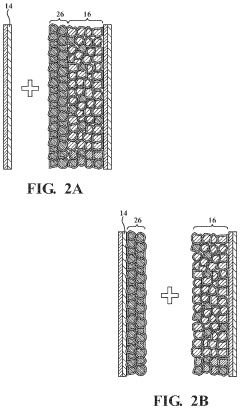
Anode-free solid-state battery and method of battery fabrication
PatentActiveUS11824159B2
Innovation
- An anode-free solid-state battery design that uses a cathode layer with transient anode elements, a bare current collector, and a gelled solid-state electrolyte layer to facilitate ionic conduction, eliminating the need for a permanent anode and simplifying the battery structure.



Anode-free sodium all-solid-state battery
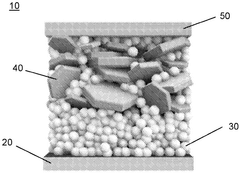
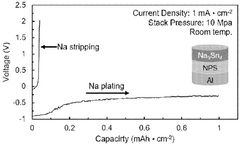
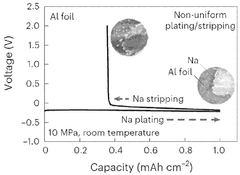
PatentWO2025085362A1
Innovation
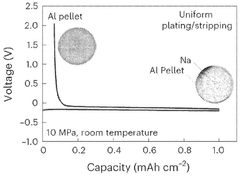
- The development of an anode-free sodium solid-state battery cell using a solid electrolyte separator made from sodium borohydride particles and a current collector formed from compressed metal particles, such as aluminum, to facilitate direct sodium deposition and improve solid-solid contact.
Manufacturing Scalability and Cost Reduction Strategies
The transition from First-Of-A-Kind (FOAK) to Nth-Of-A-Kind (NOAK) for anode-free solid-state batteries requires systematic manufacturing scalability and cost reduction strategies. Current laboratory-scale production methods, while suitable for proof-of-concept demonstrations, face significant challenges when scaled to commercial volumes.
Material processing represents a primary cost driver in anode-free solid-state battery manufacturing. Solid electrolytes typically require high-purity precursors and precise synthesis conditions, resulting in materials that can cost 10-100 times more than conventional liquid electrolytes. Implementing continuous flow synthesis methods and exploring lower-cost precursor alternatives could potentially reduce material costs by 40-60% in NOAK production.
Equipment modification presents another critical pathway toward cost reduction. Current solid-state battery manufacturing often relies on adapted conventional battery equipment, which operates sub-optimally for solid-state systems. Purpose-built equipment designed specifically for solid-state battery assembly could increase throughput by 3-5 times while reducing energy consumption by 30-40%, significantly lowering capital expenditure requirements per GWh of capacity.
Process intensification strategies must focus on eliminating rate-limiting steps in the manufacturing sequence. The solid-state interface formation between cathode and electrolyte layers typically requires extended high-temperature sintering processes that limit production rates. Emerging technologies such as flash sintering and cold sintering could reduce processing times from hours to minutes, enabling continuous rather than batch processing.
Yield improvement represents perhaps the most immediate opportunity for cost reduction. Current FOAK anode-free solid-state battery production often experiences yields below 70% due to challenges in maintaining uniform interfaces and preventing short circuits. Statistical process control implementation combined with in-line quality monitoring could progressively increase yields to over 90% in NOAK production, directly reducing per-unit costs.
Supply chain optimization will be essential as production scales. Developing dedicated supplier networks for specialized solid-state battery materials can reduce procurement costs by 20-30% through economies of scale. Additionally, co-location of key material production facilities with battery manufacturing plants could minimize logistics costs and reduce supply chain vulnerabilities.
Automation and digitalization represent the final frontier in the FOAK to NOAK transition. Current solid-state battery production remains labor-intensive compared to conventional lithium-ion manufacturing. Implementing advanced robotics and AI-driven process control could reduce labor costs by 50-70% while simultaneously improving consistency and quality in NOAK facilities.
Material processing represents a primary cost driver in anode-free solid-state battery manufacturing. Solid electrolytes typically require high-purity precursors and precise synthesis conditions, resulting in materials that can cost 10-100 times more than conventional liquid electrolytes. Implementing continuous flow synthesis methods and exploring lower-cost precursor alternatives could potentially reduce material costs by 40-60% in NOAK production.
Equipment modification presents another critical pathway toward cost reduction. Current solid-state battery manufacturing often relies on adapted conventional battery equipment, which operates sub-optimally for solid-state systems. Purpose-built equipment designed specifically for solid-state battery assembly could increase throughput by 3-5 times while reducing energy consumption by 30-40%, significantly lowering capital expenditure requirements per GWh of capacity.
Process intensification strategies must focus on eliminating rate-limiting steps in the manufacturing sequence. The solid-state interface formation between cathode and electrolyte layers typically requires extended high-temperature sintering processes that limit production rates. Emerging technologies such as flash sintering and cold sintering could reduce processing times from hours to minutes, enabling continuous rather than batch processing.
Yield improvement represents perhaps the most immediate opportunity for cost reduction. Current FOAK anode-free solid-state battery production often experiences yields below 70% due to challenges in maintaining uniform interfaces and preventing short circuits. Statistical process control implementation combined with in-line quality monitoring could progressively increase yields to over 90% in NOAK production, directly reducing per-unit costs.
Supply chain optimization will be essential as production scales. Developing dedicated supplier networks for specialized solid-state battery materials can reduce procurement costs by 20-30% through economies of scale. Additionally, co-location of key material production facilities with battery manufacturing plants could minimize logistics costs and reduce supply chain vulnerabilities.
Automation and digitalization represent the final frontier in the FOAK to NOAK transition. Current solid-state battery production remains labor-intensive compared to conventional lithium-ion manufacturing. Implementing advanced robotics and AI-driven process control could reduce labor costs by 50-70% while simultaneously improving consistency and quality in NOAK facilities.
Safety and Performance Validation Frameworks
The development of a comprehensive Safety and Performance Validation Framework is critical for transitioning anode-free solid-state batteries from First-Of-A-Kind (FOAK) to Nth-Of-A-Kind (NOAK) production. These frameworks must address the unique challenges posed by anode-free architectures while ensuring consistent performance and safety across scaled manufacturing processes.
Current validation protocols for conventional lithium-ion batteries are insufficient for anode-free solid-state technologies due to their distinct failure modes and performance characteristics. A robust framework must incorporate multi-level testing regimes spanning from materials characterization to full cell evaluation under various operating conditions. Material-level validation should focus on solid electrolyte stability, interfacial dynamics, and lithium metal plating/stripping efficiency.
Cell-level validation requires standardized protocols for evaluating cycle life, rate capability, and energy density across different form factors and scales. Particular attention must be paid to dendrite formation mechanisms, which represent a primary failure mode in anode-free designs. Advanced in-situ characterization techniques including neutron diffraction, synchrotron X-ray tomography, and electrochemical impedance spectroscopy should be integrated into these frameworks to monitor structural and chemical changes during cycling.
Safety validation presents unique challenges for anode-free systems. Traditional abuse tests must be modified to account for different thermal runaway mechanisms and mechanical failure modes. New protocols should include solid electrolyte fracture testing, interface delamination assessment, and pressure-induced short circuit evaluation. Accelerated aging tests must be developed to predict long-term performance degradation pathways specific to anode-free architectures.
Manufacturing validation frameworks represent a critical bridge between lab-scale and industrial production. These should incorporate in-line quality control metrics for solid electrolyte synthesis, interface formation, and cell assembly processes. Statistical process control methodologies must be adapted for the unique variability factors in solid-state manufacturing, with particular focus on thickness uniformity, interfacial contact quality, and stack pressure distribution.
Regulatory compliance presents another dimension requiring specialized validation frameworks. Collaboration with standards organizations such as IEC, UL, and ISO is essential to develop anode-free specific testing protocols that can achieve certification while accurately representing real-world performance and safety characteristics. These frameworks should evolve iteratively as production scales, with continuous refinement based on field performance data and manufacturing insights.
Current validation protocols for conventional lithium-ion batteries are insufficient for anode-free solid-state technologies due to their distinct failure modes and performance characteristics. A robust framework must incorporate multi-level testing regimes spanning from materials characterization to full cell evaluation under various operating conditions. Material-level validation should focus on solid electrolyte stability, interfacial dynamics, and lithium metal plating/stripping efficiency.
Cell-level validation requires standardized protocols for evaluating cycle life, rate capability, and energy density across different form factors and scales. Particular attention must be paid to dendrite formation mechanisms, which represent a primary failure mode in anode-free designs. Advanced in-situ characterization techniques including neutron diffraction, synchrotron X-ray tomography, and electrochemical impedance spectroscopy should be integrated into these frameworks to monitor structural and chemical changes during cycling.
Safety validation presents unique challenges for anode-free systems. Traditional abuse tests must be modified to account for different thermal runaway mechanisms and mechanical failure modes. New protocols should include solid electrolyte fracture testing, interface delamination assessment, and pressure-induced short circuit evaluation. Accelerated aging tests must be developed to predict long-term performance degradation pathways specific to anode-free architectures.
Manufacturing validation frameworks represent a critical bridge between lab-scale and industrial production. These should incorporate in-line quality control metrics for solid electrolyte synthesis, interface formation, and cell assembly processes. Statistical process control methodologies must be adapted for the unique variability factors in solid-state manufacturing, with particular focus on thickness uniformity, interfacial contact quality, and stack pressure distribution.
Regulatory compliance presents another dimension requiring specialized validation frameworks. Collaboration with standards organizations such as IEC, UL, and ISO is essential to develop anode-free specific testing protocols that can achieve certification while accurately representing real-world performance and safety characteristics. These frameworks should evolve iteratively as production scales, with continuous refinement based on field performance data and manufacturing insights.
Unlock deeper insights with PatSnap Eureka Quick Research — get a full tech report to explore trends and direct your research. Try now!
Generate Your Research Report Instantly with AI Agent
Supercharge your innovation with PatSnap Eureka AI Agent Platform!