

GaN HEMT Roadmap And Future Technology Trends
SEP 8, 20259 MIN READ
Generate Your Research Report Instantly with AI Agent
Patsnap Eureka helps you evaluate technical feasibility & market potential.
GaN HEMT Evolution and Development Goals
Gallium Nitride High Electron Mobility Transistors (GaN HEMTs) have emerged as revolutionary semiconductor devices that offer significant advantages over traditional silicon-based technologies. The evolution of GaN HEMT technology has been marked by continuous improvements in performance, reliability, and cost-effectiveness, driven by increasing demands in power electronics, RF communications, and other high-frequency applications.
The development trajectory of GaN HEMTs began in the early 1990s with fundamental research on wide bandgap semiconductors. By the early 2000s, the first commercial GaN HEMT devices appeared, primarily targeting defense and aerospace applications. The technology has since expanded into commercial markets, with significant adoption in telecommunications infrastructure, particularly for 5G base stations, and increasingly in power conversion applications.
Current technical goals for GaN HEMT development focus on several key parameters. Researchers aim to increase the maximum operating frequency beyond 300 GHz for advanced RF applications, while simultaneously improving power density to exceed 40 W/mm. Breakdown voltage targets have been pushed to over 1200V for power electronics applications, with aspirations to reach 1800V and beyond for medium-voltage converters.
Reliability enhancement represents another critical development goal, with industry targets including device lifetimes exceeding 10^7 hours at operating temperatures of 200°C or higher. This requires innovations in passivation techniques, gate engineering, and thermal management solutions to mitigate degradation mechanisms such as current collapse and gate leakage.
Cost reduction remains a persistent challenge, with objectives to decrease manufacturing expenses by leveraging larger wafer sizes (transitioning from 4" to 6" and eventually 8") and improving yield rates. Integration capabilities are also being enhanced, with goals to incorporate GaN HEMTs into more complex systems-on-chip solutions that combine power and logic functionalities.
The roadmap for GaN HEMT technology includes vertical device architectures to overcome the limitations of lateral designs, particularly for high-voltage applications. Novel substrate materials, including diamond and engineered composites, are being explored to improve thermal performance and reduce costs compared to traditional SiC or sapphire substrates.
Future development goals also encompass environmental considerations, with efforts to reduce the use of rare or toxic materials in device fabrication and to improve energy efficiency in manufacturing processes. The ultimate vision is to position GaN HEMTs as the dominant technology for a wide range of power and RF applications, displacing silicon-based solutions through superior performance and competitive total cost of ownership.
The development trajectory of GaN HEMTs began in the early 1990s with fundamental research on wide bandgap semiconductors. By the early 2000s, the first commercial GaN HEMT devices appeared, primarily targeting defense and aerospace applications. The technology has since expanded into commercial markets, with significant adoption in telecommunications infrastructure, particularly for 5G base stations, and increasingly in power conversion applications.
Current technical goals for GaN HEMT development focus on several key parameters. Researchers aim to increase the maximum operating frequency beyond 300 GHz for advanced RF applications, while simultaneously improving power density to exceed 40 W/mm. Breakdown voltage targets have been pushed to over 1200V for power electronics applications, with aspirations to reach 1800V and beyond for medium-voltage converters.
Reliability enhancement represents another critical development goal, with industry targets including device lifetimes exceeding 10^7 hours at operating temperatures of 200°C or higher. This requires innovations in passivation techniques, gate engineering, and thermal management solutions to mitigate degradation mechanisms such as current collapse and gate leakage.
Cost reduction remains a persistent challenge, with objectives to decrease manufacturing expenses by leveraging larger wafer sizes (transitioning from 4" to 6" and eventually 8") and improving yield rates. Integration capabilities are also being enhanced, with goals to incorporate GaN HEMTs into more complex systems-on-chip solutions that combine power and logic functionalities.
The roadmap for GaN HEMT technology includes vertical device architectures to overcome the limitations of lateral designs, particularly for high-voltage applications. Novel substrate materials, including diamond and engineered composites, are being explored to improve thermal performance and reduce costs compared to traditional SiC or sapphire substrates.
Future development goals also encompass environmental considerations, with efforts to reduce the use of rare or toxic materials in device fabrication and to improve energy efficiency in manufacturing processes. The ultimate vision is to position GaN HEMTs as the dominant technology for a wide range of power and RF applications, displacing silicon-based solutions through superior performance and competitive total cost of ownership.
Market Demand Analysis for GaN HEMT Applications
The GaN HEMT (Gallium Nitride High Electron Mobility Transistor) market has experienced significant growth in recent years, driven by increasing demand across multiple sectors. The global GaN power device market reached approximately $1.4 billion in 2022 and is projected to grow at a CAGR of 25% through 2028, with GaN HEMTs representing a substantial portion of this market.
The telecommunications sector remains the largest consumer of GaN HEMT technology, particularly with the ongoing global deployment of 5G infrastructure. Base stations utilizing GaN HEMTs have demonstrated 30-40% higher energy efficiency compared to traditional silicon-based solutions, creating strong demand as telecom operators seek to reduce operational costs while expanding network capacity.
Defense and aerospace applications constitute another major market segment, valued at approximately $380 million in 2022. The superior performance of GaN HEMTs in radar systems, electronic warfare equipment, and satellite communications has made them indispensable in modern military hardware. Market analysts predict this segment will grow at 18% annually through 2027.
The automotive industry represents the fastest-growing market for GaN HEMTs, particularly in electric vehicle (EV) applications. The demand for more efficient power conversion in onboard chargers and DC-DC converters is driving adoption, with the automotive GaN market expected to grow from $92 million in 2022 to over $600 million by 2028. This growth is supported by the increasing range requirements and faster charging capabilities demanded by consumers.
Consumer electronics manufacturers are increasingly incorporating GaN technology into power adapters and chargers, with market penetration rising from 8% in 2021 to an estimated 15% in 2023. The smaller form factor and higher efficiency of GaN-based chargers align with consumer preferences for portable, fast-charging solutions.
Industrial applications, including motor drives, renewable energy inverters, and power supplies, represent a growing market segment valued at approximately $210 million in 2022. The industrial sector's demand for higher power density and efficiency is expected to drive a 22% annual growth rate through 2027.
Regional analysis indicates that Asia-Pacific dominates the GaN HEMT market with approximately 45% share, followed by North America (30%) and Europe (20%). China's aggressive investment in 5G infrastructure and semiconductor self-sufficiency has significantly contributed to regional demand growth.
Market forecasts suggest that as manufacturing processes mature and economies of scale improve, the cost premium of GaN HEMTs over silicon alternatives will decrease from the current 2.5x to approximately 1.3x by 2026, further accelerating market adoption across all sectors.
The telecommunications sector remains the largest consumer of GaN HEMT technology, particularly with the ongoing global deployment of 5G infrastructure. Base stations utilizing GaN HEMTs have demonstrated 30-40% higher energy efficiency compared to traditional silicon-based solutions, creating strong demand as telecom operators seek to reduce operational costs while expanding network capacity.
Defense and aerospace applications constitute another major market segment, valued at approximately $380 million in 2022. The superior performance of GaN HEMTs in radar systems, electronic warfare equipment, and satellite communications has made them indispensable in modern military hardware. Market analysts predict this segment will grow at 18% annually through 2027.
The automotive industry represents the fastest-growing market for GaN HEMTs, particularly in electric vehicle (EV) applications. The demand for more efficient power conversion in onboard chargers and DC-DC converters is driving adoption, with the automotive GaN market expected to grow from $92 million in 2022 to over $600 million by 2028. This growth is supported by the increasing range requirements and faster charging capabilities demanded by consumers.
Consumer electronics manufacturers are increasingly incorporating GaN technology into power adapters and chargers, with market penetration rising from 8% in 2021 to an estimated 15% in 2023. The smaller form factor and higher efficiency of GaN-based chargers align with consumer preferences for portable, fast-charging solutions.
Industrial applications, including motor drives, renewable energy inverters, and power supplies, represent a growing market segment valued at approximately $210 million in 2022. The industrial sector's demand for higher power density and efficiency is expected to drive a 22% annual growth rate through 2027.
Regional analysis indicates that Asia-Pacific dominates the GaN HEMT market with approximately 45% share, followed by North America (30%) and Europe (20%). China's aggressive investment in 5G infrastructure and semiconductor self-sufficiency has significantly contributed to regional demand growth.
Market forecasts suggest that as manufacturing processes mature and economies of scale improve, the cost premium of GaN HEMTs over silicon alternatives will decrease from the current 2.5x to approximately 1.3x by 2026, further accelerating market adoption across all sectors.
Current State and Technical Challenges of GaN HEMT
GaN HEMT technology has witnessed remarkable advancements globally, with significant research and development efforts concentrated in the United States, Europe, Japan, and increasingly in China. Current commercial GaN HEMTs predominantly utilize AlGaN/GaN heterostructures on silicon carbide (SiC) or silicon (Si) substrates, with operating frequencies ranging from DC to 100 GHz. These devices have demonstrated impressive power densities exceeding 40 W/mm at X-band frequencies, making them highly suitable for high-power RF applications.
Despite these achievements, several technical challenges persist in GaN HEMT development. The most significant issue is the "current collapse" phenomenon, characterized by a reduction in drain current during high-voltage operation, which severely impacts device reliability and performance consistency. This degradation mechanism is primarily attributed to electron trapping at surface states and within the buffer layers, requiring innovative passivation techniques and buffer layer optimization.
Thermal management represents another critical challenge, as GaN HEMTs generate substantial heat during high-power operation. While SiC substrates offer superior thermal conductivity compared to silicon, the thermal boundary resistance between GaN and substrate materials continues to limit heat dissipation efficiency. Advanced thermal management solutions, including diamond heat spreaders and novel packaging technologies, are being explored to address this limitation.
Device scaling presents additional hurdles as manufacturers push toward higher frequencies and power densities. As gate lengths shrink below 100 nm, short-channel effects become increasingly pronounced, necessitating sophisticated gate engineering and channel design. The development of enhancement-mode (normally-off) GaN HEMTs also remains challenging, with various approaches including p-GaN gates, fluorine plasma treatment, and recessed gate structures being investigated.
Reliability concerns continue to impede broader adoption of GaN HEMT technology. Degradation mechanisms such as gate leakage, hot electron effects, and piezoelectric stress-induced failures require comprehensive understanding and mitigation strategies. Current reliability testing protocols are still evolving to accurately predict device lifetime under various operating conditions.
Manufacturing scalability and cost-effectiveness present significant industrial challenges. While GaN-on-Si technology has made substantial progress in reducing substrate costs, issues related to wafer bow, crack formation, and yield consistency persist. The transition from 6-inch to 8-inch wafer processing is underway but faces technical hurdles in maintaining material quality and process uniformity at larger diameters.
Integration with conventional silicon-based technologies represents another frontier, with efforts focused on monolithic integration of GaN HEMTs with CMOS circuits to create highly functional power systems. This integration demands compatible processing techniques and careful management of thermal and electrical interfaces between different semiconductor materials.
Despite these achievements, several technical challenges persist in GaN HEMT development. The most significant issue is the "current collapse" phenomenon, characterized by a reduction in drain current during high-voltage operation, which severely impacts device reliability and performance consistency. This degradation mechanism is primarily attributed to electron trapping at surface states and within the buffer layers, requiring innovative passivation techniques and buffer layer optimization.
Thermal management represents another critical challenge, as GaN HEMTs generate substantial heat during high-power operation. While SiC substrates offer superior thermal conductivity compared to silicon, the thermal boundary resistance between GaN and substrate materials continues to limit heat dissipation efficiency. Advanced thermal management solutions, including diamond heat spreaders and novel packaging technologies, are being explored to address this limitation.
Device scaling presents additional hurdles as manufacturers push toward higher frequencies and power densities. As gate lengths shrink below 100 nm, short-channel effects become increasingly pronounced, necessitating sophisticated gate engineering and channel design. The development of enhancement-mode (normally-off) GaN HEMTs also remains challenging, with various approaches including p-GaN gates, fluorine plasma treatment, and recessed gate structures being investigated.
Reliability concerns continue to impede broader adoption of GaN HEMT technology. Degradation mechanisms such as gate leakage, hot electron effects, and piezoelectric stress-induced failures require comprehensive understanding and mitigation strategies. Current reliability testing protocols are still evolving to accurately predict device lifetime under various operating conditions.
Manufacturing scalability and cost-effectiveness present significant industrial challenges. While GaN-on-Si technology has made substantial progress in reducing substrate costs, issues related to wafer bow, crack formation, and yield consistency persist. The transition from 6-inch to 8-inch wafer processing is underway but faces technical hurdles in maintaining material quality and process uniformity at larger diameters.
Integration with conventional silicon-based technologies represents another frontier, with efforts focused on monolithic integration of GaN HEMTs with CMOS circuits to create highly functional power systems. This integration demands compatible processing techniques and careful management of thermal and electrical interfaces between different semiconductor materials.
Current GaN HEMT Design and Fabrication Solutions
01 GaN HEMT device structure and fabrication
Gallium Nitride High Electron Mobility Transistors (GaN HEMTs) have specific device structures that enhance their performance. These structures typically include epitaxial layers, gate configurations, and specialized fabrication techniques that optimize electron mobility and power handling capabilities. Various approaches to device architecture, such as recessed gate structures, field plates, and passivation layers, are employed to improve breakdown voltage and reduce on-resistance.- GaN HEMT device structures and fabrication methods: GaN HEMT devices feature specific structural designs that enhance performance characteristics. These include specialized gate configurations, buffer layers, and channel designs that improve electron mobility and power handling capabilities. Fabrication methods involve epitaxial growth techniques, substrate selection, and processing steps that optimize device performance while addressing challenges like current collapse and thermal management.
- Power electronics applications of GaN HEMTs: GaN HEMTs are increasingly utilized in power electronics due to their high breakdown voltage, low on-resistance, and fast switching capabilities. These devices enable more efficient power conversion in applications such as power supplies, motor drives, and renewable energy systems. The wide bandgap properties of GaN allow for operation at higher temperatures and frequencies compared to silicon-based devices, resulting in smaller, more efficient power systems.
- RF and microwave applications of GaN HEMTs: GaN HEMTs excel in radio frequency and microwave applications due to their high electron mobility, power density, and operational frequency capabilities. These devices are used in telecommunications infrastructure, radar systems, and satellite communications. The ability to handle high power at high frequencies makes GaN HEMTs particularly valuable for amplifiers in wireless communication systems, offering improved efficiency and bandwidth compared to traditional semiconductor technologies.
- Reliability and performance enhancement techniques: Various techniques are employed to enhance the reliability and performance of GaN HEMTs. These include passivation layers to reduce surface traps, field plates to manage electric fields, and thermal management solutions to dissipate heat effectively. Advanced materials and interface engineering approaches are used to mitigate issues like current collapse, gate leakage, and thermal degradation, thereby extending device lifetime and improving operational stability under harsh conditions.
- Novel GaN HEMT architectures and materials: Innovative GaN HEMT architectures incorporate new materials and design concepts to push performance boundaries. These include vertical device structures, polarization-engineered heterostructures, and integration with other semiconductor materials. Novel approaches such as enhancement-mode designs, alternative substrates, and advanced barrier layers are being developed to address specific application requirements while overcoming traditional limitations of GaN technology.
02 Thermal management and reliability enhancement
Thermal management is critical for GaN HEMTs due to their high power density operation. Various solutions include advanced packaging techniques, heat spreading materials, and thermal interface materials to dissipate heat efficiently. Reliability enhancement methods address issues like current collapse, gate leakage, and degradation mechanisms through passivation techniques, buffer layer optimization, and stress testing methodologies to ensure long-term stable operation under high voltage and temperature conditions.Expand Specific Solutions03 GaN HEMT for power electronics applications
GaN HEMTs are increasingly utilized in power electronics applications due to their superior switching speed, high breakdown voltage, and low on-resistance. These devices enable more efficient power conversion systems in applications such as power supplies, motor drives, and renewable energy systems. Design considerations include gate driver optimization, circuit layout techniques to minimize parasitic effects, and protection mechanisms against voltage spikes and overcurrent conditions.Expand Specific Solutions04 GaN HEMT for RF and microwave applications
GaN HEMTs offer exceptional performance in RF and microwave applications due to their high electron mobility, high power density, and operation at high frequencies. These devices are used in radar systems, wireless communication infrastructure, and satellite communications. Specific design features include optimized gate geometries for high-frequency operation, impedance matching networks, and specialized layouts to minimize parasitic capacitances and inductances that affect RF performance.Expand Specific Solutions05 Novel materials and integration technologies for GaN HEMTs
Advanced materials and integration technologies are being developed to enhance GaN HEMT performance. These include novel barrier layers, alternative substrates beyond silicon and sapphire, and heterogeneous integration with other semiconductor technologies. Research focuses on improving material quality to reduce defects, developing new epitaxial growth techniques, and creating innovative device architectures that leverage the unique properties of gallium nitride to achieve higher performance and reliability.Expand Specific Solutions
Key Industry Players and Competitive Landscape
The GaN HEMT technology market is currently in a growth phase, characterized by increasing adoption across power electronics, RF applications, and optoelectronics. The global market size is projected to expand significantly, driven by demand in 5G infrastructure, electric vehicles, and renewable energy systems. From a technical maturity perspective, leading players like Nichia, Intel, Qualcomm, and GlobalFoundries have established strong commercial positions, while research institutions such as University of Electronic Science & Technology of China and Hong Kong University of Science & Technology are advancing fundamental innovations. Chinese companies including Sino Nitride Semiconductor and China Resources Microelectronics are rapidly gaining ground, particularly in manufacturing capabilities. The competitive landscape shows a balance between established semiconductor giants and specialized GaN-focused enterprises, with increasing collaboration between industry and academic institutions to overcome current technical limitations.
Fujitsu Ltd.
Technical Solution: Fujitsu has established itself as a pioneer in GaN HEMT technology, particularly for RF applications. Their roadmap emphasizes high-frequency performance and reliability improvements through innovative device structures. Fujitsu's current GaN HEMT technology features N-polar GaN structures that offer superior electron confinement and reduced current collapse. They've developed proprietary surface treatment and passivation techniques that significantly enhance device reliability under high-voltage operation. Fujitsu's technology roadmap includes pushing operating frequencies beyond 100 GHz through gate length scaling below 50nm while maintaining high breakdown voltages. Their recent innovations include diamond heat spreaders integrated with GaN devices to improve thermal management, allowing for higher power densities. Fujitsu is also exploring novel heterostructures including InAlN/GaN interfaces to enhance carrier mobility and channel conductivity. For future developments, they're investigating GaN-on-diamond technology that promises to dramatically improve thermal performance for high-power RF applications in 5G and 6G infrastructure.
Strengths: Extensive experience in GaN HEMT manufacturing with proven reliability in telecommunications infrastructure. Advanced thermal management solutions that enable higher power density operation. Weaknesses: Relatively high manufacturing costs associated with their premium GaN-on-SiC technology compared to emerging GaN-on-Si alternatives, potentially limiting market penetration in cost-sensitive applications.
Intel Corp.
Technical Solution: Intel has developed advanced GaN HEMT technology focusing on integration with silicon CMOS processes. Their approach involves epitaxial growth of GaN on silicon substrates using MOCVD techniques, enabling cost-effective production of high-performance RF and power devices. Intel's roadmap includes enhancing breakdown voltage capabilities (currently exceeding 900V) while reducing on-resistance to improve power efficiency. Their technology incorporates field plates and optimized gate structures to mitigate current collapse and dynamic RDS(on) issues. Intel is also exploring novel passivation techniques and buffer layer designs to enhance reliability and thermal performance. Recent developments include monolithic integration of GaN power devices with silicon-based control circuitry, creating more compact and efficient power management solutions for data centers and high-performance computing applications.
Strengths: Superior integration capabilities with silicon CMOS technology, allowing for cost-effective manufacturing and system-on-chip solutions. Strong expertise in high-volume manufacturing processes. Weaknesses: Relatively newer entrant to GaN HEMT market compared to specialized RF companies, with less field-proven reliability data for their GaN solutions in certain applications.
Critical Patents and Innovations in GaN HEMT Technology
High electron mobility transistor (HEMT) device
PatentActiveUS10734512B2
Innovation
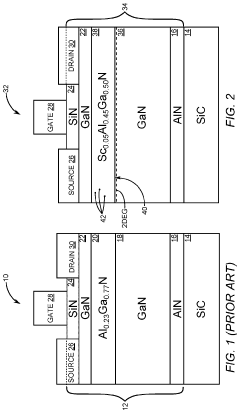
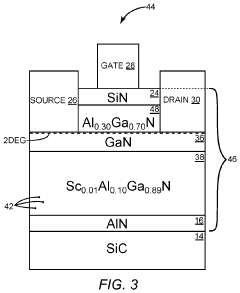
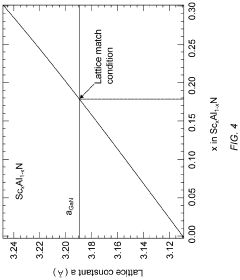
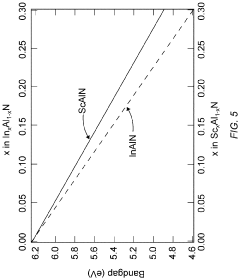
- Incorporating an aluminum (Al) based layer with a Group IIIB transition metal alloying element, such as scandium (Sc), in the epitaxial structure of HEMT devices to relieve lattice stress and maintain high sheet charge density, achieving a sheet charge density of 3.18×10^13/cm^2 with improved electron Hall mobility and reliability.
High electron mobility transistor (HEMT)
PatentActiveUS9735240B2
Innovation
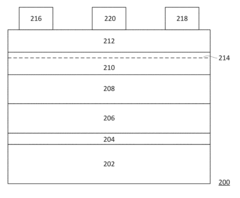
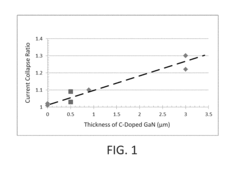
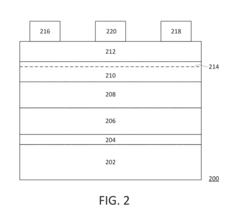
- A HEMT device with a highly resistive gallium nitride layer co-doped with carbon and a donor-type impurity, such as silicon or oxygen, is developed, where the donor-type impurity concentration is higher than carbon, maintaining a sheet resistance above 2300 Ohms/sq and suppressing undesirable defects that cause current collapse.
Thermal Management Strategies for GaN HEMT Devices
Thermal management remains one of the most critical challenges in GaN HEMT technology development, as these devices operate at high power densities that generate significant heat. Current thermal management strategies focus on multiple levels of the device architecture, from semiconductor materials to packaging solutions.
At the device level, substrate selection plays a crucial role in heat dissipation. Silicon carbide (SiC) substrates have emerged as the preferred option due to their thermal conductivity of approximately 490 W/mK, significantly outperforming silicon substrates (150 W/mK). Diamond substrates, with thermal conductivity exceeding 2000 W/mK, represent the theoretical ideal but remain prohibitively expensive for commercial applications.
Advanced packaging technologies have evolved to address thermal challenges. Flip-chip configurations have gained prominence by eliminating wire bonds and providing direct thermal paths to heat sinks. Recent developments include embedded microchannel cooling, where coolant flows directly beneath the active device region, demonstrating up to 60% improvement in thermal resistance compared to conventional approaches.
Thermal interface materials (TIMs) continue to advance with the introduction of graphene-enhanced composites and liquid metal solutions. These materials significantly reduce the thermal boundary resistance between the device and heat sink, with some next-generation TIMs achieving thermal conductivities above 25 W/mK, compared to traditional materials at 5-10 W/mK.
Computational fluid dynamics (CFD) modeling has become essential for thermal design optimization. Three-dimensional thermal simulations now incorporate multi-physics approaches that simultaneously model electrical, thermal, and mechanical behaviors. These tools enable accurate prediction of hotspot formation and optimization of cooling strategies before physical prototyping.
Emerging cooling technologies include two-phase cooling systems that utilize the latent heat of vaporization to achieve higher heat transfer coefficients. Microjet impingement cooling, which directs high-velocity coolant streams at hotspots, has demonstrated heat flux handling capabilities exceeding 1000 W/cm² in laboratory settings.
The roadmap for thermal management in GaN HEMTs points toward heterogeneous integration approaches that combine multiple cooling technologies tailored to specific device architectures. Industry leaders are increasingly adopting thermal-aware design methodologies that consider thermal management from the earliest stages of device development rather than as an afterthought.
At the device level, substrate selection plays a crucial role in heat dissipation. Silicon carbide (SiC) substrates have emerged as the preferred option due to their thermal conductivity of approximately 490 W/mK, significantly outperforming silicon substrates (150 W/mK). Diamond substrates, with thermal conductivity exceeding 2000 W/mK, represent the theoretical ideal but remain prohibitively expensive for commercial applications.
Advanced packaging technologies have evolved to address thermal challenges. Flip-chip configurations have gained prominence by eliminating wire bonds and providing direct thermal paths to heat sinks. Recent developments include embedded microchannel cooling, where coolant flows directly beneath the active device region, demonstrating up to 60% improvement in thermal resistance compared to conventional approaches.
Thermal interface materials (TIMs) continue to advance with the introduction of graphene-enhanced composites and liquid metal solutions. These materials significantly reduce the thermal boundary resistance between the device and heat sink, with some next-generation TIMs achieving thermal conductivities above 25 W/mK, compared to traditional materials at 5-10 W/mK.
Computational fluid dynamics (CFD) modeling has become essential for thermal design optimization. Three-dimensional thermal simulations now incorporate multi-physics approaches that simultaneously model electrical, thermal, and mechanical behaviors. These tools enable accurate prediction of hotspot formation and optimization of cooling strategies before physical prototyping.
Emerging cooling technologies include two-phase cooling systems that utilize the latent heat of vaporization to achieve higher heat transfer coefficients. Microjet impingement cooling, which directs high-velocity coolant streams at hotspots, has demonstrated heat flux handling capabilities exceeding 1000 W/cm² in laboratory settings.
The roadmap for thermal management in GaN HEMTs points toward heterogeneous integration approaches that combine multiple cooling technologies tailored to specific device architectures. Industry leaders are increasingly adopting thermal-aware design methodologies that consider thermal management from the earliest stages of device development rather than as an afterthought.
Reliability and Qualification Standards for GaN HEMTs
The reliability and qualification standards for GaN HEMTs represent a critical framework for ensuring these devices meet the stringent requirements of various applications, particularly in high-power and high-frequency domains. As GaN technology continues to mature, standardization efforts have evolved significantly to address the unique failure mechanisms and operational challenges of these devices.
Industry standards such as JEDEC JEP180 and AEC-Q101 have been adapted specifically for GaN HEMT qualification, establishing comprehensive test protocols that evaluate device robustness under extreme conditions. These standards typically include high-temperature reverse bias (HTRB) testing, temperature cycling, humidity testing, and accelerated lifetime tests designed to predict long-term reliability.
The qualification process for GaN HEMTs differs substantially from silicon-based devices due to unique degradation mechanisms such as current collapse, dynamic RON, and gate leakage phenomena. These mechanisms necessitate specialized testing methodologies that accurately capture the performance degradation under various operational stresses.
Mission-critical applications in aerospace, defense, and automotive sectors have driven the development of enhanced qualification standards. For instance, the automotive industry requires GaN HEMTs to demonstrate reliability at junction temperatures exceeding 175°C for thousands of hours, with failure rates below 1 FIT (failures in time) under typical operating conditions.
Recent advancements in reliability engineering have led to the implementation of physics-of-failure approaches, where qualification tests are designed based on fundamental understanding of degradation mechanisms rather than empirical correlations. This shift has enabled more accurate lifetime predictions and improved qualification efficiency.
Wafer-level reliability monitoring has emerged as a crucial component of GaN HEMT qualification, allowing manufacturers to identify potential reliability issues earlier in the production process. Statistical methods such as Weibull analysis are commonly employed to extrapolate accelerated test results to normal operating conditions.
The international harmonization of standards remains an ongoing challenge, with efforts underway to establish globally recognized qualification protocols. Organizations such as JEDEC, IEC, and AEC continue to collaborate on developing unified standards that address the specific reliability concerns of GaN technology while facilitating global market access.
As GaN HEMT technology advances toward higher power densities and operating frequencies, qualification standards must evolve accordingly. Future standards will likely incorporate more sophisticated reliability models that account for complex interactions between different degradation mechanisms and provide more accurate lifetime predictions under varied application conditions.
Industry standards such as JEDEC JEP180 and AEC-Q101 have been adapted specifically for GaN HEMT qualification, establishing comprehensive test protocols that evaluate device robustness under extreme conditions. These standards typically include high-temperature reverse bias (HTRB) testing, temperature cycling, humidity testing, and accelerated lifetime tests designed to predict long-term reliability.
The qualification process for GaN HEMTs differs substantially from silicon-based devices due to unique degradation mechanisms such as current collapse, dynamic RON, and gate leakage phenomena. These mechanisms necessitate specialized testing methodologies that accurately capture the performance degradation under various operational stresses.
Mission-critical applications in aerospace, defense, and automotive sectors have driven the development of enhanced qualification standards. For instance, the automotive industry requires GaN HEMTs to demonstrate reliability at junction temperatures exceeding 175°C for thousands of hours, with failure rates below 1 FIT (failures in time) under typical operating conditions.
Recent advancements in reliability engineering have led to the implementation of physics-of-failure approaches, where qualification tests are designed based on fundamental understanding of degradation mechanisms rather than empirical correlations. This shift has enabled more accurate lifetime predictions and improved qualification efficiency.
Wafer-level reliability monitoring has emerged as a crucial component of GaN HEMT qualification, allowing manufacturers to identify potential reliability issues earlier in the production process. Statistical methods such as Weibull analysis are commonly employed to extrapolate accelerated test results to normal operating conditions.
The international harmonization of standards remains an ongoing challenge, with efforts underway to establish globally recognized qualification protocols. Organizations such as JEDEC, IEC, and AEC continue to collaborate on developing unified standards that address the specific reliability concerns of GaN technology while facilitating global market access.
As GaN HEMT technology advances toward higher power densities and operating frequencies, qualification standards must evolve accordingly. Future standards will likely incorporate more sophisticated reliability models that account for complex interactions between different degradation mechanisms and provide more accurate lifetime predictions under varied application conditions.
Unlock deeper insights with Patsnap Eureka Quick Research — get a full tech report to explore trends and direct your research. Try now!
Generate Your Research Report Instantly with AI Agent
Supercharge your innovation with Patsnap Eureka AI Agent Platform!