

GDI Engine Combustion Control for Cleaner Emissions
AUG 28, 20259 MIN READ
Generate Your Research Report Instantly with AI Agent
PatSnap Eureka helps you evaluate technical feasibility & market potential.
GDI Engine Evolution and Emission Reduction Goals
Gasoline Direct Injection (GDI) technology has undergone significant evolution since its commercial introduction in the late 1990s. The first-generation GDI engines focused primarily on fuel efficiency improvements through stratified charge combustion, achieving approximately 5-10% better fuel economy compared to port fuel injection systems. However, these early systems faced challenges with particulate matter (PM) emissions, which became increasingly problematic as emission regulations tightened globally.
The second evolutionary phase, emerging around 2005-2010, introduced spray-guided injection systems replacing the initial wall-guided designs. This technological shift improved fuel atomization and reduced wall wetting, addressing some of the particulate formation mechanisms. During this period, manufacturers began implementing higher injection pressures, increasing from 50-100 bar in first-generation systems to 150-200 bar, which further enhanced combustion efficiency.
By the 2010s, the third generation of GDI technology emerged with dual-injection systems (combining direct and port injection), multiple injection events per cycle, and injection pressures exceeding 350 bar. These advancements were directly driven by increasingly stringent emission standards worldwide, particularly Euro 6 in Europe, Tier 3 in the United States, and China 6 regulations.
The emission reduction goals for GDI engines have evolved dramatically over the past decade. Initially focused on CO2 reduction through improved thermal efficiency, regulatory attention has shifted toward controlling criteria pollutants, particularly nitrogen oxides (NOx) and particulate matter. Current targets aim for PM mass emissions below 3 mg/km and particle number counts under 6×10^11 particles/km to meet Euro 6d standards.
Looking forward, the industry faces even more ambitious goals with upcoming Euro 7 regulations potentially reducing these limits by an additional 50-90%. This regulatory pressure is driving innovation in combustion control strategies, with manufacturers pursuing advanced injection timing control, optimized spray patterns, and enhanced air-fuel mixing techniques to achieve near-zero emission levels.
The technological roadmap for GDI engines now focuses on achieving ultra-low emissions while maintaining the efficiency advantages that made the technology attractive initially. Key development targets include reducing engine-out emissions to minimize reliance on expensive aftertreatment systems, improving cold-start emissions which account for a disproportionate share of total cycle emissions, and maintaining performance under real-world driving conditions rather than just optimizing for test cycles.
These goals represent not just regulatory compliance challenges but fundamental engineering problems requiring innovations in combustion physics, control algorithms, and sensor technology to enable precise real-time combustion management across all operating conditions.
The second evolutionary phase, emerging around 2005-2010, introduced spray-guided injection systems replacing the initial wall-guided designs. This technological shift improved fuel atomization and reduced wall wetting, addressing some of the particulate formation mechanisms. During this period, manufacturers began implementing higher injection pressures, increasing from 50-100 bar in first-generation systems to 150-200 bar, which further enhanced combustion efficiency.
By the 2010s, the third generation of GDI technology emerged with dual-injection systems (combining direct and port injection), multiple injection events per cycle, and injection pressures exceeding 350 bar. These advancements were directly driven by increasingly stringent emission standards worldwide, particularly Euro 6 in Europe, Tier 3 in the United States, and China 6 regulations.
The emission reduction goals for GDI engines have evolved dramatically over the past decade. Initially focused on CO2 reduction through improved thermal efficiency, regulatory attention has shifted toward controlling criteria pollutants, particularly nitrogen oxides (NOx) and particulate matter. Current targets aim for PM mass emissions below 3 mg/km and particle number counts under 6×10^11 particles/km to meet Euro 6d standards.
Looking forward, the industry faces even more ambitious goals with upcoming Euro 7 regulations potentially reducing these limits by an additional 50-90%. This regulatory pressure is driving innovation in combustion control strategies, with manufacturers pursuing advanced injection timing control, optimized spray patterns, and enhanced air-fuel mixing techniques to achieve near-zero emission levels.
The technological roadmap for GDI engines now focuses on achieving ultra-low emissions while maintaining the efficiency advantages that made the technology attractive initially. Key development targets include reducing engine-out emissions to minimize reliance on expensive aftertreatment systems, improving cold-start emissions which account for a disproportionate share of total cycle emissions, and maintaining performance under real-world driving conditions rather than just optimizing for test cycles.
These goals represent not just regulatory compliance challenges but fundamental engineering problems requiring innovations in combustion physics, control algorithms, and sensor technology to enable precise real-time combustion management across all operating conditions.
Market Demand for Low-Emission GDI Technologies
The global market for low-emission GDI (Gasoline Direct Injection) technologies has experienced substantial growth over the past decade, primarily driven by increasingly stringent emission regulations across major automotive markets. The European Union's Euro 6d standards, the United States EPA's Tier 3 requirements, and China's China 6 regulations have collectively created a robust demand for cleaner combustion technologies in gasoline engines.
Market research indicates that the GDI engine market was valued at approximately $41.7 billion in 2022 and is projected to reach $73.9 billion by 2030, growing at a CAGR of 7.4%. This growth trajectory is directly linked to the automotive industry's urgent need to reduce particulate matter (PM) and nitrogen oxide (NOx) emissions while maintaining or improving fuel efficiency.
Consumer preferences have also shifted significantly toward environmentally friendly vehicles with lower carbon footprints. A recent survey conducted across major automotive markets revealed that 67% of new car buyers consider environmental impact as a "very important" factor in their purchasing decisions, up from 42% five years ago. This shift in consumer sentiment has compelled automotive manufacturers to invest heavily in cleaner combustion technologies.
The market demand is particularly strong in regions with dense urban populations facing severe air quality challenges. Cities in China, India, and parts of Europe have implemented or are planning to implement low-emission zones, further accelerating the adoption of advanced GDI technologies with enhanced combustion control systems.
Fleet operators and commercial vehicle manufacturers represent another significant market segment, as they face mounting pressure to reduce their environmental impact while maintaining operational efficiency. The total cost of ownership calculations increasingly favor vehicles with advanced emission control systems due to potential regulatory penalties and operational restrictions in urban areas.
The aftermarket for GDI emission control technologies is also expanding rapidly, with retrofit solutions gaining traction in markets where older vehicles constitute a significant portion of the fleet. This segment is expected to grow at 9.2% annually through 2028, creating additional revenue streams for technology providers.
Automotive OEMs are increasingly willing to pay premium prices for GDI technologies that can deliver measurable emission reductions without compromising performance. The average price premium for advanced combustion control systems ranges between 15-20% compared to conventional systems, yet market adoption continues to accelerate due to regulatory compliance requirements and brand positioning considerations.
Market research indicates that the GDI engine market was valued at approximately $41.7 billion in 2022 and is projected to reach $73.9 billion by 2030, growing at a CAGR of 7.4%. This growth trajectory is directly linked to the automotive industry's urgent need to reduce particulate matter (PM) and nitrogen oxide (NOx) emissions while maintaining or improving fuel efficiency.
Consumer preferences have also shifted significantly toward environmentally friendly vehicles with lower carbon footprints. A recent survey conducted across major automotive markets revealed that 67% of new car buyers consider environmental impact as a "very important" factor in their purchasing decisions, up from 42% five years ago. This shift in consumer sentiment has compelled automotive manufacturers to invest heavily in cleaner combustion technologies.
The market demand is particularly strong in regions with dense urban populations facing severe air quality challenges. Cities in China, India, and parts of Europe have implemented or are planning to implement low-emission zones, further accelerating the adoption of advanced GDI technologies with enhanced combustion control systems.
Fleet operators and commercial vehicle manufacturers represent another significant market segment, as they face mounting pressure to reduce their environmental impact while maintaining operational efficiency. The total cost of ownership calculations increasingly favor vehicles with advanced emission control systems due to potential regulatory penalties and operational restrictions in urban areas.
The aftermarket for GDI emission control technologies is also expanding rapidly, with retrofit solutions gaining traction in markets where older vehicles constitute a significant portion of the fleet. This segment is expected to grow at 9.2% annually through 2028, creating additional revenue streams for technology providers.
Automotive OEMs are increasingly willing to pay premium prices for GDI technologies that can deliver measurable emission reductions without compromising performance. The average price premium for advanced combustion control systems ranges between 15-20% compared to conventional systems, yet market adoption continues to accelerate due to regulatory compliance requirements and brand positioning considerations.
Current Challenges in GDI Combustion Control
Gasoline Direct Injection (GDI) technology has emerged as a dominant solution in modern internal combustion engines due to its potential for improved fuel efficiency and reduced CO2 emissions. However, GDI engines face significant combustion control challenges that impede their ability to meet increasingly stringent emission regulations worldwide. The primary challenge stems from the inherent trade-off between particulate matter (PM) and nitrogen oxides (NOx) emissions, creating a complex optimization problem for engineers.
The precise control of fuel-air mixture formation represents a critical challenge in GDI combustion. Unlike port fuel injection systems, GDI introduces fuel directly into the combustion chamber under high pressure, creating complex spray patterns that must be precisely managed. Variations in spray penetration, atomization quality, and wall wetting significantly impact combustion stability and emissions formation. Current injection systems struggle to maintain optimal spray characteristics across the wide range of engine operating conditions, particularly during cold starts and transient operations.
Combustion phasing control presents another significant hurdle. GDI engines typically operate with stratified charge during part-load conditions to improve efficiency, but maintaining consistent combustion timing becomes problematic due to cycle-to-cycle variations. These variations arise from fluctuations in mixture formation, turbulence levels, and residual gas fractions, leading to unstable combustion events that increase emissions and reduce drivability.
Particulate matter emissions remain perhaps the most pressing challenge for GDI technology. The direct injection process can create fuel-rich pockets within the combustion chamber that promote soot formation. Current GDI engines produce significantly higher PM emissions compared to port fuel injection engines, particularly in the ultrafine particle size range that poses serious health concerns. The industry has responded with gasoline particulate filters (GPFs), but these add cost, complexity, and potential fuel economy penalties.
Cold-start emissions control represents another formidable challenge. During cold starts, fuel vaporization is poor, leading to incomplete combustion and elevated hydrocarbon and particulate emissions. Current catalyst technologies require time to reach light-off temperatures, creating an emissions control gap during the critical first minutes of operation. This challenge is particularly acute in regions with cold climates and for hybrid vehicles with frequent engine starts.
The integration of advanced combustion modes such as homogeneous charge compression ignition (HCCI) and partially premixed combustion (PPC) with GDI technology presents significant control challenges. These advanced modes offer potential emissions benefits but require precise control of multiple parameters including injection timing, pressure, and quantity, as well as valve timing and exhaust gas recirculation rates. Current engine control units lack the computational power and sensor feedback necessary to implement these strategies across the full operating range.
The precise control of fuel-air mixture formation represents a critical challenge in GDI combustion. Unlike port fuel injection systems, GDI introduces fuel directly into the combustion chamber under high pressure, creating complex spray patterns that must be precisely managed. Variations in spray penetration, atomization quality, and wall wetting significantly impact combustion stability and emissions formation. Current injection systems struggle to maintain optimal spray characteristics across the wide range of engine operating conditions, particularly during cold starts and transient operations.
Combustion phasing control presents another significant hurdle. GDI engines typically operate with stratified charge during part-load conditions to improve efficiency, but maintaining consistent combustion timing becomes problematic due to cycle-to-cycle variations. These variations arise from fluctuations in mixture formation, turbulence levels, and residual gas fractions, leading to unstable combustion events that increase emissions and reduce drivability.
Particulate matter emissions remain perhaps the most pressing challenge for GDI technology. The direct injection process can create fuel-rich pockets within the combustion chamber that promote soot formation. Current GDI engines produce significantly higher PM emissions compared to port fuel injection engines, particularly in the ultrafine particle size range that poses serious health concerns. The industry has responded with gasoline particulate filters (GPFs), but these add cost, complexity, and potential fuel economy penalties.
Cold-start emissions control represents another formidable challenge. During cold starts, fuel vaporization is poor, leading to incomplete combustion and elevated hydrocarbon and particulate emissions. Current catalyst technologies require time to reach light-off temperatures, creating an emissions control gap during the critical first minutes of operation. This challenge is particularly acute in regions with cold climates and for hybrid vehicles with frequent engine starts.
The integration of advanced combustion modes such as homogeneous charge compression ignition (HCCI) and partially premixed combustion (PPC) with GDI technology presents significant control challenges. These advanced modes offer potential emissions benefits but require precise control of multiple parameters including injection timing, pressure, and quantity, as well as valve timing and exhaust gas recirculation rates. Current engine control units lack the computational power and sensor feedback necessary to implement these strategies across the full operating range.
Current GDI Combustion Control Solutions
01 Fuel injection strategies for GDI engines
Various fuel injection strategies can be implemented in gasoline direct injection (GDI) engines to control combustion and reduce emissions. These strategies include optimizing injection timing, pressure, and spray patterns to enhance fuel atomization and mixing with air. Multiple injections per cycle can be used to create stratified charge combustion, which helps in reducing NOx emissions while maintaining fuel efficiency. Advanced injection control systems can adapt to different engine operating conditions to minimize pollutant formation.- Fuel injection strategies for GDI engines: Various fuel injection strategies can be implemented in gasoline direct injection (GDI) engines to optimize combustion and reduce emissions. These strategies include precise timing of fuel injection, multiple injections per cycle, and controlling the spray pattern. By optimizing the fuel injection process, better air-fuel mixture formation can be achieved, leading to more complete combustion and reduced emissions of particulate matter and nitrogen oxides.
- Exhaust gas recirculation (EGR) systems: Exhaust gas recirculation (EGR) systems are used in GDI engines to control combustion temperatures and reduce emissions. By recirculating a portion of the exhaust gas back into the combustion chamber, peak combustion temperatures are lowered, which helps reduce the formation of nitrogen oxides (NOx). Advanced EGR systems may include cooling mechanisms and precise control strategies to optimize the benefits while minimizing impact on engine performance.
- Advanced combustion control technologies: Advanced combustion control technologies in GDI engines focus on optimizing the combustion process to reduce emissions while maintaining or improving performance. These technologies include variable valve timing, cylinder deactivation, and combustion mode switching between homogeneous and stratified charge operation. By precisely controlling the combustion parameters, engines can operate in the most efficient mode for given conditions, resulting in reduced emissions and improved fuel economy.
- Aftertreatment systems for emission reduction: Aftertreatment systems are crucial for reducing emissions from GDI engines. These systems include three-way catalytic converters, particulate filters, and selective catalytic reduction (SCR) systems. The integration and optimization of these aftertreatment components help to effectively reduce various pollutants including carbon monoxide, hydrocarbons, nitrogen oxides, and particulate matter before they are released into the atmosphere.
- Engine design and optimization for emission control: The fundamental design and optimization of GDI engine components play a significant role in controlling emissions. This includes optimized combustion chamber geometry, piston design, intake port configuration, and cooling system design. By enhancing the basic engine architecture, better air-fuel mixing, more complete combustion, and reduced thermal stress can be achieved, which directly contributes to lower emissions without sacrificing performance or efficiency.
02 Exhaust gas recirculation (EGR) systems
Exhaust gas recirculation systems are employed in GDI engines to reduce combustion temperatures and control NOx emissions. By recirculating a portion of exhaust gases back into the combustion chamber, peak combustion temperatures are lowered, which inhibits NOx formation. Advanced EGR systems can include cooling components to further enhance the emission reduction benefits. Variable EGR control based on engine load and speed helps optimize the balance between performance and emissions compliance.Expand Specific Solutions03 Combustion chamber design optimization
The design of the combustion chamber in GDI engines significantly impacts emission control. Optimized piston crown shapes, intake port configurations, and spark plug positioning can enhance air-fuel mixing and combustion efficiency. These design elements help create ideal flow patterns within the cylinder, promoting complete combustion and reducing the formation of particulate matter and unburned hydrocarbons. Advanced combustion chamber designs also facilitate better thermal management to control emissions across various operating conditions.Expand Specific Solutions04 Electronic control systems for emissions management
Sophisticated electronic control systems are implemented in GDI engines to manage combustion parameters and minimize emissions. These systems utilize various sensors to monitor engine conditions and adjust parameters such as ignition timing, air-fuel ratio, and valve timing in real-time. Model-based control algorithms can predict and prevent conditions that lead to increased emissions. Adaptive learning capabilities allow the system to optimize performance over time while maintaining strict emissions compliance under varying operating conditions.Expand Specific Solutions05 Aftertreatment technologies for GDI engines
Various aftertreatment technologies are employed to further reduce emissions from GDI engines. These include three-way catalytic converters specifically designed for the emission characteristics of direct injection engines, particulate filters to capture soot particles, and NOx traps or selective catalytic reduction systems. Advanced thermal management strategies ensure these aftertreatment systems operate at optimal temperatures. Integration of these technologies with engine control systems allows for regeneration cycles and adaptive control to maintain emission reduction efficiency throughout the vehicle's lifetime.Expand Specific Solutions
Key Industry Players in GDI Engine Technology
The GDI Engine Combustion Control market is currently in a growth phase, with increasing demand driven by stringent global emissions regulations. The market size is projected to expand significantly as automotive manufacturers prioritize cleaner combustion technologies. Leading players include established automotive giants like Hyundai Motor Co., Kia Corp., Ford Global Technologies, and GM Global Technology Operations, who are investing heavily in GDI optimization. Technology maturity varies, with companies like BASF, Corning, and Umicore focusing on catalyst solutions, while academic institutions such as Tianjin University and Xi'an Jiaotong University contribute fundamental research. Tier-1 suppliers including DENSO, Delphi, and Cummins are advancing control systems and components, creating a competitive landscape where collaboration between OEMs, suppliers, and research institutions is driving innovation toward more efficient and cleaner GDI combustion technologies.
Hyundai Motor Co., Ltd.
Technical Solution: Hyundai has developed a Continuously Variable Valve Duration (CVVD) technology specifically optimized for their GDI engines to control emissions. This innovative system adjusts how long intake valves remain open, varying between short duration for high-speed, high-load conditions and longer duration for improved fuel efficiency at lower loads. When integrated with their GDI system, CVVD enables precise control over the combustion process by optimizing air intake based on driving conditions. Hyundai's approach also incorporates a Low-Pressure Exhaust Gas Recirculation (LP-EGR) system that cools recirculated exhaust gases more effectively than traditional high-pressure systems, significantly reducing NOx formation. Their GDI engines feature multi-hole injectors operating at pressures exceeding 200 bar, with sophisticated spray pattern optimization to minimize wall wetting and particulate formation. The system also employs advanced catalyst heating strategies during cold starts, including retarded ignition timing and split injection techniques[4][7].
Strengths: CVVD technology provides unprecedented control over valve timing and duration, offering both performance and emissions benefits; highly effective LP-EGR system for NOx reduction. Weaknesses: Complex valve control mechanisms increase manufacturing costs; requires precise calibration across operating conditions to maintain emissions compliance.
GM Global Technology Operations LLC
Technical Solution: GM has pioneered a comprehensive GDI combustion control strategy centered around their Dynamic Skip Fire (DSF) technology, which selectively deactivates cylinders based on torque demand while maintaining optimal combustion in active cylinders. Their system integrates advanced spray-guided direct injection with precisely controlled multiple injection events per cycle to minimize particulate formation. GM's technology incorporates predictive combustion models that adapt in real-time to changing conditions, optimizing air-fuel ratios and injection timing to reduce both NOx and particulate emissions simultaneously. The system also features integrated exhaust aftertreatment management that coordinates engine operation with catalyst conditions to maximize conversion efficiency. GM has implemented sophisticated knock detection algorithms that allow their GDI engines to operate closer to optimal efficiency points without compromising reliability or emissions performance[2][5].
Strengths: Dynamic Skip Fire technology provides exceptional fuel economy while maintaining low emissions; adaptive combustion models offer superior performance across varying conditions and fuel qualities. Weaknesses: Cylinder deactivation technology adds mechanical complexity; sophisticated control systems require extensive calibration effort across different vehicle platforms.
Advanced Injection and Ignition Technologies
Evaluation of the delivery and effectiveness of engine performance chemicals and products
PatentActiveUS20170114716A1
Innovation
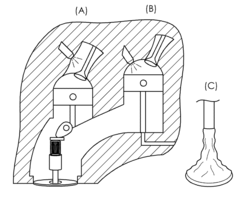
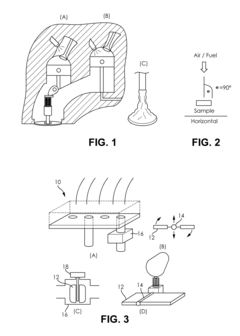
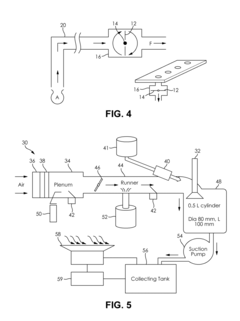
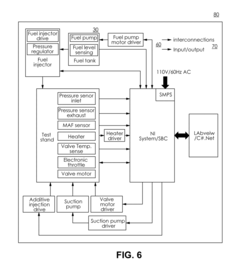
- A method and system for evaluating the delivery and effectiveness of engine performance chemicals and products for reducing intake valve deposits, utilizing a controlled environment with simulated engine conditions to quantify improvements, including adjustable parameters like air-fuel ratio, temperature, and oscillation frequency, and employing three approaches to introduce cleaners: airstream addition, suction-based distribution, and fuel additive application.
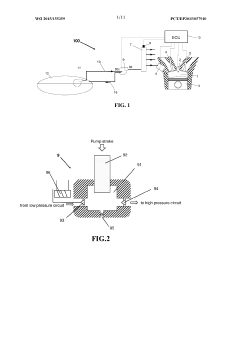
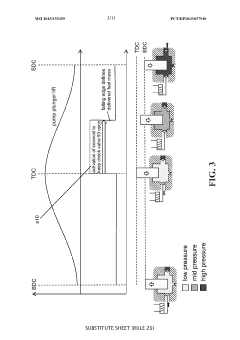
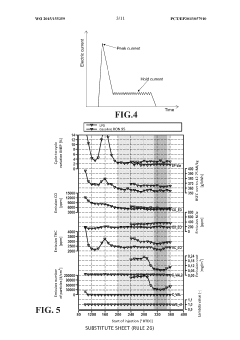
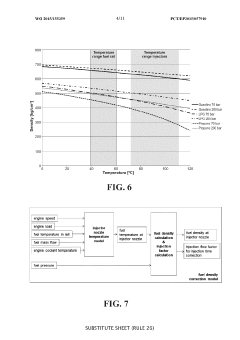
LPG direct injection engine
PatentWO2015155359A1
Innovation
- An LPG direct injection engine with a high-pressure pump and electronic control unit for precise liquefied petroleum gas injection between 360° and 60° BTDC, optimized valve overlap, and cylinder deactivation system to reduce emissions and improve efficiency.
Regulatory Framework for Vehicle Emissions
The global regulatory landscape for vehicle emissions has evolved significantly over the past decades, becoming increasingly stringent to address growing environmental and public health concerns. The European Union has established the Euro standards (currently Euro 6d), which set strict limits on nitrogen oxides (NOx), carbon monoxide (CO), hydrocarbons (HC), and particulate matter (PM) emissions. These standards have progressively tightened, with Euro 7 on the horizon promising even more rigorous requirements specifically targeting GDI engine emissions.
In the United States, the Environmental Protection Agency (EPA) and California Air Resources Board (CARB) have implemented Tier 3 and LEV III standards respectively, which focus on reducing fleet-average emissions and establishing near-zero emission targets. CARB's regulations are particularly influential, often preceding and exceeding federal standards, with many states adopting California's more stringent approach.
Asian markets demonstrate varying regulatory approaches. China has rapidly advanced its emission standards, implementing China 6 regulations comparable to Euro 6 standards, with specific provisions addressing GDI particulate emissions. Japan's emission standards align closely with European regulations but feature unique testing procedures, while South Korea has adopted standards similar to Euro 6 with implementation timelines tailored to their market conditions.
Regulatory frameworks increasingly incorporate Real Driving Emissions (RDE) testing, moving beyond laboratory conditions to ensure vehicles maintain low emission levels during actual road use. This shift represents a significant challenge for GDI engine technology, as the gap between laboratory and real-world performance has historically been substantial.
The global trend toward zero-emission vehicle mandates is reshaping the regulatory landscape, with several jurisdictions announcing future bans on internal combustion engines. However, transitional regulations specifically addressing GDI technology remain crucial for the medium term, as these engines will continue to dominate the market for years to come.
Compliance mechanisms vary globally, with some regions implementing fleet-average approaches while others enforce vehicle-by-vehicle standards. Penalties for non-compliance have increased substantially, with manufacturers facing significant financial consequences for exceeding emission limits, as evidenced by several high-profile cases in recent years.
The regulatory framework continues to evolve toward technology-neutral performance standards rather than prescriptive technical requirements, allowing manufacturers flexibility in how they achieve emission targets while encouraging innovation in combustion control technologies for GDI engines.
In the United States, the Environmental Protection Agency (EPA) and California Air Resources Board (CARB) have implemented Tier 3 and LEV III standards respectively, which focus on reducing fleet-average emissions and establishing near-zero emission targets. CARB's regulations are particularly influential, often preceding and exceeding federal standards, with many states adopting California's more stringent approach.
Asian markets demonstrate varying regulatory approaches. China has rapidly advanced its emission standards, implementing China 6 regulations comparable to Euro 6 standards, with specific provisions addressing GDI particulate emissions. Japan's emission standards align closely with European regulations but feature unique testing procedures, while South Korea has adopted standards similar to Euro 6 with implementation timelines tailored to their market conditions.
Regulatory frameworks increasingly incorporate Real Driving Emissions (RDE) testing, moving beyond laboratory conditions to ensure vehicles maintain low emission levels during actual road use. This shift represents a significant challenge for GDI engine technology, as the gap between laboratory and real-world performance has historically been substantial.
The global trend toward zero-emission vehicle mandates is reshaping the regulatory landscape, with several jurisdictions announcing future bans on internal combustion engines. However, transitional regulations specifically addressing GDI technology remain crucial for the medium term, as these engines will continue to dominate the market for years to come.
Compliance mechanisms vary globally, with some regions implementing fleet-average approaches while others enforce vehicle-by-vehicle standards. Penalties for non-compliance have increased substantially, with manufacturers facing significant financial consequences for exceeding emission limits, as evidenced by several high-profile cases in recent years.
The regulatory framework continues to evolve toward technology-neutral performance standards rather than prescriptive technical requirements, allowing manufacturers flexibility in how they achieve emission targets while encouraging innovation in combustion control technologies for GDI engines.
Sustainability Impact of GDI Technology Advancements
The advancement of Gasoline Direct Injection (GDI) technology represents a significant milestone in automotive engineering's pursuit of sustainability. GDI systems have demonstrated substantial improvements in fuel efficiency, achieving up to 15% reduction in fuel consumption compared to traditional port fuel injection systems. This translates directly to reduced carbon dioxide emissions, with studies indicating potential CO2 reductions of 12-14% in real-world driving conditions.
Beyond carbon emissions, modern GDI technology incorporates sophisticated combustion control strategies that significantly reduce nitrogen oxide (NOx) emissions. Advanced fuel mapping and precise injection timing have enabled manufacturers to meet increasingly stringent Euro 6 and Tier 3 emissions standards without sacrificing performance. The environmental impact extends to reduced hydrocarbon emissions during cold starts, a historically challenging phase for emissions control.
The sustainability benefits of GDI technology are further amplified when integrated with complementary systems. Hybrid powertrains utilizing GDI engines demonstrate synergistic efficiency gains, with some production models achieving over 20% improvement in overall emissions profiles compared to conventional powertrains. This integration represents a critical pathway toward meeting fleet-wide emissions targets while maintaining consumer acceptance.
Material sustainability has also improved through GDI implementation. The precision engineering of GDI components has driven advancements in manufacturing processes that reduce waste and energy consumption. Modern injectors utilize approximately 30% less raw material than earlier generations while delivering superior performance and longevity, reducing lifecycle environmental impact.
Water conservation represents another often-overlooked sustainability benefit. The improved thermal efficiency of GDI engines reduces cooling requirements, with some systems demonstrating up to 8% reduction in cooling system capacity needs. This translates to reduced manufacturing resource demands and lower vehicle weight, creating a positive feedback loop for efficiency.
Looking forward, GDI technology continues to evolve toward greater sustainability. Research indicates that next-generation GDI systems with advanced particulate filters and optimized combustion chamber designs could reduce particulate emissions by up to 90% compared to early GDI implementations. These advancements position GDI as a critical bridge technology in the transition toward fully sustainable transportation solutions, offering immediate environmental benefits while alternative propulsion technologies mature.
Beyond carbon emissions, modern GDI technology incorporates sophisticated combustion control strategies that significantly reduce nitrogen oxide (NOx) emissions. Advanced fuel mapping and precise injection timing have enabled manufacturers to meet increasingly stringent Euro 6 and Tier 3 emissions standards without sacrificing performance. The environmental impact extends to reduced hydrocarbon emissions during cold starts, a historically challenging phase for emissions control.
The sustainability benefits of GDI technology are further amplified when integrated with complementary systems. Hybrid powertrains utilizing GDI engines demonstrate synergistic efficiency gains, with some production models achieving over 20% improvement in overall emissions profiles compared to conventional powertrains. This integration represents a critical pathway toward meeting fleet-wide emissions targets while maintaining consumer acceptance.
Material sustainability has also improved through GDI implementation. The precision engineering of GDI components has driven advancements in manufacturing processes that reduce waste and energy consumption. Modern injectors utilize approximately 30% less raw material than earlier generations while delivering superior performance and longevity, reducing lifecycle environmental impact.
Water conservation represents another often-overlooked sustainability benefit. The improved thermal efficiency of GDI engines reduces cooling requirements, with some systems demonstrating up to 8% reduction in cooling system capacity needs. This translates to reduced manufacturing resource demands and lower vehicle weight, creating a positive feedback loop for efficiency.
Looking forward, GDI technology continues to evolve toward greater sustainability. Research indicates that next-generation GDI systems with advanced particulate filters and optimized combustion chamber designs could reduce particulate emissions by up to 90% compared to early GDI implementations. These advancements position GDI as a critical bridge technology in the transition toward fully sustainable transportation solutions, offering immediate environmental benefits while alternative propulsion technologies mature.
Unlock deeper insights with PatSnap Eureka Quick Research — get a full tech report to explore trends and direct your research. Try now!
Generate Your Research Report Instantly with AI Agent
Supercharge your innovation with PatSnap Eureka AI Agent Platform!