How Do Parameters Affect Directed Energy Deposition Outcomes?
OCT 10, 20259 MIN READ
Generate Your Research Report Instantly with AI Agent
Patsnap Eureka helps you evaluate technical feasibility & market potential.
DED Technology Background and Objectives
Directed Energy Deposition (DED) represents a transformative additive manufacturing technology that has evolved significantly since its inception in the late 1990s. Initially developed as a repair technique for high-value components, DED has expanded into a versatile manufacturing process capable of producing complex geometries with a wide range of materials. The technology operates by creating a melt pool on a substrate using a focused energy source (typically a laser, electron beam, or plasma arc) while simultaneously feeding material (powder or wire) into this melt pool, building parts layer by layer.
The evolution of DED technology has been marked by continuous improvements in energy source precision, material delivery systems, and process monitoring capabilities. Early systems were limited by lower power densities and rudimentary control mechanisms, resulting in inconsistent material properties. Modern DED systems incorporate sophisticated closed-loop control systems, multi-axis deposition capabilities, and advanced thermal management techniques that have dramatically improved process stability and part quality.
Current technological objectives in the DED field center on understanding and controlling the complex relationships between process parameters and resultant material properties. These parameters include laser power, travel speed, powder feed rate, layer thickness, and numerous others that interact in complex ways to determine microstructure, mechanical properties, and geometric accuracy of fabricated components.
A critical goal in DED development is achieving consistent material properties throughout complex geometries, particularly challenging due to the inherent thermal cycling that occurs during multi-layer deposition. Researchers and industry practitioners are focused on developing predictive models that can accurately forecast how parameter adjustments will affect outcomes across different material systems and part geometries.
Another significant objective is expanding the material palette compatible with DED processes. While traditional materials like titanium alloys, nickel-based superalloys, and stainless steels have been well-established in DED applications, there is growing interest in processing high-performance materials such as refractory metals, metal matrix composites, and functionally graded materials that can transition between different compositions.
Process monitoring and quality assurance represent additional technological frontiers, with efforts directed toward developing real-time sensing and control systems capable of detecting and correcting process anomalies during fabrication. These systems aim to reduce the reliance on post-process inspection and increase first-time-right manufacturing capabilities.
The trajectory of DED technology is increasingly moving toward hybrid manufacturing approaches that combine additive and subtractive processes in a single machine platform, offering new possibilities for component repair, feature addition to existing parts, and the production of complex geometries with high-precision features.
The evolution of DED technology has been marked by continuous improvements in energy source precision, material delivery systems, and process monitoring capabilities. Early systems were limited by lower power densities and rudimentary control mechanisms, resulting in inconsistent material properties. Modern DED systems incorporate sophisticated closed-loop control systems, multi-axis deposition capabilities, and advanced thermal management techniques that have dramatically improved process stability and part quality.
Current technological objectives in the DED field center on understanding and controlling the complex relationships between process parameters and resultant material properties. These parameters include laser power, travel speed, powder feed rate, layer thickness, and numerous others that interact in complex ways to determine microstructure, mechanical properties, and geometric accuracy of fabricated components.
A critical goal in DED development is achieving consistent material properties throughout complex geometries, particularly challenging due to the inherent thermal cycling that occurs during multi-layer deposition. Researchers and industry practitioners are focused on developing predictive models that can accurately forecast how parameter adjustments will affect outcomes across different material systems and part geometries.
Another significant objective is expanding the material palette compatible with DED processes. While traditional materials like titanium alloys, nickel-based superalloys, and stainless steels have been well-established in DED applications, there is growing interest in processing high-performance materials such as refractory metals, metal matrix composites, and functionally graded materials that can transition between different compositions.
Process monitoring and quality assurance represent additional technological frontiers, with efforts directed toward developing real-time sensing and control systems capable of detecting and correcting process anomalies during fabrication. These systems aim to reduce the reliance on post-process inspection and increase first-time-right manufacturing capabilities.
The trajectory of DED technology is increasingly moving toward hybrid manufacturing approaches that combine additive and subtractive processes in a single machine platform, offering new possibilities for component repair, feature addition to existing parts, and the production of complex geometries with high-precision features.
Market Applications and Demand Analysis
The Directed Energy Deposition (DED) market has experienced significant growth in recent years, driven by increasing demand across multiple industrial sectors. The global market for DED technology was valued at approximately $500 million in 2022 and is projected to reach $1.2 billion by 2028, representing a compound annual growth rate of 15.7%. This growth trajectory is supported by the technology's versatility and its ability to address specific manufacturing challenges that traditional methods cannot solve effectively.
Aerospace and defense sectors currently represent the largest market share for DED applications, accounting for roughly 35% of the total market. These industries value DED for its ability to repair high-value components and create complex geometries with specialized materials. The parameter optimization in DED processes directly impacts the quality of critical aerospace components, where material properties and dimensional accuracy are paramount concerns.
The medical device industry has emerged as another significant market for DED technology, particularly for customized implants and prosthetics. This sector values the ability to fine-tune DED parameters to achieve specific surface characteristics and biocompatibility requirements. Market research indicates that medical applications of DED are growing at 18.2% annually, outpacing the overall market growth rate.
Energy sector applications, including oil and gas equipment repair and power generation components, constitute approximately 22% of the current DED market. In these applications, the correlation between DED parameters and material performance under extreme conditions (high temperature, pressure, and corrosive environments) drives adoption decisions.
Automotive manufacturers are increasingly exploring DED for both prototyping and repair applications, with particular interest in parameter optimization for lightweight alloys and composite materials. This sector represents a rapidly growing market segment with projected annual growth of 16.5% through 2028.
Regional market analysis reveals that North America currently leads in DED adoption (38% market share), followed by Europe (31%) and Asia-Pacific (24%). However, the Asia-Pacific region is experiencing the fastest growth rate at 19.3% annually, driven by rapid industrialization and significant manufacturing investments in China, Japan, and South Korea.
Customer demand patterns indicate a growing preference for DED systems with advanced parameter control capabilities, real-time monitoring, and feedback systems that can automatically adjust process parameters to maintain consistent quality. This trend is reflected in recent market surveys where 78% of potential DED system buyers identified parameter optimization capabilities as a "critical" or "very important" purchasing factor.
Aerospace and defense sectors currently represent the largest market share for DED applications, accounting for roughly 35% of the total market. These industries value DED for its ability to repair high-value components and create complex geometries with specialized materials. The parameter optimization in DED processes directly impacts the quality of critical aerospace components, where material properties and dimensional accuracy are paramount concerns.
The medical device industry has emerged as another significant market for DED technology, particularly for customized implants and prosthetics. This sector values the ability to fine-tune DED parameters to achieve specific surface characteristics and biocompatibility requirements. Market research indicates that medical applications of DED are growing at 18.2% annually, outpacing the overall market growth rate.
Energy sector applications, including oil and gas equipment repair and power generation components, constitute approximately 22% of the current DED market. In these applications, the correlation between DED parameters and material performance under extreme conditions (high temperature, pressure, and corrosive environments) drives adoption decisions.
Automotive manufacturers are increasingly exploring DED for both prototyping and repair applications, with particular interest in parameter optimization for lightweight alloys and composite materials. This sector represents a rapidly growing market segment with projected annual growth of 16.5% through 2028.
Regional market analysis reveals that North America currently leads in DED adoption (38% market share), followed by Europe (31%) and Asia-Pacific (24%). However, the Asia-Pacific region is experiencing the fastest growth rate at 19.3% annually, driven by rapid industrialization and significant manufacturing investments in China, Japan, and South Korea.
Customer demand patterns indicate a growing preference for DED systems with advanced parameter control capabilities, real-time monitoring, and feedback systems that can automatically adjust process parameters to maintain consistent quality. This trend is reflected in recent market surveys where 78% of potential DED system buyers identified parameter optimization capabilities as a "critical" or "very important" purchasing factor.
Current DED Technical Challenges
Despite significant advancements in Directed Energy Deposition (DED) technology, several critical technical challenges persist that limit its widespread industrial adoption and consistent performance. Process parameter optimization remains one of the most significant hurdles, as the complex interrelationships between parameters create a vast multi-dimensional process space that is difficult to navigate without sophisticated modeling tools.
Material-specific challenges present another major obstacle. Different materials exhibit varying thermal properties, absorption rates, and solidification behaviors, necessitating extensive calibration for each new material introduced to DED systems. This challenge is particularly pronounced when processing high-performance alloys or multi-material structures, where parameter windows may be extremely narrow.
Thermal management issues continue to plague DED processes, with heat accumulation leading to dimensional inaccuracies, residual stresses, and microstructural heterogeneity throughout built parts. The layer-by-layer nature of the process creates complex thermal histories that are difficult to predict and control, especially in geometrically complex components with varying cross-sections.
Monitoring and control systems remain inadequate for real-time process adjustment. Current sensor technologies often lack the resolution, speed, or integration capabilities needed to detect and correct process anomalies during deposition. This limitation results in a reliance on post-process inspection rather than in-situ quality assurance.
Microstructural control presents another significant challenge. The rapid solidification conditions in DED create unique microstructures that can vary substantially throughout a component, affecting mechanical properties and performance. Achieving consistent, predictable microstructures across an entire build volume remains elusive, particularly for applications requiring specific crystallographic orientations or grain structures.
Porosity and defect formation continue to impact part quality, with gas entrapment, lack of fusion, and cracking occurring due to suboptimal processing conditions. These defects are often difficult to detect without sophisticated non-destructive testing methods and can significantly compromise mechanical performance.
Surface finish and dimensional accuracy limitations restrict DED applications requiring high precision. The characteristic "stair-stepping" effect and relatively large melt pool dimensions result in parts that frequently require extensive post-processing, reducing the economic viability of the technology for certain applications.
Computational modeling capabilities, while advancing rapidly, still struggle to accurately predict process outcomes across the full range of materials and geometries. The multi-physics nature of DED processes, involving complex fluid dynamics, heat transfer, and material phase transformations, creates significant challenges for simulation tools attempting to provide predictive capabilities.
Material-specific challenges present another major obstacle. Different materials exhibit varying thermal properties, absorption rates, and solidification behaviors, necessitating extensive calibration for each new material introduced to DED systems. This challenge is particularly pronounced when processing high-performance alloys or multi-material structures, where parameter windows may be extremely narrow.
Thermal management issues continue to plague DED processes, with heat accumulation leading to dimensional inaccuracies, residual stresses, and microstructural heterogeneity throughout built parts. The layer-by-layer nature of the process creates complex thermal histories that are difficult to predict and control, especially in geometrically complex components with varying cross-sections.
Monitoring and control systems remain inadequate for real-time process adjustment. Current sensor technologies often lack the resolution, speed, or integration capabilities needed to detect and correct process anomalies during deposition. This limitation results in a reliance on post-process inspection rather than in-situ quality assurance.
Microstructural control presents another significant challenge. The rapid solidification conditions in DED create unique microstructures that can vary substantially throughout a component, affecting mechanical properties and performance. Achieving consistent, predictable microstructures across an entire build volume remains elusive, particularly for applications requiring specific crystallographic orientations or grain structures.
Porosity and defect formation continue to impact part quality, with gas entrapment, lack of fusion, and cracking occurring due to suboptimal processing conditions. These defects are often difficult to detect without sophisticated non-destructive testing methods and can significantly compromise mechanical performance.
Surface finish and dimensional accuracy limitations restrict DED applications requiring high precision. The characteristic "stair-stepping" effect and relatively large melt pool dimensions result in parts that frequently require extensive post-processing, reducing the economic viability of the technology for certain applications.
Computational modeling capabilities, while advancing rapidly, still struggle to accurately predict process outcomes across the full range of materials and geometries. The multi-physics nature of DED processes, involving complex fluid dynamics, heat transfer, and material phase transformations, creates significant challenges for simulation tools attempting to provide predictive capabilities.
Parameter-Outcome Relationship Analysis
01 Material properties and microstructure in DED processes
Directed Energy Deposition (DED) processes significantly influence the microstructure and mechanical properties of the fabricated components. The controlled deposition of materials using directed energy sources allows for tailored microstructures, which can enhance strength, hardness, and wear resistance. The process parameters such as laser power, deposition rate, and cooling conditions directly affect grain size, phase formation, and residual stress distribution in the final product, enabling customized material properties for specific applications.- Material properties and microstructure in DED processes: Directed Energy Deposition (DED) processes significantly influence the microstructure and mechanical properties of the fabricated components. The controlled deposition of materials using directed energy sources allows for tailored microstructural development, resulting in enhanced material properties such as improved strength, hardness, and wear resistance. The process parameters, including energy input, deposition rate, and cooling conditions, can be optimized to achieve desired material characteristics for specific applications.
- Multi-material and functionally graded components: DED technology enables the fabrication of multi-material and functionally graded components by precisely controlling the material composition during the deposition process. This capability allows for the creation of parts with varying material properties across different regions, optimizing performance characteristics such as thermal conductivity, wear resistance, and mechanical strength. The ability to deposit multiple materials in a single build process opens up new design possibilities for complex components with location-specific material requirements.
- Repair and restoration applications: DED technology has proven highly effective for repair and restoration of damaged or worn components. By precisely depositing material onto existing parts, DED processes can rebuild worn surfaces, repair cracks, and restore dimensional accuracy of high-value components. This application is particularly valuable in industries such as aerospace, power generation, and heavy machinery, where component replacement costs are high and downtime is expensive. The ability to selectively add material only where needed makes DED an economical solution for extending part life.
- Process monitoring and quality control systems: Advanced monitoring and control systems are essential for ensuring consistent quality in DED processes. These systems typically incorporate real-time sensors that track parameters such as melt pool temperature, dimensions, and cooling rates. The collected data can be used for closed-loop control to make immediate adjustments during fabrication, ensuring dimensional accuracy and material integrity. Machine learning algorithms can analyze process data to predict and prevent defects, optimizing build parameters for specific geometries and materials.
- Hybrid manufacturing approaches: Hybrid manufacturing systems that combine DED with subtractive processes like CNC machining represent a significant advancement in additive manufacturing. These integrated systems allow for deposition of material followed by precision machining in a single setup, enabling the production of components with complex internal features and high surface finish quality. The hybrid approach overcomes limitations of standalone DED processes regarding dimensional accuracy and surface roughness, while maintaining the benefits of additive manufacturing for complex geometries and material efficiency.
02 Multi-material and functionally graded components
DED technology enables the fabrication of multi-material and functionally graded components by precisely controlling the deposition of different materials during the build process. This capability allows for the creation of parts with varying compositions and properties across their volume, optimizing performance characteristics in different regions of the same component. Applications include components requiring wear resistance in specific areas, thermal barriers, or components with gradient transitions between dissimilar materials to reduce thermal stress and improve bonding.Expand Specific Solutions03 Repair and remanufacturing applications
DED processes excel in repair and remanufacturing applications by enabling the precise addition of material to damaged or worn components. This approach extends the service life of high-value parts by restoring their original dimensions and properties, reducing the need for complete replacement. The technology is particularly valuable for repairing complex geometries, turbine blades, molds, and dies where conventional repair methods are inadequate or impossible, resulting in significant cost savings and reduced downtime.Expand Specific Solutions04 Process monitoring and quality control systems
Advanced monitoring and quality control systems are essential for ensuring consistent outcomes in DED processes. These systems incorporate real-time sensors, thermal imaging cameras, and machine learning algorithms to detect anomalies during fabrication. By continuously monitoring parameters such as melt pool dynamics, temperature distribution, and deposition rates, the systems can make automatic adjustments to maintain quality or flag potential defects. This closed-loop approach significantly improves part consistency, reduces scrap rates, and enables certification of critical components.Expand Specific Solutions05 Hybrid manufacturing combining DED with machining
Hybrid manufacturing systems that combine DED with conventional machining processes offer enhanced flexibility and precision in component fabrication. These integrated systems allow for alternating between additive and subtractive operations within the same setup, enabling the production of complex geometries with high dimensional accuracy and surface finish. The hybrid approach overcomes limitations of standalone DED processes by incorporating in-process machining to achieve tight tolerances and remove support structures, resulting in finished parts that require minimal post-processing.Expand Specific Solutions
Leading DED Equipment Manufacturers and Research Institutions
Directed Energy Deposition (DED) technology is currently in a growth phase, with the market expanding due to increasing applications in aerospace, automotive, and energy sectors. Companies like GE Avio, Toyota Motor Corp., and Rolls-Royce are driving innovation in this space, leveraging DED for complex component manufacturing and repair. The technology's maturity varies across applications, with aerospace leading adoption. Research institutions such as Dalian University of Technology and Nanjing University of Science & Technology are advancing parameter optimization to improve deposition quality, while industrial players like Huawei Digital Power and GLOBALFOUNDRIES are exploring DED for specialized manufacturing needs. The competitive landscape is characterized by collaboration between academic institutions and industry leaders to overcome technical challenges related to process parameters, material properties, and quality control.
Dalian University of Technology
Technical Solution: Dalian University of Technology has conducted pioneering research on parameter optimization for DED processes, particularly focusing on titanium alloys, stainless steels, and functionally graded materials. Their studies have established quantitative relationships between laser power (typically 500W-2kW), scanning speed (5-30 mm/s), and powder feed rate (3-12 g/min) on resulting microstructure and mechanical properties. The university's research has demonstrated that the heat input ratio (calculated as power divided by the product of travel speed and spot size) strongly correlates with grain size and orientation, with values between 10-30 J/mm² producing optimal balance between mechanical properties and build rate for most engineering alloys. Their work has also investigated the effects of layer thickness (typically 0.3-1.0mm) on interlayer bonding strength and thermal gradient, showing that thinner layers reduce anisotropy but increase build time. The university has developed advanced in-situ monitoring techniques that correlate melt pool dimensions (typically maintained between 1-3mm diameter) with resulting material quality, enabling real-time parameter adjustment to maintain consistent properties throughout complex builds.
Strengths: Strong fundamental understanding of parameter-microstructure relationships; expertise in functionally graded materials; sophisticated in-situ monitoring techniques. Weaknesses: Less focus on industrial-scale implementation; limited experience with high-temperature superalloys; research primarily conducted on laboratory-scale equipment.
Rolls-Royce Corp.
Technical Solution: Rolls-Royce has pioneered advanced DED technologies for aerospace applications, particularly focusing on high-value nickel superalloys and titanium components. Their research has established critical correlations between laser power (typically 1-3kW), powder feed rate (2-10 g/min), and resulting microstructural characteristics. The company employs a sophisticated parameter optimization approach that considers the thermal history of each layer, with deposition rates carefully controlled between 10-50 cm³/hour depending on geometry complexity. Their studies have demonstrated that travel speed variations (between 5-20 mm/s) significantly impact grain structure and orientation, with slower speeds producing larger columnar grains beneficial for high-temperature applications. Rolls-Royce has also developed proprietary algorithms that dynamically adjust process parameters based on component geometry, enabling the production of parts with tailored mechanical properties in different regions. Their research indicates that gas flow rates (10-15 L/min) and nozzle standoff distance (8-12mm) are critical for controlling oxidation and achieving consistent powder catchment efficiency.
Strengths: Extensive experience with high-performance aerospace alloys; sophisticated parameter optimization algorithms; ability to produce components with location-specific properties. Weaknesses: Process parameters highly material-specific; requires significant post-processing for critical applications; higher production costs compared to conventional manufacturing.
Critical Parameter Control Mechanisms
Build substrate for directed energy deposition additive manufacturing
PatentPendingUS20230415238A1
Innovation
- A build substrate with a clad metal layer that supports stresses and temperatures during deposition, allowing the article to be fused to the substrate and easily removed without additional cutting equipment, featuring a support substrate with a clad metal layer that can be dissolved or patterned for facilitated separation.
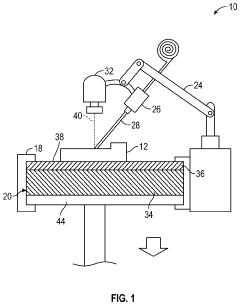
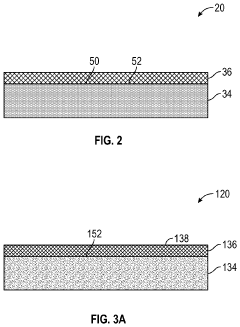
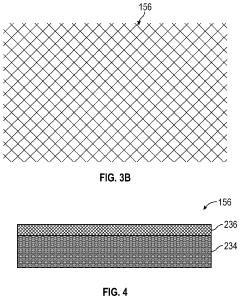
3D printing using energy sources
PatentInactiveUS20230311420A1
Innovation
- A 3D printing system that uses an energy source emitting wavelengths between 450 nm and 1200 nm to selectively fuse build material layers, achieving a high spectral selectivity ratio between areas with and without the fusing agent, ensuring proper fusion and crystallization of the build material, thereby preventing agglomeration and improving mechanical properties.


Material Compatibility and Selection Criteria
Material compatibility represents a critical factor in determining the success of Directed Energy Deposition (DED) processes. The selection of appropriate materials must consider both the inherent properties of the feedstock and their behavior under the extreme thermal conditions characteristic of DED. Primarily, materials must exhibit suitable flowability and particle size distribution when used in powder form, typically ranging from 45-150 μm for optimal deposition. Materials with high reflectivity, such as aluminum and copper alloys, present challenges due to reduced energy absorption efficiency, necessitating adjustments in laser parameters to achieve adequate melting.
Thermal properties significantly influence material compatibility, with thermal conductivity and coefficient of thermal expansion being particularly important. Materials with high thermal conductivity (e.g., copper alloys) require higher energy inputs to achieve proper melting, while those with low conductivity (e.g., titanium alloys) may experience overheating and excessive oxidation. The mismatch in thermal expansion coefficients between substrate and deposited material can lead to residual stresses and potential cracking during cooling.
Oxidation susceptibility represents another crucial selection criterion, particularly for reactive materials such as titanium and aluminum alloys. These materials demand stringent atmospheric control during deposition, often requiring inert gas shielding or vacuum environments to prevent oxide formation that would compromise mechanical properties and interlayer bonding. The metallurgical compatibility between substrate and deposited material must also be evaluated to avoid formation of brittle intermetallic compounds at the interface.
For multi-material deposition, considerations extend to potential diffusion phenomena and formation of intermediate phases. The selection criteria must account for the complete processing-structure-property relationship, including post-processing heat treatments that might be necessary to achieve desired microstructural characteristics. Materials with high crack susceptibility, such as certain nickel superalloys and tool steels, may require preheating strategies or compositional modifications to enhance processability.
Economic factors also influence material selection, with consideration given to material cost, availability, and powder recyclability. High-value materials like titanium alloys and superalloys justify more stringent process controls and higher processing costs, while more common materials may require cost-optimization strategies. The selection criteria must ultimately balance technical requirements with practical considerations of manufacturability and cost-effectiveness to ensure viable industrial implementation of DED processes.
Thermal properties significantly influence material compatibility, with thermal conductivity and coefficient of thermal expansion being particularly important. Materials with high thermal conductivity (e.g., copper alloys) require higher energy inputs to achieve proper melting, while those with low conductivity (e.g., titanium alloys) may experience overheating and excessive oxidation. The mismatch in thermal expansion coefficients between substrate and deposited material can lead to residual stresses and potential cracking during cooling.
Oxidation susceptibility represents another crucial selection criterion, particularly for reactive materials such as titanium and aluminum alloys. These materials demand stringent atmospheric control during deposition, often requiring inert gas shielding or vacuum environments to prevent oxide formation that would compromise mechanical properties and interlayer bonding. The metallurgical compatibility between substrate and deposited material must also be evaluated to avoid formation of brittle intermetallic compounds at the interface.
For multi-material deposition, considerations extend to potential diffusion phenomena and formation of intermediate phases. The selection criteria must account for the complete processing-structure-property relationship, including post-processing heat treatments that might be necessary to achieve desired microstructural characteristics. Materials with high crack susceptibility, such as certain nickel superalloys and tool steels, may require preheating strategies or compositional modifications to enhance processability.
Economic factors also influence material selection, with consideration given to material cost, availability, and powder recyclability. High-value materials like titanium alloys and superalloys justify more stringent process controls and higher processing costs, while more common materials may require cost-optimization strategies. The selection criteria must ultimately balance technical requirements with practical considerations of manufacturability and cost-effectiveness to ensure viable industrial implementation of DED processes.
Quality Assurance and Process Monitoring Systems
Quality assurance and process monitoring systems represent a critical component in the Directed Energy Deposition (DED) manufacturing ecosystem. These systems employ various sensing technologies to capture real-time data during the deposition process, enabling manufacturers to maintain consistent quality standards and detect anomalies before they result in defective parts. Current monitoring systems typically integrate multiple sensor types, including high-speed cameras, pyrometers, and spectrometers, to provide comprehensive coverage of process parameters.
Thermal monitoring stands as a cornerstone of quality assurance in DED processes. Advanced infrared cameras and pyrometers track melt pool dynamics, measuring critical variables such as temperature distribution, cooling rates, and thermal gradients. These measurements directly correlate with microstructural development and resultant mechanical properties of the deposited material. Recent advancements have enabled thermal monitoring systems to achieve millisecond response times with temperature resolution below 5°C.
Geometric verification systems have evolved significantly, now incorporating laser profilometry and structured light scanning to assess dimensional accuracy during deposition. These systems can detect deviations from CAD models with sub-millimeter precision, allowing for in-process adjustments to maintain geometric tolerances. The integration of machine learning algorithms has enhanced the capability of these systems to predict and compensate for thermal distortion effects.
Process parameter monitoring has become increasingly sophisticated, with systems now capable of tracking laser power stability, powder feed rates, and carrier gas flow with high precision. Correlations between these parameters and final part quality have been established through extensive experimental studies, enabling the development of closed-loop control systems that automatically adjust process parameters in response to detected variations.
Defect detection capabilities have advanced through the implementation of acoustic emission sensors and high-resolution optical systems. These technologies can identify common DED defects such as porosity, lack of fusion, and cracking in near real-time. The sensitivity of these systems continues to improve, with current technologies capable of detecting defects as small as 50 microns under optimal conditions.
Data integration frameworks represent the latest evolution in DED quality assurance, combining inputs from multiple monitoring systems into unified digital platforms. These frameworks leverage industrial IoT architectures to facilitate comprehensive process documentation, statistical process control, and predictive maintenance. The resulting digital thread enables full traceability from raw material to finished component, satisfying increasingly stringent quality requirements in aerospace, medical, and automotive applications.
Thermal monitoring stands as a cornerstone of quality assurance in DED processes. Advanced infrared cameras and pyrometers track melt pool dynamics, measuring critical variables such as temperature distribution, cooling rates, and thermal gradients. These measurements directly correlate with microstructural development and resultant mechanical properties of the deposited material. Recent advancements have enabled thermal monitoring systems to achieve millisecond response times with temperature resolution below 5°C.
Geometric verification systems have evolved significantly, now incorporating laser profilometry and structured light scanning to assess dimensional accuracy during deposition. These systems can detect deviations from CAD models with sub-millimeter precision, allowing for in-process adjustments to maintain geometric tolerances. The integration of machine learning algorithms has enhanced the capability of these systems to predict and compensate for thermal distortion effects.
Process parameter monitoring has become increasingly sophisticated, with systems now capable of tracking laser power stability, powder feed rates, and carrier gas flow with high precision. Correlations between these parameters and final part quality have been established through extensive experimental studies, enabling the development of closed-loop control systems that automatically adjust process parameters in response to detected variations.
Defect detection capabilities have advanced through the implementation of acoustic emission sensors and high-resolution optical systems. These technologies can identify common DED defects such as porosity, lack of fusion, and cracking in near real-time. The sensitivity of these systems continues to improve, with current technologies capable of detecting defects as small as 50 microns under optimal conditions.
Data integration frameworks represent the latest evolution in DED quality assurance, combining inputs from multiple monitoring systems into unified digital platforms. These frameworks leverage industrial IoT architectures to facilitate comprehensive process documentation, statistical process control, and predictive maintenance. The resulting digital thread enables full traceability from raw material to finished component, satisfying increasingly stringent quality requirements in aerospace, medical, and automotive applications.
Unlock deeper insights with Patsnap Eureka Quick Research — get a full tech report to explore trends and direct your research. Try now!
Generate Your Research Report Instantly with AI Agent
Supercharge your innovation with Patsnap Eureka AI Agent Platform!