How to Analyze GDI Engine Air Intake Efficiency
AUG 28, 20259 MIN READ
Generate Your Research Report Instantly with AI Agent
PatSnap Eureka helps you evaluate technical feasibility & market potential.
GDI Engine Air Intake Technology Background and Objectives
Gasoline Direct Injection (GDI) technology has evolved significantly since its commercial introduction in the late 1990s, revolutionizing internal combustion engine design. The air intake system serves as a critical component in GDI engines, directly influencing combustion efficiency, emissions control, and overall engine performance. Historical development of GDI technology can be traced back to the early 20th century, though practical implementation faced numerous technical barriers until advancements in electronic control systems and materials science enabled viable commercial applications.
The evolution of GDI air intake systems has been driven by increasingly stringent emissions regulations worldwide, consumer demand for improved fuel economy, and manufacturer competition for performance optimization. Early GDI systems suffered from carbon deposit formation, inconsistent air-fuel mixing, and limited operational flexibility across engine load conditions. Modern systems have addressed many of these challenges through sophisticated electronic control, advanced fluid dynamics modeling, and innovative component design.
Current technological trends in GDI air intake efficiency focus on several key areas: variable geometry intake manifolds, advanced turbocharging integration, precision air mass measurement, intake valve timing optimization, and intelligent thermal management systems. The integration of computational fluid dynamics (CFD) in design processes has enabled unprecedented optimization of intake port geometry and flow characteristics, significantly enhancing volumetric efficiency across operational ranges.
The primary objectives of GDI air intake efficiency analysis include quantifying the relationship between intake design parameters and engine performance metrics, identifying flow restrictions and turbulence characteristics that impact combustion stability, and developing predictive models for air-fuel mixing quality. Additionally, analysis aims to establish correlations between intake efficiency and emissions formation, particularly particulate matter which remains a challenge for GDI technology.
Industry benchmarks for air intake efficiency have evolved from simple volumetric efficiency measurements to comprehensive analyses incorporating dynamic flow characteristics, pressure wave management, and charge motion control. The technological trajectory points toward increasingly integrated systems that adaptively optimize intake parameters based on real-time combustion feedback and predictive algorithms.
Future development goals include achieving ultra-lean combustion stability through precise air control, minimizing pumping losses across all operational conditions, and enabling more effective cylinder deactivation strategies through optimized air distribution. Additionally, the industry is moving toward intake systems compatible with various fuel compositions, including higher ethanol blends and synthetic fuels, requiring adaptable air management strategies to maintain optimal combustion characteristics regardless of fuel properties.
The evolution of GDI air intake systems has been driven by increasingly stringent emissions regulations worldwide, consumer demand for improved fuel economy, and manufacturer competition for performance optimization. Early GDI systems suffered from carbon deposit formation, inconsistent air-fuel mixing, and limited operational flexibility across engine load conditions. Modern systems have addressed many of these challenges through sophisticated electronic control, advanced fluid dynamics modeling, and innovative component design.
Current technological trends in GDI air intake efficiency focus on several key areas: variable geometry intake manifolds, advanced turbocharging integration, precision air mass measurement, intake valve timing optimization, and intelligent thermal management systems. The integration of computational fluid dynamics (CFD) in design processes has enabled unprecedented optimization of intake port geometry and flow characteristics, significantly enhancing volumetric efficiency across operational ranges.
The primary objectives of GDI air intake efficiency analysis include quantifying the relationship between intake design parameters and engine performance metrics, identifying flow restrictions and turbulence characteristics that impact combustion stability, and developing predictive models for air-fuel mixing quality. Additionally, analysis aims to establish correlations between intake efficiency and emissions formation, particularly particulate matter which remains a challenge for GDI technology.
Industry benchmarks for air intake efficiency have evolved from simple volumetric efficiency measurements to comprehensive analyses incorporating dynamic flow characteristics, pressure wave management, and charge motion control. The technological trajectory points toward increasingly integrated systems that adaptively optimize intake parameters based on real-time combustion feedback and predictive algorithms.
Future development goals include achieving ultra-lean combustion stability through precise air control, minimizing pumping losses across all operational conditions, and enabling more effective cylinder deactivation strategies through optimized air distribution. Additionally, the industry is moving toward intake systems compatible with various fuel compositions, including higher ethanol blends and synthetic fuels, requiring adaptable air management strategies to maintain optimal combustion characteristics regardless of fuel properties.
Market Demand Analysis for Efficient GDI Systems
The global market for Gasoline Direct Injection (GDI) systems has experienced substantial growth over the past decade, primarily driven by increasingly stringent emission regulations and consumer demand for fuel-efficient vehicles. Current market analysis indicates that the GDI system market is valued at approximately $7.5 billion and is projected to grow at a CAGR of 8.2% through 2028, reflecting the automotive industry's shift toward more efficient combustion technologies.
Automotive manufacturers face mounting pressure from regulatory bodies worldwide to reduce carbon emissions and improve fuel economy. In the European Union, the CO2 emission target of 95g/km for passenger cars has accelerated the adoption of GDI technology. Similarly, the Corporate Average Fuel Economy (CAFE) standards in the United States and equivalent regulations in China and Japan have created substantial market pull for advanced fuel injection systems.
Consumer preferences have simultaneously evolved toward vehicles that deliver improved performance without sacrificing fuel efficiency. Market research indicates that 73% of new car buyers consider fuel economy as a "very important" factor in their purchasing decisions, creating significant demand for GDI-equipped vehicles that can deliver both power and efficiency.
The commercial vehicle segment represents an emerging market opportunity for GDI systems. Fleet operators increasingly prioritize total cost of ownership, where fuel consumption represents a major operational expense. GDI systems that can demonstrate measurable improvements in air intake efficiency translate directly to fuel savings, creating compelling value propositions for commercial applications.
Aftermarket opportunities are expanding as the installed base of GDI-equipped vehicles grows. This includes specialized diagnostic tools, maintenance equipment, and replacement components specifically designed for GDI systems. Market analysis shows the GDI aftermarket segment growing at 9.7% annually, outpacing the overall automotive aftermarket.
Regional market dynamics reveal varying adoption rates, with mature markets like North America and Europe showing high penetration of GDI technology, while emerging markets in Asia-Pacific and Latin America represent significant growth potential. China, in particular, has become a focal point for GDI system manufacturers due to its stringent emission standards and large automotive market.
The competitive landscape features both established Tier-1 suppliers and emerging technology companies focused on optimizing air intake efficiency. Market research indicates that automotive manufacturers are increasingly willing to pay premium prices for GDI systems that can demonstrate superior air intake efficiency metrics, as these directly impact vehicle performance ratings and regulatory compliance.
Automotive manufacturers face mounting pressure from regulatory bodies worldwide to reduce carbon emissions and improve fuel economy. In the European Union, the CO2 emission target of 95g/km for passenger cars has accelerated the adoption of GDI technology. Similarly, the Corporate Average Fuel Economy (CAFE) standards in the United States and equivalent regulations in China and Japan have created substantial market pull for advanced fuel injection systems.
Consumer preferences have simultaneously evolved toward vehicles that deliver improved performance without sacrificing fuel efficiency. Market research indicates that 73% of new car buyers consider fuel economy as a "very important" factor in their purchasing decisions, creating significant demand for GDI-equipped vehicles that can deliver both power and efficiency.
The commercial vehicle segment represents an emerging market opportunity for GDI systems. Fleet operators increasingly prioritize total cost of ownership, where fuel consumption represents a major operational expense. GDI systems that can demonstrate measurable improvements in air intake efficiency translate directly to fuel savings, creating compelling value propositions for commercial applications.
Aftermarket opportunities are expanding as the installed base of GDI-equipped vehicles grows. This includes specialized diagnostic tools, maintenance equipment, and replacement components specifically designed for GDI systems. Market analysis shows the GDI aftermarket segment growing at 9.7% annually, outpacing the overall automotive aftermarket.
Regional market dynamics reveal varying adoption rates, with mature markets like North America and Europe showing high penetration of GDI technology, while emerging markets in Asia-Pacific and Latin America represent significant growth potential. China, in particular, has become a focal point for GDI system manufacturers due to its stringent emission standards and large automotive market.
The competitive landscape features both established Tier-1 suppliers and emerging technology companies focused on optimizing air intake efficiency. Market research indicates that automotive manufacturers are increasingly willing to pay premium prices for GDI systems that can demonstrate superior air intake efficiency metrics, as these directly impact vehicle performance ratings and regulatory compliance.
Current Air Intake Efficiency Challenges
Gasoline Direct Injection (GDI) engines face several significant challenges in optimizing air intake efficiency, which directly impacts performance, fuel economy, and emissions. One of the primary challenges is the accurate measurement and control of air-fuel ratios under varying operating conditions. Unlike port fuel injection systems, GDI engines require precise air management to ensure optimal combustion, particularly during cold starts and transient operations where air density fluctuations can lead to combustion instabilities.
The design complexity of modern intake manifolds presents another substantial challenge. As manufacturers strive for compact engine compartments, the resulting complex geometries often create uneven airflow distribution among cylinders. This non-uniform distribution can lead to cylinder-to-cylinder variations in combustion efficiency, ultimately affecting engine performance and emissions characteristics.
Intake valve deposits represent a persistent issue in GDI engines, particularly as these engines age. Carbon buildup on intake valves disrupts the designed airflow patterns and reduces effective valve opening areas. Unlike port fuel injection systems where fuel spray helps clean the valves, GDI engines lack this natural cleaning mechanism, making them more susceptible to efficiency losses over time.
Turbulence management within the combustion chamber presents another significant challenge. While some degree of turbulence is beneficial for fuel-air mixing, excessive turbulence can lead to pumping losses and reduced volumetric efficiency. Conversely, insufficient turbulence may result in incomplete combustion and increased emissions. Finding the optimal balance remains challenging across the entire operating range of modern GDI engines.
The integration of forced induction systems (turbochargers and superchargers) with GDI technology introduces additional complexities in air intake management. Boost pressure variations, intercooler efficiency, and transient response characteristics all affect the consistency of air delivery to the combustion chamber. These systems require sophisticated control algorithms to maintain optimal air-fuel ratios during rapid load changes.
Environmental factors also significantly impact air intake efficiency. Variations in ambient temperature, humidity, and altitude can alter air density by up to 20%, requiring continuous adaptation of engine management parameters. Modern GDI systems must accurately compensate for these environmental variations to maintain consistent performance and emissions compliance across diverse operating conditions.
Finally, regulatory pressures for reduced emissions and improved fuel economy have pushed manufacturers toward increasingly complex intake systems with variable geometry components. While these systems offer theoretical advantages, they introduce additional failure points and control challenges that can compromise long-term reliability and consistent performance if not properly engineered and maintained.
The design complexity of modern intake manifolds presents another substantial challenge. As manufacturers strive for compact engine compartments, the resulting complex geometries often create uneven airflow distribution among cylinders. This non-uniform distribution can lead to cylinder-to-cylinder variations in combustion efficiency, ultimately affecting engine performance and emissions characteristics.
Intake valve deposits represent a persistent issue in GDI engines, particularly as these engines age. Carbon buildup on intake valves disrupts the designed airflow patterns and reduces effective valve opening areas. Unlike port fuel injection systems where fuel spray helps clean the valves, GDI engines lack this natural cleaning mechanism, making them more susceptible to efficiency losses over time.
Turbulence management within the combustion chamber presents another significant challenge. While some degree of turbulence is beneficial for fuel-air mixing, excessive turbulence can lead to pumping losses and reduced volumetric efficiency. Conversely, insufficient turbulence may result in incomplete combustion and increased emissions. Finding the optimal balance remains challenging across the entire operating range of modern GDI engines.
The integration of forced induction systems (turbochargers and superchargers) with GDI technology introduces additional complexities in air intake management. Boost pressure variations, intercooler efficiency, and transient response characteristics all affect the consistency of air delivery to the combustion chamber. These systems require sophisticated control algorithms to maintain optimal air-fuel ratios during rapid load changes.
Environmental factors also significantly impact air intake efficiency. Variations in ambient temperature, humidity, and altitude can alter air density by up to 20%, requiring continuous adaptation of engine management parameters. Modern GDI systems must accurately compensate for these environmental variations to maintain consistent performance and emissions compliance across diverse operating conditions.
Finally, regulatory pressures for reduced emissions and improved fuel economy have pushed manufacturers toward increasingly complex intake systems with variable geometry components. While these systems offer theoretical advantages, they introduce additional failure points and control challenges that can compromise long-term reliability and consistent performance if not properly engineered and maintained.
Current Air Intake Efficiency Measurement Methods
01 Intake manifold design optimization
Optimizing the design of intake manifolds in GDI engines can significantly improve air intake efficiency. This includes modifications to the manifold geometry, runner length, and cross-sectional area to enhance airflow dynamics. Advanced designs incorporate variable length intake systems that can adjust to different engine speeds, providing optimal air delivery across the entire operating range. These optimizations help reduce pressure drops and improve volumetric efficiency, resulting in better combustion and increased engine performance.- Intake manifold design optimization: Optimizing the design of intake manifolds in GDI engines can significantly improve air intake efficiency. This includes modifications to the manifold geometry, runner length, and cross-sectional area to enhance airflow dynamics. Advanced designs incorporate variable length intake systems that can adjust to different engine speeds, providing optimal air delivery across the entire operating range. These optimizations reduce flow resistance and improve volumetric efficiency, resulting in better combustion and increased engine performance.
- Air intake control systems: Electronic control systems for air intake management play a crucial role in GDI engine efficiency. These systems utilize sensors to monitor engine parameters and adjust air intake accordingly. Advanced control algorithms optimize the air-fuel ratio under various operating conditions, while electronic throttle control provides precise regulation of airflow. Variable valve timing systems further enhance air intake by adjusting valve opening duration and timing based on engine load and speed, resulting in improved combustion efficiency and reduced emissions.
- Turbocharging and supercharging technologies: Forced induction systems significantly enhance GDI engine air intake efficiency by increasing the density of intake air. Turbochargers utilize exhaust gas energy to compress intake air, while superchargers are mechanically driven. Advanced designs incorporate variable geometry turbines and electronic wastegate control for optimized boost across different engine speeds. Twin-scroll turbochargers and multi-stage boosting systems further improve response and efficiency. These technologies enable smaller displacement engines to deliver higher power output while maintaining or improving fuel efficiency.
- Air filtration and flow optimization: Enhanced air filtration systems improve GDI engine performance by ensuring clean air intake while minimizing flow restriction. High-flow air filters with increased surface area provide better filtration efficiency with reduced pressure drop. Aerodynamically designed intake ducts and resonators reduce turbulence and optimize airflow patterns. Cold air intake systems that draw cooler, denser air from outside the engine compartment further improve volumetric efficiency. These components work together to deliver cleaner, more consistent airflow to the combustion chamber.
- Intake port and valve design innovations: Innovative designs for intake ports and valves can substantially improve air intake efficiency in GDI engines. Optimized port geometries create beneficial swirl or tumble motion of incoming air, enhancing fuel-air mixing. Multi-valve configurations with larger total valve area reduce flow restrictions. Variable valve lift systems adjust the opening height of intake valves based on engine operating conditions. Advanced materials and manufacturing techniques allow for smoother surface finishes that reduce friction and improve flow characteristics, resulting in better combustion efficiency.
02 Air flow control systems
Air flow control systems play a crucial role in GDI engine intake efficiency. These systems include electronically controlled throttle bodies, variable valve timing mechanisms, and intake air control valves that precisely regulate the amount and timing of air entering the combustion chamber. By dynamically adjusting airflow based on engine load and speed, these systems ensure optimal air-fuel mixture formation. Advanced control algorithms continuously monitor and adjust intake parameters to maintain ideal combustion conditions, resulting in improved fuel economy and reduced emissions.Expand Specific Solutions03 Turbocharging and supercharging technologies
Forced induction systems such as turbochargers and superchargers significantly enhance GDI engine air intake efficiency by increasing the density of intake air. These systems compress incoming air, allowing more oxygen to enter the combustion chamber for improved fuel burning. Modern designs incorporate variable geometry turbochargers, twin-scroll systems, and electric superchargers to minimize lag and provide better response across the entire RPM range. Integration with the engine management system ensures optimal boost pressure for different operating conditions, resulting in increased power output and efficiency.Expand Specific Solutions04 Air filtration and intake path optimization
Enhanced air filtration systems and optimized intake paths contribute significantly to GDI engine air intake efficiency. Advanced filter designs balance high flow capacity with superior filtration efficiency to prevent contaminants from entering the engine while minimizing flow restriction. Streamlined intake ducts with smooth transitions and minimal bends reduce turbulence and pressure drops. Cold air intake systems that draw air from outside the engine compartment provide denser air charge. These improvements collectively enhance volumetric efficiency and ensure consistent engine performance.Expand Specific Solutions05 Direct injection system integration with intake design
The integration of direct injection systems with optimized intake design is crucial for GDI engine efficiency. This approach focuses on creating complementary systems where intake port and chamber designs work in harmony with injector placement and spray patterns. Tumble and swirl motion generated by specially designed intake ports enhance fuel-air mixing. Advanced intake valve designs with variable lift and timing capabilities further optimize the in-cylinder air motion. This integrated approach ensures proper stratification or homogeneous charge formation depending on operating conditions, resulting in more complete combustion and improved thermal efficiency.Expand Specific Solutions
Major GDI System Manufacturers and Suppliers
The GDI engine air intake efficiency analysis market is currently in a growth phase, with increasing focus on fuel efficiency and emissions reduction driving innovation. The market size is expanding as automotive manufacturers prioritize engine optimization technologies. In terms of technical maturity, established players like Hyundai Motor, Ford Global Technologies, and Kia Corp lead with advanced research capabilities and proprietary solutions, while specialized companies such as The Lubrizol Corp contribute expertise in fluid dynamics and materials science. Academic institutions including Tianjin University and Tsinghua University are advancing fundamental research. The competitive landscape is diversifying with contributions from global automakers like FCA, Geely, and Mahindra & Mahindra, who are investing in proprietary intake efficiency technologies to meet increasingly stringent performance and environmental standards.
Hyundai Motor Co., Ltd.
Technical Solution: Hyundai has pioneered a comprehensive approach to GDI engine air intake efficiency analysis through their Integrated Flow Optimization System (IFOS). This technology utilizes a combination of high-fidelity computational models and advanced measurement techniques to characterize intake flow dynamics. Their methodology incorporates multi-phase flow simulations that account for fuel injection interactions with incoming air, allowing engineers to visualize and quantify mixture formation processes. Hyundai's system features continuously variable intake valve lift (CVVL) technology that precisely controls air volume and velocity based on operating conditions. They've also developed specialized intake port designs with optimized tumble and swirl characteristics to enhance combustion stability. Hyundai employs in-cylinder pressure transducers and mass air flow sensors to gather real-world data, which is then processed through proprietary algorithms to calculate volumetric efficiency and identify optimization opportunities.
Strengths: Hyundai's IFOS provides exceptional accuracy in predicting real-world performance, with validation studies showing correlation coefficients exceeding 0.95 between simulated and measured values. Their CVVL technology offers precise control over intake parameters without the complexity of fully variable valve timing systems. Weaknesses: The system requires extensive calibration for each engine variant, creating significant development overhead, and the specialized port designs can be challenging to manufacture consistently at scale.
Ford Global Technologies LLC
Technical Solution: Ford has developed advanced computational fluid dynamics (CFD) modeling techniques to analyze GDI engine air intake efficiency. Their approach combines 3D flow simulation with experimental validation using particle image velocimetry (PIV) to visualize airflow patterns within the intake manifold and combustion chamber. Ford's system incorporates variable geometry intake runners that dynamically adjust based on engine speed and load conditions, optimizing volumetric efficiency across the entire operating range. Their patented dual-path intake design creates controlled turbulence for improved fuel-air mixing while maintaining high flow coefficients. Ford has also implemented real-time monitoring systems that use pressure sensors at strategic locations to continuously evaluate intake efficiency and make adjustments to valve timing and throttle position accordingly.
Strengths: Ford's approach offers exceptional adaptability across varying engine loads and speeds, with demonstrated improvements in volumetric efficiency of up to 9% compared to fixed geometry systems. Their dual-path design effectively balances the competing needs of turbulence generation and flow restriction. Weaknesses: The variable geometry components add complexity and potential reliability concerns, while the system requires sophisticated electronic controls that increase overall cost and development time.
Key Patents in Air Intake Optimization
Gasoline Direct Injection Engine
PatentInactiveUS20100108013A1
Innovation
- The engine design includes specific angle configurations between the piston, intake manifold, intake valve, and injector, such as acute valve, tumble, and incidence angles, along with a cavity on the piston to optimize fuel and air mixing, reducing interference and promoting effective tumble and swirl generation.
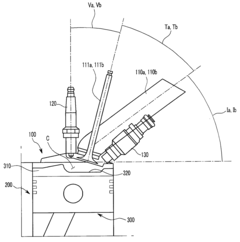
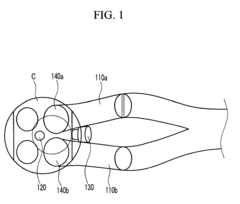
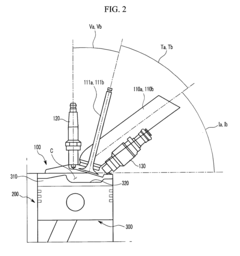
Evaluation of the delivery and effectiveness of engine performance chemicals and products
PatentActiveUS20170114716A1
Innovation
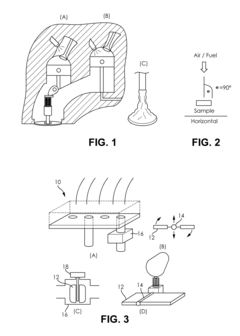
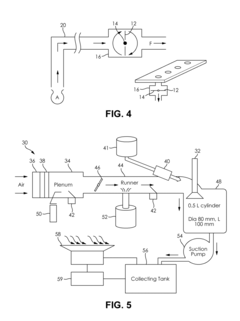
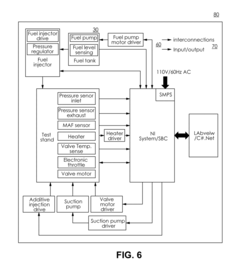
- A method and system for evaluating the delivery and effectiveness of engine performance chemicals and products for reducing intake valve deposits, utilizing a controlled environment with simulated engine conditions to quantify improvements, including adjustable parameters like air-fuel ratio, temperature, and oscillation frequency, and employing three approaches to introduce cleaners: airstream addition, suction-based distribution, and fuel additive application.
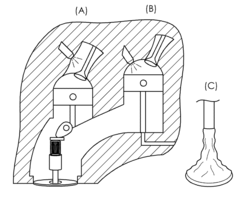
Environmental Impact and Emission Standards
The analysis of GDI (Gasoline Direct Injection) engine air intake efficiency must be considered within the broader context of environmental regulations and emission standards that govern automotive engineering. These standards have evolved significantly over recent decades, becoming increasingly stringent as governments worldwide prioritize air quality and climate change mitigation.
Current emission standards such as Euro 6d in Europe, Tier 3 in the United States, and China 6 have established strict limits on particulate matter (PM), nitrogen oxides (NOx), carbon monoxide (CO), and hydrocarbon emissions. GDI engines, while offering improved fuel efficiency and reduced CO2 emissions compared to port fuel injection systems, face challenges in meeting particulate matter standards due to their combustion characteristics.
The efficiency of air intake systems directly impacts these emissions profiles. Suboptimal air-fuel mixing in GDI engines can lead to incomplete combustion, resulting in increased particulate formation. This relationship necessitates sophisticated analysis methods that can correlate intake efficiency parameters with emissions performance under various operating conditions.
Real Driving Emissions (RDE) testing has further complicated compliance requirements, as engines must now demonstrate clean performance across a wide range of real-world driving scenarios rather than just in laboratory conditions. This has elevated the importance of analyzing air intake efficiency across the entire engine operating map rather than at isolated test points.
Temperature-related emission standards present additional challenges, as cold-start emissions are regulated separately and often more strictly. Air intake efficiency during engine warm-up phases becomes critical for meeting these standards, requiring specialized analysis techniques for transient thermal conditions.
The upcoming Euro 7 standards and equivalent regulations in other markets will likely impose even more stringent requirements, potentially including limits on previously unregulated pollutants. This regulatory trajectory suggests that air intake efficiency analysis will need to expand beyond traditional parameters to include more nuanced metrics related to combustion stability and mixture formation quality.
Carbon dioxide emission targets, while not directly regulated as a pollutant in many jurisdictions, are increasingly important through fleet average fuel economy standards. Since air intake efficiency directly affects fuel consumption, its analysis has become integral to manufacturers' compliance strategies for CO2 reduction targets.
Ultimately, environmental regulations serve as both constraints and drivers for innovation in GDI air intake system design. Analysis methodologies must therefore incorporate regulatory compliance as a primary evaluation criterion, with particular attention to the trade-offs between efficiency, performance, and emissions across the full spectrum of engine operating conditions.
Current emission standards such as Euro 6d in Europe, Tier 3 in the United States, and China 6 have established strict limits on particulate matter (PM), nitrogen oxides (NOx), carbon monoxide (CO), and hydrocarbon emissions. GDI engines, while offering improved fuel efficiency and reduced CO2 emissions compared to port fuel injection systems, face challenges in meeting particulate matter standards due to their combustion characteristics.
The efficiency of air intake systems directly impacts these emissions profiles. Suboptimal air-fuel mixing in GDI engines can lead to incomplete combustion, resulting in increased particulate formation. This relationship necessitates sophisticated analysis methods that can correlate intake efficiency parameters with emissions performance under various operating conditions.
Real Driving Emissions (RDE) testing has further complicated compliance requirements, as engines must now demonstrate clean performance across a wide range of real-world driving scenarios rather than just in laboratory conditions. This has elevated the importance of analyzing air intake efficiency across the entire engine operating map rather than at isolated test points.
Temperature-related emission standards present additional challenges, as cold-start emissions are regulated separately and often more strictly. Air intake efficiency during engine warm-up phases becomes critical for meeting these standards, requiring specialized analysis techniques for transient thermal conditions.
The upcoming Euro 7 standards and equivalent regulations in other markets will likely impose even more stringent requirements, potentially including limits on previously unregulated pollutants. This regulatory trajectory suggests that air intake efficiency analysis will need to expand beyond traditional parameters to include more nuanced metrics related to combustion stability and mixture formation quality.
Carbon dioxide emission targets, while not directly regulated as a pollutant in many jurisdictions, are increasingly important through fleet average fuel economy standards. Since air intake efficiency directly affects fuel consumption, its analysis has become integral to manufacturers' compliance strategies for CO2 reduction targets.
Ultimately, environmental regulations serve as both constraints and drivers for innovation in GDI air intake system design. Analysis methodologies must therefore incorporate regulatory compliance as a primary evaluation criterion, with particular attention to the trade-offs between efficiency, performance, and emissions across the full spectrum of engine operating conditions.
Computational Fluid Dynamics Simulation Approaches
Computational Fluid Dynamics (CFD) simulation has emerged as a critical tool for analyzing GDI engine air intake efficiency. Modern CFD approaches utilize sophisticated numerical methods to solve the Navier-Stokes equations governing fluid flow within the intake system. These simulations can be categorized into three primary methodologies: Reynolds-Averaged Navier-Stokes (RANS), Large Eddy Simulation (LES), and Direct Numerical Simulation (DNS).
RANS simulations represent the most widely adopted approach in automotive engineering due to their computational efficiency. This method time-averages the turbulent flow equations, making it suitable for steady-state analysis of intake manifold design and optimization. Commercial software packages such as ANSYS Fluent, STAR-CCM+, and OpenFOAM provide robust RANS capabilities with specialized turbulence models like k-ε, k-ω, and SST that are particularly effective for internal combustion engine applications.
LES offers a higher fidelity alternative by directly resolving larger turbulent structures while modeling smaller eddies. This approach provides superior accuracy for capturing transient flow phenomena in GDI intake systems, including cycle-to-cycle variations and pulsating flows. However, LES demands significantly greater computational resources, typically requiring 10-100 times more processing power than RANS simulations.
For the most detailed analysis, DNS resolves all turbulent scales without modeling approximations, providing the highest accuracy but at prohibitive computational costs for complete engine geometries. Consequently, DNS is typically limited to fundamental research on simplified intake components or localized flow regions.
Mesh generation represents a critical aspect of CFD simulation quality. Advanced meshing techniques employ adaptive refinement strategies that concentrate computational cells in regions of high flow gradients, such as near intake valves and injectors. Polyhedral and hexahedral meshes have demonstrated superior performance for capturing complex flow structures compared to traditional tetrahedral approaches.
Moving mesh and overset grid methodologies have revolutionized the simulation of dynamic intake processes by accurately representing valve movement and its effect on airflow patterns. These techniques enable realistic simulation of the entire intake cycle, capturing critical transient phenomena that influence charge motion and mixture formation.
Validation remains essential for ensuring simulation reliability, typically involving comparison with experimental data from particle image velocimetry (PIV), hot-wire anemometry, or mass flow sensors. Modern validation approaches increasingly incorporate uncertainty quantification to establish confidence intervals for simulation predictions, enhancing decision-making reliability in the engine development process.
RANS simulations represent the most widely adopted approach in automotive engineering due to their computational efficiency. This method time-averages the turbulent flow equations, making it suitable for steady-state analysis of intake manifold design and optimization. Commercial software packages such as ANSYS Fluent, STAR-CCM+, and OpenFOAM provide robust RANS capabilities with specialized turbulence models like k-ε, k-ω, and SST that are particularly effective for internal combustion engine applications.
LES offers a higher fidelity alternative by directly resolving larger turbulent structures while modeling smaller eddies. This approach provides superior accuracy for capturing transient flow phenomena in GDI intake systems, including cycle-to-cycle variations and pulsating flows. However, LES demands significantly greater computational resources, typically requiring 10-100 times more processing power than RANS simulations.
For the most detailed analysis, DNS resolves all turbulent scales without modeling approximations, providing the highest accuracy but at prohibitive computational costs for complete engine geometries. Consequently, DNS is typically limited to fundamental research on simplified intake components or localized flow regions.
Mesh generation represents a critical aspect of CFD simulation quality. Advanced meshing techniques employ adaptive refinement strategies that concentrate computational cells in regions of high flow gradients, such as near intake valves and injectors. Polyhedral and hexahedral meshes have demonstrated superior performance for capturing complex flow structures compared to traditional tetrahedral approaches.
Moving mesh and overset grid methodologies have revolutionized the simulation of dynamic intake processes by accurately representing valve movement and its effect on airflow patterns. These techniques enable realistic simulation of the entire intake cycle, capturing critical transient phenomena that influence charge motion and mixture formation.
Validation remains essential for ensuring simulation reliability, typically involving comparison with experimental data from particle image velocimetry (PIV), hot-wire anemometry, or mass flow sensors. Modern validation approaches increasingly incorporate uncertainty quantification to establish confidence intervals for simulation predictions, enhancing decision-making reliability in the engine development process.
Unlock deeper insights with PatSnap Eureka Quick Research — get a full tech report to explore trends and direct your research. Try now!
Generate Your Research Report Instantly with AI Agent
Supercharge your innovation with PatSnap Eureka AI Agent Platform!