How to Evaluate GDI Engine Pump Systems on Bench
AUG 28, 20259 MIN READ
Generate Your Research Report Instantly with AI Agent
Patsnap Eureka helps you evaluate technical feasibility & market potential.
GDI Pump System Evolution and Testing Objectives
Gasoline Direct Injection (GDI) technology has evolved significantly since its commercial introduction in the late 1990s. This evolution has been driven by increasingly stringent emission regulations, fuel economy requirements, and consumer demand for improved vehicle performance. The first generation of GDI systems operated at relatively low pressures (50-100 bar) and faced challenges with fuel atomization and mixture formation. As the technology matured, system pressures increased substantially, with modern systems operating at 200-350 bar, and advanced systems reaching up to 600 bar.
The evolution of GDI pump systems has been characterized by several key technological advancements. Early systems utilized single-piston pumps driven directly by the engine camshaft, while contemporary designs feature multi-piston arrangements with improved volumetric efficiency and pressure stability. Material science developments have enabled pumps to withstand higher pressures and provide greater durability despite the minimal lubrication properties of gasoline compared to diesel fuel.
Testing objectives for GDI pump systems on bench setups are multifaceted and critical for ensuring reliable field performance. Primary objectives include characterizing pump efficiency across various operating conditions, evaluating durability under sustained high-pressure operation, and assessing noise, vibration, and harshness (NVH) characteristics. These evaluations must be conducted across the full range of expected operating temperatures (-40°C to 125°C) and with various fuel compositions to ensure global market compatibility.
Pressure stability testing is particularly important, as modern engine management systems rely on precise fuel pressure control for optimal combustion. Bench testing must verify the pump's ability to maintain target pressures under dynamic load conditions and rapid transients that simulate real-world driving scenarios. Flow rate consistency across the pump's service life is another critical parameter, requiring accelerated life testing protocols on specialized bench equipment.
Contamination resistance has emerged as a significant testing objective, as global fuel quality varies considerably. Bench tests must evaluate pump performance with controlled contaminant introduction to simulate worst-case field conditions. Additionally, electromagnetic compatibility (EMC) testing ensures that electronic pump controls function properly in the electrically noisy environment of modern vehicles.
The ultimate goal of comprehensive bench testing is to validate that GDI pump systems can deliver the precise fuel quantities at the exact pressures required for optimal engine performance, while maintaining reliability throughout the vehicle's service life. This validation process has become increasingly sophisticated, employing advanced sensors, data acquisition systems, and automated test sequences to thoroughly characterize pump performance before vehicle integration.
The evolution of GDI pump systems has been characterized by several key technological advancements. Early systems utilized single-piston pumps driven directly by the engine camshaft, while contemporary designs feature multi-piston arrangements with improved volumetric efficiency and pressure stability. Material science developments have enabled pumps to withstand higher pressures and provide greater durability despite the minimal lubrication properties of gasoline compared to diesel fuel.
Testing objectives for GDI pump systems on bench setups are multifaceted and critical for ensuring reliable field performance. Primary objectives include characterizing pump efficiency across various operating conditions, evaluating durability under sustained high-pressure operation, and assessing noise, vibration, and harshness (NVH) characteristics. These evaluations must be conducted across the full range of expected operating temperatures (-40°C to 125°C) and with various fuel compositions to ensure global market compatibility.
Pressure stability testing is particularly important, as modern engine management systems rely on precise fuel pressure control for optimal combustion. Bench testing must verify the pump's ability to maintain target pressures under dynamic load conditions and rapid transients that simulate real-world driving scenarios. Flow rate consistency across the pump's service life is another critical parameter, requiring accelerated life testing protocols on specialized bench equipment.
Contamination resistance has emerged as a significant testing objective, as global fuel quality varies considerably. Bench tests must evaluate pump performance with controlled contaminant introduction to simulate worst-case field conditions. Additionally, electromagnetic compatibility (EMC) testing ensures that electronic pump controls function properly in the electrically noisy environment of modern vehicles.
The ultimate goal of comprehensive bench testing is to validate that GDI pump systems can deliver the precise fuel quantities at the exact pressures required for optimal engine performance, while maintaining reliability throughout the vehicle's service life. This validation process has become increasingly sophisticated, employing advanced sensors, data acquisition systems, and automated test sequences to thoroughly characterize pump performance before vehicle integration.
Market Requirements for Advanced GDI Pump Technologies
The global automotive industry is witnessing a significant shift towards more stringent emission standards and improved fuel efficiency requirements, directly impacting the development trajectory of Gasoline Direct Injection (GDI) pump technologies. Market analysis indicates that by 2025, over 70% of new gasoline-powered vehicles worldwide will utilize GDI systems, creating substantial demand for advanced pump solutions that can meet evolving regulatory and consumer expectations.
Primary market drivers for advanced GDI pump technologies include the need for reduced emissions, improved fuel economy, enhanced engine performance, and greater reliability. Regulatory frameworks such as Euro 7, China 6b, and US EPA Tier 3 standards are pushing manufacturers to develop GDI systems capable of operating at higher pressures—typically between 350-500 bar, with premium applications reaching up to 600 bar—to achieve more complete fuel atomization and combustion efficiency.
Consumer expectations are equally influential, with market research showing that vehicle purchasers increasingly prioritize fuel economy without compromising performance. This has created demand for GDI pumps that can deliver precise fuel quantities across varying engine loads and speeds while maintaining durability throughout the vehicle's lifecycle.
The commercial vehicle sector presents additional requirements, including the need for GDI pump systems that can withstand higher duty cycles and more demanding operational conditions. These systems must demonstrate extended service intervals and exceptional reliability metrics to minimize downtime and maintenance costs.
Regional market variations are significant, with European markets emphasizing emissions compliance and fuel efficiency, North American consumers focusing on performance and reliability, and Asian markets seeking cost-effective solutions that balance performance with affordability. These regional differences necessitate adaptable pump designs that can be optimized for specific market requirements.
OEM specifications are becoming increasingly stringent, with requirements for GDI pumps to operate effectively with various fuel compositions, including those containing higher ethanol content. This adaptability requirement extends to noise, vibration, and harshness (NVH) characteristics, as premium vehicle manufacturers specify maximum acceptable noise levels for fuel system components.
Cost considerations remain paramount, with market analysis suggesting that competitive GDI pump technologies must achieve performance targets while maintaining a production cost that allows for integration into mass-market vehicles. The industry benchmark indicates that next-generation GDI pump systems should target a 15-20% improvement in performance metrics while limiting cost increases to under 10% compared to current-generation systems.
Primary market drivers for advanced GDI pump technologies include the need for reduced emissions, improved fuel economy, enhanced engine performance, and greater reliability. Regulatory frameworks such as Euro 7, China 6b, and US EPA Tier 3 standards are pushing manufacturers to develop GDI systems capable of operating at higher pressures—typically between 350-500 bar, with premium applications reaching up to 600 bar—to achieve more complete fuel atomization and combustion efficiency.
Consumer expectations are equally influential, with market research showing that vehicle purchasers increasingly prioritize fuel economy without compromising performance. This has created demand for GDI pumps that can deliver precise fuel quantities across varying engine loads and speeds while maintaining durability throughout the vehicle's lifecycle.
The commercial vehicle sector presents additional requirements, including the need for GDI pump systems that can withstand higher duty cycles and more demanding operational conditions. These systems must demonstrate extended service intervals and exceptional reliability metrics to minimize downtime and maintenance costs.
Regional market variations are significant, with European markets emphasizing emissions compliance and fuel efficiency, North American consumers focusing on performance and reliability, and Asian markets seeking cost-effective solutions that balance performance with affordability. These regional differences necessitate adaptable pump designs that can be optimized for specific market requirements.
OEM specifications are becoming increasingly stringent, with requirements for GDI pumps to operate effectively with various fuel compositions, including those containing higher ethanol content. This adaptability requirement extends to noise, vibration, and harshness (NVH) characteristics, as premium vehicle manufacturers specify maximum acceptable noise levels for fuel system components.
Cost considerations remain paramount, with market analysis suggesting that competitive GDI pump technologies must achieve performance targets while maintaining a production cost that allows for integration into mass-market vehicles. The industry benchmark indicates that next-generation GDI pump systems should target a 15-20% improvement in performance metrics while limiting cost increases to under 10% compared to current-generation systems.
Current Challenges in GDI Pump Bench Testing
Despite significant advancements in GDI pump technology, bench testing these systems presents numerous challenges that impede accurate evaluation and validation. The primary challenge lies in replicating real-world operating conditions within controlled laboratory environments. GDI pumps operate under extreme pressure conditions (up to 350 bar) with rapid cycling, making it difficult to design test benches that can sustain these demanding parameters over extended testing periods without compromising measurement accuracy or equipment integrity.
Temperature management presents another significant obstacle. GDI pumps generate substantial heat during operation, and their performance characteristics vary considerably across different temperature ranges. Current bench testing setups struggle to maintain consistent thermal conditions throughout testing cycles, particularly when simulating cold-start scenarios or high-load operations where thermal gradients can significantly impact pump performance and durability assessments.
Fuel compatibility issues further complicate testing procedures. Modern fuels contain various additives and can vary in composition across regions and seasons. Test benches must accommodate these variations while maintaining test consistency. Additionally, alternative fuels and biofuel blends introduce new variables that many existing test systems are not equipped to handle properly, leading to potential discrepancies between bench test results and real-world performance.
Measurement precision represents a critical challenge, particularly for high-frequency phenomena. GDI pumps operate with extremely precise timing and flow characteristics, often requiring microsecond-level measurement capabilities. Current sensor technologies struggle to capture transient events accurately, such as pressure pulsations, cavitation occurrences, and flow instabilities that significantly impact pump performance and longevity.
Durability testing methodologies remain inadequate for predicting long-term reliability. Accelerated life testing protocols often fail to account for complex interaction effects between mechanical wear, thermal cycling, and chemical degradation processes. This limitation makes it difficult to correlate bench test results with actual field performance, particularly for components expected to last the vehicle's lifetime.
Integration challenges also exist when evaluating GDI pumps as part of complete fuel delivery systems. Bench tests frequently isolate the pump from other system components, potentially missing critical interaction effects with injectors, pressure regulators, and electronic control systems. This compartmentalized approach can lead to overlooked failure modes that only emerge when components operate as an integrated system under dynamic conditions.
Finally, standardization gaps across the industry create difficulties in comparing test results between different facilities or manufacturers. The absence of universally accepted test protocols, reference fuels, and measurement methodologies leads to inconsistent evaluation criteria and complicates technology benchmarking efforts across the sector.
Temperature management presents another significant obstacle. GDI pumps generate substantial heat during operation, and their performance characteristics vary considerably across different temperature ranges. Current bench testing setups struggle to maintain consistent thermal conditions throughout testing cycles, particularly when simulating cold-start scenarios or high-load operations where thermal gradients can significantly impact pump performance and durability assessments.
Fuel compatibility issues further complicate testing procedures. Modern fuels contain various additives and can vary in composition across regions and seasons. Test benches must accommodate these variations while maintaining test consistency. Additionally, alternative fuels and biofuel blends introduce new variables that many existing test systems are not equipped to handle properly, leading to potential discrepancies between bench test results and real-world performance.
Measurement precision represents a critical challenge, particularly for high-frequency phenomena. GDI pumps operate with extremely precise timing and flow characteristics, often requiring microsecond-level measurement capabilities. Current sensor technologies struggle to capture transient events accurately, such as pressure pulsations, cavitation occurrences, and flow instabilities that significantly impact pump performance and longevity.
Durability testing methodologies remain inadequate for predicting long-term reliability. Accelerated life testing protocols often fail to account for complex interaction effects between mechanical wear, thermal cycling, and chemical degradation processes. This limitation makes it difficult to correlate bench test results with actual field performance, particularly for components expected to last the vehicle's lifetime.
Integration challenges also exist when evaluating GDI pumps as part of complete fuel delivery systems. Bench tests frequently isolate the pump from other system components, potentially missing critical interaction effects with injectors, pressure regulators, and electronic control systems. This compartmentalized approach can lead to overlooked failure modes that only emerge when components operate as an integrated system under dynamic conditions.
Finally, standardization gaps across the industry create difficulties in comparing test results between different facilities or manufacturers. The absence of universally accepted test protocols, reference fuels, and measurement methodologies leads to inconsistent evaluation criteria and complicates technology benchmarking efforts across the sector.
Benchmark Methodologies for GDI Pump Evaluation
01 GDI Fuel Pump Performance Evaluation
Evaluation methods for gasoline direct injection (GDI) fuel pump systems focus on measuring key performance parameters such as pressure stability, flow rate, and efficiency under various operating conditions. These evaluation techniques involve specialized testing equipment to simulate real-world engine conditions and analyze the pump's ability to maintain consistent fuel delivery at high pressures required for direct injection systems. Performance metrics typically include pressure response time, maximum pressure capability, and durability under sustained operation.- GDI Fuel Pump Performance Evaluation: Evaluation systems for gasoline direct injection (GDI) fuel pumps focus on measuring key performance parameters such as pressure generation, flow rate, and efficiency under various operating conditions. These systems typically include sensors for monitoring pressure fluctuations, temperature variations, and flow characteristics. Advanced testing protocols allow for simulation of different engine loads and speeds to assess pump durability and reliability over extended operation periods.
- High-Pressure GDI Pump Design Optimization: Design optimization of high-pressure GDI pumps involves structural analysis of components to withstand extreme pressure conditions while maintaining efficiency. Key design considerations include cam profile optimization, plunger geometry, valve timing, and material selection for wear resistance. Computational fluid dynamics and finite element analysis are employed to identify potential failure points and optimize flow characteristics, resulting in improved fuel atomization and reduced emissions.
- GDI Pump Control Systems and Algorithms: Advanced control systems for GDI pumps utilize real-time feedback mechanisms to adjust fuel delivery based on engine demands. These systems incorporate electronic control units with sophisticated algorithms that process data from multiple sensors to optimize fuel pressure and timing. Adaptive control strategies can compensate for pump wear, fuel quality variations, and changing environmental conditions, ensuring consistent performance throughout the engine operating range.
- GDI Pump Diagnostic and Monitoring Systems: Diagnostic systems for GDI pumps employ various sensors and analytical tools to detect performance degradation, component wear, and potential failures before they affect engine operation. These systems monitor parameters such as pressure pulsations, power consumption, noise levels, and temperature profiles to identify abnormal operating conditions. Advanced monitoring approaches include vibration analysis, acoustic emission detection, and electrical signature analysis to provide comprehensive health assessment of pump systems.
- GDI Pump Integration with Engine Management Systems: Integration of GDI pump systems with broader engine management frameworks enables coordinated control of fuel delivery with other engine subsystems. These integrated approaches synchronize pump operation with injection timing, ignition events, and variable valve timing to optimize combustion efficiency across different operating modes. Communication protocols between the pump controller and engine control unit allow for adaptive strategies that can respond to changing driving conditions while maintaining optimal fuel economy and emissions performance.
02 Diagnostic Systems for GDI Pump Failures
Diagnostic systems and methodologies for identifying and analyzing failures in GDI pump systems utilize sensors, monitoring software, and data analysis tools to detect abnormalities in pump operation. These systems can evaluate parameters such as pressure fluctuations, electrical current draw, and noise signatures to identify potential failure modes before catastrophic breakdown occurs. Advanced diagnostic approaches incorporate machine learning algorithms to predict pump failures based on historical performance data and trend analysis.Expand Specific Solutions03 Efficiency Optimization in GDI Pump Design
Innovations in GDI pump design focus on optimizing energy efficiency while maintaining the high-pressure capabilities required for direct injection systems. These designs incorporate advanced materials, precision manufacturing techniques, and improved mechanical configurations to reduce friction, minimize energy losses, and enhance overall system efficiency. Evaluation methodologies for these optimized designs include comparative testing under standardized conditions to measure improvements in power consumption, heat generation, and mechanical efficiency.Expand Specific Solutions04 Durability Testing for GDI Pump Systems
Comprehensive durability testing protocols for GDI pump systems involve accelerated life testing, thermal cycling, and contamination resistance evaluation to predict long-term reliability in real-world applications. These tests subject pump components to extreme operating conditions, including high-temperature operation, rapid pressure cycling, and exposure to fuel contaminants. Evaluation metrics include wear patterns, material degradation, and performance consistency over extended test periods to validate design improvements and material selections.Expand Specific Solutions05 Integration of GDI Pump Systems with Engine Control Units
Evaluation of the integration between GDI pump systems and engine control units (ECUs) focuses on communication protocols, response times, and adaptive control strategies. These evaluations assess how effectively the pump system responds to dynamic commands from the ECU under varying engine loads and operating conditions. Testing methodologies include real-time monitoring of signal processing, command execution, and feedback mechanisms to ensure optimal fuel delivery timing and quantity for maximum engine performance and emissions compliance.Expand Specific Solutions
Leading Manufacturers and Suppliers in GDI Pump Industry
The GDI Engine Pump Systems evaluation market is in a growth phase, with increasing adoption across automotive sectors. The competitive landscape is dominated by established automotive manufacturers like Hyundai Motor, Ford, Kia, and BYD, who are investing heavily in GDI technology advancement. Technical maturity varies significantly among players, with companies like Continental Automotive, Delphi Technologies, and Hyundai KEFICO leading in innovation and bench testing methodologies. Chinese manufacturers including Weichai Power, Geely, and Guangxi Yuchai are rapidly closing the technology gap. The market is expected to expand as emission regulations tighten globally, driving further refinement in pump system evaluation techniques and standards.
Delphi Technologies IP Ltd.
Technical Solution: Delphi Technologies has developed advanced GDI pump testing systems that utilize high-precision flow measurement equipment and specialized test benches to evaluate performance across various operating conditions. Their methodology incorporates real-time monitoring of pressure pulsations, flow rates, and temperature effects on pump efficiency. The company employs a comprehensive approach that simulates actual engine conditions while measuring key parameters including pressure generation capability (up to 300+ bar), flow rate accuracy, power consumption, and durability under sustained high-pressure operation. Their test benches feature sophisticated data acquisition systems capable of microsecond-level sampling to capture transient behaviors critical to GDI pump performance evaluation. Delphi's testing protocols also include contamination resistance testing using standardized particulate matter to assess filter performance and long-term reliability[1].
Strengths: Industry-leading precision in measurement systems allowing detection of subtle performance variations; comprehensive simulation capabilities that accurately replicate real-world engine conditions. Weaknesses: Higher implementation costs compared to simpler testing solutions; requires specialized technical expertise to operate and interpret results effectively.
PHINIA Delphi France SAS
Technical Solution: PHINIA Delphi France has engineered a sophisticated GDI pump evaluation system featuring multi-stage testing protocols that assess both mechanical and hydraulic performance metrics. Their bench testing approach incorporates specialized fixtures that precisely replicate mounting conditions while enabling measurement of critical parameters including pressure stability, flow linearity across RPM ranges, and power consumption efficiency. The system employs advanced sensors to monitor vibration characteristics, noise generation, and thermal performance during extended operation. PHINIA's methodology includes accelerated life testing capabilities where pumps undergo pressure cycling tests simulating millions of engine cycles in compressed timeframes. Their data analysis platform incorporates machine learning algorithms to identify potential failure patterns before they manifest in vehicle applications, allowing for predictive quality assessments[2].
Strengths: Comprehensive testing methodology that evaluates both immediate performance and long-term durability factors; advanced data analytics capabilities for predictive quality assessment. Weaknesses: Complex testing apparatus requires significant calibration and maintenance; testing protocols may be overly conservative compared to real-world requirements.
Critical Parameters and Performance Metrics for GDI Pumps
Apparatus for evaluating high pressure GDI fuel injection system
PatentActiveKR1020150144942A
Innovation
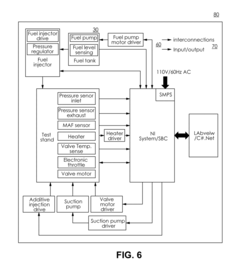
- A high-pressure GDI fuel injection system evaluation apparatus comprising a fuel tank, low-pressure and high-pressure fuel pumps, fuel rails, injectors, a DAQ device, and a main control unit, along with features like sealed chambers for endurance testing, flow meters, and oil-lubricated fuel pumps, enables comprehensive evaluation of the system's performance and durability.


Evaluation of the delivery and effectiveness of engine performance chemicals and products
PatentActiveUS20170114716A1
Innovation
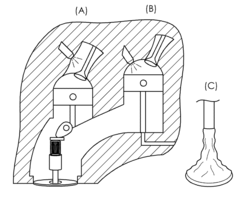
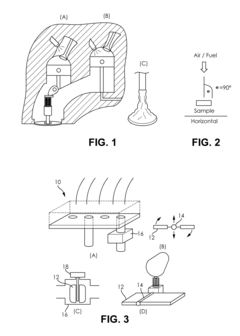
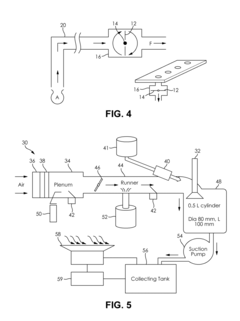
- A method and system for evaluating the delivery and effectiveness of engine performance chemicals and products for reducing intake valve deposits, utilizing a controlled environment with simulated engine conditions to quantify improvements, including adjustable parameters like air-fuel ratio, temperature, and oscillation frequency, and employing three approaches to introduce cleaners: airstream addition, suction-based distribution, and fuel additive application.
Environmental Compliance and Emissions Standards Impact
The evaluation of GDI engine pump systems must increasingly account for stringent environmental regulations and emissions standards worldwide. These standards directly impact testing methodologies, performance benchmarks, and design requirements for fuel delivery systems. The European Union's Euro 7 standards, set to be implemented in 2025, will require GDI systems to demonstrate significantly lower particulate matter emissions under a wider range of operating conditions, necessitating more comprehensive bench testing protocols that simulate these varied scenarios.
In the United States, the EPA's Tier 3 and California's LEVIII standards have progressively tightened NOx and hydrocarbon emissions limits, placing greater emphasis on precise fuel delivery and atomization characteristics that must be verified during bench testing. These regulations have driven the development of more sophisticated evaluation metrics for GDI pumps, including spray pattern analysis under transient conditions and fuel pressure stability measurements across broader operating ranges.
China's implementation of China 6 standards represents one of the most stringent regulatory frameworks globally, requiring GDI systems to maintain optimal performance while meeting lower emissions thresholds. This has necessitated the integration of real-world driving cycles into bench testing procedures to ensure compliance across actual usage patterns rather than just standardized test cycles.
The global trend toward Real Driving Emissions (RDE) testing has fundamentally altered bench evaluation approaches for GDI pump systems. Modern bench testing must now incorporate dynamic load profiles that simulate acceleration events, cold starts, and altitude variations to predict emissions compliance under these more challenging conditions. This shift has led to the development of hardware-in-the-loop testing systems that can replicate these complex scenarios while maintaining laboratory precision.
Carbon dioxide emissions regulations and fuel economy standards also significantly influence GDI pump evaluation criteria. Bench tests must now assess pump efficiency across the entire operating range, with particular attention to energy consumption during idle and low-load conditions where small inefficiencies can substantially impact overall vehicle emissions compliance. This has driven the adoption of more precise flow measurement technologies and thermal management evaluation techniques.
Emerging regulations addressing non-regulated emissions, such as ultrafine particles and secondary organic aerosols, are beginning to shape next-generation bench testing protocols. These will likely require more sophisticated particle size distribution measurements and chemical composition analysis capabilities to be integrated into standard bench testing equipment for GDI pump evaluation, representing a significant evolution in testing methodology driven by environmental compliance requirements.
In the United States, the EPA's Tier 3 and California's LEVIII standards have progressively tightened NOx and hydrocarbon emissions limits, placing greater emphasis on precise fuel delivery and atomization characteristics that must be verified during bench testing. These regulations have driven the development of more sophisticated evaluation metrics for GDI pumps, including spray pattern analysis under transient conditions and fuel pressure stability measurements across broader operating ranges.
China's implementation of China 6 standards represents one of the most stringent regulatory frameworks globally, requiring GDI systems to maintain optimal performance while meeting lower emissions thresholds. This has necessitated the integration of real-world driving cycles into bench testing procedures to ensure compliance across actual usage patterns rather than just standardized test cycles.
The global trend toward Real Driving Emissions (RDE) testing has fundamentally altered bench evaluation approaches for GDI pump systems. Modern bench testing must now incorporate dynamic load profiles that simulate acceleration events, cold starts, and altitude variations to predict emissions compliance under these more challenging conditions. This shift has led to the development of hardware-in-the-loop testing systems that can replicate these complex scenarios while maintaining laboratory precision.
Carbon dioxide emissions regulations and fuel economy standards also significantly influence GDI pump evaluation criteria. Bench tests must now assess pump efficiency across the entire operating range, with particular attention to energy consumption during idle and low-load conditions where small inefficiencies can substantially impact overall vehicle emissions compliance. This has driven the adoption of more precise flow measurement technologies and thermal management evaluation techniques.
Emerging regulations addressing non-regulated emissions, such as ultrafine particles and secondary organic aerosols, are beginning to shape next-generation bench testing protocols. These will likely require more sophisticated particle size distribution measurements and chemical composition analysis capabilities to be integrated into standard bench testing equipment for GDI pump evaluation, representing a significant evolution in testing methodology driven by environmental compliance requirements.
Cost-Benefit Analysis of Bench Testing vs Field Testing
When evaluating GDI (Gasoline Direct Injection) engine pump systems, organizations must carefully weigh the financial implications of bench testing versus field testing methodologies. Bench testing offers significant cost advantages in the initial development phases, with laboratory setups typically requiring 40-60% less capital investment compared to comprehensive field testing programs. This cost differential stems primarily from reduced equipment requirements, controlled environmental conditions, and lower personnel demands.
The operational expenses associated with bench testing are substantially lower, with studies indicating savings of approximately 30-45% in day-to-day testing costs. These savings derive from reduced fuel consumption, minimized facility overhead, and decreased maintenance requirements. Additionally, bench testing dramatically accelerates the testing timeline, allowing engineers to complete evaluation cycles in days rather than the weeks or months required for equivalent field testing.
However, field testing provides irreplaceable real-world performance data that bench testing cannot fully replicate. While more expensive initially, field testing often prevents costly design revisions and warranty claims post-production. Industry data suggests that identifying a critical pump failure during bench testing costs approximately $5,000-15,000, whereas the same issue discovered during field testing may cost $25,000-50,000, and if found after production, remediation costs can exceed $500,000 per incident.
The return on investment calculation must consider the testing phase and specific evaluation objectives. Early-stage development benefits most from bench testing's cost efficiency, with ROI ratios typically ranging from 4:1 to 8:1 compared to field testing. For final validation phases, however, field testing delivers superior long-term value despite higher immediate costs, with ROI potentially reaching 10:1 when considering prevented warranty claims and brand protection.
A balanced approach often yields optimal results. Progressive testing strategies that begin with comprehensive bench testing followed by targeted field validation demonstrate cost reductions of 25-35% compared to traditional testing sequences, while maintaining or improving quality outcomes. This hybrid methodology allows organizations to capitalize on bench testing efficiency while ensuring real-world performance through strategic field validation.
The cost-benefit equation must also factor in time-to-market advantages. Bench testing accelerates development cycles by 30-50%, potentially translating to millions in additional revenue through earlier market entry. This temporal advantage represents a significant but often overlooked component of the complete financial analysis when comparing these testing methodologies.
The operational expenses associated with bench testing are substantially lower, with studies indicating savings of approximately 30-45% in day-to-day testing costs. These savings derive from reduced fuel consumption, minimized facility overhead, and decreased maintenance requirements. Additionally, bench testing dramatically accelerates the testing timeline, allowing engineers to complete evaluation cycles in days rather than the weeks or months required for equivalent field testing.
However, field testing provides irreplaceable real-world performance data that bench testing cannot fully replicate. While more expensive initially, field testing often prevents costly design revisions and warranty claims post-production. Industry data suggests that identifying a critical pump failure during bench testing costs approximately $5,000-15,000, whereas the same issue discovered during field testing may cost $25,000-50,000, and if found after production, remediation costs can exceed $500,000 per incident.
The return on investment calculation must consider the testing phase and specific evaluation objectives. Early-stage development benefits most from bench testing's cost efficiency, with ROI ratios typically ranging from 4:1 to 8:1 compared to field testing. For final validation phases, however, field testing delivers superior long-term value despite higher immediate costs, with ROI potentially reaching 10:1 when considering prevented warranty claims and brand protection.
A balanced approach often yields optimal results. Progressive testing strategies that begin with comprehensive bench testing followed by targeted field validation demonstrate cost reductions of 25-35% compared to traditional testing sequences, while maintaining or improving quality outcomes. This hybrid methodology allows organizations to capitalize on bench testing efficiency while ensuring real-world performance through strategic field validation.
The cost-benefit equation must also factor in time-to-market advantages. Bench testing accelerates development cycles by 30-50%, potentially translating to millions in additional revenue through earlier market entry. This temporal advantage represents a significant but often overlooked component of the complete financial analysis when comparing these testing methodologies.
Unlock deeper insights with Patsnap Eureka Quick Research — get a full tech report to explore trends and direct your research. Try now!
Generate Your Research Report Instantly with AI Agent
Supercharge your innovation with Patsnap Eureka AI Agent Platform!