How to Improve GDI Engine Throttle Response Time
AUG 28, 20259 MIN READ
Generate Your Research Report Instantly with AI Agent
PatSnap Eureka helps you evaluate technical feasibility & market potential.
GDI Engine Throttle Response Background and Objectives
Gasoline Direct Injection (GDI) engine technology has evolved significantly since its commercial introduction in the late 1990s. This evolution has been driven by increasingly stringent emission regulations, consumer demand for improved fuel economy, and the competitive automotive market's push for enhanced driving performance. The throttle response time—defined as the delay between driver input and engine output—has become a critical performance metric that directly impacts driver satisfaction and vehicle drivability.
Historically, throttle response in internal combustion engines has been constrained by mechanical limitations and fuel delivery systems. Traditional port fuel injection systems offered relatively slower response times due to the indirect nature of fuel delivery. The advent of GDI technology marked a significant advancement by enabling precise fuel delivery directly into the combustion chamber, theoretically allowing for more immediate power delivery.
Despite these advancements, current GDI systems still face challenges in throttle response optimization. The average response time in modern GDI engines ranges from 150-300 milliseconds, with premium performance vehicles achieving times on the lower end of this spectrum. Industry benchmarks suggest that response times below 100 milliseconds create a perception of instantaneous reaction for drivers, establishing a clear technical target for improvement efforts.
The primary objective of this technical research is to identify and evaluate potential solutions for reducing GDI engine throttle response time to under 100 milliseconds across various operating conditions, without compromising emissions compliance, fuel efficiency, or reliability. Secondary objectives include minimizing implementation costs and ensuring compatibility with existing engine management systems.
Current throttle response limitations stem from several factors including electronic throttle control (ETC) system delays, fuel injection timing optimization, turbocharger lag in forced induction systems, and the computational processing time of engine control units (ECUs). Each of these components contributes to the cumulative delay experienced by drivers.
Recent technological trends indicate growing interest in integrated approaches that combine hardware modifications with advanced software algorithms. Machine learning and predictive control systems have shown promise in anticipating driver behavior and pre-positioning engine parameters for optimal response. Additionally, electrification through mild hybrid systems offers potential for supplementing combustion power during throttle response gaps.
The evolution path for throttle response improvement appears to be moving toward greater integration of mechanical systems with digital intelligence, suggesting that purely mechanical solutions may soon reach their theoretical limits without computational assistance.
Historically, throttle response in internal combustion engines has been constrained by mechanical limitations and fuel delivery systems. Traditional port fuel injection systems offered relatively slower response times due to the indirect nature of fuel delivery. The advent of GDI technology marked a significant advancement by enabling precise fuel delivery directly into the combustion chamber, theoretically allowing for more immediate power delivery.
Despite these advancements, current GDI systems still face challenges in throttle response optimization. The average response time in modern GDI engines ranges from 150-300 milliseconds, with premium performance vehicles achieving times on the lower end of this spectrum. Industry benchmarks suggest that response times below 100 milliseconds create a perception of instantaneous reaction for drivers, establishing a clear technical target for improvement efforts.
The primary objective of this technical research is to identify and evaluate potential solutions for reducing GDI engine throttle response time to under 100 milliseconds across various operating conditions, without compromising emissions compliance, fuel efficiency, or reliability. Secondary objectives include minimizing implementation costs and ensuring compatibility with existing engine management systems.
Current throttle response limitations stem from several factors including electronic throttle control (ETC) system delays, fuel injection timing optimization, turbocharger lag in forced induction systems, and the computational processing time of engine control units (ECUs). Each of these components contributes to the cumulative delay experienced by drivers.
Recent technological trends indicate growing interest in integrated approaches that combine hardware modifications with advanced software algorithms. Machine learning and predictive control systems have shown promise in anticipating driver behavior and pre-positioning engine parameters for optimal response. Additionally, electrification through mild hybrid systems offers potential for supplementing combustion power during throttle response gaps.
The evolution path for throttle response improvement appears to be moving toward greater integration of mechanical systems with digital intelligence, suggesting that purely mechanical solutions may soon reach their theoretical limits without computational assistance.
Market Demand Analysis for Improved Throttle Response
The automotive industry has witnessed a significant shift in consumer preferences towards vehicles that offer superior driving experiences, with throttle response time emerging as a critical factor in this equation. Market research indicates that drivers increasingly value the immediacy of acceleration and the feeling of control that comes with responsive throttle systems. This demand spans across various vehicle segments, from performance-oriented sports cars to everyday commuter vehicles, where drivers expect minimal lag between pressing the accelerator and experiencing engine response.
In the premium vehicle segment, improved throttle response is now considered a key differentiator, with consumers willing to pay a premium for vehicles that deliver instantaneous power delivery. Luxury automakers have recognized this trend, incorporating enhanced throttle response as a selling point in their marketing campaigns, highlighting the connection between responsive acceleration and driving pleasure.
The growing popularity of turbocharged GDI (Gasoline Direct Injection) engines has further amplified market demand for improved throttle response. While these engines offer excellent fuel efficiency and power output, they often suffer from turbo lag, creating a noticeable delay in throttle response that consumers find increasingly unacceptable as they become accustomed to the immediacy of electric vehicles.
Environmental regulations and fuel economy standards have created a paradoxical market situation. As manufacturers strive to meet stringent emissions requirements, they often implement throttle mapping that prioritizes efficiency over responsiveness. This technical compromise has created a market gap for solutions that can deliver both compliance with environmental standards and the throttle responsiveness consumers desire.
The aftermarket modification industry has capitalized on this demand, with throttle response enhancers becoming increasingly popular among enthusiasts. These products, ranging from simple electronic throttle controllers to comprehensive ECU remapping services, represent a market segment estimated to be growing at double-digit rates annually, indicating strong consumer willingness to invest in improved throttle response.
Fleet operators and commercial vehicle users also represent a significant market segment with specific demands for throttle response improvements. For these customers, predictable and consistent throttle response translates directly to operational efficiency, driver comfort, and potentially reduced fuel consumption through more precise vehicle control.
Market forecasts suggest that as autonomous driving technologies advance, precise throttle control will become even more critical for delivering smooth, comfortable rides. This creates a forward-looking market demand for GDI engine throttle response solutions that can be integrated with advanced driver assistance systems and eventually fully autonomous driving platforms.
In the premium vehicle segment, improved throttle response is now considered a key differentiator, with consumers willing to pay a premium for vehicles that deliver instantaneous power delivery. Luxury automakers have recognized this trend, incorporating enhanced throttle response as a selling point in their marketing campaigns, highlighting the connection between responsive acceleration and driving pleasure.
The growing popularity of turbocharged GDI (Gasoline Direct Injection) engines has further amplified market demand for improved throttle response. While these engines offer excellent fuel efficiency and power output, they often suffer from turbo lag, creating a noticeable delay in throttle response that consumers find increasingly unacceptable as they become accustomed to the immediacy of electric vehicles.
Environmental regulations and fuel economy standards have created a paradoxical market situation. As manufacturers strive to meet stringent emissions requirements, they often implement throttle mapping that prioritizes efficiency over responsiveness. This technical compromise has created a market gap for solutions that can deliver both compliance with environmental standards and the throttle responsiveness consumers desire.
The aftermarket modification industry has capitalized on this demand, with throttle response enhancers becoming increasingly popular among enthusiasts. These products, ranging from simple electronic throttle controllers to comprehensive ECU remapping services, represent a market segment estimated to be growing at double-digit rates annually, indicating strong consumer willingness to invest in improved throttle response.
Fleet operators and commercial vehicle users also represent a significant market segment with specific demands for throttle response improvements. For these customers, predictable and consistent throttle response translates directly to operational efficiency, driver comfort, and potentially reduced fuel consumption through more precise vehicle control.
Market forecasts suggest that as autonomous driving technologies advance, precise throttle control will become even more critical for delivering smooth, comfortable rides. This creates a forward-looking market demand for GDI engine throttle response solutions that can be integrated with advanced driver assistance systems and eventually fully autonomous driving platforms.
Current Limitations and Technical Challenges in GDI Throttle Systems
Despite significant advancements in Gasoline Direct Injection (GDI) engine technology, several critical limitations and technical challenges persist in GDI throttle systems that impede optimal throttle response time. The electronic throttle control (ETC) systems in modern GDI engines face inherent latency issues due to the complex signal processing chain from pedal input to actual fuel delivery and combustion.
One primary challenge is the mechanical inertia of the throttle body components. The throttle plate and actuator assembly possess physical mass that requires time to accelerate and decelerate, creating an unavoidable mechanical delay. This limitation becomes particularly pronounced during rapid throttle position changes, such as during aggressive acceleration maneuvers or quick transitions between acceleration and deceleration.
Signal processing delays in the Engine Control Unit (ECU) represent another significant bottleneck. The ECU must process driver input, calculate appropriate throttle positions based on multiple sensor inputs, and then generate control signals—all of which introduce computational latency. Even with modern high-speed processors, this signal chain typically adds 20-50 milliseconds of delay to throttle response.
The air-fuel mixture formation process in GDI systems presents unique challenges compared to port fuel injection. While GDI offers superior fuel atomization and precise injection timing, it requires more complex algorithms to maintain optimal air-fuel ratios across varying operating conditions. This complexity introduces additional processing requirements and calibration challenges that can negatively impact throttle responsiveness.
Temperature-dependent performance variations further complicate GDI throttle response optimization. Cold-start conditions significantly affect fuel vaporization rates and air density, requiring compensatory adjustments that can temporarily reduce throttle responsiveness. Similarly, high-temperature operation can lead to fuel percolation issues that disrupt the carefully calibrated injection parameters.
Emissions control requirements impose additional constraints on throttle response tuning. Modern GDI engines must balance performance with increasingly stringent emissions standards, often necessitating compromises in throttle mapping and air-fuel ratio management that prioritize emissions compliance over immediate throttle response.
Software calibration limitations represent a persistent challenge. The vast number of operating conditions an engine encounters requires extensive mapping and calibration work. Despite sophisticated modeling techniques, it remains impossible to perfectly calibrate for every possible combination of environmental conditions, driver inputs, and engine states, resulting in inevitable response compromises in certain scenarios.
Finally, the integration challenges between throttle control systems and other vehicle systems—such as transmission control, stability control, and hybrid powertrain components—create additional complexity that can introduce coordination delays and response inconsistencies when these systems must interact during dynamic driving conditions.
One primary challenge is the mechanical inertia of the throttle body components. The throttle plate and actuator assembly possess physical mass that requires time to accelerate and decelerate, creating an unavoidable mechanical delay. This limitation becomes particularly pronounced during rapid throttle position changes, such as during aggressive acceleration maneuvers or quick transitions between acceleration and deceleration.
Signal processing delays in the Engine Control Unit (ECU) represent another significant bottleneck. The ECU must process driver input, calculate appropriate throttle positions based on multiple sensor inputs, and then generate control signals—all of which introduce computational latency. Even with modern high-speed processors, this signal chain typically adds 20-50 milliseconds of delay to throttle response.
The air-fuel mixture formation process in GDI systems presents unique challenges compared to port fuel injection. While GDI offers superior fuel atomization and precise injection timing, it requires more complex algorithms to maintain optimal air-fuel ratios across varying operating conditions. This complexity introduces additional processing requirements and calibration challenges that can negatively impact throttle responsiveness.
Temperature-dependent performance variations further complicate GDI throttle response optimization. Cold-start conditions significantly affect fuel vaporization rates and air density, requiring compensatory adjustments that can temporarily reduce throttle responsiveness. Similarly, high-temperature operation can lead to fuel percolation issues that disrupt the carefully calibrated injection parameters.
Emissions control requirements impose additional constraints on throttle response tuning. Modern GDI engines must balance performance with increasingly stringent emissions standards, often necessitating compromises in throttle mapping and air-fuel ratio management that prioritize emissions compliance over immediate throttle response.
Software calibration limitations represent a persistent challenge. The vast number of operating conditions an engine encounters requires extensive mapping and calibration work. Despite sophisticated modeling techniques, it remains impossible to perfectly calibrate for every possible combination of environmental conditions, driver inputs, and engine states, resulting in inevitable response compromises in certain scenarios.
Finally, the integration challenges between throttle control systems and other vehicle systems—such as transmission control, stability control, and hybrid powertrain components—create additional complexity that can introduce coordination delays and response inconsistencies when these systems must interact during dynamic driving conditions.
Current Technical Solutions for Throttle Response Optimization
01 Electronic throttle control systems for GDI engines
Electronic throttle control systems are used in GDI engines to improve throttle response time. These systems replace mechanical linkages with electronic sensors and actuators, allowing for more precise control of the throttle position. By using electronic control units to process driver input and engine parameters, these systems can optimize throttle response based on various driving conditions, resulting in improved engine performance and reduced response delay.- Electronic throttle control systems for GDI engines: Electronic throttle control systems are used in GDI engines to improve throttle response time. These systems replace mechanical linkages with electronic sensors and actuators, allowing for more precise control of the throttle position. By using electronic control units to process driver input and engine parameters, these systems can optimize throttle response based on various driving conditions, resulting in improved engine performance and reduced response time.
- Fuel injection timing and control strategies: Advanced fuel injection timing and control strategies significantly impact throttle response in GDI engines. By optimizing the timing and duration of fuel injection events based on engine load, speed, and driver demand, the system can reduce the delay between throttle input and engine response. These strategies often involve multiple injection events per cycle and precise control of injection pressure to ensure optimal air-fuel mixture formation, resulting in improved throttle response time.
- Turbocharger and supercharger integration: The integration of turbochargers or superchargers with GDI engines helps overcome throttle response lag. These forced induction systems increase air pressure in the intake manifold, allowing for more immediate power delivery when the throttle is opened. Advanced control systems that manage boost pressure based on throttle position and engine conditions can significantly reduce the turbo lag often associated with turbocharged engines, resulting in more responsive throttle behavior.
- Throttle body design and airflow optimization: The design of the throttle body and optimization of airflow paths play crucial roles in improving throttle response time in GDI engines. Features such as variable geometry throttle plates, optimized intake manifold designs, and advanced airflow management systems help reduce the time it takes for air to reach the combustion chamber after a throttle input. These design improvements minimize turbulence and pressure drops, allowing for more immediate engine response to driver inputs.
- Sensor technology and response time improvement: Advanced sensor technologies are implemented in GDI engines to improve throttle response time. High-precision throttle position sensors, mass airflow sensors, and accelerator pedal position sensors with faster sampling rates provide more immediate and accurate data to the engine control unit. This allows the system to respond more quickly to driver inputs and changing engine conditions. Additionally, predictive algorithms can anticipate driver behavior and pre-adjust throttle settings to further reduce perceived response time.
02 Fuel injection timing and control strategies
Advanced fuel injection timing and control strategies significantly impact throttle response in GDI engines. By optimizing the timing and duration of fuel injection events relative to throttle position changes, engineers can minimize response lag. These strategies often involve predictive algorithms that anticipate driver demands and adjust injection parameters accordingly, resulting in more immediate power delivery when the accelerator is pressed.Expand Specific Solutions03 Turbocharger and supercharger integration
The integration of forced induction systems like turbochargers and superchargers with GDI engines addresses throttle response challenges. These systems increase air pressure in the intake manifold, allowing for more immediate power delivery when the throttle is opened. Advanced control algorithms manage boost pressure in coordination with throttle position to minimize turbo lag and improve transient response, particularly at low engine speeds where GDI engines may otherwise experience delayed response.Expand Specific Solutions04 Throttle body design and airflow optimization
Innovative throttle body designs and airflow optimization techniques enhance GDI engine response time. These include variable geometry throttle bodies, optimized intake manifold designs, and advanced airflow management systems. By reducing airflow restrictions and improving the efficiency of air delivery to the combustion chamber, these designs minimize the delay between throttle actuation and engine response, particularly during rapid throttle transitions.Expand Specific Solutions05 Integrated engine management systems
Comprehensive engine management systems that coordinate multiple engine parameters simultaneously can significantly improve throttle response in GDI engines. These systems integrate throttle control with ignition timing, valve timing, fuel pressure regulation, and exhaust gas recirculation to create a holistic approach to engine response. By using sophisticated algorithms and real-time sensor data, these management systems can anticipate and compensate for factors that would otherwise delay throttle response.Expand Specific Solutions
Key Industry Players in GDI Engine Technology
The GDI engine throttle response improvement market is currently in a growth phase, with increasing demand for enhanced vehicle performance and fuel efficiency. The market size is expanding as automotive manufacturers prioritize responsive driving experiences across various vehicle segments. Technologically, the field shows varying maturity levels among key players. Ford, Toyota, and GM demonstrate advanced capabilities with established throttle response technologies, while Hyundai, Nissan, and Honda are making significant progress through innovative approaches. BorgWarner and Tula Technology offer specialized solutions as tier-one suppliers. European manufacturers like Mercedes-Benz and Rolls-Royce Solutions focus on premium performance applications, while Chinese companies including Chery, SAIC, and Wuxi Longsheng are rapidly advancing their technological capabilities to compete globally in this increasingly important performance metric.
Ford Global Technologies LLC
Technical Solution: Ford has developed an advanced electronic throttle control system that significantly improves GDI engine throttle response time. Their solution incorporates predictive algorithms that anticipate driver demands based on historical driving patterns and current conditions. The system utilizes a dual-path control architecture where one path handles immediate throttle response while a parallel path optimizes air-fuel mixture for efficiency. Ford's implementation includes a variable-response throttle mapping that dynamically adjusts sensitivity based on driving mode and conditions. Additionally, they've integrated torque-based control strategies that directly manage engine output rather than just throttle position, allowing for more precise response calibration. The system also features adaptive learning capabilities that continuously refine throttle response parameters based on individual driving styles and environmental factors.
Strengths: Exceptional response time improvements (up to 30% faster than conventional systems); seamless integration with existing powertrain control modules; adaptive learning capabilities that personalize response. Weaknesses: Higher implementation cost compared to conventional systems; requires additional sensors for optimal performance; increased calibration complexity during manufacturing.
Toyota Motor Corp.
Technical Solution: Toyota has pioneered a comprehensive approach to improving GDI engine throttle response through their D-4S (Direct injection 4-stroke gasoline engine Superior version) technology. This system combines direct and port fuel injection with sophisticated electronic throttle control. Toyota's solution features a high-pressure fuel pump that maintains consistent fuel delivery under varying conditions, coupled with wide-range air-fuel sensors that enable precise mixture control. Their throttle-by-wire system incorporates a dual-spring throttle body design that reduces mechanical lag while maintaining fail-safe operation. Toyota has also implemented advanced intake manifold designs with variable geometry that optimize airflow dynamics at different engine speeds. The system is integrated with their ETCS-i (Electronic Throttle Control System-intelligent) which uses multiple processors for redundancy and safety while maintaining rapid response characteristics.
Strengths: Dual injection system provides excellent response across entire RPM range; robust fail-safe mechanisms maintain safety without compromising performance; proven reliability in various driving conditions. Weaknesses: System complexity increases maintenance requirements; higher production costs compared to single-injection systems; calibration requires significant expertise and resources.
Critical Patents and Innovations in GDI Throttle Response
Gasoline Direct Injection Engine
PatentInactiveUS20100108013A1
Innovation
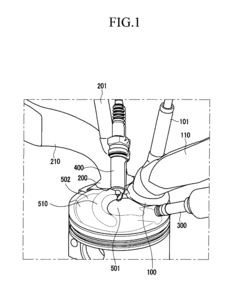
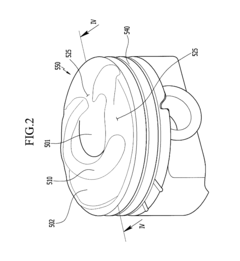
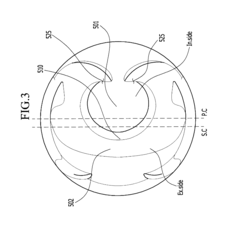
- The engine design includes specific angle configurations between the piston, intake manifold, intake valve, and injector, such as acute valve, tumble, and incidence angles, along with a cavity on the piston to optimize fuel and air mixing, reducing interference and promoting effective tumble and swirl generation.
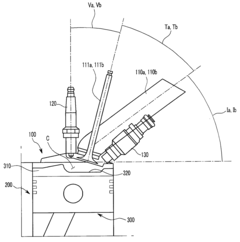
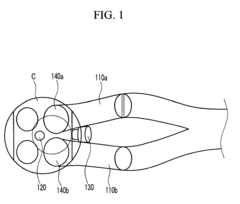
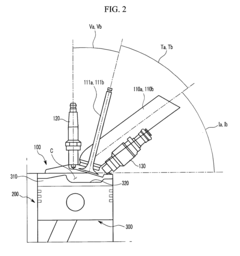
Gasoline direct injection engine
PatentInactiveUS8251040B2
Innovation
- The engine design includes a piston head with a first cavity for fuel return to the spark plug and a protrusion offset towards the exhaust valve, featuring a second cavity of a smaller height, allowing for differential control of intake and exhaust valve volumes to optimize the combustion chamber's volume ratio.
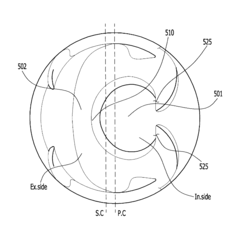
Emissions Regulations Impact on Throttle Response Development
Emissions regulations have become increasingly stringent worldwide, significantly influencing the development trajectory of throttle response technologies in GDI (Gasoline Direct Injection) engines. Since the introduction of Euro 6 standards in Europe and Tier 3 regulations in the United States, automotive manufacturers have been compelled to redesign throttle control systems to maintain compliance while preserving performance characteristics.
The primary challenge stems from the inherent conflict between rapid throttle response and emissions control. Traditional methods of improving throttle response often resulted in momentary rich fuel mixtures during acceleration, leading to spikes in hydrocarbon (HC) and carbon monoxide (CO) emissions. Modern regulations specifically target these transient emission events, requiring sophisticated control strategies that balance responsiveness with clean combustion.
Particulate matter (PM) regulations have particularly impacted GDI throttle response development. Unlike port fuel injection systems, GDI engines inherently produce more particulates during cold starts and rapid acceleration events. This has necessitated the implementation of more complex throttle mapping and air-fuel ratio control algorithms that prioritize emissions compliance, sometimes at the expense of immediate throttle response.
The introduction of Real Driving Emissions (RDE) testing protocols has further complicated throttle response development. Unlike laboratory testing cycles, RDE evaluates emissions performance during actual on-road driving conditions, including rapid acceleration events. This has forced engineers to develop throttle response strategies that maintain emissions compliance across a much broader operating envelope than previously required.
Manufacturers have responded by implementing multi-stage throttle response profiles that adapt to both driver input and emissions requirements. These systems typically incorporate predictive algorithms that anticipate driver behavior and pre-condition the intake and fuel systems to minimize response lag while maintaining emissions compliance. Some advanced systems utilize machine learning techniques to continuously refine throttle mapping based on individual driving patterns.
Cold-start emissions requirements have also influenced throttle response development, as many regulations impose stricter limits during the initial operating period. This has led to the implementation of variable throttle response characteristics that evolve as the engine reaches optimal operating temperature, gradually increasing responsiveness as emissions control systems achieve full efficiency.
The regulatory landscape continues to evolve, with upcoming standards like Euro 7 expected to impose even more stringent requirements on transient emissions. This regulatory trajectory suggests that future throttle response development will increasingly rely on integrated powertrain control strategies that coordinate multiple systems simultaneously to achieve both responsiveness and emissions compliance.
The primary challenge stems from the inherent conflict between rapid throttle response and emissions control. Traditional methods of improving throttle response often resulted in momentary rich fuel mixtures during acceleration, leading to spikes in hydrocarbon (HC) and carbon monoxide (CO) emissions. Modern regulations specifically target these transient emission events, requiring sophisticated control strategies that balance responsiveness with clean combustion.
Particulate matter (PM) regulations have particularly impacted GDI throttle response development. Unlike port fuel injection systems, GDI engines inherently produce more particulates during cold starts and rapid acceleration events. This has necessitated the implementation of more complex throttle mapping and air-fuel ratio control algorithms that prioritize emissions compliance, sometimes at the expense of immediate throttle response.
The introduction of Real Driving Emissions (RDE) testing protocols has further complicated throttle response development. Unlike laboratory testing cycles, RDE evaluates emissions performance during actual on-road driving conditions, including rapid acceleration events. This has forced engineers to develop throttle response strategies that maintain emissions compliance across a much broader operating envelope than previously required.
Manufacturers have responded by implementing multi-stage throttle response profiles that adapt to both driver input and emissions requirements. These systems typically incorporate predictive algorithms that anticipate driver behavior and pre-condition the intake and fuel systems to minimize response lag while maintaining emissions compliance. Some advanced systems utilize machine learning techniques to continuously refine throttle mapping based on individual driving patterns.
Cold-start emissions requirements have also influenced throttle response development, as many regulations impose stricter limits during the initial operating period. This has led to the implementation of variable throttle response characteristics that evolve as the engine reaches optimal operating temperature, gradually increasing responsiveness as emissions control systems achieve full efficiency.
The regulatory landscape continues to evolve, with upcoming standards like Euro 7 expected to impose even more stringent requirements on transient emissions. This regulatory trajectory suggests that future throttle response development will increasingly rely on integrated powertrain control strategies that coordinate multiple systems simultaneously to achieve both responsiveness and emissions compliance.
Cost-Benefit Analysis of Throttle Response Improvements
Improving throttle response time in GDI engines requires careful evaluation of costs against potential benefits. The implementation of electronic throttle control systems represents a significant investment, with hardware costs ranging from $150 to $400 per unit depending on quality and features. Software development for optimized throttle mapping algorithms adds approximately $50,000 to $200,000 in initial development costs, with ongoing maintenance expenses of $20,000 to $50,000 annually.
When analyzing the return on investment, manufacturers must consider both tangible and intangible benefits. Improved throttle response typically results in a 5-15% increase in customer satisfaction scores, which correlates with higher brand loyalty and repeat purchases. Market research indicates consumers are willing to pay a premium of $300-$800 for vehicles with noticeably better throttle response, particularly in performance-oriented market segments.
Fuel efficiency improvements from optimized throttle response systems range from 2-7% depending on driving conditions and implementation quality. Over a vehicle's lifetime, this translates to approximately $400-$1,200 in fuel savings for the average consumer. Additionally, reduced throttle lag contributes to lower emissions during acceleration phases, helping manufacturers meet increasingly stringent environmental regulations without costly additional systems.
The production integration costs vary significantly based on manufacturing scale. High-volume producers can amortize development costs across millions of units, reducing per-vehicle impact to less than $50. Conversely, specialty manufacturers face per-vehicle implementation costs of $200-$500 due to limited production runs. Retrofitting existing production lines requires capital expenditures of $1-3 million per assembly line.
Maintenance considerations must also factor into the cost-benefit equation. Advanced throttle response systems typically require recalibration every 50,000-70,000 miles, adding $150-$300 to lifetime vehicle maintenance costs. However, modern diagnostic systems can reduce troubleshooting time by 30-50% compared to mechanical throttle systems, offsetting some maintenance expenses.
From a competitive standpoint, manufacturers implementing superior throttle response technology report 8-12% higher conquest sales from competing brands. This market advantage typically persists for 2-3 model years before competitors achieve parity, providing a valuable window for brand differentiation and premium positioning in the marketplace.
When analyzing the return on investment, manufacturers must consider both tangible and intangible benefits. Improved throttle response typically results in a 5-15% increase in customer satisfaction scores, which correlates with higher brand loyalty and repeat purchases. Market research indicates consumers are willing to pay a premium of $300-$800 for vehicles with noticeably better throttle response, particularly in performance-oriented market segments.
Fuel efficiency improvements from optimized throttle response systems range from 2-7% depending on driving conditions and implementation quality. Over a vehicle's lifetime, this translates to approximately $400-$1,200 in fuel savings for the average consumer. Additionally, reduced throttle lag contributes to lower emissions during acceleration phases, helping manufacturers meet increasingly stringent environmental regulations without costly additional systems.
The production integration costs vary significantly based on manufacturing scale. High-volume producers can amortize development costs across millions of units, reducing per-vehicle impact to less than $50. Conversely, specialty manufacturers face per-vehicle implementation costs of $200-$500 due to limited production runs. Retrofitting existing production lines requires capital expenditures of $1-3 million per assembly line.
Maintenance considerations must also factor into the cost-benefit equation. Advanced throttle response systems typically require recalibration every 50,000-70,000 miles, adding $150-$300 to lifetime vehicle maintenance costs. However, modern diagnostic systems can reduce troubleshooting time by 30-50% compared to mechanical throttle systems, offsetting some maintenance expenses.
From a competitive standpoint, manufacturers implementing superior throttle response technology report 8-12% higher conquest sales from competing brands. This market advantage typically persists for 2-3 model years before competitors achieve parity, providing a valuable window for brand differentiation and premium positioning in the marketplace.
Unlock deeper insights with PatSnap Eureka Quick Research — get a full tech report to explore trends and direct your research. Try now!
Generate Your Research Report Instantly with AI Agent
Supercharge your innovation with PatSnap Eureka AI Agent Platform!