
Shell-and-tube vs. plate heat exchanger performance comparison
OCT 14, 20259 MIN READ
Generate Your Research Report Instantly with AI Agent
Patsnap Eureka helps you evaluate technical feasibility & market potential.
Heat Exchanger Technology Evolution and Objectives
Heat exchangers have evolved significantly since their inception in the early 20th century, with shell-and-tube designs representing one of the earliest standardized configurations. Initially developed for steam power generation and industrial processing, these robust exchangers became the industry standard due to their reliability and straightforward manufacturing processes. The 1920s to 1940s saw incremental improvements in materials and fabrication techniques, enhancing their performance in high-pressure and corrosive environments.
The introduction of plate heat exchangers in the 1930s marked a pivotal shift in the industry, though their widespread adoption only accelerated post-1950s with advancements in gasket materials and plate design. This technology offered significant advantages in terms of heat transfer efficiency and compactness, challenging the dominance of shell-and-tube exchangers in certain applications.
The energy crisis of the 1970s catalyzed further innovation, driving manufacturers to develop more efficient heat transfer solutions. This period saw substantial improvements in both technologies: enhanced tube geometries and baffle designs for shell-and-tube exchangers, and more sophisticated plate patterns and distribution systems for plate heat exchangers.
Recent decades have witnessed the refinement of computational fluid dynamics (CFD) modeling, allowing for precise optimization of flow patterns and heat transfer surfaces in both exchanger types. Material science advancements have expanded the application range of both technologies, with specialized alloys and composites enabling operation in increasingly extreme conditions.
The current technological trajectory aims to address several key objectives. Primary among these is maximizing energy efficiency through enhanced heat transfer coefficients while minimizing pressure drop penalties. Reducing the physical footprint of heat exchange systems remains crucial, particularly in space-constrained applications such as offshore platforms and urban processing facilities.
Sustainability objectives have gained prominence, with designs focusing on minimizing material usage, extending operational lifespan, and facilitating maintenance and cleaning to reduce lifecycle environmental impact. Additionally, adaptability to variable process conditions has become increasingly important as industrial systems require greater flexibility.
Looking forward, the industry is pursuing advanced manufacturing techniques like 3D printing for complex geometries, integration of smart monitoring systems for predictive maintenance, and development of novel materials that can withstand extreme temperatures and pressures while maintaining excellent heat transfer properties. The ultimate goal remains achieving optimal thermal performance with minimal energy input, space requirements, and environmental impact across diverse industrial applications.
Market Demand Analysis for Industrial Heat Transfer Solutions
The global industrial heat transfer solutions market is experiencing robust growth, driven by increasing energy efficiency requirements across manufacturing sectors. Current market valuation exceeds $7.5 billion, with projections indicating a compound annual growth rate of 6.2% through 2028. This growth trajectory is particularly evident in chemical processing, food and beverage, HVAC, and pharmaceutical industries where efficient heat transfer is critical to operational excellence.
Heat exchanger technology selection has become a strategic decision point for industrial operations, with the comparison between shell-and-tube and plate heat exchangers representing a fundamental consideration in system design. Market research indicates that while shell-and-tube exchangers currently hold approximately 45% market share due to their established presence, plate heat exchangers are growing at nearly twice the industry average rate, reflecting shifting demand patterns.
Energy efficiency regulations and sustainability initiatives are primary market drivers, with multinational corporations increasingly prioritizing heat recovery systems that minimize energy consumption. The European Union's Energy Efficiency Directive and similar regulations in North America and Asia have created substantial demand for high-efficiency heat transfer solutions, with plate heat exchangers often delivering superior performance metrics in these applications.
Cost sensitivity varies significantly by industry segment. Process industries typically evaluate heat exchanger technologies based on total cost of ownership rather than initial capital expenditure, creating market opportunities for premium solutions that offer superior efficiency. Conversely, HVAC and certain utility applications remain highly price-sensitive, where the lower initial cost of certain shell-and-tube configurations maintains their market position despite potential lifetime efficiency disadvantages.
Space constraints in modern industrial facilities have emerged as a critical market factor. Facility modernization projects and brownfield expansions frequently face significant space limitations, driving demand for compact heat transfer solutions. This trend particularly benefits plate heat exchangers, which typically require 50-80% less floor space than equivalent shell-and-tube units for comparable thermal duty.
Maintenance considerations significantly influence purchasing decisions, with end-users increasingly valuing designs that minimize production downtime. Market surveys indicate that maintenance accessibility and cleaning efficiency rank among the top five selection criteria for 78% of process industry customers, creating distinct market segments for both technologies based on specific application requirements.
Regional market dynamics show notable variation, with developing economies in Asia-Pacific and Latin America demonstrating stronger growth in shell-and-tube technologies, while European and North American markets show accelerated adoption of plate heat exchanger technologies, particularly in retrofit and replacement applications where performance improvements justify premium pricing.
Current State and Technical Challenges in Heat Exchanger Design
Heat exchanger technology has evolved significantly over the past decades, with shell-and-tube and plate heat exchangers emerging as the two dominant designs in industrial applications. Currently, shell-and-tube heat exchangers represent approximately 60% of the global market due to their established manufacturing processes and reliability in high-pressure applications. Meanwhile, plate heat exchangers have gained substantial market share, growing at an annual rate of 7-8% compared to 3-4% for traditional designs.
The current technical landscape reveals distinct performance characteristics between these two designs. Shell-and-tube exchangers typically operate with overall heat transfer coefficients ranging from 150-1200 W/m²K, while plate heat exchangers achieve 1000-4000 W/m²K, representing a significant efficiency advantage. This performance gap stems from the fundamental design differences: plate exchangers create turbulent flow at lower Reynolds numbers, enhancing heat transfer while requiring less pumping power.
Despite advancements, several technical challenges persist in heat exchanger optimization. Fouling remains a critical issue, reducing thermal efficiency by 10-40% in industrial applications and increasing maintenance costs. Shell-and-tube designs typically experience fouling rates of 0.0001-0.0005 m²K/W, while plate exchangers show lower rates but face more challenging cleaning procedures when fouling occurs.
Material selection presents another significant challenge, particularly for corrosive environments. Traditional stainless steel construction limits temperature and pressure capabilities, while advanced materials like titanium and specialized alloys increase costs by 200-300%. The industry faces a continuous trade-off between performance, durability, and economic viability.
Computational fluid dynamics (CFD) modeling has revolutionized design processes, yet accurate prediction of two-phase flow behavior and fouling dynamics remains problematic. Current models typically show 15-25% deviation from experimental results in complex flow regimes, highlighting the need for improved simulation capabilities.
Miniaturization represents another frontier, with micro-channel heat exchangers demonstrating heat transfer coefficients up to 10,000 W/m²K. However, manufacturing challenges and high pressure drops have limited widespread adoption to specialized applications like electronics cooling and compact refrigeration systems.
The geographical distribution of heat exchanger technology development shows concentration in Europe, North America, and East Asia, with emerging research clusters in India and Brazil. European manufacturers lead in plate heat exchanger innovations, while North American companies maintain strength in shell-and-tube technologies for petrochemical applications. This regional specialization creates both collaboration opportunities and competitive challenges for global technology advancement.
Performance Comparison of Shell-and-tube vs. Plate Heat Exchangers
01 Design improvements for shell-and-tube heat exchangers
Various design improvements can enhance the performance of shell-and-tube heat exchangers. These include optimized tube arrangements, improved baffle configurations, and enhanced shell designs that reduce pressure drop while increasing heat transfer efficiency. Modifications to tube geometry and layout can minimize flow resistance and maximize heat exchange surface area, resulting in better overall thermal performance.- Design improvements for shell-and-tube heat exchangers: Various design improvements can enhance the performance of shell-and-tube heat exchangers. These include optimized tube arrangements, improved baffle configurations, and enhanced flow distribution systems. Such design modifications can reduce pressure drop, minimize fouling, and increase heat transfer efficiency. Advanced tube geometries and shell configurations contribute to better thermal performance and extended operational life of these heat exchangers.
- Performance enhancement techniques for plate heat exchangers: Plate heat exchangers can achieve improved performance through several techniques including optimized plate corrugation patterns, enhanced flow distribution, and improved gasket designs. These enhancements increase turbulence at lower flow rates, improve heat transfer coefficients, and reduce fouling tendencies. Advanced plate geometries and arrangement patterns can significantly boost thermal efficiency while maintaining acceptable pressure drops across the exchanger.
- Innovative materials and coatings for heat exchangers: The use of innovative materials and specialized coatings can significantly improve heat exchanger performance. Advanced alloys, composite materials, and anti-fouling coatings extend equipment lifespan and maintain thermal efficiency over time. These materials offer benefits such as improved corrosion resistance, reduced scaling, enhanced heat transfer properties, and better mechanical strength under varying operating conditions, ultimately leading to more efficient and durable heat exchange systems.
- Flow optimization and turbulence enhancement techniques: Flow optimization techniques focus on creating controlled turbulence to enhance heat transfer while minimizing pressure drop penalties. Methods include strategic placement of turbulators, vortex generators, and flow disruptors within heat exchanger channels. These features break up boundary layers, promote mixing, and increase the overall heat transfer coefficient. Advanced computational fluid dynamics modeling helps optimize these features for specific operating conditions and fluid properties.
- Modular and hybrid heat exchanger designs: Modular and hybrid heat exchanger designs combine features from different exchanger types to maximize performance for specific applications. These innovative configurations may integrate shell-and-tube elements with plate features or incorporate multiple heat transfer mechanisms within a single unit. Such designs offer advantages including compact footprint, enhanced heat transfer efficiency, operational flexibility, and improved maintenance access, making them suitable for applications with space constraints or variable operating conditions.
02 Performance enhancement techniques for plate heat exchangers
Plate heat exchangers can achieve higher performance through specialized plate designs with optimized corrugation patterns, improved flow distribution systems, and enhanced sealing technologies. These techniques increase turbulence in the fluid flow while maintaining acceptable pressure drops, resulting in higher heat transfer coefficients. Advanced manufacturing methods allow for more precise control of plate geometry and channel dimensions.Expand Specific Solutions03 Novel materials and coatings for heat exchanger efficiency
The use of advanced materials and specialized coatings can significantly improve heat exchanger performance. High thermal conductivity materials reduce thermal resistance, while anti-fouling and anti-corrosion coatings maintain efficiency over longer operational periods. Composite materials and surface treatments can enhance heat transfer while extending equipment lifespan under harsh operating conditions.Expand Specific Solutions04 Flow optimization and turbulence enhancement methods
Various methods to optimize fluid flow patterns and enhance turbulence can improve heat exchanger performance. These include the use of turbulators, vortex generators, and specialized flow distributors that break up boundary layers and promote mixing. Computational fluid dynamics is used to design these features, resulting in higher heat transfer coefficients without excessive pressure drop penalties.Expand Specific Solutions05 Modular and hybrid heat exchanger systems
Modular and hybrid heat exchanger designs combine the advantages of different heat exchanger types to achieve superior performance. These systems may integrate shell-and-tube and plate heat exchanger elements in series or parallel configurations, allowing for optimization based on specific process requirements. Modular designs also facilitate easier maintenance and the ability to scale capacity as needed.Expand Specific Solutions
Leading Manufacturers and Competitive Landscape Analysis
The heat exchanger market is in a mature growth phase with increasing demand driven by energy efficiency requirements across industries. The global market size is estimated at $15-20 billion, with steady annual growth of 5-7%. Shell-and-tube exchangers represent the traditional technology with established manufacturing processes, while plate heat exchangers are gaining market share due to their compact design and higher efficiency. Companies like Vahterus Oy have pioneered hybrid Plate & Shell technology, while established players including Daikin Industries, Shell, ExxonMobil, and Lockheed Martin continue investing in R&D for performance improvements. Asian manufacturers such as Lanpec Technologies and Shanghai Lanbin are expanding market presence through cost-competitive offerings, while academic institutions like South China University of Technology and Shandong University contribute to technological advancement through research collaborations.
DAIKIN INDUSTRIES Ltd.
Technical Solution: Daikin has developed innovative plate heat exchanger technologies optimized for HVAC and refrigeration applications. Their brazed plate heat exchanger designs feature asymmetric chevron patterns that create controlled turbulence, maximizing heat transfer while minimizing pressure drop. Daikin's research has demonstrated that their optimized plate geometries can achieve overall heat transfer coefficients up to 3-5 times higher than equivalent shell-and-tube designs in refrigerant applications. Their proprietary manufacturing process allows for precise control of plate pressing depths and patterns, creating customized turbulence profiles for specific fluid combinations. Daikin has also pioneered compact plate heat exchanger designs specifically for R32 and other low-GWP refrigerants, incorporating enhanced pressure resistance features while maintaining high thermal efficiency.
Strengths: Exceptional compactness (up to 80% smaller than equivalent shell-and-tube units); superior heat transfer efficiency in refrigeration applications; excellent performance with variable flow rates. Weaknesses: Limited pressure and temperature operating ranges compared to shell-and-tube designs; more susceptible to clogging with particulate-laden fluids; more challenging to clean in certain applications.
Vahterus Oy
Technical Solution: Vahterus has pioneered the Plate & Shell Heat Exchanger (PSHE) technology, which combines the thermal efficiency of plate heat exchangers with the pressure capabilities of shell-and-tube designs. Their patented fully welded plate pack is enclosed within a pressure vessel, eliminating gaskets and enabling operation at pressures up to 100 bar and temperatures ranging from -200°C to 500°C. Vahterus' research demonstrates that their PSHE technology achieves heat transfer coefficients 3-5 times higher than traditional shell-and-tube exchangers while requiring only 20-30% of the footprint. Their unique circular plate design with optimized flow distribution ensures uniform velocity profiles across the entire heat transfer surface, minimizing dead zones and reducing fouling tendencies. Vahterus has also developed specialized anti-fouling plate patterns for challenging applications in the petrochemical and pulp & paper industries.
Strengths: Combines high pressure/temperature capabilities with compact size; excellent thermal efficiency across wide operating ranges; fully welded construction eliminates gasket limitations. Weaknesses: Higher manufacturing complexity than conventional plate designs; more difficult to inspect internal surfaces; limited availability of service providers compared to traditional technologies.
Key Technical Innovations in Heat Transfer Efficiency
Modular Plate and Shell Heat Exchanger
PatentActiveUS20170284744A1
Innovation
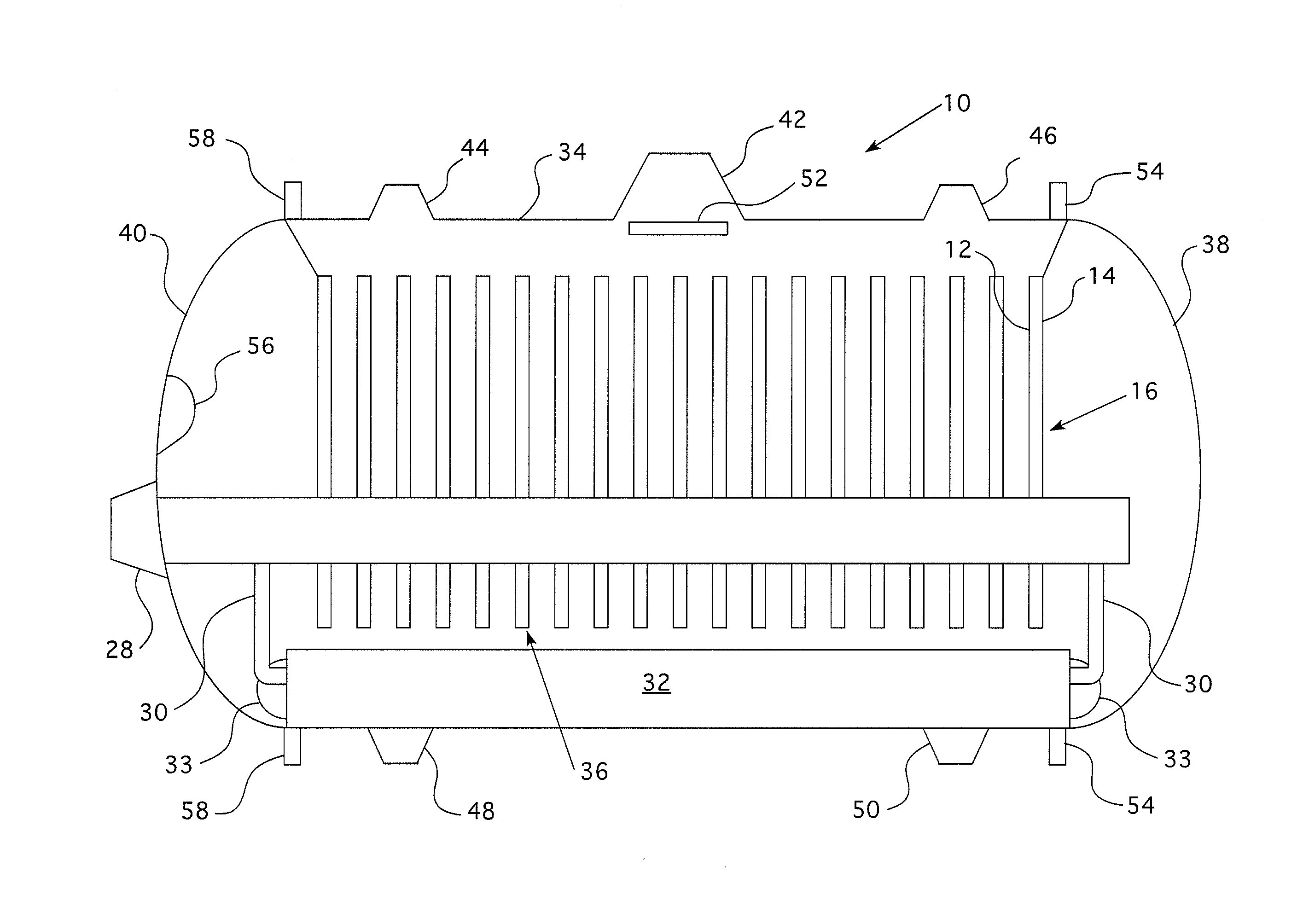
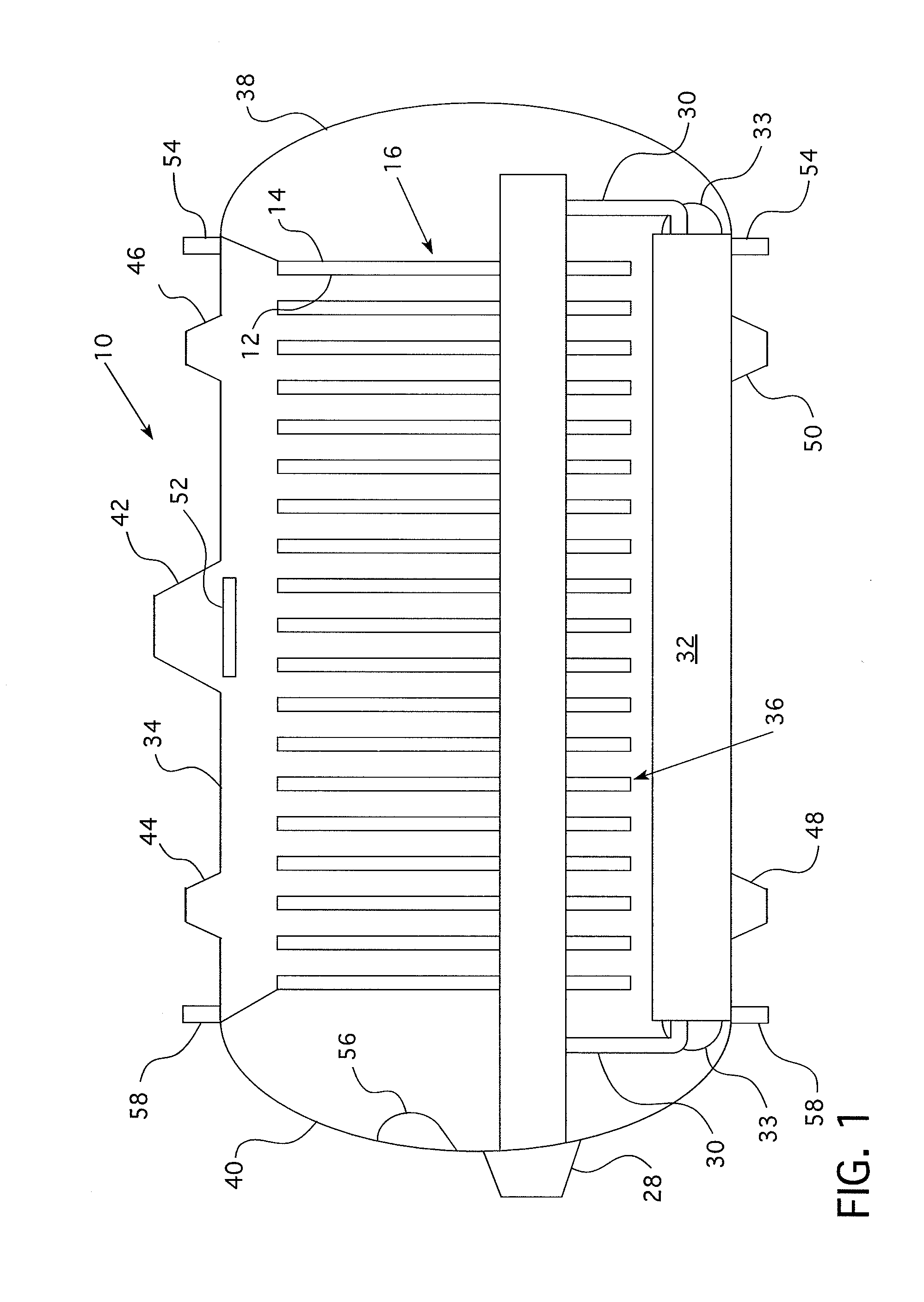
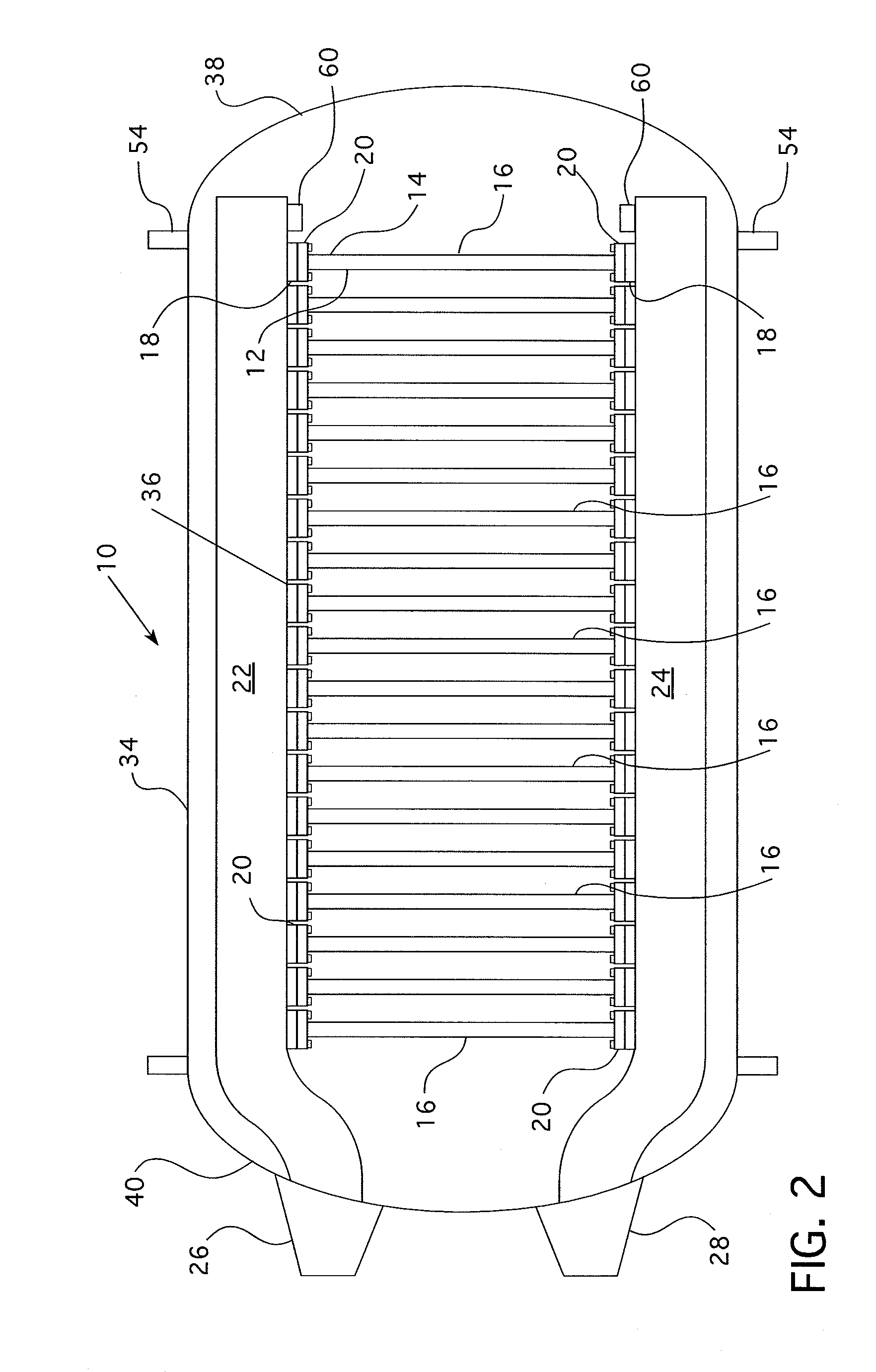
- A modular plate and shell feedwater heater design where welded heat transfer plate pairs are arranged in a shell, allowing for easy removal and replacement of heat transfer plates for inspection, repair, or uprating, with a removable head and gasket connections for increased flexibility and efficiency.


Modular plate and shell heat exchanger
PatentInactiveUS20120103578A1
Innovation
- A modular plate and shell feedwater heater design where welded heat transfer plate pairs are arranged in a shell, allowing for easy removal and replacement, with a removable head for inspection and expansion of heat transfer capacity to accommodate power plant uprates, using gaskets and tie rods for sealing and support.

Cost-Benefit Analysis of Different Heat Exchanger Types
When comparing shell-and-tube heat exchangers with plate heat exchangers, cost-benefit analysis reveals significant differences across multiple economic dimensions. Initial capital expenditure typically favors shell-and-tube exchangers, which generally cost 25-40% less than equivalent plate heat exchangers in terms of heat transfer capacity. However, this initial cost advantage must be weighed against long-term operational considerations.
Operational efficiency presents a compelling case for plate heat exchangers, which demonstrate 3-5 times higher heat transfer coefficients than shell-and-tube designs. This translates to approximately 20-30% lower energy consumption over the equipment lifecycle, resulting in substantial utility cost savings. For a medium-sized industrial application, these savings can amount to $5,000-15,000 annually depending on energy prices and usage patterns.
Maintenance economics also differ significantly between these technologies. Shell-and-tube exchangers require complete disassembly for cleaning, resulting in higher labor costs and extended downtime periods. Conversely, plate heat exchangers can be disassembled more easily, reducing maintenance downtime by 40-60% and associated labor costs by 30-50% per maintenance cycle.
Space utilization represents another economic factor, with plate heat exchangers requiring only 20-30% of the installation footprint compared to shell-and-tube units of equivalent capacity. This space efficiency translates to real estate savings in facility design and can reduce associated infrastructure costs by 15-25%.
Lifecycle cost analysis reveals that despite higher initial investment, plate heat exchangers often achieve break-even within 2-4 years through operational savings. Over a typical 15-20 year service life, plate exchangers demonstrate 15-25% lower total cost of ownership when accounting for all factors including installation, energy consumption, maintenance, and space utilization.
Industry-specific considerations also impact cost-benefit calculations. In pharmaceutical and food processing applications, the superior sanitary characteristics of plate exchangers reduce contamination risks and associated quality control costs. Conversely, in high-pressure or extreme temperature applications, shell-and-tube designs may present lower lifetime costs despite higher operational expenses due to their robust construction and lower replacement frequency.
Environmental Impact and Sustainability Considerations
The environmental impact of heat exchangers is becoming increasingly important as industries strive for more sustainable operations. Shell-and-tube and plate heat exchangers differ significantly in their environmental footprints throughout their lifecycle. Material consumption represents a key differentiator, with plate heat exchangers typically requiring 80-85% less material than equivalent shell-and-tube units for the same thermal duty, translating to reduced resource extraction and manufacturing emissions.
Energy efficiency during operation constitutes another critical environmental factor. Plate heat exchangers generally achieve higher thermal efficiency with temperature approaches as low as 1°C compared to 5-10°C in shell-and-tube designs. This improved efficiency can reduce energy consumption by 10-20%, directly lowering greenhouse gas emissions associated with power generation. The compact design of plate heat exchangers also minimizes refrigerant charge in refrigeration systems, reducing potential for harmful refrigerant leakage.
Water consumption presents additional environmental considerations. Plate heat exchangers typically require less cooling water due to their higher efficiency, potentially reducing water usage by 20-30% compared to shell-and-tube alternatives. This water conservation becomes increasingly valuable as water scarcity concerns grow globally.
Maintenance practices also influence environmental impact. Plate heat exchangers allow for mechanical cleaning and plate replacement without complete system replacement, extending operational life and reducing waste. However, gasket replacement in plate designs generates recurring waste streams not present in welded shell-and-tube units.
End-of-life considerations reveal that plate heat exchangers offer superior recyclability, with up to 95% of materials being recoverable and recyclable compared to approximately 70-80% for shell-and-tube units. The simpler material separation in plate designs facilitates more effective recycling processes.
Carbon footprint analysis across the complete lifecycle shows plate heat exchangers typically generate 15-25% lower emissions than comparable shell-and-tube units when accounting for manufacturing, operation, and disposal. This advantage becomes more pronounced in applications requiring frequent cleaning or experiencing scaling issues, where the operational efficiency of plate designs maintains better performance over time.
Regulatory compliance represents another dimension of environmental impact, with plate heat exchangers often better positioned to meet increasingly stringent energy efficiency standards and environmental regulations in various industries, particularly in food processing, pharmaceutical manufacturing, and HVAC applications.
Unlock deeper insights with Patsnap Eureka Quick Research — get a full tech report to explore trends and direct your research. Try now!
Generate Your Research Report Instantly with AI Agent
Supercharge your innovation with Patsnap Eureka AI Agent Platform!