Wearable Biosensors and Their Applications in Electronics
OCT 24, 202510 MIN READ
Generate Your Research Report Instantly with AI Agent
Patsnap Eureka helps you evaluate technical feasibility & market potential.
Wearable Biosensor Technology Evolution and Objectives
Wearable biosensors have evolved significantly over the past few decades, transforming from simple mechanical devices to sophisticated electronic systems capable of continuous health monitoring. The journey began in the 1960s with basic wearable heart rate monitors, which laid the foundation for future innovations. By the 1990s, advancements in microelectronics enabled the development of more compact and efficient biosensors, marking a crucial turning point in wearable technology.
The early 2000s witnessed the integration of wireless connectivity features, allowing real-time data transmission and remote monitoring capabilities. This period also saw the emergence of consumer-oriented wearable devices like fitness trackers and smartwatches with basic biosensing functions. The technological trajectory has been consistently moving toward miniaturization, improved accuracy, and enhanced power efficiency.
Recent years have brought revolutionary developments in materials science, particularly in flexible and stretchable electronics, which have dramatically expanded the potential applications of wearable biosensors. Innovations in conductive polymers, nanomaterials, and soft electronics have enabled the creation of skin-like, conformal sensors that can be comfortably worn for extended periods while providing accurate physiological measurements.
The primary objective of current wearable biosensor technology is to achieve seamless integration with the human body while delivering clinical-grade diagnostic information. This includes developing sensors that can continuously monitor multiple biomarkers simultaneously, from basic vital signs to complex biochemical parameters such as glucose levels, electrolytes, and stress hormones. The ultimate goal is to create comprehensive health monitoring systems that can detect and predict potential health issues before they manifest as clinical symptoms.
Another critical objective is improving the energy efficiency and power management of these devices. Research is focused on developing self-powered biosensors that can harvest energy from body heat, movement, or ambient light, eliminating the need for frequent battery replacements or recharging. This would significantly enhance user experience and enable truly continuous monitoring.
Data security and privacy represent additional important considerations in the evolution of wearable biosensors. As these devices collect increasingly sensitive health information, developing robust encryption methods and secure data transmission protocols has become a paramount objective. The industry is working toward establishing standardized frameworks for handling biometric data while ensuring compliance with healthcare regulations and personal privacy laws.
Looking forward, the technological trajectory points toward fully integrated biosensing platforms that combine multiple sensing modalities with advanced data analytics and artificial intelligence. These systems aim to provide personalized health insights and actionable recommendations based on individual physiological patterns and medical history.
The early 2000s witnessed the integration of wireless connectivity features, allowing real-time data transmission and remote monitoring capabilities. This period also saw the emergence of consumer-oriented wearable devices like fitness trackers and smartwatches with basic biosensing functions. The technological trajectory has been consistently moving toward miniaturization, improved accuracy, and enhanced power efficiency.
Recent years have brought revolutionary developments in materials science, particularly in flexible and stretchable electronics, which have dramatically expanded the potential applications of wearable biosensors. Innovations in conductive polymers, nanomaterials, and soft electronics have enabled the creation of skin-like, conformal sensors that can be comfortably worn for extended periods while providing accurate physiological measurements.
The primary objective of current wearable biosensor technology is to achieve seamless integration with the human body while delivering clinical-grade diagnostic information. This includes developing sensors that can continuously monitor multiple biomarkers simultaneously, from basic vital signs to complex biochemical parameters such as glucose levels, electrolytes, and stress hormones. The ultimate goal is to create comprehensive health monitoring systems that can detect and predict potential health issues before they manifest as clinical symptoms.
Another critical objective is improving the energy efficiency and power management of these devices. Research is focused on developing self-powered biosensors that can harvest energy from body heat, movement, or ambient light, eliminating the need for frequent battery replacements or recharging. This would significantly enhance user experience and enable truly continuous monitoring.
Data security and privacy represent additional important considerations in the evolution of wearable biosensors. As these devices collect increasingly sensitive health information, developing robust encryption methods and secure data transmission protocols has become a paramount objective. The industry is working toward establishing standardized frameworks for handling biometric data while ensuring compliance with healthcare regulations and personal privacy laws.
Looking forward, the technological trajectory points toward fully integrated biosensing platforms that combine multiple sensing modalities with advanced data analytics and artificial intelligence. These systems aim to provide personalized health insights and actionable recommendations based on individual physiological patterns and medical history.
Market Analysis for Wearable Biosensor Applications
The global market for wearable biosensors has experienced remarkable growth in recent years, driven by increasing health consciousness, technological advancements, and the rising prevalence of chronic diseases. The market was valued at approximately $12.1 billion in 2021 and is projected to reach $33.7 billion by 2027, growing at a CAGR of 18.6% during the forecast period.
Healthcare applications dominate the wearable biosensor market, accounting for over 40% of the total market share. This segment includes continuous glucose monitoring devices, cardiac monitors, and blood pressure monitors. The fitness and wellness segment follows closely, representing about 35% of the market with devices focused on activity tracking, sleep monitoring, and stress management.
Consumer demand patterns reveal a strong preference for non-invasive, comfortable, and accurate biosensors with extended battery life. Market surveys indicate that 67% of consumers prioritize accuracy over other features, while 58% consider comfort as a critical factor influencing purchasing decisions. Additionally, data privacy concerns significantly impact consumer adoption rates, with 72% of potential users expressing concerns about how their health data is stored and utilized.
Regional analysis shows North America leading the market with approximately 38% share, followed by Europe (28%) and Asia-Pacific (24%). However, the Asia-Pacific region is expected to witness the highest growth rate of 22.3% during the forecast period, primarily due to increasing healthcare expenditure, growing awareness about preventive healthcare, and the presence of major manufacturing hubs in countries like China and South Korea.
Key market segments by application include medical monitoring (40%), fitness and sports (35%), remote patient monitoring (15%), and others (10%). The continuous glucose monitoring segment alone is expected to grow at 20.5% CAGR, driven by the increasing prevalence of diabetes and technological innovations enabling more accurate and convenient monitoring solutions.
Consumer adoption barriers include high initial costs, concerns about data accuracy, privacy issues, and limited reimbursement policies. However, these barriers are gradually diminishing as technology advances and healthcare policies evolve to accommodate remote monitoring solutions.
The COVID-19 pandemic has accelerated market growth by highlighting the importance of remote health monitoring and creating new opportunities for telehealth integration. Market forecasts suggest that integration with artificial intelligence and machine learning capabilities will be a major growth driver, enabling predictive analytics and personalized health insights from biosensor data.
Healthcare applications dominate the wearable biosensor market, accounting for over 40% of the total market share. This segment includes continuous glucose monitoring devices, cardiac monitors, and blood pressure monitors. The fitness and wellness segment follows closely, representing about 35% of the market with devices focused on activity tracking, sleep monitoring, and stress management.
Consumer demand patterns reveal a strong preference for non-invasive, comfortable, and accurate biosensors with extended battery life. Market surveys indicate that 67% of consumers prioritize accuracy over other features, while 58% consider comfort as a critical factor influencing purchasing decisions. Additionally, data privacy concerns significantly impact consumer adoption rates, with 72% of potential users expressing concerns about how their health data is stored and utilized.
Regional analysis shows North America leading the market with approximately 38% share, followed by Europe (28%) and Asia-Pacific (24%). However, the Asia-Pacific region is expected to witness the highest growth rate of 22.3% during the forecast period, primarily due to increasing healthcare expenditure, growing awareness about preventive healthcare, and the presence of major manufacturing hubs in countries like China and South Korea.
Key market segments by application include medical monitoring (40%), fitness and sports (35%), remote patient monitoring (15%), and others (10%). The continuous glucose monitoring segment alone is expected to grow at 20.5% CAGR, driven by the increasing prevalence of diabetes and technological innovations enabling more accurate and convenient monitoring solutions.
Consumer adoption barriers include high initial costs, concerns about data accuracy, privacy issues, and limited reimbursement policies. However, these barriers are gradually diminishing as technology advances and healthcare policies evolve to accommodate remote monitoring solutions.
The COVID-19 pandemic has accelerated market growth by highlighting the importance of remote health monitoring and creating new opportunities for telehealth integration. Market forecasts suggest that integration with artificial intelligence and machine learning capabilities will be a major growth driver, enabling predictive analytics and personalized health insights from biosensor data.
Current Technological Landscape and Challenges
The wearable biosensor market has experienced exponential growth over the past decade, with global market value projected to reach $27.2 billion by 2026, growing at a CAGR of 19.2%. Current technological developments span multiple domains including flexible electronics, miniaturized sensors, wireless communication protocols, and advanced data analytics. The integration of these technologies has enabled continuous physiological monitoring capabilities previously confined to clinical settings.
Despite significant advancements, wearable biosensors face substantial technical challenges. Power management remains a critical limitation, with most devices requiring frequent recharging or battery replacement, hindering long-term continuous monitoring applications. Current battery technologies struggle to balance capacity with the size and weight constraints essential for wearable comfort. Energy harvesting solutions such as piezoelectric, thermoelectric, and photovoltaic systems show promise but remain insufficient for high-power sensing applications.
Sensor accuracy and reliability present another major challenge, particularly in real-world environments where motion artifacts, environmental interference, and skin-sensor interface variations significantly impact data quality. Current calibration methods often require frequent user intervention, reducing practical usability. Cross-sensitivity between different analytes further complicates multi-parameter sensing applications, limiting the diagnostic value of collected data.
Biocompatibility and user comfort issues persist across the industry. Extended skin contact can cause irritation, allergic reactions, or pressure sores with current materials. The trade-off between rigid components necessary for electronic functionality and flexible materials required for comfort remains unresolved in many applications. Waterproofing and durability concerns further limit adoption in everyday scenarios.
Data security and privacy represent increasingly critical challenges as biosensors collect more sensitive health information. Current encryption methods often consume significant power, creating tension between security requirements and battery life. Regulatory frameworks across different regions impose varying requirements, complicating global deployment strategies.
Geographically, North America leads in wearable biosensor research and commercialization, accounting for approximately 42% of global patents, followed by East Asia (31%) and Europe (21%). China has demonstrated the fastest growth rate in patent filings, increasing by 215% between 2015 and 2020. Academic-industry partnerships are most prevalent in the United States, while government-funded research dominates in East Asian markets.
The integration challenge between wearable biosensors and existing healthcare infrastructure remains substantial. Interoperability standards are fragmented, with competing protocols limiting seamless data exchange. Clinical validation studies lag behind technological development, creating barriers to medical adoption despite consumer market proliferation.
Despite significant advancements, wearable biosensors face substantial technical challenges. Power management remains a critical limitation, with most devices requiring frequent recharging or battery replacement, hindering long-term continuous monitoring applications. Current battery technologies struggle to balance capacity with the size and weight constraints essential for wearable comfort. Energy harvesting solutions such as piezoelectric, thermoelectric, and photovoltaic systems show promise but remain insufficient for high-power sensing applications.
Sensor accuracy and reliability present another major challenge, particularly in real-world environments where motion artifacts, environmental interference, and skin-sensor interface variations significantly impact data quality. Current calibration methods often require frequent user intervention, reducing practical usability. Cross-sensitivity between different analytes further complicates multi-parameter sensing applications, limiting the diagnostic value of collected data.
Biocompatibility and user comfort issues persist across the industry. Extended skin contact can cause irritation, allergic reactions, or pressure sores with current materials. The trade-off between rigid components necessary for electronic functionality and flexible materials required for comfort remains unresolved in many applications. Waterproofing and durability concerns further limit adoption in everyday scenarios.
Data security and privacy represent increasingly critical challenges as biosensors collect more sensitive health information. Current encryption methods often consume significant power, creating tension between security requirements and battery life. Regulatory frameworks across different regions impose varying requirements, complicating global deployment strategies.
Geographically, North America leads in wearable biosensor research and commercialization, accounting for approximately 42% of global patents, followed by East Asia (31%) and Europe (21%). China has demonstrated the fastest growth rate in patent filings, increasing by 215% between 2015 and 2020. Academic-industry partnerships are most prevalent in the United States, while government-funded research dominates in East Asian markets.
The integration challenge between wearable biosensors and existing healthcare infrastructure remains substantial. Interoperability standards are fragmented, with competing protocols limiting seamless data exchange. Clinical validation studies lag behind technological development, creating barriers to medical adoption despite consumer market proliferation.
Technical Solutions for Biosensor Integration in Electronics
01 Wearable biosensors for health monitoring
Wearable biosensors designed for continuous health monitoring can track various physiological parameters such as heart rate, blood pressure, body temperature, and blood glucose levels. These devices enable real-time health tracking and early detection of abnormalities, allowing for timely medical intervention. The sensors are typically integrated into comfortable, non-invasive wearable formats that can be used for extended periods in daily life.- Wearable biosensors for health monitoring: Wearable biosensors designed for continuous health monitoring can track various physiological parameters such as heart rate, blood pressure, body temperature, and glucose levels. These devices enable real-time health tracking and early detection of abnormalities, allowing for timely medical intervention. The sensors are typically integrated into comfortable wearable formats like patches, wristbands, or clothing to facilitate long-term use while maintaining accuracy in data collection.
- Sweat-based biosensing technologies: Sweat-based biosensors analyze biomarkers present in sweat to provide non-invasive monitoring of various health indicators. These sensors can detect electrolytes, metabolites, hormones, and other biomolecules in sweat, offering insights into hydration status, stress levels, and potential disease markers. The technology typically employs electrochemical, optical, or colorimetric detection methods integrated into flexible, skin-adherent platforms that can collect and analyze sweat in real-time during daily activities or exercise.
- Implantable and minimally invasive biosensors: Implantable and minimally invasive biosensors are designed to be placed within or just beneath the skin to monitor internal physiological parameters with high accuracy. These sensors can continuously track biomarkers in interstitial fluid or blood, providing precise measurements for conditions requiring constant monitoring such as diabetes. Advanced materials and biocompatible coatings are used to reduce foreign body response and extend the functional lifetime of these sensors while maintaining connectivity with external data collection devices.
- Flexible and stretchable biosensor platforms: Flexible and stretchable biosensor platforms are engineered to conform to the contours of the human body, enhancing comfort and improving signal quality. These sensors utilize advanced materials such as conductive polymers, nanomaterials, and elastomeric substrates to maintain functionality during movement and deformation. The flexible nature allows for better skin contact and reduced motion artifacts, making them suitable for long-term wear in various applications including athletic performance monitoring, rehabilitation, and clinical diagnostics.
- Data processing and connectivity solutions for biosensors: Advanced data processing and connectivity solutions enable wearable biosensors to transmit, analyze, and interpret collected physiological data effectively. These systems incorporate machine learning algorithms to identify patterns and anomalies in biosensor data, providing meaningful health insights and personalized recommendations. Wireless communication technologies such as Bluetooth, NFC, and cellular connectivity facilitate seamless data transfer to smartphones, cloud platforms, or healthcare providers, enabling remote monitoring and integration with electronic health records.
02 Sweat-based biosensing technologies
Biosensors that analyze sweat composition can provide valuable insights into a person's health status without invasive procedures. These sensors detect various biomarkers in sweat, including electrolytes, metabolites, and hormones, which can indicate hydration levels, stress, and potential health issues. The technology typically involves flexible materials that conform to the skin and microfluidic channels that collect and analyze sweat in real-time.Expand Specific Solutions03 Implantable and minimally invasive biosensors
Advanced biosensing technologies that can be implanted under the skin or inserted into the body with minimal invasion provide continuous monitoring of internal physiological parameters. These sensors can detect specific biomarkers in interstitial fluid or blood, monitor glucose levels for diabetic patients, or track cardiac function. They often incorporate biocompatible materials to reduce rejection and wireless communication capabilities for data transmission.Expand Specific Solutions04 Smart textile and fabric-integrated biosensors
Biosensors integrated directly into textiles and fabrics enable comfortable, unobtrusive health monitoring through everyday clothing items. These smart textiles incorporate conductive fibers, flexible electronics, and sensing elements that can monitor vital signs, body movements, and physiological parameters. The technology allows for washable, durable sensing capabilities that maintain accuracy while providing user comfort during daily activities.Expand Specific Solutions05 Data processing and AI integration in biosensor systems
Advanced data processing techniques and artificial intelligence are integrated with wearable biosensors to enhance the analysis and interpretation of collected physiological data. These systems can identify patterns, predict health events, and provide personalized health insights based on continuous monitoring. The technology includes edge computing capabilities for real-time processing, secure data transmission protocols, and machine learning algorithms that improve diagnostic accuracy over time.Expand Specific Solutions
Leading Companies in Wearable Biosensor Industry
The wearable biosensors market is currently in a growth phase, characterized by rapid technological advancements and expanding applications in healthcare monitoring and consumer electronics. The global market size is projected to reach significant value, driven by increasing health consciousness and demand for continuous monitoring solutions. In terms of technological maturity, industry leaders like Apple, Samsung, and Google are advancing sophisticated biosensor integration in mainstream consumer products, while specialized players such as Prevayl Innovations and SynchNeuro focus on niche applications with higher sensitivity. Academic institutions including MIT, Caltech, and Tsinghua-Berkeley Shenzhen Institute are driving fundamental research, creating a competitive landscape where commercial innovation is balanced with scientific advancement. The ecosystem shows a healthy mix of established electronics manufacturers and emerging startups, indicating robust market development potential.
Samsung Electronics Co., Ltd.
Technical Solution: Samsung has developed a comprehensive wearable biosensor platform centered around their Galaxy Watch series and Samsung Health ecosystem. Their approach incorporates multiple sensor technologies including photoplethysmography (PPG) for heart rate monitoring, bioelectrical impedance analysis (BIA) for body composition measurement, and accelerometers for activity tracking. Samsung's BioActive Sensor combines three powerful health sensors—optical heart rate, electrical heart signal, and bioelectrical impedance analysis—into a single compact chip. This integration enables continuous monitoring of blood pressure, ECG, and body composition metrics including skeletal muscle mass and body fat percentage. Samsung has also pioneered advanced sleep tracking with their Sleep Score algorithm that analyzes sleep patterns using heart rate variability and respiratory rate data collected throughout the night[3][4]. Their biosensor platform is supported by Samsung Health Monitor app, which received FDA clearance for ECG monitoring, demonstrating clinical-grade accuracy.
Strengths: Comprehensive health metrics beyond basic fitness tracking; integration of multiple sensor types in compact form factors; compatibility with both Android and iOS devices; strong focus on sleep analysis technology. Weaknesses: Some advanced health features limited to Samsung smartphones only; regional variations in available health monitoring features due to different regulatory approvals; battery life limitations when multiple biosensors are active simultaneously.
Prevayl Innovations Ltd.
Technical Solution: Prevayl has developed a sophisticated textile-integrated biosensor platform that seamlessly embeds sensing technology directly into everyday clothing. Their proprietary knitting techniques incorporate conductive yarns and specialized sensors into garments without compromising comfort or washability. The Prevayl system utilizes a combination of ECG (electrocardiogram) sensors, EMG (electromyography) sensors for muscle activity, and bioimpedance analysis for respiratory monitoring—all integrated into a single garment. Their sensor-embedded clothing connects to a small, detachable electronic module that processes and transmits data wirelessly to their companion app. Prevayl's technology can monitor heart rate variability, breathing rate and depth, body temperature, and movement patterns simultaneously during various activities[8]. Their algorithm suite processes this multimodal data to provide insights on cardiovascular health, recovery status, stress levels, and sleep quality. The company has developed specialized fabrics with varying sensor densities for different body regions, optimizing signal quality while maintaining garment comfort and durability through hundreds of wash cycles.
Strengths: Truly unobtrusive "wear and forget" monitoring experience; comprehensive physiological data collection through multiple sensor types; washable and durable sensor integration; fashion-forward approach making technology invisible. Weaknesses: Higher price point compared to traditional wearables; requires specialized manufacturing processes limiting production scalability; reliance on detachable electronic module that must be removed before washing.
Key Patents and Research in Wearable Biosensing
Wearable biosensors and applications thereof
PatentActiveUS11813057B2
Innovation
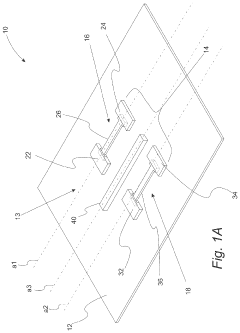
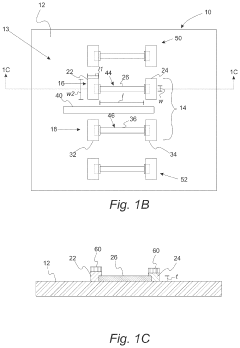
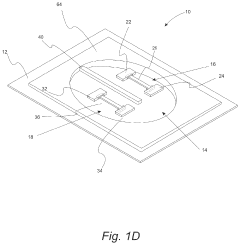
- Development of highly sensitive In2O3 nanoribbon transistor biosensors with integrated on-chip gold gate electrodes, deposited on flexible polyethylene terephthalate substrates, functionalized with glucose oxidase, chitosan, and single-walled carbon nanotubes, capable of detecting glucose concentrations between 10 nM to 1 mM in external body fluids without breaking the skin.
Wearable biosensors for semi-invasive, real-time monitoring of analytes, and related methods and apparatus
PatentWO2023003983A1
Innovation
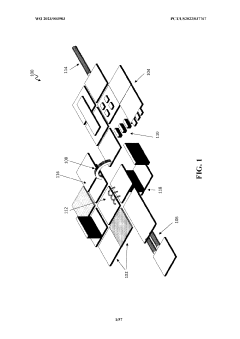
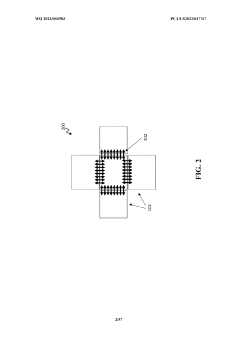
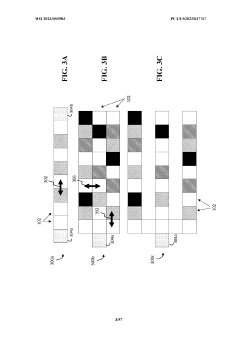
- Development of integrated photonic systems with sensor photonic integrated circuits (PICs) functionalized with binding ligands, capable of real-time monitoring using refractive index-based biosensing, absorption spectroscopy, and fluorescence spectroscopy, integrated into wearable devices with microneedles for semi-invasive sampling and optical analyte sensors configured to detect multiple analytes simultaneously.

Materials Science Advancements for Flexible Electronics
Recent advancements in materials science have revolutionized the development of flexible electronics, particularly in the realm of wearable biosensors. The evolution from rigid to flexible substrates represents a paradigm shift that has enabled unprecedented integration of electronic components with the human body. Materials such as polydimethylsiloxane (PDMS), polyimide, and parylene have emerged as frontrunners due to their exceptional flexibility, biocompatibility, and durability under repeated mechanical stress.
Conductive materials have similarly undergone significant transformation, with silver nanowires, carbon nanotubes, and graphene offering superior electrical properties while maintaining flexibility. These materials exhibit remarkable conductivity even when subjected to bending, twisting, and stretching, making them ideal for biosensing applications that require consistent performance during body movement.
Stretchable electronics represent another breakthrough, incorporating materials that can withstand significant deformation while maintaining functionality. Liquid metal alloys, particularly gallium-based compounds, have demonstrated exceptional promise by providing conductivity comparable to solid metals while offering fluidity that accommodates extreme deformation without performance degradation.
Self-healing materials constitute a cutting-edge development that addresses durability concerns in wearable technology. Polymers embedded with microencapsulated healing agents can autonomously repair microcracks and damage, significantly extending device lifespan in real-world applications where mechanical stress is inevitable.
Biocompatible interfaces have been enhanced through the development of hydrogel-based materials that mimic the mechanical properties of human tissue. These materials facilitate improved signal transduction between electronic components and biological systems while minimizing foreign body responses and inflammation, critical for long-term biosensor deployment.
Energy harvesting materials have also advanced considerably, with piezoelectric and triboelectric nanogenerators capable of converting mechanical energy from body movement into electrical power. Thermoelectric materials that exploit temperature differentials between skin and ambient environment further contribute to self-powered biosensing systems, eliminating the need for frequent battery replacement.
Biodegradable electronics represent an emerging frontier, utilizing materials such as silk fibroin, cellulose derivatives, and magnesium alloys that can perform their intended functions before harmlessly dissolving in physiological environments. This approach addresses end-of-life concerns for temporary medical monitoring applications while reducing electronic waste.
These materials science advancements collectively enable the next generation of wearable biosensors that are increasingly unobtrusive, reliable, and capable of continuous, long-term physiological monitoring without compromising user comfort or mobility.
Conductive materials have similarly undergone significant transformation, with silver nanowires, carbon nanotubes, and graphene offering superior electrical properties while maintaining flexibility. These materials exhibit remarkable conductivity even when subjected to bending, twisting, and stretching, making them ideal for biosensing applications that require consistent performance during body movement.
Stretchable electronics represent another breakthrough, incorporating materials that can withstand significant deformation while maintaining functionality. Liquid metal alloys, particularly gallium-based compounds, have demonstrated exceptional promise by providing conductivity comparable to solid metals while offering fluidity that accommodates extreme deformation without performance degradation.
Self-healing materials constitute a cutting-edge development that addresses durability concerns in wearable technology. Polymers embedded with microencapsulated healing agents can autonomously repair microcracks and damage, significantly extending device lifespan in real-world applications where mechanical stress is inevitable.
Biocompatible interfaces have been enhanced through the development of hydrogel-based materials that mimic the mechanical properties of human tissue. These materials facilitate improved signal transduction between electronic components and biological systems while minimizing foreign body responses and inflammation, critical for long-term biosensor deployment.
Energy harvesting materials have also advanced considerably, with piezoelectric and triboelectric nanogenerators capable of converting mechanical energy from body movement into electrical power. Thermoelectric materials that exploit temperature differentials between skin and ambient environment further contribute to self-powered biosensing systems, eliminating the need for frequent battery replacement.
Biodegradable electronics represent an emerging frontier, utilizing materials such as silk fibroin, cellulose derivatives, and magnesium alloys that can perform their intended functions before harmlessly dissolving in physiological environments. This approach addresses end-of-life concerns for temporary medical monitoring applications while reducing electronic waste.
These materials science advancements collectively enable the next generation of wearable biosensors that are increasingly unobtrusive, reliable, and capable of continuous, long-term physiological monitoring without compromising user comfort or mobility.
Data Privacy and Security Considerations
As wearable biosensors continue to revolutionize healthcare and consumer electronics, data privacy and security considerations have emerged as critical challenges that must be addressed. The intimate nature of biometric data collected by these devices—including heart rate, blood glucose levels, sleep patterns, and even emotional states—creates unprecedented privacy vulnerabilities. This sensitive information requires robust protection frameworks that balance innovation with ethical responsibility.
The regulatory landscape governing biosensor data security remains fragmented globally, with the European Union's General Data Protection Regulation (GDPR) setting the most comprehensive standards for biometric data protection. In contrast, the United States employs a sector-specific approach through laws like HIPAA, which covers only certain health data contexts, creating significant protection gaps for consumer wearables. Asian markets demonstrate varying levels of regulatory maturity, with Japan and South Korea implementing stringent protections while emerging markets often lack specialized frameworks.
Technical vulnerabilities in wearable biosensors present significant security challenges. Bluetooth Low Energy (BLE) protocols, commonly used for data transmission in wearables, contain exploitable security flaws that can enable man-in-the-middle attacks. Limited computational resources in these devices often restrict implementation of sophisticated encryption algorithms, forcing compromises between battery life and security robustness. Additionally, cloud storage of aggregated biosensor data creates centralized vulnerability points that attract sophisticated cyber attacks.
Industry responses to these challenges have evolved significantly. Leading manufacturers have implemented end-to-end encryption, secure enclaves for sensitive data processing, and differential privacy techniques that allow meaningful analytics while protecting individual identities. Multi-factor authentication has become standard practice, while blockchain-based solutions are emerging to provide transparent audit trails for health data access and usage.
The ethical dimensions of biosensor data security extend beyond technical solutions. Questions of informed consent become particularly complex when devices continuously collect data in ways users may not fully comprehend. The potential for algorithmic discrimination based on biosensor data raises serious concerns about fairness and equity. Furthermore, the increasing integration of wearable data with insurance and employment decisions creates power imbalances that require careful ethical consideration.
Future security frameworks must evolve toward context-aware protection models that dynamically adjust security levels based on data sensitivity and usage context. Federated learning approaches that keep sensitive data on local devices while enabling collective insights show particular promise. As biosensors become more sophisticated and ubiquitous, developing security solutions that scale with technological advancement while maintaining user trust will remain a critical industry imperative.
The regulatory landscape governing biosensor data security remains fragmented globally, with the European Union's General Data Protection Regulation (GDPR) setting the most comprehensive standards for biometric data protection. In contrast, the United States employs a sector-specific approach through laws like HIPAA, which covers only certain health data contexts, creating significant protection gaps for consumer wearables. Asian markets demonstrate varying levels of regulatory maturity, with Japan and South Korea implementing stringent protections while emerging markets often lack specialized frameworks.
Technical vulnerabilities in wearable biosensors present significant security challenges. Bluetooth Low Energy (BLE) protocols, commonly used for data transmission in wearables, contain exploitable security flaws that can enable man-in-the-middle attacks. Limited computational resources in these devices often restrict implementation of sophisticated encryption algorithms, forcing compromises between battery life and security robustness. Additionally, cloud storage of aggregated biosensor data creates centralized vulnerability points that attract sophisticated cyber attacks.
Industry responses to these challenges have evolved significantly. Leading manufacturers have implemented end-to-end encryption, secure enclaves for sensitive data processing, and differential privacy techniques that allow meaningful analytics while protecting individual identities. Multi-factor authentication has become standard practice, while blockchain-based solutions are emerging to provide transparent audit trails for health data access and usage.
The ethical dimensions of biosensor data security extend beyond technical solutions. Questions of informed consent become particularly complex when devices continuously collect data in ways users may not fully comprehend. The potential for algorithmic discrimination based on biosensor data raises serious concerns about fairness and equity. Furthermore, the increasing integration of wearable data with insurance and employment decisions creates power imbalances that require careful ethical consideration.
Future security frameworks must evolve toward context-aware protection models that dynamically adjust security levels based on data sensitivity and usage context. Federated learning approaches that keep sensitive data on local devices while enabling collective insights show particular promise. As biosensors become more sophisticated and ubiquitous, developing security solutions that scale with technological advancement while maintaining user trust will remain a critical industry imperative.
Unlock deeper insights with Patsnap Eureka Quick Research — get a full tech report to explore trends and direct your research. Try now!
Generate Your Research Report Instantly with AI Agent
Supercharge your innovation with Patsnap Eureka AI Agent Platform!