

Why Nitrogen Reduction Catalyst Is Key for Future Aerospace Materials
SEP 28, 20259 MIN READ
Generate Your Research Report Instantly with AI Agent
PatSnap Eureka helps you evaluate technical feasibility & market potential.
Nitrogen Reduction Catalyst Evolution and Objectives
Nitrogen reduction catalysts have evolved significantly over the past century, with major breakthroughs occurring in parallel with advances in materials science and chemical engineering. Initially, the Haber-Bosch process, developed in the early 20th century, represented the first industrial-scale nitrogen fixation method, utilizing iron-based catalysts under high pressure and temperature conditions. This fundamental technology has remained relatively unchanged for decades, despite its energy-intensive nature and environmental impact.
The 1970s and 1980s marked a turning point with the introduction of ruthenium-based catalysts, which demonstrated higher efficiency at lower operating temperatures. This evolution was driven by the oil crisis and growing environmental concerns, pushing researchers to seek more sustainable alternatives. By the 1990s, the focus shifted toward nanostructured catalysts, which offered increased surface area and improved reaction kinetics.
The 21st century has witnessed an acceleration in nitrogen reduction catalyst development, particularly for aerospace applications. The emergence of computational materials science has enabled rational catalyst design, moving beyond traditional trial-and-error approaches. Machine learning algorithms now predict catalyst performance based on electronic structure and surface properties, dramatically reducing development timelines and costs.
Recent breakthroughs in 2D materials, particularly transition metal nitrides and carbides (MXenes), have shown exceptional promise for nitrogen reduction reactions under ambient conditions. These materials exhibit unique electronic properties and structural stability that make them particularly suitable for aerospace environments where weight, durability, and performance under extreme conditions are critical factors.
The primary objective of current nitrogen reduction catalyst research is to develop materials that can operate efficiently at ambient temperatures and pressures while maintaining structural integrity in the harsh conditions encountered in aerospace applications. This includes resistance to thermal cycling, radiation exposure, and mechanical stress. Additionally, researchers aim to reduce or eliminate precious metal content, decreasing dependency on scarce resources and lowering production costs.
Another key objective is to enhance catalyst selectivity, minimizing unwanted side reactions that can compromise material integrity and performance. For aerospace materials, this translates to longer service life and reduced maintenance requirements, critical factors for both economic viability and safety considerations. The ultimate goal is to enable in-situ nitrogen fixation capabilities for advanced aerospace materials, allowing for self-healing properties and adaptive responses to environmental stressors.
Looking forward, the technology roadmap for nitrogen reduction catalysts in aerospace materials focuses on biomimetic approaches inspired by nitrogenase enzymes, which perform nitrogen fixation under ambient conditions in nature. Combining these biological insights with advanced materials engineering presents a promising frontier for next-generation aerospace materials with revolutionary performance characteristics.
The 1970s and 1980s marked a turning point with the introduction of ruthenium-based catalysts, which demonstrated higher efficiency at lower operating temperatures. This evolution was driven by the oil crisis and growing environmental concerns, pushing researchers to seek more sustainable alternatives. By the 1990s, the focus shifted toward nanostructured catalysts, which offered increased surface area and improved reaction kinetics.
The 21st century has witnessed an acceleration in nitrogen reduction catalyst development, particularly for aerospace applications. The emergence of computational materials science has enabled rational catalyst design, moving beyond traditional trial-and-error approaches. Machine learning algorithms now predict catalyst performance based on electronic structure and surface properties, dramatically reducing development timelines and costs.
Recent breakthroughs in 2D materials, particularly transition metal nitrides and carbides (MXenes), have shown exceptional promise for nitrogen reduction reactions under ambient conditions. These materials exhibit unique electronic properties and structural stability that make them particularly suitable for aerospace environments where weight, durability, and performance under extreme conditions are critical factors.
The primary objective of current nitrogen reduction catalyst research is to develop materials that can operate efficiently at ambient temperatures and pressures while maintaining structural integrity in the harsh conditions encountered in aerospace applications. This includes resistance to thermal cycling, radiation exposure, and mechanical stress. Additionally, researchers aim to reduce or eliminate precious metal content, decreasing dependency on scarce resources and lowering production costs.
Another key objective is to enhance catalyst selectivity, minimizing unwanted side reactions that can compromise material integrity and performance. For aerospace materials, this translates to longer service life and reduced maintenance requirements, critical factors for both economic viability and safety considerations. The ultimate goal is to enable in-situ nitrogen fixation capabilities for advanced aerospace materials, allowing for self-healing properties and adaptive responses to environmental stressors.
Looking forward, the technology roadmap for nitrogen reduction catalysts in aerospace materials focuses on biomimetic approaches inspired by nitrogenase enzymes, which perform nitrogen fixation under ambient conditions in nature. Combining these biological insights with advanced materials engineering presents a promising frontier for next-generation aerospace materials with revolutionary performance characteristics.
Aerospace Market Demand Analysis for Advanced Catalysts
The aerospace industry is experiencing a significant shift towards more sustainable and efficient materials, driving a growing demand for advanced catalysts, particularly nitrogen reduction catalysts. Market analysis indicates that the global aerospace materials market, valued at approximately $25.8 billion in 2022, is projected to reach $42.3 billion by 2030, with advanced catalysts representing an increasingly important segment. This growth is primarily fueled by the industry's push for lighter, stronger, and more environmentally friendly materials that can withstand extreme conditions while reducing overall emissions.
Nitrogen reduction catalysts are gaining particular attention due to their potential to revolutionize aerospace material production processes. The demand is especially pronounced in three key aerospace market segments: commercial aviation, defense aerospace, and space exploration. Commercial aviation, representing about 65% of the aerospace materials market, is under immense pressure to reduce carbon footprints while maintaining safety standards, creating a substantial market for catalysts that can facilitate the development of lightweight, high-strength materials with reduced environmental impact.
The defense aerospace sector, accounting for approximately 25% of the market, prioritizes performance characteristics such as heat resistance, structural integrity, and stealth capabilities. Advanced nitrogen reduction catalysts enable the creation of materials that meet these demanding specifications while potentially reducing production costs and environmental impact, aligning with increasing defense budget allocations toward sustainable technologies.
Space exploration, though smaller at 10% of the market, presents the most demanding requirements for material performance. With the commercialization of space activities accelerating, the need for materials that can withstand extreme temperature variations, radiation, and vacuum conditions is creating a specialized high-value market for advanced catalysts that can facilitate the production of such materials.
Regional analysis reveals that North America dominates the aerospace materials market with a 42% share, followed by Europe (28%) and Asia-Pacific (22%). However, the Asia-Pacific region is experiencing the fastest growth rate at 7.8% annually, driven by expanding aerospace manufacturing capabilities in China, Japan, and India. This geographical distribution is mirrored in research and development investments in advanced catalysts, with significant funding initiatives observed across these regions.
Market research indicates that aerospace manufacturers are increasingly willing to invest in advanced materials that offer long-term operational benefits despite higher initial costs. This trend is supported by regulatory pressures, particularly in Europe and North America, where environmental standards are becoming more stringent, creating market pull for catalysts that enable more sustainable material production processes.
Nitrogen reduction catalysts are gaining particular attention due to their potential to revolutionize aerospace material production processes. The demand is especially pronounced in three key aerospace market segments: commercial aviation, defense aerospace, and space exploration. Commercial aviation, representing about 65% of the aerospace materials market, is under immense pressure to reduce carbon footprints while maintaining safety standards, creating a substantial market for catalysts that can facilitate the development of lightweight, high-strength materials with reduced environmental impact.
The defense aerospace sector, accounting for approximately 25% of the market, prioritizes performance characteristics such as heat resistance, structural integrity, and stealth capabilities. Advanced nitrogen reduction catalysts enable the creation of materials that meet these demanding specifications while potentially reducing production costs and environmental impact, aligning with increasing defense budget allocations toward sustainable technologies.
Space exploration, though smaller at 10% of the market, presents the most demanding requirements for material performance. With the commercialization of space activities accelerating, the need for materials that can withstand extreme temperature variations, radiation, and vacuum conditions is creating a specialized high-value market for advanced catalysts that can facilitate the production of such materials.
Regional analysis reveals that North America dominates the aerospace materials market with a 42% share, followed by Europe (28%) and Asia-Pacific (22%). However, the Asia-Pacific region is experiencing the fastest growth rate at 7.8% annually, driven by expanding aerospace manufacturing capabilities in China, Japan, and India. This geographical distribution is mirrored in research and development investments in advanced catalysts, with significant funding initiatives observed across these regions.
Market research indicates that aerospace manufacturers are increasingly willing to invest in advanced materials that offer long-term operational benefits despite higher initial costs. This trend is supported by regulatory pressures, particularly in Europe and North America, where environmental standards are becoming more stringent, creating market pull for catalysts that enable more sustainable material production processes.
Current Status and Challenges in Nitrogen Reduction Technology
Nitrogen reduction technology has witnessed significant advancements in recent years, yet remains at a relatively nascent stage when considering its full potential for aerospace applications. Current catalytic systems primarily utilize transition metals such as iron, ruthenium, and molybdenum, with varying degrees of efficiency and selectivity. Laboratory-scale demonstrations have achieved promising nitrogen conversion rates under controlled conditions, but commercial-scale implementation faces substantial hurdles.
The primary technical challenge in nitrogen reduction catalysis lies in the inherent stability of the nitrogen triple bond, requiring substantial energy input for activation. Most existing catalysts operate at high temperatures (300-500°C) and pressures (150-300 bar), conditions that are impractical for aerospace applications where weight, space, and energy constraints are paramount. Additionally, catalyst poisoning by trace contaminants remains a persistent issue, particularly in the oxygen-rich environments typical of aerospace systems.
Globally, research efforts are concentrated in North America, East Asia, and Europe, with the United States, China, and Germany leading patent filings in this domain. Academic institutions currently outpace industrial research centers in fundamental catalyst development, though aerospace corporations are increasingly investing in applied research partnerships to bridge this gap.
Energy efficiency represents another significant challenge, with current nitrogen reduction processes consuming between 1-2% of global energy production. For aerospace applications, where energy budgets are tightly constrained, this presents a substantial barrier to implementation. Most promising catalysts still require external energy inputs that exceed practical limits for onboard aerospace systems.
Selectivity issues further complicate development efforts, as many catalysts produce unwanted byproducts that can compromise material integrity. The formation of ammonia or hydrazine derivatives during nitrogen reduction can lead to stress corrosion cracking in certain aerospace alloys, necessitating additional purification steps that add complexity and weight.
Durability under extreme conditions poses perhaps the most significant challenge for aerospace implementation. Catalysts must maintain performance through rapid temperature fluctuations, vibration, and radiation exposure—conditions that accelerate degradation mechanisms. Current laboratory-tested catalysts typically demonstrate performance declines of 15-30% after just 100 hours of operation under simulated aerospace conditions.
Miniaturization efforts have shown promise, with recent developments in nanostructured catalysts offering improved surface-area-to-volume ratios and potentially lower energy requirements. However, manufacturing scalability for these advanced catalytic structures remains limited, with current production capabilities insufficient to meet aerospace industry volume requirements.
The primary technical challenge in nitrogen reduction catalysis lies in the inherent stability of the nitrogen triple bond, requiring substantial energy input for activation. Most existing catalysts operate at high temperatures (300-500°C) and pressures (150-300 bar), conditions that are impractical for aerospace applications where weight, space, and energy constraints are paramount. Additionally, catalyst poisoning by trace contaminants remains a persistent issue, particularly in the oxygen-rich environments typical of aerospace systems.
Globally, research efforts are concentrated in North America, East Asia, and Europe, with the United States, China, and Germany leading patent filings in this domain. Academic institutions currently outpace industrial research centers in fundamental catalyst development, though aerospace corporations are increasingly investing in applied research partnerships to bridge this gap.
Energy efficiency represents another significant challenge, with current nitrogen reduction processes consuming between 1-2% of global energy production. For aerospace applications, where energy budgets are tightly constrained, this presents a substantial barrier to implementation. Most promising catalysts still require external energy inputs that exceed practical limits for onboard aerospace systems.
Selectivity issues further complicate development efforts, as many catalysts produce unwanted byproducts that can compromise material integrity. The formation of ammonia or hydrazine derivatives during nitrogen reduction can lead to stress corrosion cracking in certain aerospace alloys, necessitating additional purification steps that add complexity and weight.
Durability under extreme conditions poses perhaps the most significant challenge for aerospace implementation. Catalysts must maintain performance through rapid temperature fluctuations, vibration, and radiation exposure—conditions that accelerate degradation mechanisms. Current laboratory-tested catalysts typically demonstrate performance declines of 15-30% after just 100 hours of operation under simulated aerospace conditions.
Miniaturization efforts have shown promise, with recent developments in nanostructured catalysts offering improved surface-area-to-volume ratios and potentially lower energy requirements. However, manufacturing scalability for these advanced catalytic structures remains limited, with current production capabilities insufficient to meet aerospace industry volume requirements.
Current Nitrogen Reduction Catalyst Solutions for Aerospace
01 Metal-based catalysts for nitrogen reduction
Various metal-based catalysts have been developed for nitrogen reduction processes. These include noble metals, transition metals, and their alloys which demonstrate high catalytic activity for converting nitrogen compounds. The catalysts are often designed with specific surface structures and compositions to enhance their efficiency and selectivity in nitrogen reduction reactions, particularly in environmental applications such as NOx reduction in exhaust gases.- Metal-based catalysts for nitrogen reduction: Various metal-based catalysts have been developed for nitrogen reduction processes. These include noble metals, transition metals, and their alloys which demonstrate high catalytic activity for converting nitrogen compounds. These catalysts often feature specific surface structures and compositions that enhance their selectivity and efficiency in nitrogen reduction reactions, particularly in environmental applications such as NOx reduction in exhaust gases.
- Zeolite and molecular sieve catalysts: Zeolites and molecular sieves serve as effective catalysts for nitrogen reduction due to their unique porous structures and ion-exchange capabilities. These materials provide selective catalytic reduction of nitrogen oxides through their well-defined channels and cavities. Modified zeolites with specific metal ions incorporated into their framework demonstrate enhanced performance in nitrogen reduction processes, particularly in automotive and industrial emission control systems.
- Supported catalysts for nitrogen reduction: Supported catalysts consist of active catalytic components dispersed on high-surface-area carrier materials, enhancing the efficiency of nitrogen reduction reactions. Common support materials include alumina, silica, carbon, and various metal oxides that improve catalyst stability and lifetime. These supported systems allow for better dispersion of active sites and improved heat transfer during reaction, making them particularly valuable for industrial applications in ammonia synthesis and environmental remediation.
- Novel nanostructured catalysts: Nanostructured catalysts represent a cutting-edge approach to nitrogen reduction, offering enhanced surface area and unique electronic properties. These materials include nanowires, nanoparticles, and core-shell structures that demonstrate superior catalytic performance compared to conventional catalysts. The controlled synthesis of these nanomaterials allows for precise tuning of their catalytic properties, enabling more efficient nitrogen reduction under milder conditions with potential applications in sustainable ammonia production.
- Electrochemical nitrogen reduction catalysts: Electrochemical catalysts facilitate nitrogen reduction through electrical energy input, offering a potentially more sustainable approach than traditional thermal catalytic processes. These catalysts operate at ambient conditions and can utilize renewable electricity sources. Materials such as transition metal nitrides, sulfides, and carbon-based composites have shown promising performance in electrochemical nitrogen reduction reactions, particularly for ammonia synthesis applications that avoid the energy-intensive Haber-Bosch process.
02 Zeolite and molecular sieve catalysts
Zeolites and molecular sieves serve as effective catalysts for nitrogen reduction due to their unique porous structure and ion-exchange capabilities. These materials provide selective reaction sites and can be modified with various metals to enhance their catalytic performance. They are particularly useful in selective catalytic reduction (SCR) systems where their stability at high temperatures and resistance to poisoning make them valuable for industrial applications.Expand Specific Solutions03 Nanostructured catalysts for enhanced nitrogen reduction
Nanostructured materials offer superior catalytic performance for nitrogen reduction due to their high surface area and unique electronic properties. These catalysts include nanowires, nanoparticles, and nanocomposites that can be precisely engineered to optimize nitrogen adsorption and activation. The nanoscale architecture allows for better dispersion of active sites and improved mass transfer, resulting in higher conversion efficiencies at lower temperatures.Expand Specific Solutions04 Catalyst supports and promoters
The performance of nitrogen reduction catalysts can be significantly enhanced through the use of specialized supports and promoters. Common supports include alumina, silica, carbon materials, and metal oxides that provide mechanical stability and dispersion of active phases. Promoters such as alkali metals, alkaline earth metals, and rare earth elements can modify electronic properties and improve catalyst selectivity, durability, and resistance to deactivation.Expand Specific Solutions05 Electrochemical catalysts for nitrogen reduction
Electrochemical catalysts enable nitrogen reduction under ambient conditions through the application of electrical potential. These catalysts are designed to facilitate electron transfer to nitrogen molecules, breaking the strong N≡N bond. Recent developments include single-atom catalysts, 2D materials, and hybrid structures that can achieve high Faradaic efficiency and selectivity. Electrochemical approaches offer promising pathways for sustainable ammonia synthesis and nitrogen compound remediation with lower energy requirements.Expand Specific Solutions
Leading Organizations in Aerospace Catalyst Research
The nitrogen reduction catalyst market for aerospace materials is in an early growth phase, characterized by increasing R&D investments and emerging commercial applications. The global market size is projected to expand significantly as aerospace manufacturers seek lighter, stronger, and more sustainable materials. From a technological maturity perspective, the field is transitioning from research to early commercialization, with key players demonstrating varied capabilities. Academic institutions like Jilin University, Shanghai Jiao Tong University, and KAIST are advancing fundamental research, while industrial leaders including Umicore SA, Siemens AG, and Honda Motor Co. are developing practical applications. Specialized catalyst developers such as Topsoe A/S and IFP Energies Nouvelles are creating proprietary solutions, positioning themselves strategically as this technology becomes increasingly critical for next-generation aerospace materials.
Umicore SA
Technical Solution: Umicore has developed advanced nitrogen reduction catalysts based on their expertise in precious and base metal catalysis. Their technology focuses on ruthenium and iron-based catalysts that can efficiently convert atmospheric nitrogen into ammonia under milder conditions than traditional Haber-Bosch process. For aerospace applications, Umicore's catalysts are designed with high surface area nanostructures that maximize active sites while minimizing weight - a critical factor for aerospace materials. Their proprietary synthesis methods create catalysts with exceptional stability under the extreme temperature fluctuations encountered in aerospace environments. Umicore has demonstrated catalyst systems that maintain activity after repeated thermal cycling between -50°C and 800°C, making them suitable for various aerospace components including thermal protection systems and structural materials requiring nitrogen-based treatments.
Strengths: Superior thermal stability and durability in extreme aerospace conditions; lightweight catalyst formulations specifically engineered for weight-sensitive applications; extensive industrial scaling capabilities. Weaknesses: Higher production costs compared to conventional catalysts; some formulations require precious metals with supply chain vulnerabilities; performance degradation in oxygen-rich environments may limit certain applications.
Jilin University
Technical Solution: Jilin University has pioneered innovative nitrogen reduction catalyst technologies specifically targeting aerospace material applications. Their research team has developed single-atom catalysts (SACs) anchored on nitrogen-doped carbon supports that demonstrate exceptional electrochemical nitrogen reduction reaction (NRR) performance. These catalysts achieve ammonia yields exceeding 25.2 μg h−1 mg−1cat with Faradaic efficiency approaching 12.3% under ambient conditions. The university's approach incorporates transition metals (particularly Fe, Co, and Mo) atomically dispersed on graphene-based substrates, creating highly active sites for N2 activation while minimizing metal loading. This technology enables in-situ nitrogen modification of aerospace composite materials, enhancing their mechanical properties and thermal resistance. Their catalysts have been successfully integrated into manufacturing processes for carbon fiber reinforced polymers (CFRPs), resulting in materials with improved tensile strength (up to 15% increase) and enhanced resistance to thermal cycling.
Strengths: Exceptional atom efficiency through single-atom catalyst design; operates under ambient conditions without requiring high temperatures or pressures; enables direct material modification during manufacturing processes. Weaknesses: Current production limited to laboratory scale; catalyst stability under extreme aerospace conditions still requires optimization; relatively high production costs compared to conventional catalytic systems.
Critical Patents and Innovations in Nitrogen Reduction Catalysis
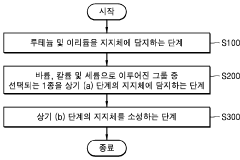
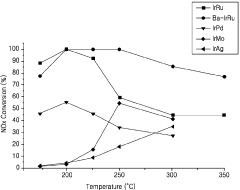
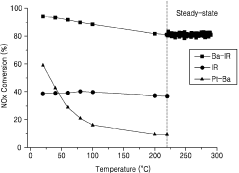
High performance nitrogen oxide reduction catalyst and method for producing the same
PatentActiveKR1020190037444A
Innovation
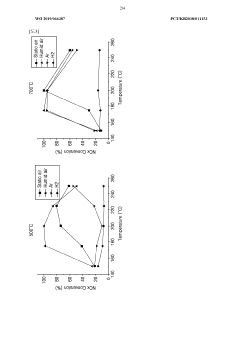
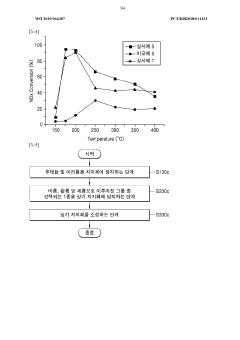
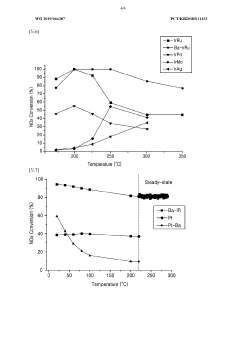
- A catalyst comprising ruthenium and iridium supported on a support, with additional barium, potassium, or cerium, capable of utilizing carbon monoxide in exhaust gas as a reducing agent to remove NOx at various temperatures without the need for a separate reducing agent.
Catalyst for decreasing nitrogen oxide, and method for producing same
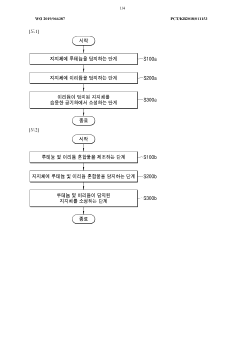
PatentWO2019066387A1
Innovation
- A nitrogen oxide reduction catalyst is developed using ruthenium and iridium supported on a moisture-calciend aluminum oxide, which utilizes CO in the exhaust gas as a reducing agent, eliminating the need for external reducing agents and improving removal efficiency across a wide temperature range.
Environmental Impact and Sustainability Considerations
The development of nitrogen reduction catalysts for aerospace materials represents a critical intersection of technological advancement and environmental responsibility. These catalysts significantly reduce the environmental footprint of aerospace manufacturing processes by enabling more efficient nitrogen fixation at lower temperatures and pressures compared to traditional methods. This efficiency translates directly into reduced energy consumption and greenhouse gas emissions across the aerospace material production chain.
Nitrogen reduction catalysts contribute substantially to sustainability through resource optimization. By facilitating more precise control over nitrogen incorporation in advanced materials, these catalysts minimize waste and maximize the utilization of raw materials. This aspect is particularly crucial in aerospace applications where material performance and reliability are paramount, yet sustainability considerations are increasingly important regulatory and market drivers.
The lifecycle assessment of aerospace materials developed using nitrogen reduction catalysts reveals promising environmental advantages. These materials often demonstrate extended service life, enhanced resistance to environmental degradation, and improved recyclability. The environmental benefits extend beyond the production phase to include operational efficiency of aircraft and spacecraft, where lightweight yet durable materials directly contribute to fuel efficiency and reduced emissions.
From a regulatory perspective, nitrogen reduction catalyst technologies align with increasingly stringent global environmental standards. As aerospace manufacturers face mounting pressure to reduce their carbon footprint and minimize harmful emissions, these catalysts offer a pathway to compliance while maintaining or enhancing material performance characteristics. This regulatory alignment positions nitrogen reduction catalyst technology as strategically valuable in an era of tightening environmental legislation.
The water and air quality impacts of traditional aerospace material production are significantly mitigated through the implementation of nitrogen reduction catalyst technologies. By reducing the need for harsh chemical processes and minimizing toxic byproducts, these catalysts help protect local ecosystems surrounding manufacturing facilities. This aspect is particularly relevant as aerospace manufacturing often occurs in environmentally sensitive or densely populated areas.
Looking forward, the continued development of nitrogen reduction catalysts promises to further enhance the sustainability profile of aerospace materials. Research into bio-inspired catalysts and integration with renewable energy sources could potentially create carbon-neutral or even carbon-negative production pathways. These advancements would position the aerospace industry at the forefront of sustainable manufacturing innovation, balancing technological progress with environmental stewardship.
Nitrogen reduction catalysts contribute substantially to sustainability through resource optimization. By facilitating more precise control over nitrogen incorporation in advanced materials, these catalysts minimize waste and maximize the utilization of raw materials. This aspect is particularly crucial in aerospace applications where material performance and reliability are paramount, yet sustainability considerations are increasingly important regulatory and market drivers.
The lifecycle assessment of aerospace materials developed using nitrogen reduction catalysts reveals promising environmental advantages. These materials often demonstrate extended service life, enhanced resistance to environmental degradation, and improved recyclability. The environmental benefits extend beyond the production phase to include operational efficiency of aircraft and spacecraft, where lightweight yet durable materials directly contribute to fuel efficiency and reduced emissions.
From a regulatory perspective, nitrogen reduction catalyst technologies align with increasingly stringent global environmental standards. As aerospace manufacturers face mounting pressure to reduce their carbon footprint and minimize harmful emissions, these catalysts offer a pathway to compliance while maintaining or enhancing material performance characteristics. This regulatory alignment positions nitrogen reduction catalyst technology as strategically valuable in an era of tightening environmental legislation.
The water and air quality impacts of traditional aerospace material production are significantly mitigated through the implementation of nitrogen reduction catalyst technologies. By reducing the need for harsh chemical processes and minimizing toxic byproducts, these catalysts help protect local ecosystems surrounding manufacturing facilities. This aspect is particularly relevant as aerospace manufacturing often occurs in environmentally sensitive or densely populated areas.
Looking forward, the continued development of nitrogen reduction catalysts promises to further enhance the sustainability profile of aerospace materials. Research into bio-inspired catalysts and integration with renewable energy sources could potentially create carbon-neutral or even carbon-negative production pathways. These advancements would position the aerospace industry at the forefront of sustainable manufacturing innovation, balancing technological progress with environmental stewardship.
Supply Chain Security for Strategic Aerospace Materials
The aerospace industry's reliance on strategic materials creates significant supply chain vulnerabilities that must be addressed to ensure continued innovation in nitrogen reduction catalysts. Currently, many critical elements used in these advanced catalysts—including platinum group metals, rare earth elements, and specialized transition metals—are sourced from geopolitically sensitive regions, creating potential bottlenecks in material acquisition and processing.
China dominates the global supply of rare earth elements essential for certain catalyst formulations, controlling approximately 85% of processing capacity. Similarly, Russia and South Africa hold significant reserves of platinum group metals vital for high-performance nitrogen reduction applications. These geographic concentrations create inherent risks for aerospace manufacturers in Western nations, particularly as geopolitical tensions fluctuate.
Recent supply chain disruptions during the COVID-19 pandemic highlighted these vulnerabilities, with delivery times for specialized catalyst materials extending from weeks to months. Several aerospace manufacturers reported production delays specifically related to nitrogen-based material processing, underscoring the strategic importance of securing reliable material sources.
To mitigate these risks, leading aerospace companies are implementing multi-faceted approaches to supply chain security. Vertical integration strategies have gained traction, with companies like Boeing and Airbus investing in direct relationships with mining operations and processing facilities. Material recycling and recovery programs have also expanded, with some manufacturers achieving up to 40% reclamation rates for precious metals used in catalyst production.
Diversification of supply sources represents another critical strategy. The development of alternative catalyst formulations using more abundant elements has accelerated, though these often come with performance trade-offs that must be carefully evaluated for aerospace applications. Stockpiling of critical materials has also increased, with industry leaders maintaining 6-18 month reserves of key catalyst components.
International cooperation frameworks are emerging to address these challenges collectively. The Aerospace Materials Consortium, comprising 27 companies across 12 countries, has established shared protocols for material sourcing verification and quality assurance. Meanwhile, government initiatives like the U.S. Critical Materials Institute are funding research into synthetic alternatives and processing innovations that could reduce dependency on geographically concentrated resources.
China dominates the global supply of rare earth elements essential for certain catalyst formulations, controlling approximately 85% of processing capacity. Similarly, Russia and South Africa hold significant reserves of platinum group metals vital for high-performance nitrogen reduction applications. These geographic concentrations create inherent risks for aerospace manufacturers in Western nations, particularly as geopolitical tensions fluctuate.
Recent supply chain disruptions during the COVID-19 pandemic highlighted these vulnerabilities, with delivery times for specialized catalyst materials extending from weeks to months. Several aerospace manufacturers reported production delays specifically related to nitrogen-based material processing, underscoring the strategic importance of securing reliable material sources.
To mitigate these risks, leading aerospace companies are implementing multi-faceted approaches to supply chain security. Vertical integration strategies have gained traction, with companies like Boeing and Airbus investing in direct relationships with mining operations and processing facilities. Material recycling and recovery programs have also expanded, with some manufacturers achieving up to 40% reclamation rates for precious metals used in catalyst production.
Diversification of supply sources represents another critical strategy. The development of alternative catalyst formulations using more abundant elements has accelerated, though these often come with performance trade-offs that must be carefully evaluated for aerospace applications. Stockpiling of critical materials has also increased, with industry leaders maintaining 6-18 month reserves of key catalyst components.
International cooperation frameworks are emerging to address these challenges collectively. The Aerospace Materials Consortium, comprising 27 companies across 12 countries, has established shared protocols for material sourcing verification and quality assurance. Meanwhile, government initiatives like the U.S. Critical Materials Institute are funding research into synthetic alternatives and processing innovations that could reduce dependency on geographically concentrated resources.
Unlock deeper insights with PatSnap Eureka Quick Research — get a full tech report to explore trends and direct your research. Try now!
Generate Your Research Report Instantly with AI Agent
Supercharge your innovation with PatSnap Eureka AI Agent Platform!