

Super-hydrophobic polytetrafluoroethylene fiber membrane preparation method
A technology of polytetrafluoroethylene film and polytetrafluoroethylene, which is applied in the field of preparation of hydrophobic film materials, can solve the problems of only focusing on the removal of fiber-forming templates, and achieve the effect of fiber shape and surface integrity, strength and toughness
Patent Information
- Authority / Receiving Office
- CN · China
- Patent Type
- Applications(China)
- Current Assignee / Owner
- Publication Date
- 2015-10-28
Smart Images
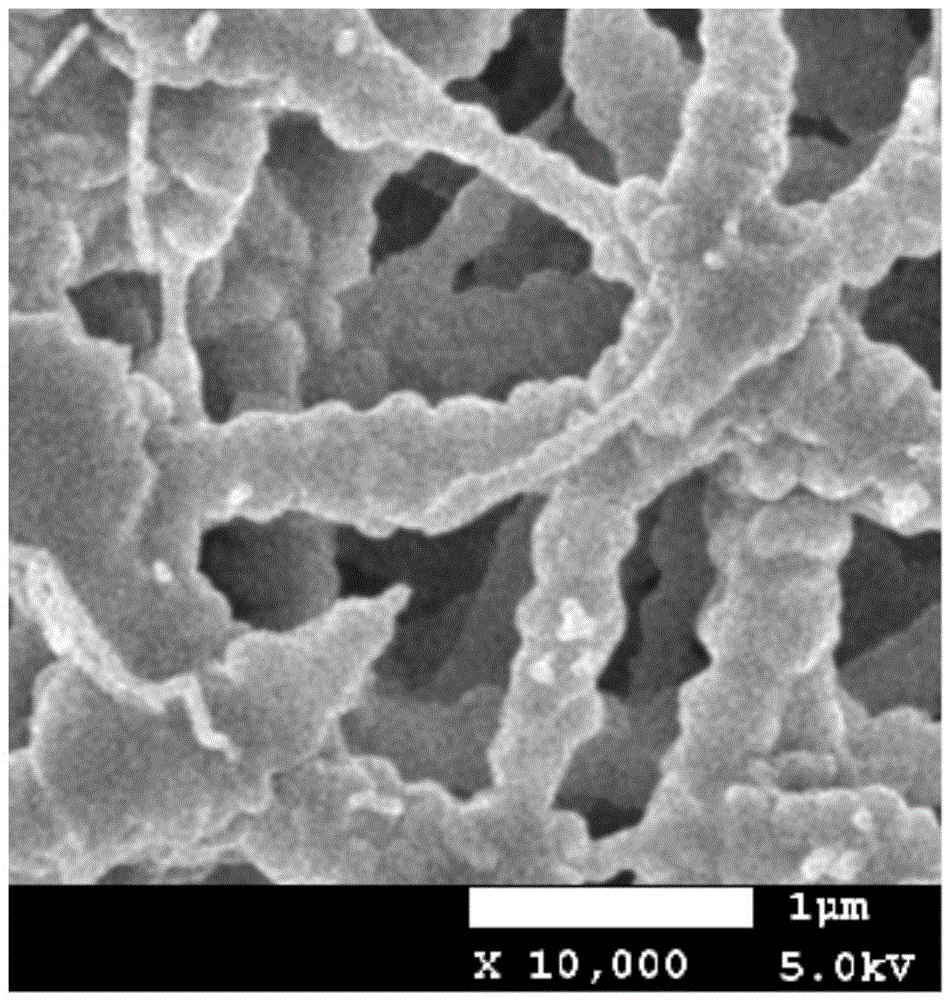
Figure 1
Abstract
Description
technical field
[0001] The invention relates to a preparation method of a separation membrane material used in the separation field, in particular to a preparation method of a hydrophobic membrane material. technical background
[0002] Hydrophobicity is an important property of polytetrafluoroethylene (PTFE) materials, and it is the main performance of PTFE porous membranes applied to membrane materials. Although polytetrafluoroethylene material has low surface energy, the water contact angle of smooth polytetrafluoroethylene plane is between 98° and 112°, and the hydrophobic performance is not good.
[0003] At present, the biaxial stretching method is mostly used in the preparation of polytetrafluoroethylene porous membranes. When this method wants to obtain a film with a higher porosity, the film needs to be stretched at a large scale, the surface structure cannot be controlled, and the film thickness is only less than a dozen microns. Supporting materials are needed in...
Examples
Embodiment 1
[0030]The polytetrafluoroethylene emulsion with a solid content of 60% was added dropwise to a polyacrylic acid aqueous solution with a mass fraction of 12%, and stirred evenly to prepare a spinning solution. Then the polytetrafluoroethylene precursor film was fabricated by electrospinning method. Winding on a cylindrical support mold with a diameter of 5cm, winding 5 layers, and sending it to a tube furnace with nitrogen gas, the temperature of the sintering process is controlled by a program, and the temperature is raised from room temperature to 110°C at 10°C / min, kept at 110°C for 90min, and at 7°C The heating rate is raised from 110°C to 290°C / min, the temperature is kept at 290°C for 100 minutes, the temperature is raised from 290°C to 380°C, the heating rate is 6°C / min, and the temperature is kept for 60 minutes.
[0031] Cooling: Under a flowing nitrogen atmosphere, cool down from 373°C to 180°C at a rate of 8°C / min, keep at 180°C for 80 minutes, and then cool naturall...
Embodiment 2
[0034] The polytetrafluoroethylene emulsion with a solid content of 60% was added dropwise to an aqueous solution of polyacrylic acid with a mass fraction of 9%, and stirred evenly to prepare a spinning solution. Then the polytetrafluoroethylene precursor film was fabricated by electrospinning method. Winding on a cylindrical support mold with a diameter of 5cm, winding 5 layers, and sending it to a tube furnace with nitrogen gas. The temperature of the sintering process is controlled by a program. / min The heating rate is raised from 90°C to 260°C, the temperature is kept at 260°C for 120 minutes, the temperature is raised from 260°C to 375°C, the heating rate is 8°C / min, and the temperature is kept for 115 minutes.
[0035] Cooling: Under the flowing atmosphere of air, cool down from 390°C to 200°C at a rate of 15°C / min, keep at 200°C for 30 minutes, and then cool naturally.
[0036] After cooling, take it out and pull out the cylindrical support mold to obtain a cylindrica...
Embodiment 3
[0038] The polytetrafluoroethylene emulsion with a solid content of 60% is added dropwise to a polyacrylic acid aqueous solution with a mass fraction of 5%, and stirred evenly to prepare a spinning solution. Then the polytetrafluoroethylene precursor film was fabricated by electrospinning method. Winding on a cylindrical support mold with a diameter of 5cm, winding 5 layers, and sending it to a tube furnace with nitrogen gas. The temperature of the sintering process is controlled by a program. / min The heating rate is raised from 100°C to 275°C, the temperature is kept at 275°C for 110 minutes, the temperature is raised from 275°C to 380°C, the heating rate is 3°C / min, and the temperature is kept for 90 minutes.
[0039] Cooling: Under the flowing air atmosphere, cool down from 376°C to 190°C at a rate of 5°C / min, keep at 190°C for 40 minutes, and then cool naturally.
[0040] After cooling, take it out and pull out the cylindrical support mold to obtain a cylindrical polytet...