Method for capacity credit assessment of photovoltaic power generation system

A photovoltaic power generation system, confidence capacity technology, applied in the direction of instruments, data processing applications, resources, etc., can solve problems such as weak adaptability and robustness, uncertainty, and different accurate solution errors.

CN105719059AActive Publication Date: 2016-06-29HEFEI UNIV OF TECH
2 Cites 17 Cited by

Patent Information

Authority / Receiving Office
CN · China
Patent Type
Applications(China)
Current Assignee / Owner
Publication Date
2016-06-29

Smart Images

  • Figure 1
    Figure 1
  • Figure 2
    Figure 2
  • Figure 3
    Figure 3
Patent Text Reader

Abstract

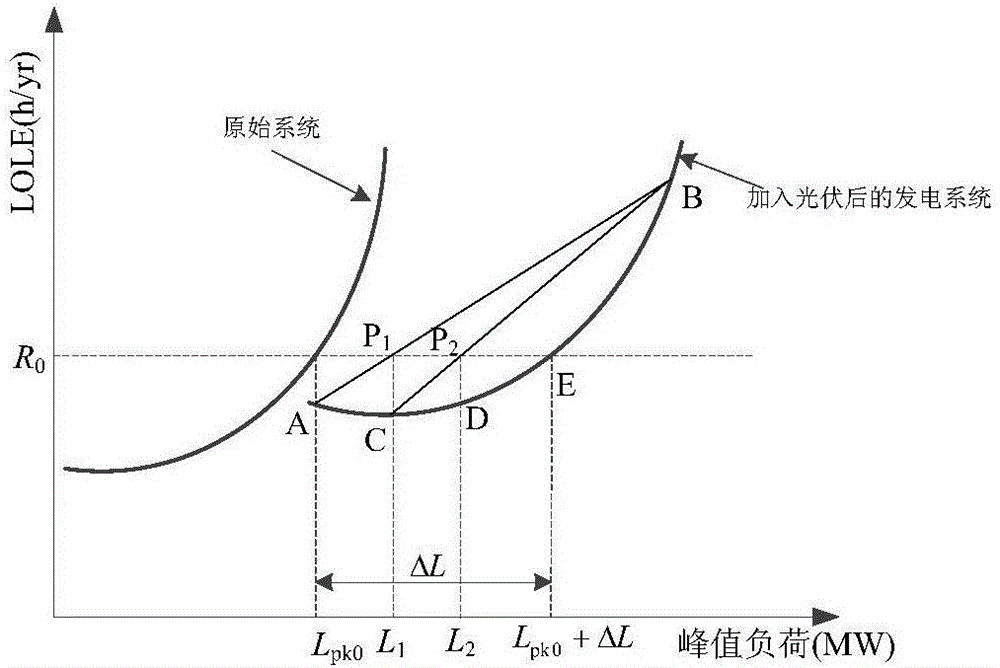
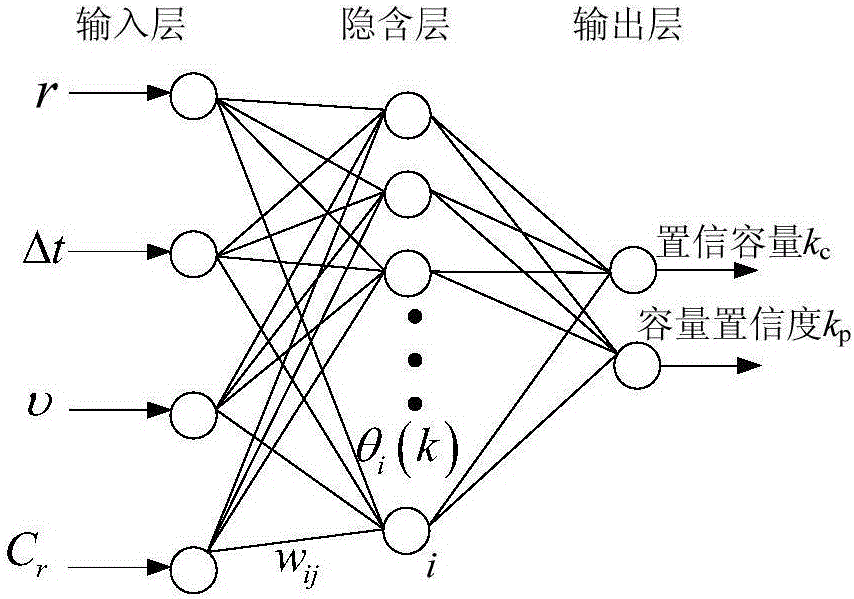
The invention discloses a method for capacity credit assessment of a photovoltaic power generation system. The method comprises: putting forward four factors that affect the capacity credit of a photovoltaic power generation system, i.e., the photovoltaic permeability, the data sampling time interval, the photovoltaic-load output fluctuation and the time sequence correlation between photovoltaic output and load fluctuation; calculating the reliability of the power system by using sequential Monte Carlo simulation and solving the capacity credit by the Secant Method; establishing a three-layer error back propagation neural network between the four factors and the capacity credit; training the neural network by using input and output data sets which are obtained under different irradiation modes; and obtaining the capacity credit of the photovoltaic power generation system under the given condition by using the generalization ability of the neural network which is already trained. The method for capacity credit assessment of a photovoltaic power generation system can be used for planning and design of photovoltaic composite generation and transmission systems, requires no sequential Monte Carlo simulation individually for each specific photovoltaic power generation system, and solves the problem of poor universality of the prior art.
Need to check novelty before this filing date? Find Prior Art

Description

technical field

[0001] The invention relates to a method for evaluating the confidence capacity of a photovoltaic power generation system, which belongs to the field of photovoltaic power generation. Background technique

[0002] With the reduction of the cost of photovoltaic power generation, the advancement of technology and its friendliness to the environment, large-scale ground photovoltaic power generation systems have developed rapidly, the installed capacity has increased day by day, and the penetration rate of photovoltaic power generation in the power system has gradually increased. Existing studies have shown that photovoltaic power generation has not only energy value, but also capacity value, and its capacity value is reflected in the effective and credible capacity of the photovoltaic power generation system, which is the credible capacity of the photovoltaic power generation system. In order to avoid redundant construction and waste of resources, the evaluation...

Examples

Embodiment Construction

[0051] The preferred modes of the present invention will be further described in detail below in conjunction with the accompanying drawings.

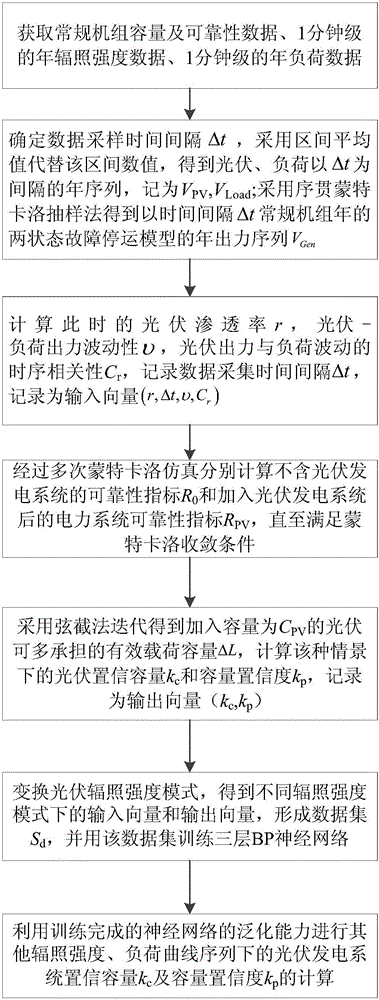
[0052] Such as figure 1 Shown, main steps of the present invention are as follows:

[0053] Step 1. Obtain the rated capacity and reliability data of conventional units in the power generation system through sampling, including the rated capacity G of each conventional unit i , the average normal working time t MTTF_i , mean time to failure t MTTR_i , (i=1,2,…,N), where N is the number of conventional units, and the sum of the rated capacities of all conventional units is Photovoltaic power generation system rated capacity C PV , 1-minute-level annual radiation intensity data, and 1-minute-level annual load data.

[0054] The load data obtained in practice is usually at hourly intervals, in order to obtain 1-minute load data, it can be obtained by linear interpolation between two data points;

[0055] Step 2. In the simulation pe...