AI technical title is built by Patsnap AI team. It summarizes the technical point description of the patent document.
a graphene and graphene technology, applied in the field of carbon nanostructures, can solve the problems of low production rate of cvd-based synthesis methods for graphene sheets, labour-intensive preparations, and complex equipment, and achieve the effects of preventing the generation of oxidation defects, high exfoliation rate, and high exfoliation ra
Active Publication Date: 2019-10-29
CAMBRIDGE ENTERPRISE LTD
View PDF25 Cites 0 Cited by
Summary
Abstract
Description
Claims
Application Information
AI Technical Summary
This helps you quickly interpret patents by identifying the three key elements:
Problems solved by technology
Method used
Benefits of technology
Benefits of technology
[0022]In preferred methods, the graphite electrode is operated such that it becomes cathodic in polarity during electrochemical erosion. The graphite electrode may, for example, become cathodic in polarity in connection with a counter electrode or anode. The counter electrode is also arranged in contact with the molten salt and may also be a graphite electrode. Anodic oxidation of graphite (such as may occur were the graphite electrode to be made anodic during exfoliation) may lead to the formation of a significant amount of oxygen-containing groups due to the overoxidation of the graphite. Exfoliation of graphite electrodes under cathodic conditions may provide the advantage of an absence of oxidizing conditions thereby preventing the generation of oxidation defects in the graphene product.
[0023]More than one graphite electrode may be arranged in contact with the molten salt and each of the more than one graphite electrode may be exfoliated. The use of two or more electrodes may advantageously allow the production of graphene on a large scale by using a number of relatively small sized electrodes. This may be beneficial as a number of smaller electrodes may not require high electric currents to produce graphene, with resultant technical and safety advantages. It may be beneficial, for example, to operate the exfoliation process using an electrode current density of, say, 2 A / cm2. To effect a higher exfoliation rate it may be possible to use a larger graphite electrode. However, to maintain current density within desired levels it would be necessary to increase the overall current that is applied. The exfoliation of multiple smaller electrodes may allow higher production rates without the need to use higher electric currents.
[0038]In a further aspect, a method of producing graphene sheets may comprise the steps of, (a) forming a carbonaceous powder by electrochemical erosion of a graphite electrode in a molten salt, in which electrochemical erosion of the graphite electrode is performed under an atmosphere comprising an inert gas and hydrogen, and (b) recovering the resulting carbonaceous powder, which comprises graphene sheets, from the molten salt. Preferably the atmosphere does not contain water. The use of an atmosphere comprising hydrogen in contact with the molten salt may improve the production of graphene sheets such that a thermal treatment step is not required to produce a high yield of graphene. Graphene produced using a moist atmosphere according to embodiments disclosed above may contain impurities, such as lithium carbonate. The use of a dry gaseous atmosphere comprising hydrogen may allow formation of high purity graphene. The method may comprise the further step of (c) thermally treating the carbonaceous powder by heating the carbonaceous powder in a non-oxidising atmosphere to produce a thermally treated powder comprising graphene sheets. Preferably the atmosphere comprises an inert gas selected from the list consisting of argon and nitrogen, and hydrogen. Preferably the atmosphere comprises between 2 and 10 mole percent hydrogen, for example about 4 mole percent hydrogen. Preferred or advantageous features of the method may be as set out above in relation to the first aspect.
Problems solved by technology
Later, relatively larger amounts of chemically modified graphene sheets were produced by a number of approaches, all of which made use of HOPG as the starting material and involved labour-intensive preparations.
CVD-based synthesis methods for graphene sheets suffer from low production rates, which can be as low as 32 nm min−1.
Moreover, these methods require complex equipment.
It has been shown that the electrolysis of room temperature ionic liquids with graphite electrodes may lead to some erosion or exfoliation of the graphite electrode material into carbon nanostructures including graphene sheets.
However, the rate of the synthesis of graphene in room temperature ionic liquids is low.
Moreover, room temperature ionic liquids are mostly toxic, non-biodegradable and too expensive.
At present, no graphene sheet production process exists that is capable of supplying large amounts of graphene sheets or graphene-based materials.
Thus, the development of applications and materials using graphene is difficult.
Method used
the structure of the environmentally friendly knitted fabric provided by the present invention; figure 2 Flow chart of the yarn wrapping machine for environmentally friendly knitted fabrics and storage devices; image 3 Is the parameter map of the yarn covering machine
View more
Image
Smart Image Click on the blue labels to locate them in the text.
Viewing Examples
Smart Image
Click on the blue label to locate the original text in one second.
Reading with bidirectional positioning of images and text.
Smart Image
Examples
Experimental program
Comparison scheme
Effect test
Embodiment Construction
[0070]Specific embodiments of the invention according to one or more aspect disclosed above will now be described with reference to the figures, in which;
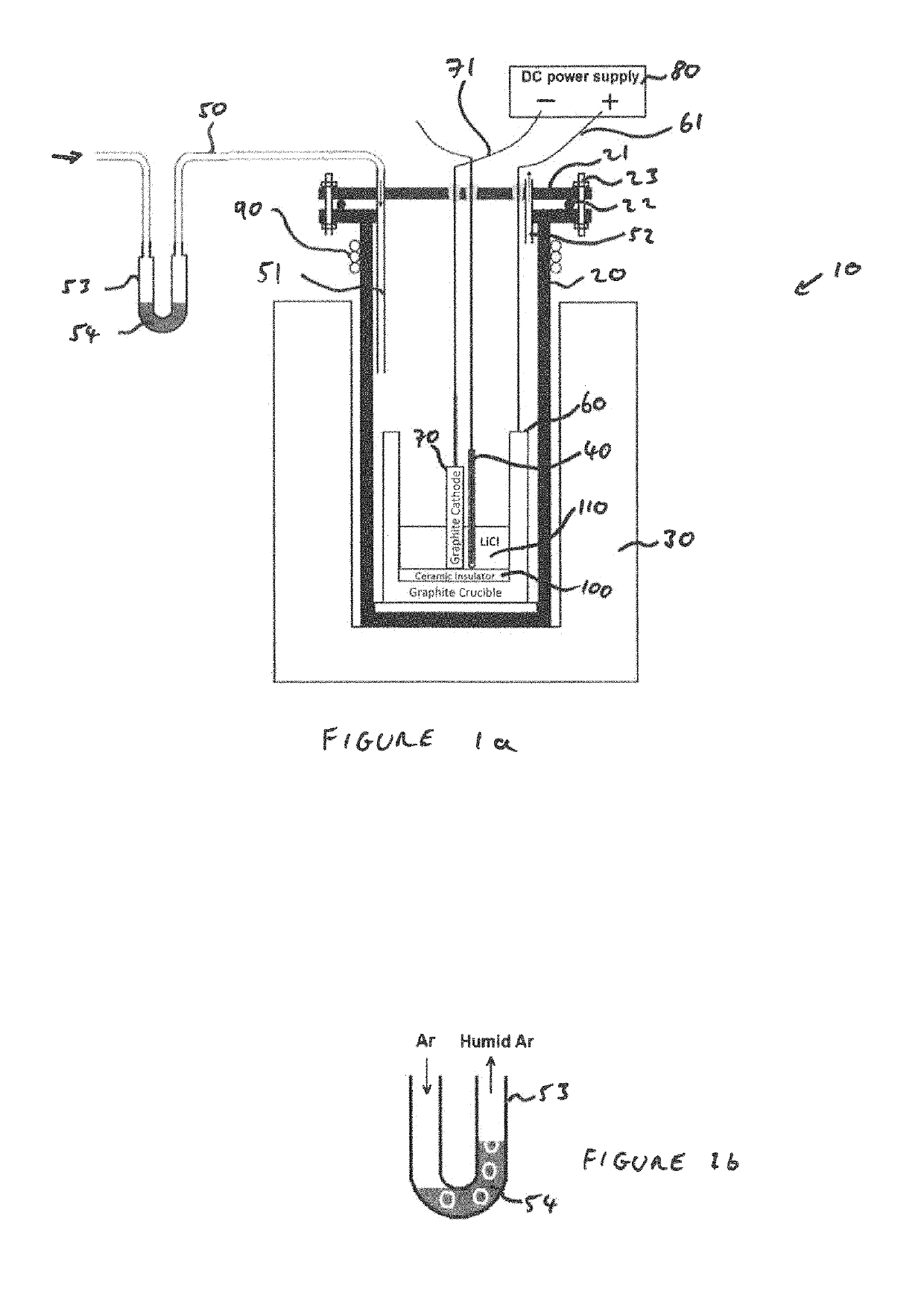
[0071]FIG. 1a is a schematic illustration of an apparatus for electrochemical erosion of a graphite electrode to produce a carbonaceous powder;
[0072]FIG. 1b is a close up of a portion of the apparatus of FIG. 1 illustrating how moist gas is produced;
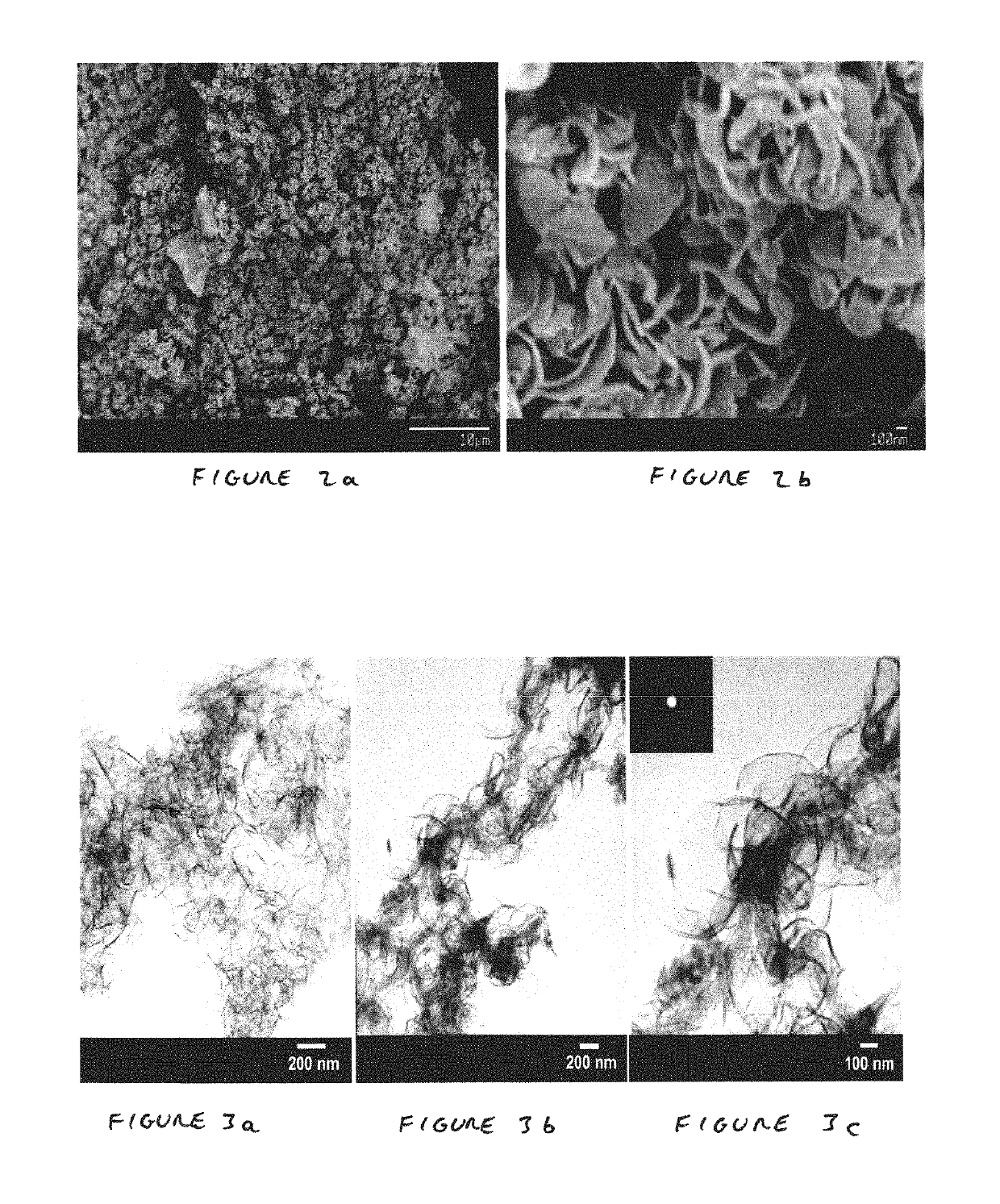
[0073]FIGS. 2a and 2b are scanning electron microscopy (SEM) micrographs of the carbonaceous powder formed by electrochemical erosion of a graphite electrode, showing a structure of predominantly carbon flakes and carbon plates, FIG. 2a is at low magnification and shows clumps of graphene sheets, FIG. 2b is at much higher magnification shows the clumps are made up of segments of graphene sheets;
[0074]FIGS. 3a, 3b and 3c are transmission electron microscopy (TEM) micrographs showing graphene sheets produced as a result of thermally treating a carbonaceous powder formed by electrochemical...
the structure of the environmentally friendly knitted fabric provided by the present invention; figure 2 Flow chart of the yarn wrapping machine for environmentally friendly knitted fabrics and storage devices; image 3 Is the parameter map of the yarn covering machine
Login to View More
PUM
Property
Measurement
Unit
temperature
aaaaa
aaaaa
temperature
aaaaa
aaaaa
temperature
aaaaa
aaaaa
Login to View More
Abstract
A method of producing graphene sheets comprising the steps of, forming a carbonaceous powder by electrochemical erosion of a graphite electrode in a molten salt comprising hydrogen ions, recovering the resulting carbonaceous powder from the molten salt liquid, and thermally treating the carbonaceous powder by heating the carbonaceous powder in a non-oxidising atmosphere to produce a thermally treated powder comprising graphene sheets. The method allows high production rates of high purity graphene sheets.
Description
[0001]The invention relates to methods of producing graphene sheets, for example graphene nanosheets, by processes that involves the electrochemical exfoliation of a graphite electrode, preferably followed by heating in a non-oxidising or reducing environmentBACKGROUND[0002]The term “carbon nanostructures” includes structures such as fullerenes, carbon nanotubes (CNTs), carbon nanofibres, carbon nanoparticles, carbon nanoplates, and graphene. Graphene, in particular, possesses many extraordinary properties such as high ballistic electron mobility, high thermal conductivity, high Young's modulus, high fracture strength, and a high specific surface area. Recently, graphene-based nanomaterials that are, in the literature, variously called graphene, carbon nanoflakes, carbon nanoflowers, carbon nanohorns, carbon nanowalls, or graphene nanosheets (GNSs), have attracted scientific attention due to their unique dimensions, structure, and electronic properties, which make them promising can...
Claims
the structure of the environmentally friendly knitted fabric provided by the present invention; figure 2 Flow chart of the yarn wrapping machine for environmentally friendly knitted fabrics and storage devices; image 3 Is the parameter map of the yarn covering machine
Login to View More
Application Information
Patent Timeline
Application Date:The date an application was filed.
Publication Date:The date a patent or application was officially published.
First Publication Date:The earliest publication date of a patent with the same application number.
Issue Date:Publication date of the patent grant document.
PCT Entry Date:The Entry date of PCT National Phase.
Estimated Expiry Date:The statutory expiry date of a patent right according to the Patent Law, and it is the longest term of protection that the patent right can achieve without the termination of the patent right due to other reasons(Term extension factor has been taken into account ).
Invalid Date:Actual expiry date is based on effective date or publication date of legal transaction data of invalid patent.


 Login to View More