Orthokeratological contact lenses and design methods therefor

a technology of orthokeratology and contact lenses, applied in the field of contact lenses, can solve the problems of hyperopic eyes that cannot focus on the hyperopic eye cannot provide a sharp focus of light at the retinal plane of the eye, and the hyperopic eye cannot achieve the effect of focusing on either far or near objects, and achieves a highly predictable and effective orthokeratology of myopia

US20060152674A1Inactive Publication Date: 2006-07-13BERKE WILLIAM M
5 Cites 10 Cited by

Patent Information

Authority / Receiving Office
US · United States
Patent Type
Applications(United States)
Current Assignee / Owner
Publication Date
2006-07-13
Estimated Expiration
Not applicable · inactive patent

Smart Images

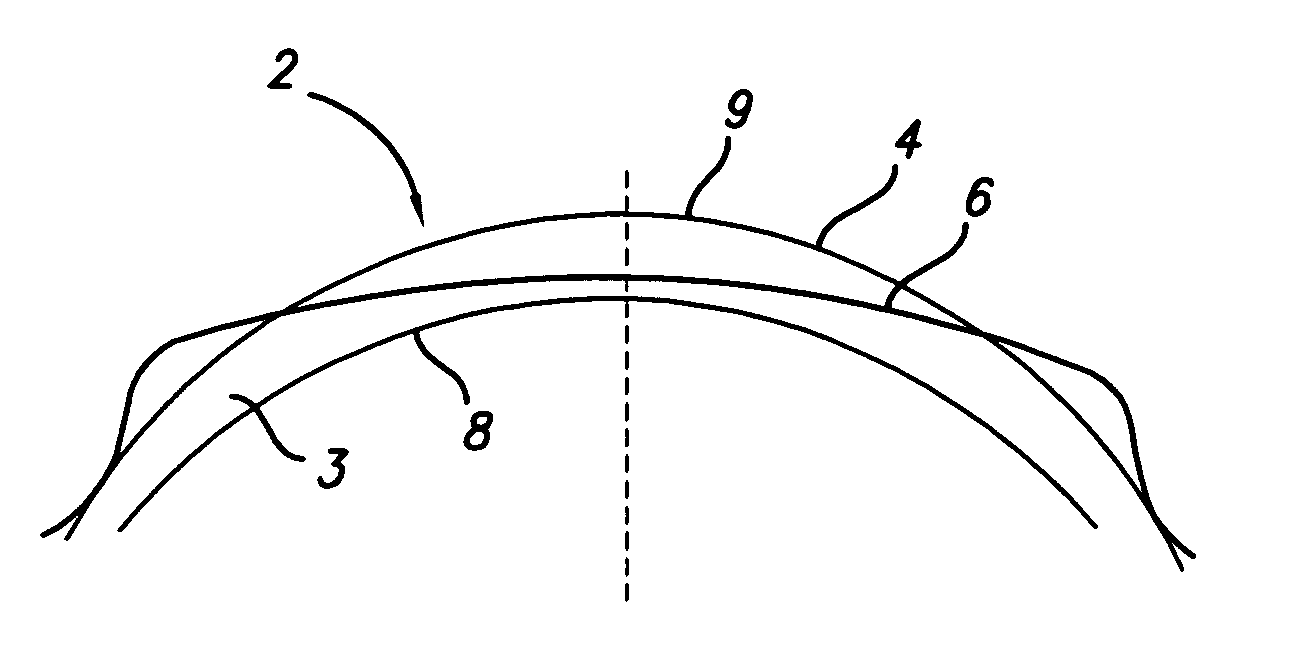
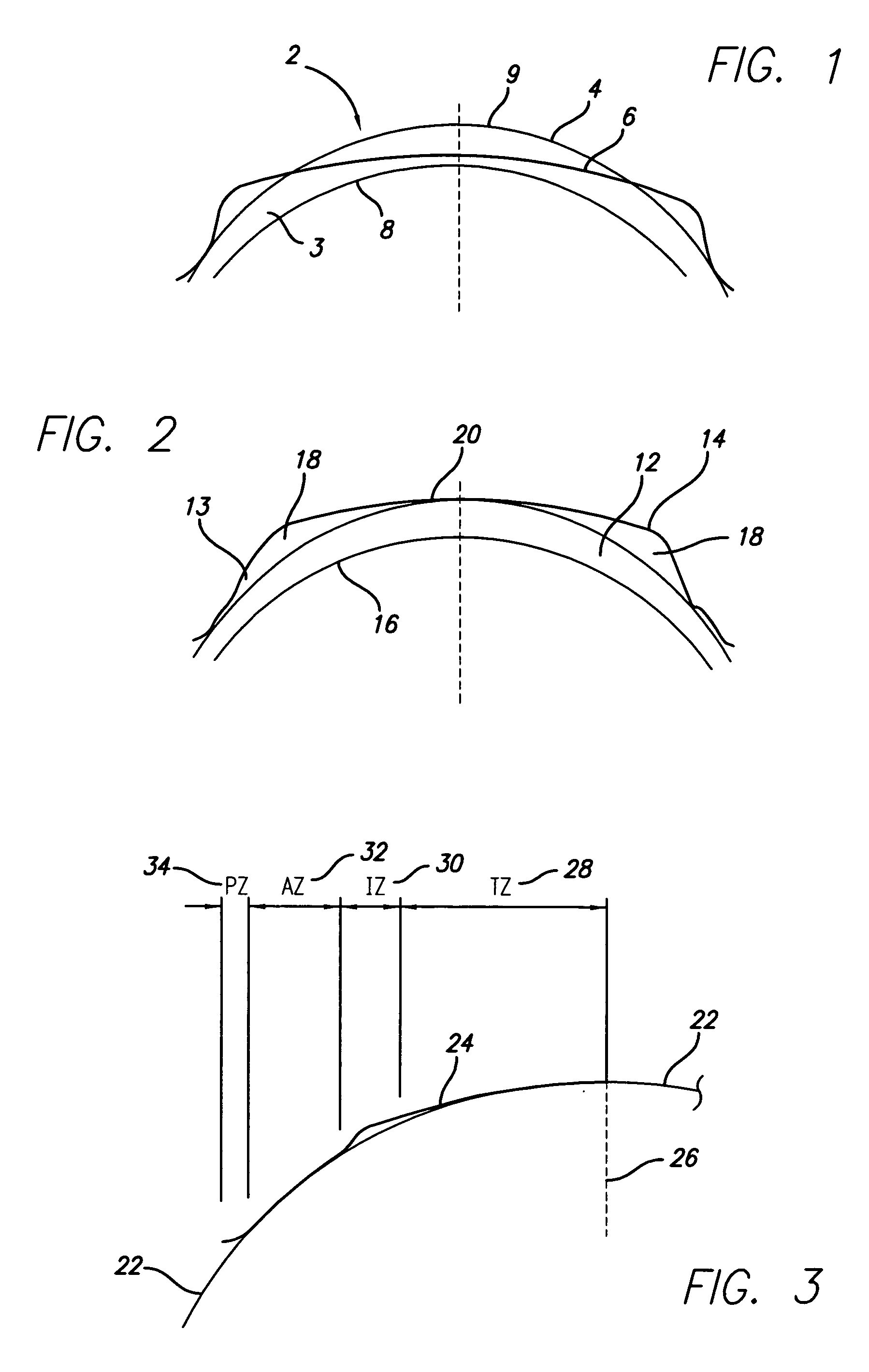
  • Figure 1
    Figure 1
  • Figure 2
    Figure 2
  • Figure 3
    Figure 3
Patent Text Reader

Abstract

The present invention provides an orthokeratological contact lens to be worn on a patient's cornea and methods for prescribing the same. The contact lens comprises a parabolic lens having an inner surface configured to face an epithelium of the patient's cornea, wherein the parabolic lens is adapted to reshape the cornea by way of epithelium tissue growth. In a pre-treatment configuration, an outer surface of the epithelium does not conform to the contours of the inner surface of the parabolic lens such that there exits a gap comprising a hypertrophy volume that is disposed between the epithelium and the parabolic lens.
Need to check novelty before this filing date? Find Prior Art

Description

REFERENCE TO RELATED APPLICATIONS

[0001] This application claims priority from U.S. Provisional Patent Application No. 60 / 629,221, filed on Nov. 17, 2004, the contents of which are incorporated herein by reference.FIELD OF THE INVENTION

[0002] The present invention is directed generally to contact lenses and more particularly to rigid orthokeratological contact lenses and methods for prescribing the same. BACKGROUND OF THE INVENTION

[0003] Millions of people experience difficulties with their vision due to a number of common refractive conditions such as myopia (nearsightedness) and hyperopia, (farsightedness). Myopia is a visual abnormality where an eye cannot focus on far-away objects because the cornea is curved too steeply and / or the eye is elongated axially front to back, such that it fails to provide a sharp focus of light at the retinal plane of the eye. On the other hand a hyperopic eye cannot focus on either far or near objects because the curvature of the cornea of the eye...

Examples

Embodiment Construction

[0029] In the following paragraphs, the present invention will be described in detail by way of example with reference to the attached drawings. Throughout this description, the preferred embodiment and examples shown should be considered as exemplars, rather than as limitations on the present invention. As used herein, the “present invention” refers to any one of the embodiments of the invention described herein, and any equivalents. Furthermore, reference to various feature(s) of the “present invention” throughout this document does not mean that all claimed embodiments or methods must include the referenced feature(s).

[0030] The present invention is directed to contact lenses, methods of producing the contact lenses and methods of treatment of myopia using the contact lenses. Particularly, each contact lens preferably is designed based on physiological and anatomical considerations of a patient's eye to obtain a rapid and predictable orthokeratological change in the refractive p...