Systems and methods for correlating alarms in a network

a communication network and alarm technology, applied in the field of communication networks, can solve the problems of generating nearly simultaneous alarms from several other elements, routing may trigger alarms, and non-communication equipment such as cooling fans, so as to improve the operation of network hardware equipment, reduce the down time of hardware devices, and enhance the effect of alarm monitoring and analysis

Inactive Publication Date: 2017-06-01
CENX
View PDF4 Cites 1 Cited by
  • Summary
  • Abstract
  • Description
  • Claims
  • Application Information

AI Technical Summary

Benefits of technology

This approach reduces downtime and optimizes network hardware performance by enabling early detection and resolution of faults, allowing operators to focus on the true source of failures rather than sifting through extraneous diagnostics, thus minimizing collateral network failures.

Problems solved by technology

Each piece of equipment, referred herein as a network element, may be complex enough to handle hundreds or thousands of simultaneous connections, and different pieces of equipment may be widely dispersed across a region.
For example, a failing port in a router may trigger an alarm.
Even non-communications equipment such as cooling fans can generate alarms.
Alarms can be useful tools for detecting and diagnosing network problems, but they may not always indicate a failure in the network object generating the alarm.
Specifically, a failure in one network object may generate an alarm from the failing element and cause the generation of nearly simultaneous alarms from several other elements that depend on the failing element.
The problem is further compounded in networks with potentially millions of alarm-generating network objects manufactured by multiple vendors with different alarm protocols and formats.

Method used

the structure of the environmentally friendly knitted fabric provided by the present invention; figure 2 Flow chart of the yarn wrapping machine for environmentally friendly knitted fabrics and storage devices; image 3 Is the parameter map of the yarn covering machine
View more

Image

Smart Image Click on the blue labels to locate them in the text.
Viewing Examples
Smart Image
  • Systems and methods for correlating alarms in a network
  • Systems and methods for correlating alarms in a network
  • Systems and methods for correlating alarms in a network

Examples

Experimental program
Comparison scheme
Effect test

Embodiment Construction

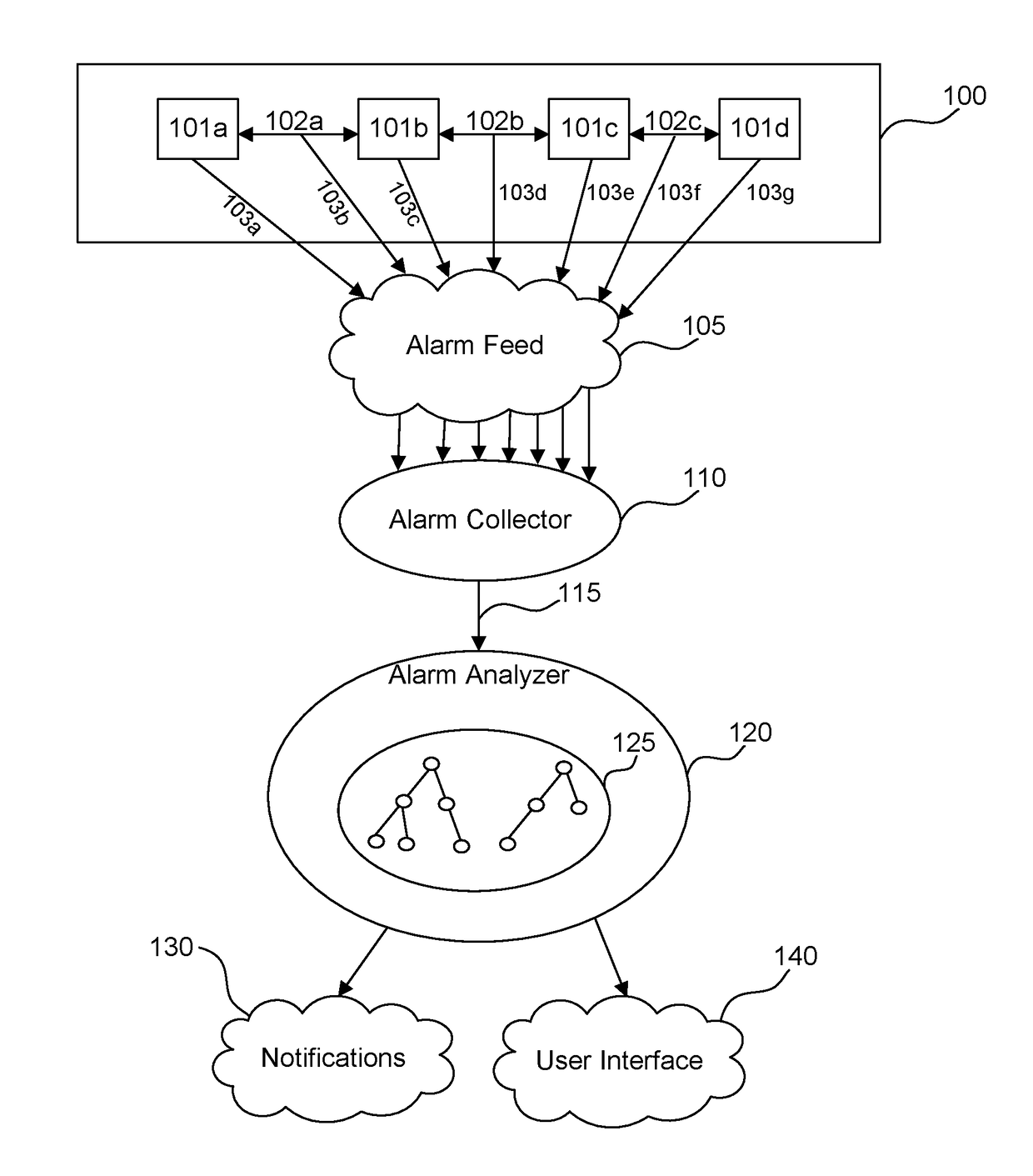
[0025]FIG. 1 illustrates an embodiment of the invention in the context of an alarm generating network 100. Alarm generating network 100 is provided as an example to illustrate embodiments of the invention, and is not intended to limit the scope of the disclosures herein. Specifically, the present disclosure is applicable to any number or arrangement of network objects in a network. The network 100 comprises seven alarm-generating objects: 101a-101d and 102a-102c. The objects 101a-101d and 102a-102c are each configured to generate an alarm 103a-103b upon detection of a potential problem that may require the attention of a network operator. Example alarms may include FAIL, WARNING, UNAVAILABLE, OK, CLEAR, or their equivalents. The alarm feed 105 provides a channel to the network operation center for the alarms 103 to be collected and analyzed. The alarm collector 110 receives, filters, and normalizes the alarms 103 to provide a vendor-agnostic output 115 to the alarm analyzer 120. The...

the structure of the environmentally friendly knitted fabric provided by the present invention; figure 2 Flow chart of the yarn wrapping machine for environmentally friendly knitted fabrics and storage devices; image 3 Is the parameter map of the yarn covering machine
Login to View More

PUM

No PUM Login to View More

Abstract

Networking equipment often generates alarms that operators must sift through to troubleshoot the network. The heterogeneous nature of the equipment and their associated alarms renders this task difficult. Furthermore, a network fault may trigger collateral alarms in adjacent equipment, sometimes obscuring the root cause of the fault. The present disclosure includes a system for correlating multiple successive alarms to discriminate between alarms from a faulty network object and alarms from a properly functioning network object that is dependent on the faulty network object.

Description

CROSS-REFERENCE TO RELATED APPLICATION[0001]This application claims the benefit of U.S. patent application Ser. No. 14 / 605,604, filed Jan. 26, 2015, which is hereby incorporated herein by reference in its entirety.BACKGROUND[0002]Field of Disclosure[0003]Certain embodiments of the invention relate to communication networks. More specifically, certain embodiments of the invention relate to methods and systems for correlating alarms in a communication network.[0004]Related Art[0005]Modern communications carriers operate local, regional, and nationwide networks to provide connectivity to customers. These networks are built with a variety of equipment to perform various tasks, and such equipment may be manufactured by multiple vendors. Each piece of equipment, referred herein as a network element, may be complex enough to handle hundreds or thousands of simultaneous connections, and different pieces of equipment may be widely dispersed across a region. Wireless base stations, for exampl...

Claims

the structure of the environmentally friendly knitted fabric provided by the present invention; figure 2 Flow chart of the yarn wrapping machine for environmentally friendly knitted fabrics and storage devices; image 3 Is the parameter map of the yarn covering machine
Login to View More

Application Information

Patent Timeline
no application Login to View More
Patent Type & AuthorityApplications(United States)
IPC IPC(8): H04L12/24H04L12/26
CPCH04L41/065H04L43/045H04L41/12H04L41/0609
InventorWESSELS, BRUCETZOLOV, PEYO
OwnerCENX